
I’ve moved my blogging to Substack!
Feel free to check out any of the content I have here, but also be sure to check out my newest content at Reckoning and Elevating What Works.

One Resolution to Rule Them All
Change is hard. And even though you’re the one person over whose behavior you theoretically should have the most control, changing yourself is often exceedingly difficult.
Nonetheless, many of us doggedly pursue self-betterment. We set goals, hoping that we’ll achieve them along with whatever benefits they bring. We fantasize about the possibility of becoming someone closer to our idealized version of ourselves.
And during late December, many of us set resolutions for the next year.
Yet time and time again, most of us find our resolutions quickly broken. If you need evidence of this, simply go to any fitness center for a few days in early January and take note of how many people are there. Then, go back in early February. The crowds will almost always be gone.
There’s one resolution, though, that can rule them all. It’s one that I’ve found helpful when trying to change myself in a small way.
That resolution is simply this:

Change is hard. And even though you’re the one person over whose behavior you theoretically should have the most control, changing yourself is often exceedingly difficult.
Nonetheless, many of us doggedly pursue self-betterment. We set goals, hoping that we’ll achieve them along with whatever benefits they bring. We fantasize about the possibility of becoming someone closer to our idealized version of ourselves.
And during late December, many of us set resolutions for the next year.
Yet time and time again, most of us find our resolutions quickly broken. If you need evidence of this, simply go to any fitness center for a few days in early January and take note of how many people are there. Then, go back in early February. The crowds will almost always be gone.
There’s one resolution, though, that can rule them all. It’s one that I’ve found helpful when trying to change myself in a small way.
That resolution is simply this: Pick one new good habit and stick to it no matter what. Make yourself a slave to it.
Practice your new habit when you feel like it.
Practice your new habit when you don’t feel like it.
But whatever happens, stick to it.
Another way to think about this is to make a resolution to keep one resolution. Don’t try to change everything about your life or all of your habits—that’s exhausting and won’t work. Pick one manageable aspect of your life, something that you can do every day or every week.
And stick to it.
For example, one of my resolutions last year at this time was to write a blog post every week. Sometimes I felt like it—the ideas and the words came easily. Other times, it was tough. There were a few times when I woke up at 4 a.m. on a weekend to make sure I wrote my post.
Over time, though, it got easier. It became a good habit, one that I’m beginning to take for granted. It’s no longer a “change”—it’s simply something I do every week.
As you think about 2017, I encourage you to think about New Year’s Resolutions. But I encourage you even more to think about focusing your efforts on just a few resolutions, or even just one. Pick one habit, something that you can easily measure (e.g., “Did I do this—yes or no?”), and implement it.
Because when everything is a priority, nothing is a priority.
By the way, this applies to your professional life just as much as to your personal life. How do you think your employees or coworkers feel when you pile on a long list of new procedures or strategic initiatives?
Instead, focus. Pick one new good habit. And in 2017, make it part of your life—no matter what.
Find this thought provoking? Leave a comment, like and share!
About Ben Baran
Ben Baran, Ph.D., is probably one of the few people in the world who is equally comfortable in a university classroom, a corporate boardroom and in full body armor carrying a U.S. government-issued M4 assault rifle. Visit: www.benbaran.com.

You Should Be Embarrassed
I recently read something that I wrote a few years ago. It was dreadful.
The writing was vague, bloated, constipated. How could I have thought—and I did, at the time of writing it—that it was good?
I was embarrassed.
But I’m perfectly fine with that. In fact, I’m

I recently read something that I wrote a few years ago. It was dreadful.
The writing was vague, bloated, constipated. How could I have thought—and I did, at the time of writing it—that it was good?
I was embarrassed.
But I’m perfectly fine with that. In fact, I’m happy about it.
That’s because if you’re not periodically at least a little bit embarrassed about something you produced or did a year or two ago, then you have a big problem. It’s a red flag signaling the possibility that you haven’t learned, you haven’t grown or you haven’t honed your skills.
Although they’re relatively arbitrary in and of themselves, various dates on the calendar sometimes prompt me to reflect—my birthday and the winter holidays come to mind. I think that’s fairly common among most of us. And that periodic time for reflection is an opportunity not just to think about what’s next, but also to think about where you’ve been and how you’ve developed.
If that reflection causes you to wince a bit, great. That simply means that you’ve moved to a higher playing field, one in which you have a new perspective allowing you to notice the difference between what you once thought was your “best” and that of which you are now capable.
A little bit of embarrassment about your prior levels of performance also opens the door for you to appreciate how far you’ve come, what you’ve done and what you’ve learned.
So I invite you to reflect. Think about where you were last year at this time and what you were doing. Take a look at some of the work you produced. Some of it may surprise you for its quality, but there’s a chance that some if it may surprise you for its mediocrity.
And I invite you face the mediocrity of your past and to be a little embarrassed. Embrace the realization that we’re all works in progress—and that embarrassment about the past might mean that you’re moving in the right direction.
Find this thought provoking? Leave a comment, like and share!
About Ben Baran
Ben Baran, Ph.D., is probably one of the few people in the world who is equally comfortable in a university classroom, a corporate boardroom and in full body armor carrying a U.S. government-issued M4 assault rifle. Visit: www.benbaran.com.

Be Vigilant for Your Moment
Despite its sometimes harsh weather and a professional football team that continually disappoints its fans, Cleveland, Ohio, is home to one of the world’s best orchestras.
And that’s not just my amateurish opinion. Gramophone magazine, for example, compiled a list of the 20 best orchestras in the world, based upon ratings from top music critics—whom, I would readily assume, know more about classical music than I.
The Cleveland Orchestra, on this list, is number seven.
It’s rated higher than the Los Angeles Philharmonic, the Boston Symphony Orchestra, the New York Philharmonic and a number of other great orchestras in the United States and around the world.
So the Cleveland Orchestra is, quite naturally, a point of pride for northeast Ohio.
And during the holiday season, the Cleveland Orchestra turns its attention to performing a variety of holiday tunes in its annual Christmas Concert series.
As I have in the past, I found this year’s performance to be splendid. But during the performance, I noticed something that got me thinking.
It was

Despite its sometimes harsh weather and a professional football team that continually disappoints its fans, Cleveland, Ohio, is home to one of the world’s best orchestras.
And that’s not just my amateurish opinion. Gramophone magazine, for example, compiled a list of the 20 best orchestras in the world, based upon ratings from top music critics—whom, I would readily assume, know more about classical music than I.
The Cleveland Orchestra, on this list, is number seven.
It’s rated higher than the Los Angeles Philharmonic, the Boston Symphony Orchestra, the New York Philharmonic and a number of other great orchestras in the United States and around the world.
So the Cleveland Orchestra is, quite naturally, a point of pride for northeast Ohio.
And during the holiday season, the Cleveland Orchestra turns its attention to performing a variety of holiday tunes in its annual Christmas Concert series.
As I have in the past, I found this year’s performance to be splendid. But during the performance, I noticed something that got me thinking.
It was the harp. And more specifically, the harpist.
During an orchestral performance, as you know or can imagine, each musician and his or her instrument fills a specific role. Most prominent, typically, is that of the violins and other stringed instruments. Those musicians, it seems to me, are actually producing sounds from their instruments for much more total time than some of the less frequently heard-from sections.
Which brings us back to the harp. From my seat in the front-left section of Severance Hall, I had a direct view of the side of the stage where the harp and organ were situated. I was able to watch the harpist closely.

In contrast to the violinists and violists and cellists, the harpist’s role is infrequent. It can be rather distinct and prominent in the music, but the harp’s role isn’t to provide the bulk of the musical structure that the orchestra as a whole creates.
So the harpist, as I noticed, must be extraordinarily vigilant. She was just as engaged in the music when she was not playing as when she was playing—she was reading every page of the music, positioning the harp and her hands in anticipation of her parts as they would arrive.
And when they did arrive—her moment to perform—she did so with perfect timing and results.
For me at least, there’s a lesson in the role of the harpist. Sometimes, it’s easy to think that our lives and careers are supposed to be like the violins—a continual production of excellence that everyone notices and appreciates. But that’s potentially misleading and inaccurate.
Because in reality, there’s probably a big part of our lives and careers and our lives that is more like that of the harpist. We have our roles—combined with our specific talents, skills, sets of knowledge—and every so often, we’re needed to perform. It’s our turn to pluck the strings, so to speak, and deliver what only we can in that moment.
The most important point, however, isn’t that our roles are probably more punctuated than we assume.
The most important point is that we must be ready.
We can’t disengage. We must know what’s going on around us; we need to be on the same sheet of music as those with whom we’re performing—our teams at work, our families, our friends. We need to know what our strengths are and how we can contribute.
There are times for performing, and there are times for watching.
And timing is everything.
So, be vigilant for your moment. We’re all counting on you. I, for one, can’t wait to hear your notes.
Find this thought provoking? Leave a comment, like and share!
About Ben Baran
Ben Baran, Ph.D., is probably one of the few people in the world who is equally comfortable in a university classroom, a corporate boardroom and in full body armor carrying a U.S. government-issued M4 assault rifle. Visit: www.benbaran.com.

What Leaders Can Learn From Mr. Olympia
Imagine that you’re about to interview for the job of your dreams. Or that you’re about to give a high-stakes presentation. Or take an important test. Or simply focus on getting a few things done in the next hour.
What are you thinking? What are you telling yourself in your mind?
If you’re anything like 8-time Mr. Olympia Ronnie Coleman, you’re telling yourself, “Ain’t nothin’ to it but to do it.”
Coleman is widely considered one of the greatest bodybuilders of all time, which is impressive enough, but what I find compelling is how he talked. In particular, how he

Imagine that you’re about to interview for the job of your dreams. Or that you’re about to give a high-stakes presentation. Or take an important test. Or simply focus on getting a few things done in the next hour.
What are you thinking? What are you telling yourself in your mind?
If you’re anything like 8-time Mr. Olympia Ronnie Coleman, you’re telling yourself, “Ain’t nothin’ to it but to do it.”
Coleman is widely considered one of the greatest bodybuilders of all time, which is impressive enough, but what I find compelling is how he talked. In particular, how he talked to himself.
You can find plenty of evidence of this on YouTube, and in addition to being interesting, it’s often entertaining. He’s funny. He’d be kicked out of Planet Fitness in about 0.3 seconds.
And Coleman’s “self-talk,” as it’s called in the psychology literature, is easy to spot because he often does it aloud.
When approaching a massive weight that he was about to lift, he’d say things like:
- “Yeah, buddy!”
- “Nothin’ but a peanut.”
- “Light weight!”
- “Ain’t nothin’ to it but to do it.”
And then he’d go lift something about as heavy as my car.
But what’s really compelling is how our internal monologue—our self-talk, or our “mindchatter” as my friend Bill Gentry of the Center for Creative Leadership calls it—influences our performance as leaders and managers.
A few years ago, I was part of a research team that specifically looked at how executives talked to themselves. In our study, we analyzed a few hundred letters that senior executives wrote to themselves at the conclusion of a leadership development program. We then took our ratings of their self-talk in those letters and analyzed how it compared with how their own bosses and followers rated their leadership. Lo and behold, the best leaders had self-talk patterns that were positive, reflective and constructive in nature.
The ineffective leaders, on the other hand, tended to have pessimistic, negative self-talk. They also tended to report being more stressed than their positive self-talking, effective counterparts.
Much of the scientific research on the outcomes of self-talk comes from the world of sport psychology. And the findings in that realm tend to support what we found in the business world—positive self-talk is productive and useful.
So what might self-talk “look like?” For that, let’s turn to a study that constructed a measure of self-talk for athletes. They categorized self-talk into eight groups as listed below.
- Psych Up: Let’s go, Give 100%, Do your best
- Anxiety Control: Relax, Calm down, No stress
- Confidence: I feel strong, I can make it, I believe in me
- Instruction: Concentrate, Focus on your technique, Focus on what you need to do right now
- Worry: I’m wrong again, I cannot concentrate, I am not as good as the others
- Disengagement: I want to stop, I want to get out of here, I am fed up
- Somatic Fatigue: I am tired, Today I “suck,” My body is not in good condition
- Irrelevant Thoughts: I am thirsty, What will I do later tonight, I want to take a shower
If you truly reflect upon your own thoughts, I bet you’d be able to find examples from most if not all of these categories. We all “talk” to ourselves. The question is whether we’re positive and constructive or negative and destructive in our patterns of self-talk.
Regardless of whether we’re trying to do our best running a meeting or preparing for a tough conversation at work, it behooves us to be mindful of our self-talk. Literally forcing ourselves to use positive patterns of self-talk helps change our attitude and our mood, allowing us to do our best.
Because no matter what situations we face in this crazy life, we always have control over how we react and our resulting attitude. And a big part of changing our attitude is controlling what we allow to go on in our minds.
So the next time you face a tough management moment, I encourage you to first stop and think, “Ain’t nothing to it but to do it.”
Find this thought provoking? Leave a comment, like and share!
About Ben Baran
Ben Baran, Ph.D., is probably one of the few people in the world who is equally comfortable in a university classroom, a corporate boardroom and in full body armor carrying a U.S. government-issued M4 assault rifle. More at www.benbaran.com, www.agilityconsulting.com and www.strategicagilityinstitute.com.

Your Most Precious Resource
I recently heard someone quote a deceptively insightful short poem. Titled, “How did it get so late so soon,” it’s one of many gems penned by the late Theodor Geisel, and here it is.
"How did it get so late so soon?
It’s night before it’s afternoon.
December is here before it’s June.
My goodness how the time has flewn.
How did it get so late so soon?"
Geisel, more commonly known as Dr. Seuss, captures here the feeling that I get frequently when I think about seasons ending, new years beginning and everyone (including me) aging.
It’s not just about nostalgia; it’s not just about how even a 100-year lifetime is but a flash in the course of history.
It’s more than that.
It’s about how there’s one thing

I recently heard someone quote a deceptively insightful short poem. Titled, “How did it get so late so soon,” it’s one of many gems penned by the late Theodor Geisel, and here it is.
“How did it get so late so soon?
It’s night before it’s afternoon.
December is here before it’s June.
My goodness how the time has flewn.
How did it get so late so soon?”
Geisel, more commonly known as Dr. Seuss, captures here the feeling that I get frequently when I think about seasons ending, new years beginning and everyone (including me) aging.
It’s not just about nostalgia; it’s not just about how even a 100-year lifetime is but a flash in the course of history.
It’s more than that.
It’s about how there’s one thing that we all have in common, one thing that none of us can acquire. It’s about how there’s one thing that—according to Bruce Springsteen—“slips away, and leaves you with nothing mister, but boring stories of … glory days.”
That thing, of course, is time. It’s our most precious resource, but we all squander it daily. We waste time on failing projects. We allow ourselves to become distracted. We even trick ourselves into thinking that we’re doing valuable work when we’re really just avoiding less-desirable, yet more-critical tasks.
Even more importantly, we often fail to consider that every moment we spend doing something is a moment we aren’t spending doing something else. We hate quitting so much that we often would rather slog on in agony while not making progress toward other, more desirable goals.
Many leaders—even ones who are fairly successful—are just as guilty as the rest of us. But as the well-known management educator and writer Peter Drucker, in his 1966 classic book The Effective Executive, wrote,
“Effective executives, in my observation, do not start with their tasks. They start with their time. And they do not start out with planning. They start by finding out where their time actually goes. Then they attempt to manage their time and to cut back unproductive demands on their time.”
I find that high-performing managers and executives often make the mistake of performing tasks themselves because they can do it fast and do it right. This is fine in and of itself, but these tasks are often ones that can and should be offloaded to others. Investing time in training and mentoring others is important and saves time in the long run, but many executives struggle with the tradeoff—it takes time to train and mentor. So they continually put off delegating and take on more and more themselves.
This is a recipe for burnout. It’s a recipe for stagnation.
At a higher level, it’s also a recipe for missing what’s great in life. Face it: Someday, you are going to die. So am I. Recognizing our own mortality is good; it can help us focus on what’s really important—in our jobs, in our relationships, in our lives.
And while the skill to master one’s use of time is a lifelong quest, a few things that have helped me include:
- Being increasingly selective and intentional about saying “yes” to new projects,
- Recognizing when projects are failing and killing them quickly if appropriate,
- Challenging myself to devote all of my attention to an undesirable task for set periods of time,
- Checking e-mail less frequently instead of using e-mail as my to-do list, and
- Analyzing whether my priorities are aligned with my longer-term goals.
Because although the Rolling Stones—and I’m a fan—told me that “Time is on my side,” it quite clearly is not. So, in our limited time on this planet, I think it’s helpful to prune our activities as best as we can to focus on what gives us meaning and purpose. It’s tough, but I’m going to give it another shot.
In so doing, I’m reminded of what Henry David Thoreau wrote in Walden; or, Life in the Woods:
“I went to the woods because I wished live deliberately, to front only the essential facts of life, and see if I could not learn what it had to teach, and not, when I came to die, discover that I had not lived. I did not wish to live what was not life, living is so dear; nor did I wish to practise resignation, unless it was quite necessary. I wanted to live deep and suck out all the marrow of life, to live so sturdily and Spartan-like as to put to rout all that was not life, to cut a broad swath and shave close, to drive life into a corner, and reduce it to its lowest terms.”
Find this thought provoking? Leave a comment, like and share!
About Ben Baran
Ben Baran, Ph.D., is probably one of the few people in the world who is equally comfortable in a university classroom, a corporate boardroom and in full body armor carrying a U.S. government-issued M4 assault rifle. Visit: www.benbaran.com.

On Gratitude, Agility and Career Transitions
When I was a teenager, I thought I had it all figured out: My life and career would be a logical series of steps and accomplishments. I’d go to college, earn an officer’s commission in the U.S. Navy, see the world. Then, I’d probably go to law school and enjoy another set of logical steps of accomplishments toward “success” in the civilian world.
Reality, of course, is different.
Life—and careers—are often full of twists and turns, punctuated by triumphs and failures. Some of those ups and downs are big and public, most are

When I was a teenager, I thought I had it all figured out: My life and career would be a logical series of steps and accomplishments. I’d go to college, earn an officer’s commission in the U.S. Navy, see the world. Then, I’d probably go to law school and enjoy another set of logical steps of accomplishments toward “success” in the civilian world.
Reality, of course, is different.
Life—and careers—are often full of twists and turns, punctuated by triumphs and failures. Some of those ups and downs are big and public, most are small and private. It’s a journey that I’ve found to be best accomplished by a sense of agility, by being nimble and trying to make a positive difference in whatever opportunity arises.
In those early years, I never would have predicted that in the next two decades I would have:
- Spent my most rewarding tour of duty in the Navy as a reservist called back to active duty in the landlocked country of Afghanistan,
- Earned a master’s degree in industrial/organizational psychology and a Ph.D. in organizational science (I was a political science and communication studies double major as an undergraduate), or
- Served for five years as a member of the faculty of the Haile/US Bank College of Business at Northern Kentucky University (NKU).
And it’s on this last point—my role as an assistant professor in the Department of Management at NKU—that I’d like to focus. Although I haven’t been on campus since the spring semester ended a few months ago, this week is technically my last one at NKU. I’m moving on to a tremendously exciting opportunity as a member of the faculty of the Monte Ahuja College of Business at Cleveland State University.
As I look back at the various roles I’ve held and organizations within which I’ve served, I’m reminded of how each experience taught me something new, making me simultaneously more confident and more humble than before. I’m also reminded of how so much of these experiences is shaped by special people and numerous small interactions that together have made me a better person.
Regarding NKU, then, I’d like to do something I haven’t done before, or at least in this way. I’d like to express my gratitude to those people—fellow professors, staff members, administrators, students, and other members of the campus community—who, more than anything, infused me with additional passion for higher education.
NKU is full of smart, hard-working and caring people. People who:
- Debate at length different ways to improve student learning,
- Teach with passion and celebrate when students succeed,
- Support each other’s efforts to innovate or try new things,
- Get to know each other personally and professionally, and
- Engage the community throughout Northern Kentucky and the greater Cincinnati area through research and learning through service.
I’m particularly grateful for all of the members of the Department of Management, the Executive Leadership and Organizational Change program and the Haile/US Bank College of Business at large for their personal and collective support of me, my development and my work.
Their support to me was unwavering, despite the odd challenges that I posed. For example, during my entire time at NKU, I lived 250 miles away. My department leaders understood this and helped when possible to make my teaching schedule work well given my situation. And when I told them that I’d have to leave for one year to serve in Afghanistan, their response was nothing short of total support and gratitude for my military service.
Thank you, NKU.
As I make this transition, I think an underlying lesson that I’ve learned is that gratitude and agility go hand-in-hand. To be agile as leaders or in our careers, we have to lean on those around us. We have to build and maintain relationships. We must be open and humble to learn from others.
And to keep all of that going for the long term, we must be grateful for the people we have the privilege to work alongside during this journey of life. All of you amazing NKU people will forever be my colleagues and friends.
Now as for my colleagues at Cleveland State University, I can hardly wait to learn from you and figure out ways to contribute positively through what we do together.
In the words of one of my former bosses, John Bland at The University of North Carolina at Charlotte, for whom I’m also grateful: Onward!
Find this thought provoking? Leave a comment, like and share!
About Ben Baran
Ben Baran, Ph.D., is probably one of the few people in the world who is equally comfortable in a university classroom, a corporate boardroom and in full body armor carrying a U.S. government-issued M4 assault rifle. Visit: www.benbaran.com.

On Strength Training and Leadership
Goals are everywhere, but they rarely correspond with behavior. To illustrate, here’s a quick story.
I started taking strength training seriously in January 2013. I was serving in Afghanistan, and neither my military base nor the weather was conducive for my go-to physical exercise, running.
So I dove into educating myself and practicing getting strong by focusing on kettlebell training and the “big lifts” in the world of barbells: squat, bench press, and deadlift.
I made some progress, but I hit a plateau after a few months. This is common, but my plateau seemed unusually stubborn. I found this troubling, particularly given that my goal was to join the “1,000 Pound Club” by the time I was set to leave my base in late November. This means that the clock was ticking, reminding me of the dwindling of time left for me to squat, bench press, and deadlift a combined 1,000 lbs.
Then, I started reading

Goals are everywhere, but they rarely correspond with behavior. To illustrate, here’s a quick story.
I started taking strength training seriously in January 2013. I was serving in Afghanistan, and neither my military base nor the weather was conducive for my go-to physical exercise, running.
So I dove into educating myself and practicing getting strong by focusing on kettlebell training and the “big lifts” in the world of barbells: squat, bench press, and deadlift.
I made some progress, but I hit a plateau after a few months. This is common, but my plateau seemed unusually stubborn. I found this troubling, particularly given that my goal was to join the “1,000 Pound Club” by the time I was set to leave my base in late November. This means that the clock was ticking, reminding me of the dwindling of time left for me to squat, bench press, and deadlift a combined 1,000 lbs.
Then, I started reading more from the renowned strength and conditioning coach and writer Dan John (he’s full of great advice and philosophical musings, as is Pavel Tsatsouline).
At that moment in Afghanistan, one of Dan John’s most deceptively profound statements resonated with me like a quick slap to the face:
“The goal is to keep the goal the goal.”
Up until that point, I had been combining my strength training with some periodic treadmill running and other “cardio” exercise. But Dan John’s statement, “The goal is to keep the goal the goal,” illustrated how I was doing all kinds of things that weren’t conducive to my goal. In addition to my regular treadmill running, I wasn’t consuming enough protein each day, and I wasn’t getting enough sleep.
So I changed. I aligned my schedule, my training program and my diet to that goal. I forged new habits and stuck to them. And on Nov. 8, 2013, I squatted 315, bench pressed 275 and deadlifted 425—for a total of 1,015 lbs.
I’m not sharing any of that to brag. Not at all. Although I’m probably a little stronger than the average person and it was a nice personal milestone, it’s all relative. In the world of serious lifting, I’m really weak.
So what does this have to do with leadership?
I’m sharing that personal experience because I think it has a great deal to do with what I see people struggle with over and over and over again.
Leaders set goals and busy themselves with setting priorities. Organizations have numerous metrics to assess performance. That’s good, in and of itself.
It’s necessary to have goals and ways to measure them, but it’s not sufficient if they don’t influence behavior.
All too often, I encounter executives who are distracted. They have goals—indeed, often brilliant, strategic ones—but they fail to execute. It’s because they aren’t keeping the goal the goal. They fail to separate what they can do or even should do with what they must do. Their “priorities” are more often than not just lists of more stuff to do.
There’s a Russian or Chinese (or West Virginian, for that matter) proverb that states: “He who chases two rabbits, misses both.”
It seems to me that distractions and “being busy” are killing both effectiveness and efficiency for leaders and organizations everywhere. Looking critically at my own life, I can find many examples.
But in an increasingly turbulent world—one in which we have increasingly greater numbers of flashy things vying for our attention—it seems like we could all perform at a higher level if we paused, identified what really matters and held ourselves accountable for behaving in ways that align with our top priority.
Namely, I think that whether you’re trying to pick up something heavy or lead a team or guide an organization in a new strategic direction, it’s helpful to remember that goals are meaningless unless you truly commit to both the goal and what it’s going to take to achieve it—and what you’re going to prune from your list of activities (what’s your “to don’t” list?).
So here’s to picking up something heavy, developing a new product, launching a new business or inspiring a team to go beyond what they thought possible—all while keeping the goal the goal.
Find this thought provoking? Leave a comment, like and share!
About Ben Baran
Ben Baran, Ph.D., is probably one of the few people in the world who is equally comfortable in a university classroom, a corporate boardroom and in full body armor carrying a U.S. government-issued M4 assault rifle. Visit: www.benbaran.com.

Why Perfection Isn’t Good Enough
“I just want it to go the right way,” he said, with tears starting to form at the corners of his eyes. “I’m trying and trying and trying and it’s not working.”
The tears began to flow, as he rapidly stamped his feet on the green artificial turn covering the mini-golf course. His knuckles turned white as he gripped his club with a surge of frustration, and he swung as hard as he could at the ball.
He missed. It was fortunate that he did, because

“I just want it to go the right way,” he said, with tears starting to form at the corners of his eyes. “I’m trying and trying and trying and it’s not working.”
The tears began to flow, as he rapidly stamped his feet on the green artificial turf covering the mini-golf course. His knuckles turned white as he gripped his club with a surge of frustration, and he swung as hard as he could at the ball.
He missed. It was fortunate that he did, because had his club head connected with the ball, property damage or harm to bystanders would have been probable.
During that moment in 2014 watching my then 3-year-old son, I had a flashback. It was a moment of complete and total empathy.
Years ago, that was me.
When I was a kid, I loved playing board games with my family. But I hated losing. I remember swiping all of the chess pieces off the board mid-game in a fit of anger. For a few years, that was my common reaction to even a hint of things not going my way.
I once ruined a National Geographic trivia game for the entire family by spending a full day or two memorizing the answers to every single question. I quickly became unbeatable—and I became a totally annoying competitor. No one would play with me. Game over.
The strength of one’s quest for perfection is probably a function of both our environment and our genes. Regardless, perfection as a quest or even as a goal needs to be abolished—for children, for adults, for leaders, for teams, for organizations.
In other words, perfection simply isn’t good enough. In fact, it’s entirely counterproductive in today’s fast-paced world. Expecting perfection, either from yourself or from the people around you, is anathema to success, and here are a few reasons why.
- It’s isolating. When people project an image of perfection, those around them might be less likely to suggest different ways to do things. They might think, “She’s perfect and knows everything. She’s never wrong. So why would she need my idea? She has it all figured out.” This saps the creative energy from any team, and it can insulate the “perfect” person from potentially critical information.
- It’s exhausting. We only have so many resources at our disposal, only so many activities to which we can attend. So if you’re attempting to achieve perfection in all of them, you’ll run out of gas very quickly.
- It’s slow. As LinkedIn founder Reid Hoffman is often quoted as saying, “If you are not embarrassed by the first version of your product, you've launched too late.” Achieving anything close to perfection takes a lot of time, and if you’re trying to develop the perfect product or service, it’s going to take so long that you risk (a) creating something that perfectly solves a non-existent problem or (b) creating something that’s already outdated. Focus instead on creating quickly and learning.
- It’s often unnecessary. Many problems in our lives and in our organizations can be addressed adequately with a solution that takes care of 80 percent of the issue. And the effort that it would take to have a 100-percent solution (assuming one actually exists, which is doubtful) often far outweighs the benefits.
- It’s a unicorn. It doesn’t exist. Even the most seemingly error-free organizations and groups (like nuclear power plants, naval aircraft carriers and surgical teams) encounter small failures frequently. The key is that the people in those situations have been trained to recognize weak signals of danger quickly and make rapid course corrections. That’s not perfection; it’s highly reliable iteration.
When I think about my son and that moment of frustration on the mini-golf course in 2014, I feel for him. And it’s not just that I feel his pain in that moment. It’s that I know that setting the bar at the level of perfection is harmful. It limits his willingness to try, to fail. As such, it’s my job to help him learn to experiment, to mess things up and to learn.
Because after all, it’s not perfection that the world needs. It’s grit, leadership and teamwork.
So, perfection? You and I are over. We’re done.
Please excuse me now while I go to the golf course.
And cry on every hole.
Find this thought provoking? Leave a comment, like and share!
About Ben Baran
Ben Baran, Ph.D., is probably one of the few people in the world who is equally comfortable in a university classroom, a corporate boardroom and in full body armor carrying a U.S. government-issued M4 assault rifle. Visit: www.benbaran.com.

Reflections on Deep Squats, Mobility, and Afghan Toilets
“I f&#$ing love squats,” snarled the bald, 6-foot-3-inch, 240lb-plus, weight-belt wearing U.S. Army soldier, who resembled Shrek minus the green hue. I watched as he then proceeded to balance about 100lbs less than his bodyweight on his big shoulders and … “squat.” Only it wasn’t a squat.
It was what I see about 99 percent of the guys in the gym do when they think they are “squatting.” Instead of lowering himself until his hips descended just below his knees, he maybe came down about 12 inches, making about a 20-degree bend in his knee, before returning to an upright position. Sorry folks, that’s not a squat.

“I f&#$ing love squats,” snarled the bald, 6-foot-3-inch, 240lb-plus, weight-belt wearing U.S. Army soldier, who resembled Shrek minus the green hue. I watched as he then proceeded to balance about 100lbs less than his bodyweight on his big shoulders and … “squat.” Only it wasn’t a squat.
It was what I see about 99 percent of the guys in the gym do when they think they are “squatting.” Instead of lowering himself until his hips descended just below his knees, he maybe came down about 12 inches, making about a 20-degree bend in his knee, before returning to an upright position. Sorry folks, that’s not a squat.
The common reason people like to give for not squatting all the way down—to parallel or below—is that it’s “bad for your knees.” These might be the same people who will likely tell you that drinking Guinness is like “drinking a meal.” The facts are that (a) squatting properly all the way down isn't bad for your knees and (b) Guinness is one of the lighter beers one can drink, with fewer calories than regular Budweiser, Heineken, or Miller Genuine Draft.
I have a theory about the typical American and European aversion to deep squats and the related lack of hip mobility from which they suffer. It has to do with cultural norms that drive lifestyle habits. Those habits, over time, change how our bodies tend to operate. But it has nothing to do with the natural construction of our bodies.
In Afghanistan, local people squat all the time. And these are deep squats—with their buttocks suspended near their heels about an inch above the ground. In this respect, they've retained an ability that comes naturally to small children.
Afghans squat while hanging out on the side of the road.



They squat while heating water for tea.

They squat while selling sunglasses.

They squat while cooking on the sidewalk.

And they squat while fixing bicycles.

Afghans can hold a squat that would make most Americans wince with pain and sweat with effort after just a few moments. I've heard the same is true across many Asian cultures. It could have something to do with their lack of furniture. Or it could have something to do with their toilets.
This is an Afghan toilet. It’s similar to those you might find in other parts of Asia. If you’re looking for a seat, you can keep searching until your eyes fall out. There isn't one.

Using such a toilet, as you can imagine, requires one to hold a deep squat for a few minutes. And using such a toilet from a very young age would almost guarantee a sustained level of hip mobility into adulthood that many fitness gurus would envy. The good news for the rest of us who use toilets that have seats is that we can regain that mobility and learn to squat properly.
Afghans and others who squat naturally aren't born with some freaky musculoskeletal properties that allow them to squat in such a manner. All children do this, so the common lack of hip mobility in adults must be an acquired disability. Learning to perform deep squats properly is good for your joints and your overall ability to move your body in useful ways.
So getting back to our “squat”-loving soldier, what should he do? Well, the first thing he should do is stop spreading his nonsensical bro-science to the smaller guys who follow him around the gym mopping up the “wisdom” he spills ad nauseam about “getting huge.” The second thing he should do is focus on practicing the movement the right way, not “working out” to failure.
What would that practice look like? Here’s a great outline of a series of drills from strength coach Dan John. Following a similar philosophy, here’s what’s worked for me:
- Face-the-wall squats (more info)
- Goblet squats with a kettlebell (a dumbbell would work too)
- Single front squats with a kettlebell
- Double front squats with kettlebells
- Back squats with a barbell, starting with very light weight and using my iPhone to take video selfies for immediate feedback on my form
So get motivated to regain your childhood mobility and start squatting the right way. It’ll take time and practice, but it’s worth it for your overall strength and physical well-being. And by following some of the ideas mentioned and linked to above, you won’t even need to switch to an Afghan toilet.
That’s unless you want to, of course—your call.
Safety disclaimer: Although I went to graduate school for a long time and some people call me “doctor,” I’m not a medical doctor. Always check with your physician prior to starting any kind of physical fitness regimen. That just makes good sense.

Seven Reasons why Kettlebells are my Fitness Weapon of Choice
If you’ve ever wondered what those “funny-looking weights with a handle on top” sitting in the corner of your gym are, here’s a quick introduction. Those are kettlebells. And they’re not funny looking. Kettlebells are the gym-equipment equivalent of an AC/DC rock song. They’re a United States Marine Corp KA-BAR® fighting knife. They’re black coffee; they’re straight whiskey. Kettlebells are bare-bones, stripped-down hunks of cold steel that provide endless opportunities for the user to become stronger physically and tougher mentally.
I’ve been rather active most of my life, but the most prominent exercise to which I’ve devoted myself during most of those years has been running.

If you’ve ever wondered what those “funny-looking weights with a handle on top” sitting in the corner of your gym are, here’s a quick introduction. Those are kettlebells. And they’re not funny looking. Kettlebells are the gym-equipment equivalent of an AC/DC rock song. They’re a United States Marine Corp KA-BAR® fighting knife. They’re black coffee; they’re straight whiskey. Kettlebells are bare-bones, stripped-down hunks of cold steel that provide endless opportunities for the user to become stronger physically and tougher mentally.
I’ve been rather active most of my life, but the most prominent exercise to which I’ve devoted myself during most of those years has been running. I’ve run a marathon and a bunch of half-marathons, along with a handful of other races. I’ve burned through many pairs of shoes. Running has almost always been my go-to workout, along with occasional weightlifting and bodyweight exercises such as pullups and pushups.
But my pursuit of fitness through running took a turn for the worse when I reported for duty in December 2012 at a small, crowded military base in central Kabul, Afghanistan. On the day I checked in, a mixture of slushy snow, mud, and ice covered everything. Regardless of the season, it was crowded. The air is dusty in Kabul. And treadmills are boring. My running prospects were looking dreadful.
Thankfully, my older brother had introduced me to kettlebells a few years ago. I had learned a few basic exercises; however, I wasn’t consistent in my workouts with them. But given the poor running conditions that I faced living in Kabul, I chose to hit the gym. And I headed straight toward the pile of kettlebells.
During the past eight months, I’ve become good friends with these unforgiving chunks of forged iron. By most kettlebell fitness standards—set by those who know far more than I—I’ve made significant progress. For example, I can confidently exceed 200 snatches in 10 minutes with a 24kg kettlebell on any given day.
So, based upon my experience, here are seven reasons I’ve decided that kettlebells are my fitness weapon of choice.
- They’re compact. A kettlebell is just one, solid piece of equipment. It barely takes up any floor space. It doesn’t require a bench, a stool, a bar, or any medieval torture-chamber arrangement of pulleys and cables to make it work. It’s a self-contained tool.
- They’re durable. I have six kettlebells at home. Unless I soak them in a vat of acid for a few months, they’ll always be ready for use. They won’t break. They don’t need maintenance.
- They’re versatile. These compact, handled cannonballs deliver full-body workouts through a variety of tried-and-true movements. Want strong legs? How about shoulders and arms of steel? Want to lose weight? Need to gain hip mobility? Kettlebells can help with all of those goals and more.
- They’re effective. If your goal is to get strong, start with kettlebells. And that strength is the foundation of being an athlete of any sort. When used properly and across a consistent schedule, you’ll find that your entire body will become stronger and your joints will become more mobile. Don’t believe me? Try doing a Turkish getup. You will then know the meaning of “full-body exercise.”
- They’re challenging. Even though I’ve been something of a gym rat for the past eight months, I continue to find new ways to be challenged by the 24kg kettlebell. We don’t have any bigger ones here at my gym, but that’s not a big deal. Once I became very comfortable with some of the basic exercises, I started incorporating them into multi-movement exercises. In kettlebell parlance, those are called complexes. I checked my pulse after one of my favorites the other day—172 beats per minute.
- They’re complementary. No, kettlebells aren’t going to tell you that your hair looks nice. That’s “complimentary.” Rather, kettlebell training goes well with—or complements—other types of training. For example, right now my training consists of both kettlebell exercises and classic “big lifts” using barbells (e.g., squats, deadlifts, bench press, overhead press, and bent-over rows). The kettlebells keep my conditioning up to par while continuing to expand my skill and strength. I’ve also found that yes, it’s true—“kettlebells and deadlifts go together like vodka and pickles.”
- It’s fun to say “pood.” Kettlebells are steeped in history, much of which comes from Russia and the former Soviet Union. They came to the United States largely through the advocacy of Pavel Tsatsouline, a former fitness instructor for the Soviet special forces. If you’re serious about fitness at all, start by reading and doing pretty much everything Pavel suggests. I don’t care if you’re male or female, young or old. But back to “pood,” one of my favorite words. A pood is an old Russian unit of measurement. It’s about 16kg, or 35lbs. Kettlebells are sometimes referred to in poods; for example, the 24kg kettlebell is a “one and a half pood.” Pood. It’s just fun to say.
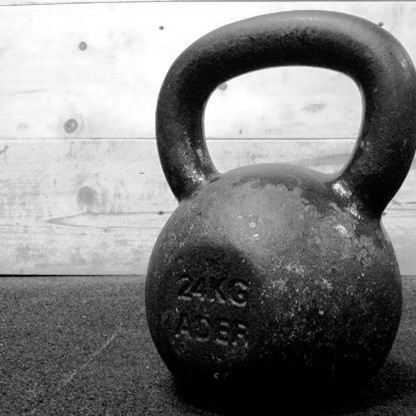
There are myriad ways to work out and get fit. Kettlebells aren’t magic; they’re just another tool. But they’re a wonderfully helpful tool, and one I greatly enjoy. I highly recommend them for anyone who’s serious about their own well-being. Add them to your arsenal, and you’ll likely find that they also become your fitness weapon of choice.
Where would one start? That’s easy. Buy a copy of Pavel’s book, Enter the Kettlebell! And do what he says to do, following the plans he outlines in the book.
Go get strong!
Safety disclaimer: Although I went to graduate school for a long time and some people call me “doctor,” I’m not a medical doctor. Always check with your physician prior to starting any kind of physical fitness regimen. That just makes good sense.