
I’ve moved my blogging to Substack!
Feel free to check out any of the content I have here, but also be sure to check out my newest content at Reckoning and Elevating What Works.
Accidents at Sea and Human Behavior
When I heard about the collision involving USS Fitzgerald (DDG 62) on June 17, 2017, my heart sank. For me and other Navy veterans who have served aboard ships like Fitzgerald, the feeling is rather personal—we’ve driven ships, we’ve been in situations that are tough to navigate, and we can imagine fairly closely the moments before and after a collision.
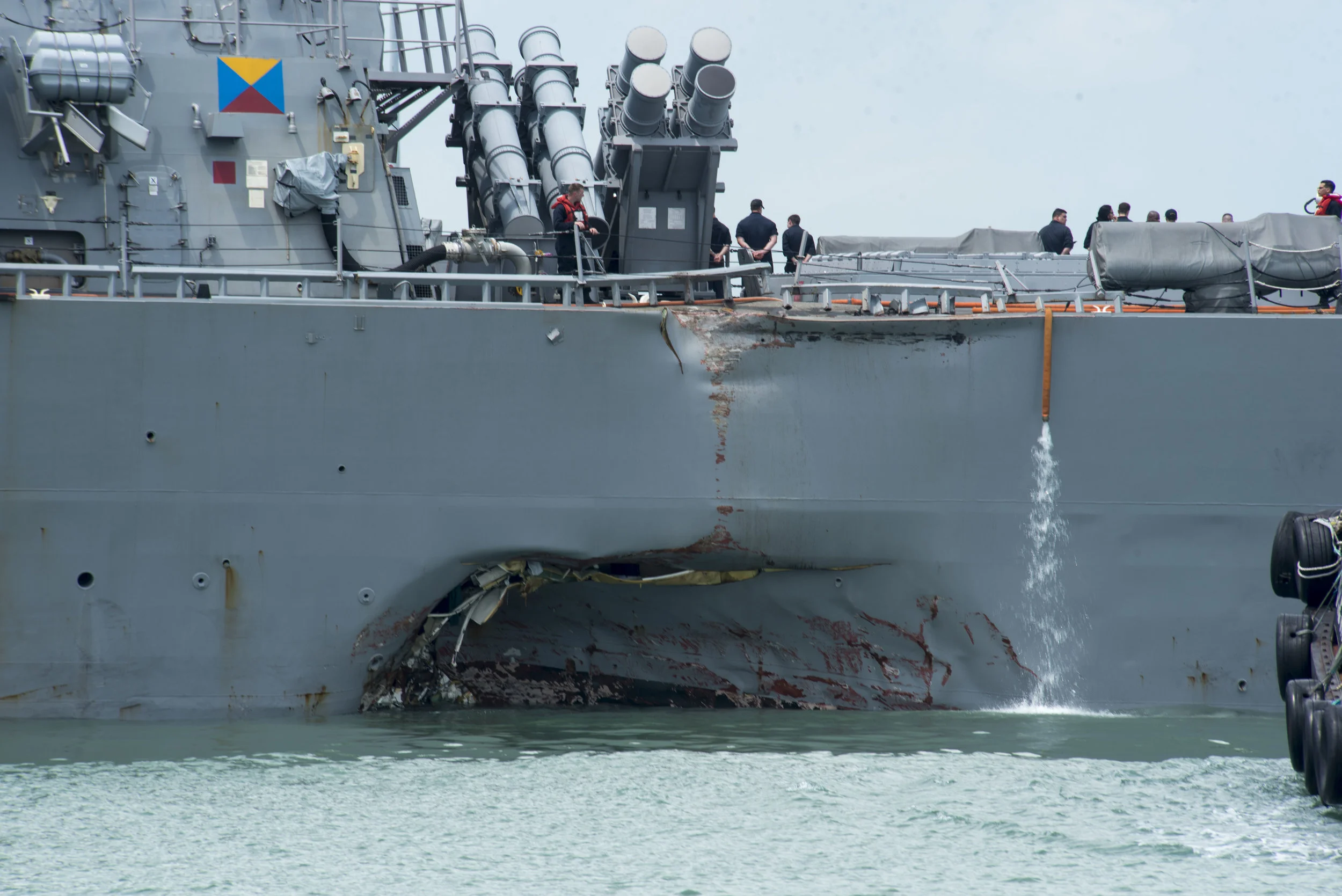
Then, only about two months after Fitzgerald, came the news that USS John S. McCain (DDG 56) collided with a vessel on Aug. 21 near the Strait of Malacca. Because it connects the Pacific and Indian Oceans, it’s a high-traffic area, one that puts many large ships within relatively close proximity of each other. Of the many tough waters in the world to traverse, this one is somewhere near the top of the list.
My heart—and, I’m sure, the hearts of many others—sank again.
First, of course, I think of those killed and injured. My thoughts and prayers are with them and their families.
Second, I wonder:
Why?
What happened?
Myriad explanations abound, and
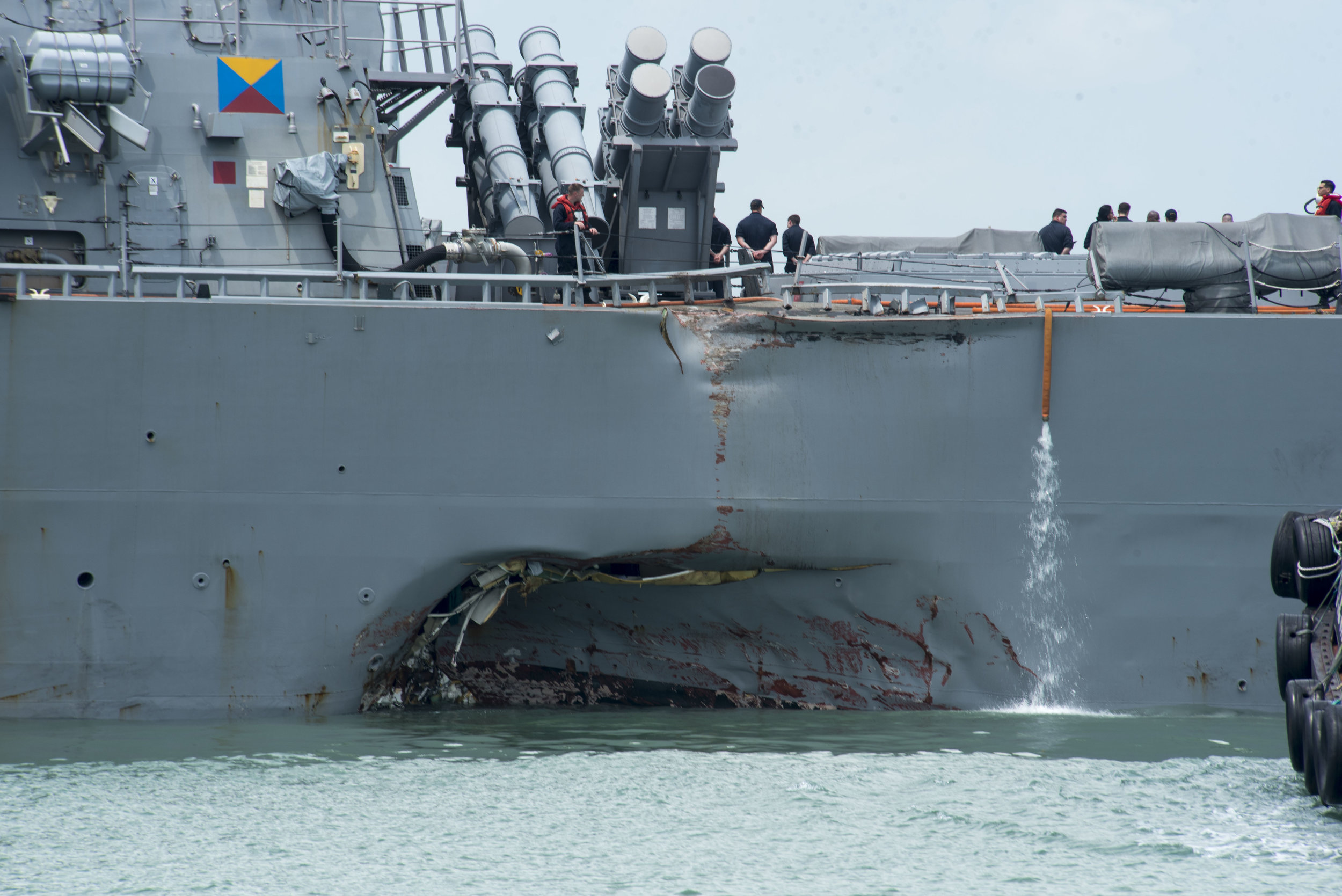
Aug. 21, 2017--Damage to the port side of the guided-missile destroyer USS John S. McCain (DDG 56) as it steers towards Changi Naval Base, Republic of Singapore, following a collision with the merchant vessel Alnic MC. Photo by Mass Communication Specialist 2nd Class Joshua Fulton. The appearance of U.S. Department of Defense (DoD) visual information does not imply or constitute DoD endorsement.
When I heard about the collision involving USS Fitzgerald (DDG 62) on June 17, 2017, my heart sank. For me and other Navy veterans who have served aboard ships like Fitzgerald, the feeling is rather personal—we’ve driven ships, we’ve been in situations that are tough to navigate, and we can imagine fairly closely the moments before and after a collision.
Then, only about two months after Fitzgerald, came the news that USS John S. McCain (DDG 56) collided with a vessel on Aug. 21 near the Strait of Malacca. Because it connects the Pacific and Indian Oceans, it’s a high-traffic area, one that puts many large ships within relatively close proximity of each other. Of the many tough waters in the world to traverse, this one is somewhere near the top of the list.
My heart—and, I’m sure, the hearts of many others—sank again.
First, of course, I think of those killed and injured. My thoughts and prayers are with them and their families.
Second, I wonder:
Why?
What happened?
Myriad explanations abound, and the investigations for both the Fitzgerald and McCain collisions are ongoing. One report, which outlines actions that occurred after the Fitzgerald collision (but doesn’t investigate the events leading up to the collision) has been released (read it here). It’s well worth reading, as it discusses the specifics of what occurred and the damage-control efforts that followed.
The investigations regarding the causes will thoroughly explore the incidents. I won’t speculate regarding what happened specifically in these situations.
I do, however, think it’s reasonable to expect—given the research on safety and accidents plus my firsthand knowledge of being a surface warfare officer in the U.S. Navy—that the investigations will find a number of related factors, including:
A chain of events. It’s difficult to imagine such an event being caused by a single poor decision, a single mechanical problem, or any other “one” cause. Given the complexity of operating a large ship safely at sea, a number of redundant systems are in place to help reduce risk. For example, on a U.S. Navy ship, more than one group of people are looking at charts and monitoring other ships nearby. Mechanical features have backups and the backups have backups. Therefore, a collision would involve a number of events in which things went wrong. The scholar James Reason’s “Swiss Cheese Model” comes to mind. This model suggests that errors occur when various failures of human behavior and aspects of the environment align such that vulnerabilities or the “holes” (hence the Swiss cheese) line up to cause an error or accident.
A human component to the situation. In any such disaster, people are making decisions. These are real people—complex humans who differ in how they think, communicate, and make judgments. The human component also involves the reality that ships are organizations. They are complex amalgamations of unique people attempting—and nearly all the time succeeding, it should be noted—at interacting in mindful, productive way. As such, issues of leadership and culture are critical. Everyone, regardless of rank or status, must know in the depths of their very being that their coworkers and leaders want them to bring confusing or even vaguely problematic situations to their attention.
When interacting in a high-risk environment, furthermore, the best organizations are ones that anticipate and contain errors quickly. Research on such “high-reliability organizations” suggests this capability allows the organization to catch small problems before they escalate into bigger ones, potentially leading to disaster. (The scholars Karl Weick, Kathleen Sutcliffe, Todd La Porte, and Karlene Roberts are some of foremost researchers in this area—for interested readers, I suggest starting here.)
I’m confident that the U.S. Navy will investigate these incidents quickly enough to promote understanding and learning, but not too quickly, as a too rapid investigation could overlook potential aspects of the problem.
I’m hopeful that the lessons learned from these incidents will be (a) the right lessons that can lead to improved performance and (b) implemented in a thoughtful-yet-rapid manner.
Until then, be safe shipmates.
About Ben Baran
Ben Baran, Ph.D., is probably one of the few people in the world who is equally comfortable in a university classroom, a corporate boardroom and in full body armor carrying a U.S. government-issued M4 assault rifle. Visit: www.benbaran.com.
Ben is also the author of the e-book, The Navy’s 11: Reflections and tips for leaders everywhere based upon the U.S. Navy’s Leadership Principles. It’s full of ...

- Leadership guidance, based upon the U.S. Navy's Leadership Principles, which have been used to create and sustain the greatest navy known to humankind;
- Real-world examples, based upon my nearly 20 years of experience with the U.S. Navy and a decade of academic research combined with business consulting;
- Actionable tips, meant to help you implement the leadership principles in your daily life and work; and
- Much more!
Click here to get your FREE copy today.

Can Leadership Prevent Mistakes?
"While I was in the middle of the room, the attic floor and beams collapsed onto the second floor crashing down to the first floor where I was standing. The time between us entering the building and the time of the collapse was no longer than 90 seconds. I was knocked to the floor and was trapped under the debris. I suffered a head injury and a torn patellar tendon. The contents of the upstairs ended up in the first floor room and I could have been killed. By my judgment, approximately 80,000 gallons of water was pumped into that structure and we were ordered in anyway. This was after a previous call to evacuate 45 minutes earlier. This should not have happened!"
Mistakes happen. Sometimes, those mistakes hurt or kill people. I’ve studied them among fire fighters, who sometimes experience events like the one described above (which comes from Report 07-0001036, U.S. Department of Homeland Security, 2014). The mistakes that people in the fire service and other high-risk occupations make often have important safety implications. In other industries and occupations, mistakes may not hurt or kill people, but mistakes often derail projects or anger customers. They create conflict and they degrade the quality of what we make or do.
Mistakes aren’t exclusive to any industry or sector.
Mistakes also almost happen. These close calls or near misses—when discussed well and integrated into a learning program—can serve as powerful wakeup calls for people and teams.
Regardless of whether we’re talking about mistakes or near misses, learning from the past to improve future performance is

“While I was in the middle of the room, the attic floor and beams collapsed onto the second floor crashing down to the first floor where I was standing. The time between us entering the building and the time of the collapse was no longer than 90 seconds. I was knocked to the floor and was trapped under the debris. I suffered a head injury and a torn patellar tendon. The contents of the upstairs ended up in the first floor room and I could have been killed. By my judgment, approximately 80,000 gallons of water was pumped into that structure and we were ordered in anyway. This was after a previous call to evacuate 45 minutes earlier. This should not have happened! ”
Mistakes happen. Sometimes, those mistakes hurt or kill people. I’ve studied them among fire fighters, who sometimes experience events like the one described above (which comes from Report 07-0001036, U.S. Department of Homeland Security, 2014). The mistakes that people in the fire service and other high-risk occupations make often have important safety implications. In other industries and occupations, mistakes may not hurt or kill people, but mistakes often derail projects or anger customers. They create conflict and they degrade the quality of what we make or do.
Mistakes aren’t exclusive to any industry or sector.
Mistakes also almost happen. These close calls or near misses—when discussed well and integrated into a learning program—can serve as powerful wakeup calls for people and teams.
Regardless of whether we’re talking about mistakes or near misses, learning from the past to improve future performance is a fundamental management and leadership objective (Catino & Patriotta, 2013; Morris & Moore, 2000). But a common problem that I’ve seen in organizations is that we’re often apt to treat mistakes as problems with individual people. Sometimes an individual person is part of the problem, but pinning a mistake on a single person doesn’t necessarily help a team or organization learn. Instead, what’s required is a culture that embraces learning from mistakes in non-judgmental, non-punitive way.
One example of such an approach is in health care. Modern hospitals are systems in which extraordinary good and life-saving care happens daily. But they’re also places where mistakes hurt and even kill people.
Frequently.
And one person within the healthcare industry whose insights I’ve always enjoyed is Paul F. Levy, the former president and CEO of Beth Israel Deaconess Medical Center in Boston.
In the clip below, he discusses some of the nuances of teamwork and leadership as they pertain to mistakes in health care. Paraphrasing one of his senior leaders commenting on what to do about a doctor who made a serious mistake (starting at 7:00 in the video), he says,
“If we want to establish a culture in our organization that encourages and permits people to admit their mistakes and their near misses, we are more likely to establish that culture if we do not punish doctors who, with best of intentions, make a mistake. They’ve already suffered enough. ”
So, is there a way to make organizations error free? In this continually changing world, probably not. The key, instead, is to promote continual learning through what we do and what we say, catching small errors before they become big ones and taking the necessary steps to improve. That’s at the heart of building a team and organization that encourages open discussion of hazards and errors, of what almost went wrong and what could have happened.
Years ago, I had a much more punitive approach to dealing with mistakes than I do now. That’s because I’ve realized that leadership isn’t about being perfect or having a perfect team. It’s about unlocking people’s own ability to learn, to imagine, and to become something greater than they realized was possible.
Leadership, therefore, can’t prevent mistakes. But with an approach of humility, continuous improvement and open communication, it can help to build routines and patterns of learning that make mistakes less likely and less frequent.
Find this thought provoking? Leave a comment, like and share!
About Ben Baran
Ben Baran, Ph.D., is probably one of the few people in the world who is equally comfortable in a university classroom, a corporate boardroom and in full body armor carrying a U.S. government-issued M4 assault rifle. Visit: www.benbaran.com.
References
Catino, M., G. Patriotta. 2013. Learning from errors: Cognition, emotions and safety culture in the Italian air force. Organizational Studies, 34: 437-467.
Morris, M. W., P. C. Moore. 2000. The lessons we (don’t) learn: Counterfactual thinking and organizational accountability after a close call. Administrative Science Quarterly, 45: 737-765.
U.S. Department of Homeland Security. 2014. National Fire Fighter Near-Miss Reporting System. Retrieved from http://www.firefighternearmiss.com

When Drowning Prevention Meets Business Strategy
My children love the water. They swim, they splash, they laugh.
My children, like most children, are fast. They dart, they scurry, they hide.
Therefore, when my children encounter water, it can be an exhausting experience for my wife and me. We must be vigilant.
The pool we frequent has lifeguards. But their vigilance will never match mine.
Unless, of course, we’re talking about

My children love the water. They swim, they splash, they laugh.
My children, like most children, are fast. They dart, they scurry, they hide.
Therefore, when my children encounter water, it can be an exhausting experience for my wife and me. We must be vigilant.
The pool we frequent has lifeguards. But their vigilance will never match mine.
Unless, of course, we’re talking about lifeguards at Great Wolf Lodge. Their vigilance surpasses mine 99 percent of the time (at least when it comes to paying attention to all of the children in an area, not just my own).
And one reason, I suspect, has to do with business strategy.
For the unfamiliar, Great Wolf Lodge is a large, growing chain of indoor, family-friendly water parks. They’re open year-round, and children of all ages can swim, go down slides and splash around with a host of water-related valves and buckets. My children love it.
But Great Wolf Lodge realizes that regardless of how fun they make the water park or how attentive they are to the overall customer experience, there’s a chink in their armor.
They have an Achilles heel.
There’s a specific type of failure that could severely damage their reputation and their business.
It’s drowning, leading to the death of a child.
The entire business model of Great Wolf Lodge depends on the safety of the children and a fun experience for everyone. If the safety of the experience—either real or perceived—came into question within the minds of potential customers, their business would suffer dramatically. (And the safety of children is intrinsically good, of course.)
And so, back to the lifeguards. During the times I’ve visited Great Wolf Lodge, I couldn’t help but notice that they:
- Avoid eye contact with people outside of the water
- Continually scan their gaze back and forth on their area, focusing on the water itself, not on individual children
- Seem to rotate on shifts more frequently than lifeguards at most pools
- Get tested unexpectedly by training personnel who nonchalantly toss a dummy child into the water and time how fast the lifeguard reacts
In this way, Great Wolf Lodge lifeguards and their managers are preoccupied with failure. They have specifically identified what they must avoid as an organization. And they have constructed hiring, training, cultural norms and incentives to guide behavior accordingly.

Photo from: https://www.greatwolf.com/culture
To be fair, Great Wolf Lodge doesn’t have a zero-incident safety record. I highly doubt any park of its magnitude does. But it’s also fair to say that the probability of any specific child having a serious incident at Great Wolf Lodge is very, very low. That’s the way it should be. Safety is boring. It’s a non-event.
For businesses not in the amusement park industry, however, I think there are some lessons to be learned from Great Wolf Lodge, its lifeguards and its preoccupation with drowning.
These lessons include:
- Focusing on the positive might be warm and fuzzy, but it’s critical to identify what your organization must avoid
- Avoiding failure—and really risk management in general to some degree—involves creatively thinking about what could go wrong
- Once you’ve identified these potential internal weaknesses or external threats, you should consider what you can do about them
- Leaders can use these risky areas of their operations as a focusing mechanism for employee behavior through hiring practices, training and incentives
- Managing for non-events requires ongoing vigilance, which must be shared and replenished
The key is to figure out what “a drowning child” looks like in your organization, and then to identify how it can be detected as quickly as possible. Having a reliable organization doesn’t mean that you’ll never encounter a “drowning child,” but it does mean that your people will recognize what it looks like and take mitigating actions—before it becomes a catastrophe.
Find this thought provoking? Leave a comment, like and share!
About Ben Baran
Ben Baran, Ph.D., is probably one of the few people in the world who is equally comfortable in a university classroom, a corporate boardroom and in full body armor carrying a U.S. government-issued M4 assault rifle. Visit: www.benbaran.com.

Why Perfection Isn’t Good Enough
“I just want it to go the right way,” he said, with tears starting to form at the corners of his eyes. “I’m trying and trying and trying and it’s not working.”
The tears began to flow, as he rapidly stamped his feet on the green artificial turn covering the mini-golf course. His knuckles turned white as he gripped his club with a surge of frustration, and he swung as hard as he could at the ball.
He missed. It was fortunate that he did, because

“I just want it to go the right way,” he said, with tears starting to form at the corners of his eyes. “I’m trying and trying and trying and it’s not working.”
The tears began to flow, as he rapidly stamped his feet on the green artificial turf covering the mini-golf course. His knuckles turned white as he gripped his club with a surge of frustration, and he swung as hard as he could at the ball.
He missed. It was fortunate that he did, because had his club head connected with the ball, property damage or harm to bystanders would have been probable.
During that moment in 2014 watching my then 3-year-old son, I had a flashback. It was a moment of complete and total empathy.
Years ago, that was me.
When I was a kid, I loved playing board games with my family. But I hated losing. I remember swiping all of the chess pieces off the board mid-game in a fit of anger. For a few years, that was my common reaction to even a hint of things not going my way.
I once ruined a National Geographic trivia game for the entire family by spending a full day or two memorizing the answers to every single question. I quickly became unbeatable—and I became a totally annoying competitor. No one would play with me. Game over.
The strength of one’s quest for perfection is probably a function of both our environment and our genes. Regardless, perfection as a quest or even as a goal needs to be abolished—for children, for adults, for leaders, for teams, for organizations.
In other words, perfection simply isn’t good enough. In fact, it’s entirely counterproductive in today’s fast-paced world. Expecting perfection, either from yourself or from the people around you, is anathema to success, and here are a few reasons why.
- It’s isolating. When people project an image of perfection, those around them might be less likely to suggest different ways to do things. They might think, “She’s perfect and knows everything. She’s never wrong. So why would she need my idea? She has it all figured out.” This saps the creative energy from any team, and it can insulate the “perfect” person from potentially critical information.
- It’s exhausting. We only have so many resources at our disposal, only so many activities to which we can attend. So if you’re attempting to achieve perfection in all of them, you’ll run out of gas very quickly.
- It’s slow. As LinkedIn founder Reid Hoffman is often quoted as saying, “If you are not embarrassed by the first version of your product, you've launched too late.” Achieving anything close to perfection takes a lot of time, and if you’re trying to develop the perfect product or service, it’s going to take so long that you risk (a) creating something that perfectly solves a non-existent problem or (b) creating something that’s already outdated. Focus instead on creating quickly and learning.
- It’s often unnecessary. Many problems in our lives and in our organizations can be addressed adequately with a solution that takes care of 80 percent of the issue. And the effort that it would take to have a 100-percent solution (assuming one actually exists, which is doubtful) often far outweighs the benefits.
- It’s a unicorn. It doesn’t exist. Even the most seemingly error-free organizations and groups (like nuclear power plants, naval aircraft carriers and surgical teams) encounter small failures frequently. The key is that the people in those situations have been trained to recognize weak signals of danger quickly and make rapid course corrections. That’s not perfection; it’s highly reliable iteration.
When I think about my son and that moment of frustration on the mini-golf course in 2014, I feel for him. And it’s not just that I feel his pain in that moment. It’s that I know that setting the bar at the level of perfection is harmful. It limits his willingness to try, to fail. As such, it’s my job to help him learn to experiment, to mess things up and to learn.
Because after all, it’s not perfection that the world needs. It’s grit, leadership and teamwork.
So, perfection? You and I are over. We’re done.
Please excuse me now while I go to the golf course.
And cry on every hole.
Find this thought provoking? Leave a comment, like and share!
About Ben Baran
Ben Baran, Ph.D., is probably one of the few people in the world who is equally comfortable in a university classroom, a corporate boardroom and in full body armor carrying a U.S. government-issued M4 assault rifle. Visit: www.benbaran.com.

Can HR Drive High Reliability?
Positive thinking is sometimes overrated. In fact, too much positive thinking can be disastrous. While optimism can help people and organizations bounce back from tough times, when allowed to dominate the psyche during good times, it can blind us to the possibility of what could go wrong.
It’s important, periodically, to think creatively about potential doom.

Positive thinking is sometimes overrated. In fact, too much positive thinking can be disastrous. While optimism can help people and organizations bounce back from tough times, when allowed to dominate the psyche during good times, it can blind us to the possibility of what could go wrong.
It’s important, periodically, to think creatively about potential doom.
Such “preoccupation with failure” is one pattern of behavior that helps some organizations have far fewer accidents than we would expect given what they do. For example, plenty could go wrong in a nuclear power plant or aboard a naval aircraft carrier. But few errors devolve into disasters in either, in part because its people explicitly know what failure could look like and catch small problems before they become catastrophes.
These types of organizations are “high-reliability organizations,” and I think there’s something that human resources (HR) departments could learn from them.
In particular, what might happen if we tried to apply the five hallmarks of high reliability to HR practices? This is a topic that I addressed in “High-Reliability HR: Preparing the Organization for Catastrophes,” which appeared in the Winter 2016 issue of People & Strategy.
To summarize some of the key points of that article, consider the following five hallmarks of high reliability:
- Preoccupation with failure: What could go wrong?
- Reluctance to simplify interpretations: What’s the true cause?
- Sensitivity to operations: Are we in touch with the ground-level reality?
- Commitment to resilience: How do we recover?
- Deference to expertise: Who knows best?
I argue that HR could play a pivotal role in helping an organization adopt these principles. For example, HR could help with scenario planning based upon identified risks, developing leaders who promote a climate of healthy questioning, assisting with reporting and analyzing near misses, training employees on actions to take during catastrophes and implementing hiring practices that select employees with the specialized skills needed by the organization.
Some may say that HR has no place in disaster planning or emergency preparedness, suggesting that such efforts need to be solely under the purview of business continuity, security or risk management functions.
But shouldn’t HR be concerned holistically about the human side of the organization’s survival and success? Isn’t HR as a function positioned well to act as custodians of a culture that moves the organization toward high-reliability?
Or maybe we should go back to calling HR the “personnel” department.
Regardless, it’s worth it for us as HR professionals to liberate our thinking as we think about what the HR function is and how it contributes to the overall organization in the 21st Century. My full article on this topic applies the high-reliability HR framework to the topic of an active shooter on a college campus, and it’s meant to provoke a conversation about the potential role of HR in ensuring a secure enterprise.
To download the full article, click here.
Does HR have a role in helping the organization prepare for disasters and bounce back when they occur? Leave a comment below!
Find this thought provoking? Like and share!
About Ben Baran
Ben Baran, Ph.D., is probably one of the few people in the world who is equally comfortable in a university classroom, a corporate boardroom and in full body armor carrying a U.S. government-issued M4 assault rifle. Visit: www.benbaran.com.

Strike a match: Agile improvisation in the face of disaster
On August 5, 1949, a team of 15 smokejumpers parachuted into the Mann Gulch near the Missouri River in Montana to fight a fire that had started the previous day. At first appraisal, fighting the fire seemed a simple task. But thus began one of the worst disasters in the modern history of wildfire suppression in which all but two of the team members lost their lives.
Immortalized in Norman Maclean’s book Young Men and Fire[i], in the folk song Cold Missouri Waters by James Keelaghan and in famed organizational scholar Karl Weick’s scholarly analysis[ii], the incident is a tragic-yet-fascinating account of a team attempting to sense and respond to a rapidly evolving environment. It’s a story of improvisation, counter-intuitive action and collapsed team structures.
According to Maclean’s account, the team

"Playing with Matches" by Dennis Wilkinson is licensed under CC BY 2.0
On August 5, 1949, a team of 15 smokejumpers parachuted into the Mann Gulch near the Missouri River in Montana to fight a fire that had started the previous day. At first appraisal, fighting the fire seemed a simple task. But thus began one of the worst disasters in the modern history of wildfire suppression in which all but two of the team members lost their lives.
Immortalized in Norman Maclean’s book Young Men and Fire[i], in the folk song Cold Missouri Waters by James Keelaghan and in famed organizational scholar Karl Weick’s scholarly analysis[ii], the incident is a tragic-yet-fascinating account of a team attempting to sense and respond to a rapidly evolving environment. It’s a story of improvisation, counter-intuitive action and collapsed team structures.
According to Maclean’s account, the team was beginning to evaluate the fire and plan an attack when the team leader, Wagner Dodge, saw that the wildfire had breached the valley and was approaching their direction rapidly. Quickly, the situation devolved into an all-out race to a rocky area at the top of the ridge, with flames chasing them at a rate of approximately 610 feet per minute.
That’s when Dodge took two actions that both highlight extreme moments of agility.
- He ordered his men to drop their tools. Dodge realized that they needed to run faster if they were to have any chance of reaching the top, and that their heavy tools were slowing them down. But this is a strange order to give a group of experienced firefighters—it’s like telling a group of Marines to throw down their rifles.
- Moments later, he took out a match, struck it and threw it into the waist-high dry grass around him. As his own personal fire grew around him, he ordered his men to lie down with him in the area he scorched. None of them did.
Consider the magnitude of creativity Dodge displayed in these moments: (1) casting away his tools, the very physical representations of being a firefighter and (2) starting a fire and climbing into it, when the entire purpose of firefighting is to extinguish flames while avoiding direct contact if possible.
Dodge arose later from the ashes that had provided a barrier between him and the wall of flame that swept the hillside. He soon learned that only he and one other team member survived. All 13 others died.
This story has numerous lessons, one of which is the value of agile improvisation.
Dodge quickly realized that the environment had changed and took novel, dramatic steps to survive.
The story also highlights the value in continually sensing and monitoring one’s environment for subtle signs of danger. Such processes that support anticipating change involve the use of analytics, which is all about making sense of what’s going on, organizing that information and using it to respond appropriately.
How does an organization systematically sense and monitor its environment? We’ve found that it’s through consistently measuring what’s important from every corner of the system, gathering insights from employees across levels, functions and geographies. It’s about establishing an attitude of questioning assumptions and the status quo, making it OK for people to voice ideas and even dissent.
Agile organizations aren’t error-free.
They’re organizations that have embedded the ability to notice small deviations and deal with them quickly. And formal systems for sensing and monitoring set the foundation for such noticing to occur. Coupled with agile responses—like Dodge’s burning match—organizations can begin to thrive in spite of the turbulence around them.
References
[i] Norman Maclean, Young Men and Fire (Chicago: University of Chicago Press, 1993).
[ii] Karl E. Weick, “The Collapse of Sensemaking in Organizations: The Mann Gulch Disaster,” Administrative Science Quarterly 38, no. 4 (December 1993): 628, doi:10.2307/2393339.
About Ben Baran
Ben Baran, Ph.D., is probably one of the few people in the world who is equally comfortable in a university classroom, a corporate boardroom and in full body armor carrying a U.S. government-issued M4 assault rifle. Visit: www.benbaran.com.