
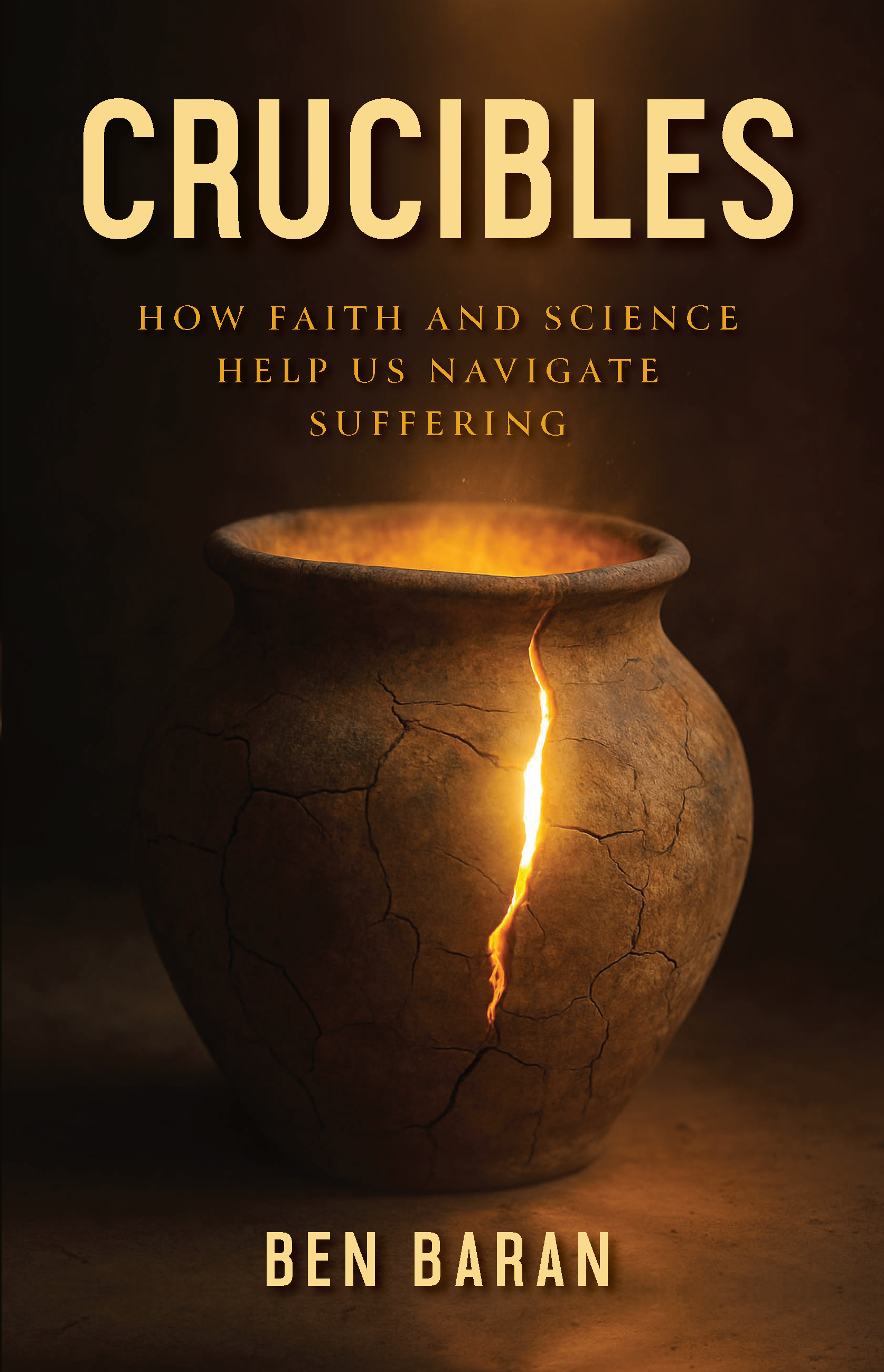
A thoughtful, hope-filled guide for navigating life’s hardest moments
Crucibles: How Faith and Science Help Us Navigate Suffering is available NOW.
Drawing from social science, Catholic wisdom, and lived experience, Crucibles offers an honest and hopeful framework for understanding suffering—not as something to merely endure, but as something that can transform us.
All 2026 author royalties will be donated to Mighty Vincent, a nonprofit that seeks to bring joy, compassion, and love to the world by facilitating volunteer service and by creating awareness of those in need.
What is Crucibles?
I think my wonderful editor put it well in what she wrote for the book’s back cover:
“Life’s trials can break us—or they can forge us.
“When tragedy struck his family, Ben Baran was forced to confront suffering in its rawest form. In the aftermath, Baran—a Navy admiral, organizational psychologist, Catholic, husband, and father—sought answers to the questions all of us eventually face: How do we endure the unendurable? What purpose might suffering serve? Can faith and science together show us a way through?
“Crucibles is his honest and hope-filled response. Baran weaves insights from psychology and sociology with the Catholic tradition, especially the teachings of St. John Paul II. He explores how adversity can both wound and transform. Drawing on stories from Antarctic explorers, Holocaust survivors, soldiers, saints, and parents, he shows how life’s crucibles are unavoidable but also potentially redemptive—clarifying who we are, forging resilience, and binding us together in solidarity.
“A guide for anyone facing hardship or preparing for it, this candid and compassionate book is full of raw beauty and unvarnished hope, reminding us that even in our deepest trials, we are never alone.”
Receive thoughtful reflections on faith, science, and navigating life's challenges, along with occasional updates as Crucibles approaches publication. Subscribe to Reckoning below.
Why This Book Matters
Suffering is universal, yet many of us are poorly equipped to face it.
We live in a moment filled with distraction, numbing mechanisms, and shallow answers to life’s deepest pain.
Crucibles offers something different: an intellectually serious, spiritually grounded, and deeply human exploration of how hardship can become a source of resilience, solidarity, and redemption.
Unlike most books on suffering, which lean primarily on psychology, spirituality, or philosophy alone, Crucibles integrates all three.
Inside, readers will discover:
What social science reveals about resilience amid adversity
How Catholic teaching illuminates suffering’s deeper meaning
Why hardship can clarify identity and deepen connection
Practical ways to navigate suffering with honesty and hope
A framework for preparing for life’s inevitable trials
Join the Journey
If Crucibles resonates with you, I’d be grateful if you would:
Provide a rating and written review of Crucibles on Amazon (this is tremendously important for visibility). Here’s the direct link for that.
Subscribe for updates on Substack.
Share the book with someone who might need it.
Ask me about speaking to your parish or group (use the link on this page).
I’m deeply grateful for your support—and for your prayers as this book makes its way into the world.
As appropriate, I’ll be sharing various updates as things continue to evolve. Thanks again.
Early Praise for Crucibles
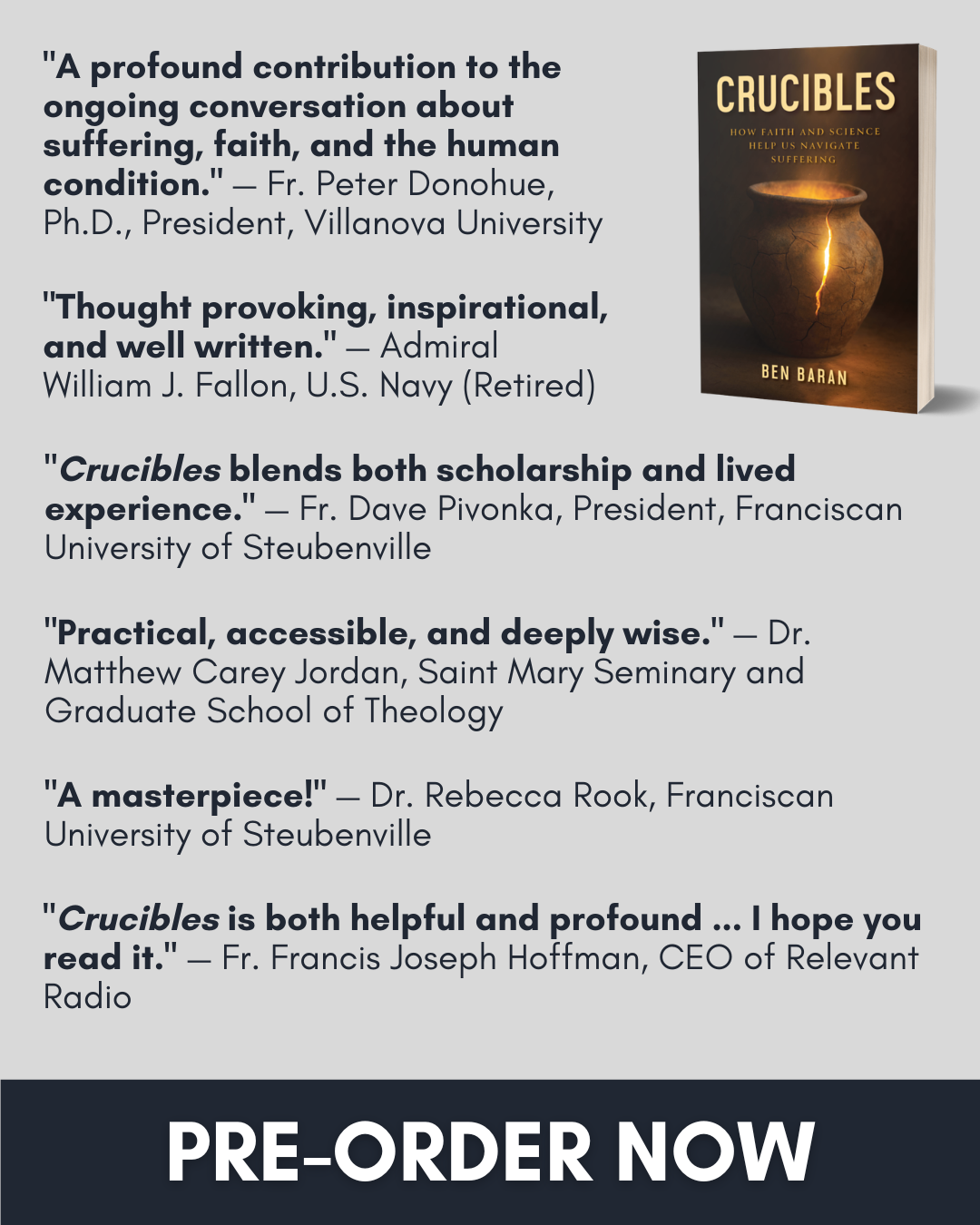
"Crucibles is both helpful and profound ... I hope you read it."
—Rev. Francis Joseph Hoffman, CEO of Relevant Radio
"As French author Léon Bloy reminds us, "There are places in the heart that do not yet exist; suffering has to enter in for them to come to be." This book isn't simply a message of resilience and recovery, but it reminds us that life's trials can become the paths through which we grow and are made stronger. Crucibles blends both scholarship and lived experience, providing powerful reminders throughout of how the Lord can bring good from even the most profound suffering."
—Father Dave Pivonka, TOR, President, Franciscan University of Steubenville
"At this moment in history, we are witnessing a quiet revival of Christian Faith, especially among younger people—and not only in the United States, but around the world. One of the prevailing reasons for this religious revival is that young people are seeking meaning, especially in their suffering. Ben Baran's Crucibles is a credible account of how faith and science work together to make sense of our lives and our experiences, especially the heavy and heartbreaking ones. Whatever your age or generation, it should be on your reading list this year."
—Fr. Damian Ference, Ph.D., Vicar for Evangelization in the Diocese of Cleveland
"Thought provoking, inspirational, and well written ... a helpful framework for dealing with adversity and suffering."
—Admiral William J. Fallon, U.S. Navy (Retired)
“When a former student reaches out and asks me to review his book, I am flattered. When that student and his wife experience a tragic loss, you take a deep breath, remembering the day you reached out to them and tried to find words that would bring light amid a dark night. In such moments, you always hope you are finding the right words. St. Augustine observed that often it is the student who instructs the teacher. Ben Baran’s Crucibles is a father’s profound exploration of the restless heart seeking peace amid the trials of life. With a positive perspective, Ben confronts the reality of suffering as both a wound and a catalyst for transformation. He invites us to understand that while suffering is deeply personal, it also calls us into a richer communion with the Body of Christ. Crucibles is a testament to hope, meaning, and the transformative power of grace in our darkest hours. It is a profound contribution to the ongoing conversation about suffering, faith, and the human condition. Whether teacher, student, priest, or penitent, we all need help navigating life’s darkest moments.”
—Fr. Peter Donohue, OSA, PhD., President, Villanova University
"Crucibles is a marvelous book. Drawing on his own experience, the work of social scientists, and the riches of the Catholic faith, Ben Baran offers profound insights into how to effectively navigate—and even redeem—the suffering we experience as human beings living in a fallen world. Practical, accessible, and deeply wise, this book will help anyone wrestling with life's trials, walking with others through difficult times, or simply seeking to live well amidst hardship and disappointment. Highly recommended!"
—Dr. Matthew Carey Jordan, Professor of Philosophy and Vice President of Academic Affairs, Saint Mary Seminary and Graduate School of Theology
"A masterpiece! Crucibles weaves together stories, the wisdom of St. John Paul II, and social science to present a rich tapestry of the beauty, purpose, and meaning that can be found in life's trials. Readers will gain not only practical tools and a refreshed perspective for enduring suffering, but also a strengthening of hope—the hope spoken of in Hebrews 6:19, one that is an anchor for the soul, firm and secure, and that reaches beyond the veil to the things of eternity."
—Dr. Rebecca Rook, Professor of Education and Dean, School of Professional Programs, Franciscan University of Steubenville
"Crucibles offers wisdom about suffering that is both intellectually rigorous and firmly grounded in Catholic teaching. This book will challenge you to think differently about adversity and to see more clearly how suffering can deepen compassion, courage, and faith."
—Dr. Erika Lopina, Associate Professor of Psychology, Elon University
“We know that ‘in this world you will have trouble’ (John 16:33), yet in Crucibles, Ben Baran reveals how those very hardships can shape us in profound and unexpected ways. As a longtime observer of his life and work, I have seen him embody the truth he shares here — that even our deepest wounds can become sources of strength, compassion, and purpose. Writing with the authority of both a scholar and a faithful witness, Baran invites us to discover suffering's redemptive possibilities in the light of faith.”
—Dr. Tammy Beck, Associate Professor of Management, University of Nebraska-Lincoln