
I’ve moved my blogging to Substack!
Feel free to check out any of the content I have here, but also be sure to check out my newest content at Reckoning and Elevating What Works.

Agile HR: Trends and Opportunities
The future of human resources (HR) lies at the intersection of strategy, data analytics, design thinking, and a new set of practices and mindsets ushered in by the world of agile methods and organizational agility writ large.
And the time is ripe for HR professionals to have the bandwidth necessary to devote themselves to such matters. Numerous HR services—particularly those that are

The future of human resources (HR) lies at the intersection of strategy, data analytics, design thinking, and a new set of practices and mindsets ushered in by the world of agile methods and organizational agility writ large.
And the time is ripe for HR professionals to have the bandwidth necessary to devote themselves to such matters. Numerous HR services—particularly those that are more compliance and administrative in nature—have been prime candidates for outsourcing for years. Automation, furthermore, has the potential to eliminate or reduce further many repetitive HR tasks.
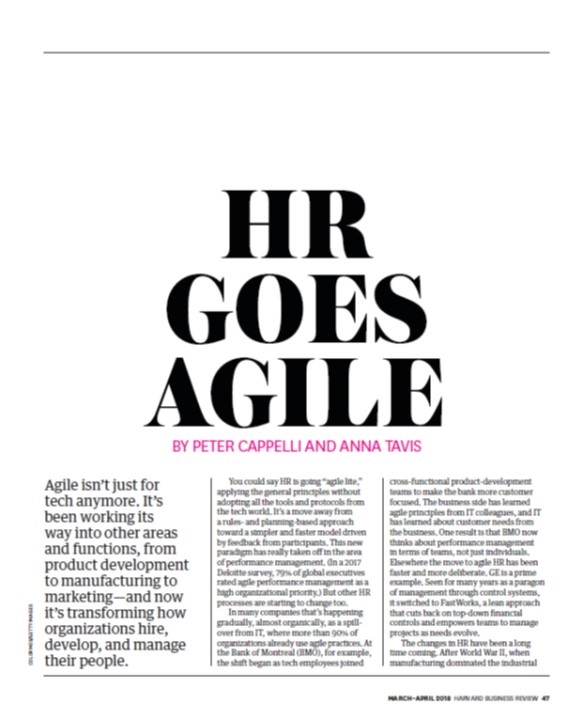
In the March-April 2018 issue of Harvard Business Review, Peter Cappelli and Anna Tavis outline a number of ways in which HR is adopting agile principles. In their article, “HR Goes Agile,” Cappelli and Tavis highlight how HR practices are beginning to trend away from the old approaches governed by rules and plans. Taking cues from agile, they contend, HR is increasingly moving toward a feedback-driven approach characterized by simplicity and speed.
Here are some highlights from their article.
First, a number of big trends are fundamentally influencing HR. These include increasingly rare lifelong employment and an environment marked by rapid change, which drives rapidly changing skill requirements.
Second, the strategic imperative now is rapid innovation, and this applies to HR. In a fast-paced world, top-down planning doesn’t work very well. Instead, nimble, user-driven methods such as rapid prototyping, team-based decisions, and “sprints” centered on specific tasks.
Third, such changes in the larger business environment are driving changes in specific practices, many of which are either HR-driven or used by HR. These include:
Performance appraisals, in which the clear trend is toward having higher-frequency, sometimes project-based feedback versus the typical annual review. The emphasis here is on quick feedback to enable “course corrections.” Elements of agile methods and design thinking can also inform the organization’s approach toward performance appraisal design, with a specific emphasis on involving employees in the prototyping, testing, and iterative improvement process.
Coaching, in which organizations are realizing that they must invest time in developing manager’s skills. In a world driven by high-quality feedback to drive fast improvement, managers need to build a robust set of communication and coaching skills.
Teams, in which work may be best organized by projects instead of by functions or other aspects of formal hierarchy. Here, methodologies such as Scrum are proving useful, as well as norms and rituals that support multi-directional feedback, lower-level decision-making, and supervisors who facilitate healthy teams—not just individual performance.
Compensation, in which incentives may be used to reinforce values such as learning and sharing knowledge. Another potential implication is the use of quick bonuses instead of annual merit-based raises.
Recruiting, in which the use of cross-functional teams with hiring managers who rotate on and off depending on whether they’re hiring can drive the acquisition effort for specific sets of jobs. Prioritization is also key, because not all vacancies are created equal: Some should be filled before others.
Learning and development, in which efforts become tailored to the job and the person in real-time. IBM appears to be at the forefront of these efforts, using “cognitive” (artificial intelligence) approaches to drive training. Additional value may be created by training the organization on specialized topics within the world of agile principles and methods.
My take on this is that these are excellent points—and all in HR should heed them.
But there’s much more, some of which I’ve written about previously. What remains somewhat unexplored is how HR can specifically help the organization overall become more nimble, more agile. Becoming agile itself may be a start, but HR should also continue to work to better define how its practices and strategies can drive innovation and responsiveness to change overall. Related topics and bodies of knowledge including strategy, data analytics, and design thinking play critical roles as well.
What’s clear is that these are exciting times. And perhaps within this context, HR has an opportunity to—in the words of management scholar Gary Hamel— create organizations that are both “fit for the future” and “fit for human beings.”
About Ben Baran
Ben Baran, Ph.D., is probably one of the few people in the world who is equally comfortable in a university classroom, a corporate boardroom and in full body armor carrying a U.S. government-issued M4 assault rifle. He regularly consults leaders and organizations across a wide range of sectors and industries. Visit: www.benbaran.com.

Human Resource Management and The Great Unlearning
Exciting changes in the world of human resources (HR) abound. As noted by Stephen Barley (University of California Santa Barbara), Beth Bechky, and Frances Milliken (both of New York University) in their recent article in Academy of Management Discoveries,
“Few people would deny that the nature of work and employment has changed over the last four decades, not only in the United States but in many countries worldwide. Moreover, the nature of work is likely to continue to change as we move further into the 21st century.”
Such changes make HR work continually dynamic, with evolving practices with regard to new technologies, the increasing prevalence of contingent workers, and more. Barley and his coauthors also mention the rise of artificial intelligence and the rise of project-based work as fundamental shifts that will influence careers and even how people think about themselves in relation to their organizations and society.
These changes alone are enough to keep HR leaders and other executives up at night.
Yet I wonder

Exciting changes in the world of human resources (HR) abound. As noted by Stephen Barley (University of California Santa Barbara), Beth Bechky, and Frances Milliken (both of New York University) in their recent article in Academy of Management Discoveries,
“Few people would deny that the nature of work and employment has changed over the last four decades, not only in the United States but in many countries worldwide. Moreover, the nature of work is likely to continue to change as we move further into the 21st century.”
Such changes make HR work continually dynamic, with evolving practices with regard to new technologies, the increasing prevalence of contingent workers, and more. Barley and his coauthors also mention the rise of artificial intelligence and the rise of project-based work as fundamental shifts that will influence careers and even how people think about themselves in relation to their organizations and society.
These changes alone are enough to keep HR leaders and other executives up at night.
Yet I wonder if there are additional, perhaps even more fundamental shifts underway that will forever alter how people behave and interact at work.
Those changes have to do with a recognition of the ingenious beauty of human organizing, the remarkable capacity that we all have to iterate toward something better, and the foolishness—and downright arrogance—that can accompany our best managerial attempts to control.
Teams and organizations are increasingly finding benefits in valuing:
- Individuals and interactions over processes and tools
- Working [solutions] over comprehensive documentation
- Customer collaboration over contract negotiation
- Responding to change over following a plan
If those values look familiar, you’ve likely seen them in the Agile Manifesto, which includes these values and a set of principles for software development.
But here’s the thing—these values and principles have been around for decades prior to their articulation in the Agile Manifesto. That’s because they’re based in how people actually work, not in how various management systems of the 20th Century forced them to obey.
As noted in The Wharton School’s Aug. 1 article, Has Agile Management’s Moment Arrived?,
“The agile approach is one that uses teams to work through a process designed to respond to unpredictability; that allows for and encourages changes in direction; that gives teams great authority and transparency; and that builds in customer or user response to the end product or service while it is still being developed.”
Because agile management thrives in a state of uncertainty, it is highly likely to continue to spread into other sectors and functions, far beyond that of software development.
Case in point: General Electric, which has been implementing similar principles for the past few years with regard to its manufacturing—within a program called “FastWorks.”
And given that agile methods, including those advocated by Scrum, are continuing to increase in popularity, I see a tremendous opportunity—and threat—ahead for the world of HR.
Namely, in successful organizations, HR will be a central component of what I’m starting to think of as “The Great Unlearning.”
The Great Unlearning is what’s required of organizations that are fundamentally committed to a different way of working, a way that’s characterized by how humans actually interact best.
Going back to Barley and his coauthors’ recent work, in addition to discussing fundamental shifts in the world of work, they also astutely highlight how most of management knowledge and practice comes from research and assumptions developed decades ago. They write:
“… it is surprising how little organization and management studies have had to say about the phenomenon. Our field’s lack of attention to the ways in which work is changing is problematic because organization studies and organizational behavior grew out of industrial sociology and industrial and organizational psychology in the 1960s and 1970s.”
For HR leaders, The Great Unlearning means that they will have to undo much of what we have taken for granted as management dogma. For example, if an organization does much of its work based upon project-based teamwork, what might that mean in terms of:
- The employer relationship—will there be much of a need for permanent employees in the future?
- Compensation—what is the value of hourly wages if results are truly project-based?
- Recruiting and selection—how do you find people who can perform in an interdependent, team-based environment?
- Development—how do you help the millions of workers who are deeply accustomed to traditional ways of working adapt to new structures and ways of working? How do you help an organization nurture a culture in which new values matter more than those of the past?
- And much more.
The Great Unlearning for HR also includes HR as a profession taking a hard look at itself in the mirror. Although people have been preaching—rightly, in my opinion—about how HR needs to transform for the past two decades (Dave Ulrich’s 1998 Harvard Business Review article comes to mind), has it really happened?
In most organizations that I know, HR is still the compliance department, the place where you go to find out about your benefits, the people who give you stuff to sign. In today's business environment, HR must unlearn its own ways of working. HR must also help organizations unlearn the behaviors that have been taken-for-granted by employees since the Industrial Revolution.
In short, it seems that The Great Unlearning for HR includes both a threat and an opportunity for HR leaders.
It’s threatening for HR leaders who prefer to maintain the status quo.
It’s an opportunity for HR leaders who are willing to take the risks necessary to make their organizations primed for the future.
About Ben Baran
Ben Baran, Ph.D., is probably one of the few people in the world who is equally comfortable in a university classroom, a corporate boardroom and in full body armor carrying a U.S. government-issued M4 assault rifle. Visit: www.benbaran.com.
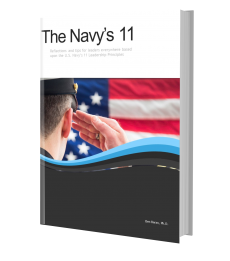
Ben is also the author of the e-book, The Navy’s 11: Reflections and tips for leaders everywhere based upon the U.S. Navy’s Leadership Principles. It’s full of ...
- Leadership guidance, based upon the U.S. Navy's Leadership Principles, which have been used to create and sustain the greatest navy known to humankind;
- Real-world examples, based upon my nearly 20 years of experience with the U.S. Navy and a decade of academic research combined with business consulting;
- Actionable tips, meant to help you implement the leadership principles in your daily life and work; and
- Much more!
Click here to get your FREE copy today.

The Death Star Aimed at Your Scrum Team
I worry about many companies that are starting to use scrum for project management or product development.
I worry not because scrum doesn’t work. It surely can, and when done right, it can be a highly invigorating and effective process for all involved.
I worry about companies that are starting to use scrum for two reasons:

I worry about many companies that are starting to use scrum for project management or product development.
Note: You may already know this, but scrum is a team-based methodology for solving complex problems. It’s based upon a highly transparent and visible workflow, and it relies heavily upon the candid use of evidence to experiment and iterate. A full discussion of scrum is beyond the scope of this post; click here for an overview.
I worry not because scrum doesn’t work. It surely can, and when done right, it can be a highly invigorating and effective process for all involved.
I worry about companies that are starting to use scrum for two reasons:
First, some companies try to introduce scrum without guidance from someone who has been there and done that. Regardless of the intelligence of the team members, it’s exceedingly difficult to “do scrum” void of firsthand experience. It’s simply too different from the status quo for the vast majority of people to really “get” from only reading about it. Great companies with great leaders—like a current manufacturing client working with me and my world-class partners Mike Richardson and Chris Everett—understand this and get the coaching and support necessary to make the transition to scrum. Everett puts it this way, “You can read a ton about boxing, but that’s not going to help you a whole lot in the ring.”
Second, and perhaps even more commonly, many companies introduce scrum without sufficient understanding among top management about how their own behavior must change to support scrum and overall organizational agility. This is the top of what Richardson calls the “T-shaped” approach to agility. The horizontal part of the “T” is all about executive processes and behaviors, with the verticals (there can and should be more than one) being core business processes. Those executive processes and behaviors at the top of the “T”—either intentional or unintentional—can become a “Death Star” aimed at the verdant, energized world created by the new scrum team.
One example of this is “dark work.” Dark work comprises all of those tasks or projects that are unplanned and simply added on top of all the other tasks or projects that the team and others have already vetted for strategic importance and workload feasibility. It’s the unplanned “Hey, could you take a look at this?” or “Excuse me, would you help with this project?” If a team is using scrum correctly, its members are carefully and continually reviewing and prioritizing their task list. They’re making estimates based upon workload capacity—which itself is an estimate based upon their conversations. But if dark work creeps in, it can cause a team member to falter in delivering to other team members, eventually leading to a breakdown in the overall process.
The key to success is two-fold:
Scrum requires agile behaviors across the top of the organizational chart, starting with a hard look at strategy and strategic initiatives. Prioritization here is critical, too. If everything is a priority, nothing is a priority. Top management needs to understand not only how their scrum teams are operating, but they also need to become more nimble themselves. This requires an honest appraisal of their current state along with an unvarnished, no-kidding set of agile operating principles to which they hold themselves and each other accountable.
With regard to the “Death Star” of dark work specifically, executives need to realize that interrupting the scrum process has consequences. If the dark work really is a necessity—it can certainly happen—executives shouldn’t be surprised if the scrum team then reprioritizes its work due to the workload change.
One of the most rewarding aspects of scrum, from my experience, is seeing the creative energy that it can bring to those involved. It’s a method of doing work, I think, that’s much closer to how humans work best than what happens in most organizations.
At the same time, top leaders must be mindful that allowing a scrum team to flourish requires much more than simply giving a team the permission to work in a different way.
It also requires agility within the top management team.
And that often starts with every executive realizing that change always starts with one person in particular—the man or woman in the mirror.
Find this thought provoking? Leave a comment, like and share!
About Ben Baran
Ben Baran, Ph.D., is probably one of the few people in the world who is equally comfortable in a university classroom, a corporate boardroom and in full body armor carrying a U.S. government-issued M4 assault rifle. Visit: www.benbaran.com.