
I’ve moved my blogging to Substack!
Feel free to check out any of the content I have here, but also be sure to check out my newest content at Reckoning and Elevating What Works.

Be Vigilant for Your Moment
Despite its sometimes harsh weather and a professional football team that continually disappoints its fans, Cleveland, Ohio, is home to one of the world’s best orchestras.
And that’s not just my amateurish opinion. Gramophone magazine, for example, compiled a list of the 20 best orchestras in the world, based upon ratings from top music critics—whom, I would readily assume, know more about classical music than I.
The Cleveland Orchestra, on this list, is number seven.
It’s rated higher than the Los Angeles Philharmonic, the Boston Symphony Orchestra, the New York Philharmonic and a number of other great orchestras in the United States and around the world.
So the Cleveland Orchestra is, quite naturally, a point of pride for northeast Ohio.
And during the holiday season, the Cleveland Orchestra turns its attention to performing a variety of holiday tunes in its annual Christmas Concert series.
As I have in the past, I found this year’s performance to be splendid. But during the performance, I noticed something that got me thinking.
It was
Despite its sometimes harsh weather and a professional football team that continually disappoints its fans, Cleveland, Ohio, is home to one of the world’s best orchestras.
And that’s not just my amateurish opinion. Gramophone magazine, for example, compiled a list of the 20 best orchestras in the world, based upon ratings from top music critics—whom, I would readily assume, know more about classical music than I.
The Cleveland Orchestra, on this list, is number seven.
It’s rated higher than the Los Angeles Philharmonic, the Boston Symphony Orchestra, the New York Philharmonic and a number of other great orchestras in the United States and around the world.
So the Cleveland Orchestra is, quite naturally, a point of pride for northeast Ohio.
And during the holiday season, the Cleveland Orchestra turns its attention to performing a variety of holiday tunes in its annual Christmas Concert series.
As I have in the past, I found this year’s performance to be splendid. But during the performance, I noticed something that got me thinking.
It was the harp. And more specifically, the harpist.
During an orchestral performance, as you know or can imagine, each musician and his or her instrument fills a specific role. Most prominent, typically, is that of the violins and other stringed instruments. Those musicians, it seems to me, are actually producing sounds from their instruments for much more total time than some of the less frequently heard-from sections.
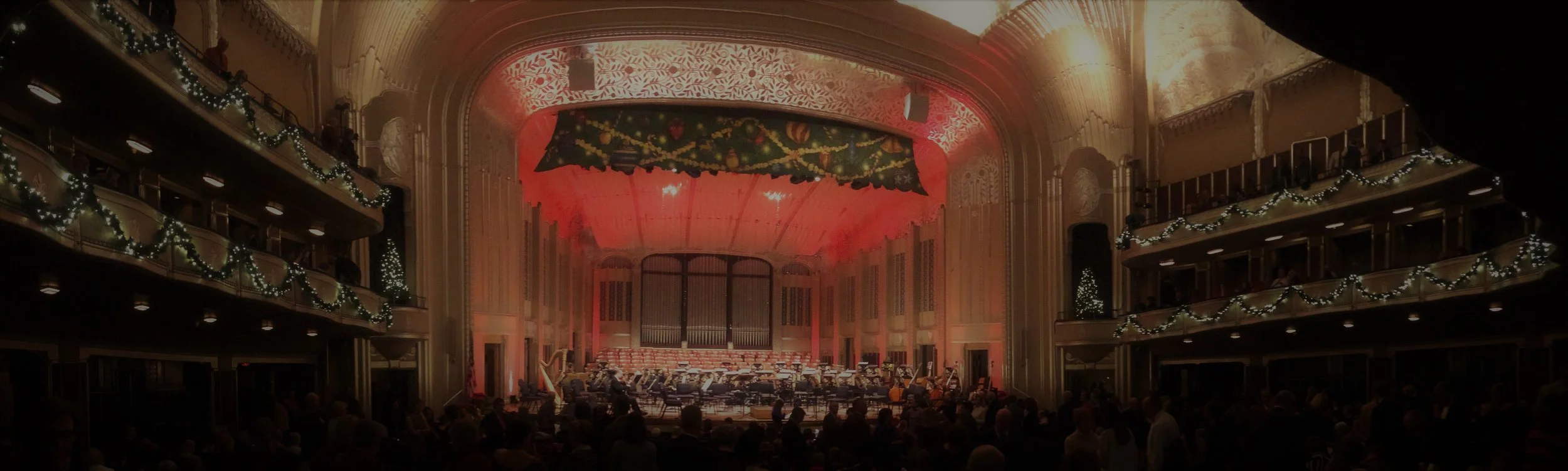
Which brings us back to the harp. From my seat in the front-left section of Severance Hall, I had a direct view of the side of the stage where the harp and organ were situated. I was able to watch the harpist closely.

In contrast to the violinists and violists and cellists, the harpist’s role is infrequent. It can be rather distinct and prominent in the music, but the harp’s role isn’t to provide the bulk of the musical structure that the orchestra as a whole creates.
So the harpist, as I noticed, must be extraordinarily vigilant. She was just as engaged in the music when she was not playing as when she was playing—she was reading every page of the music, positioning the harp and her hands in anticipation of her parts as they would arrive.
And when they did arrive—her moment to perform—she did so with perfect timing and results.
For me at least, there’s a lesson in the role of the harpist. Sometimes, it’s easy to think that our lives and careers are supposed to be like the violins—a continual production of excellence that everyone notices and appreciates. But that’s potentially misleading and inaccurate.
Because in reality, there’s probably a big part of our lives and careers and our lives that is more like that of the harpist. We have our roles—combined with our specific talents, skills, sets of knowledge—and every so often, we’re needed to perform. It’s our turn to pluck the strings, so to speak, and deliver what only we can in that moment.
The most important point, however, isn’t that our roles are probably more punctuated than we assume.
The most important point is that we must be ready.
We can’t disengage. We must know what’s going on around us; we need to be on the same sheet of music as those with whom we’re performing—our teams at work, our families, our friends. We need to know what our strengths are and how we can contribute.
There are times for performing, and there are times for watching.
And timing is everything.
So, be vigilant for your moment. We’re all counting on you. I, for one, can’t wait to hear your notes.
Find this thought provoking? Leave a comment, like and share!
About Ben Baran
Ben Baran, Ph.D., is probably one of the few people in the world who is equally comfortable in a university classroom, a corporate boardroom and in full body armor carrying a U.S. government-issued M4 assault rifle. Visit: www.benbaran.com.

Using the Premortem to Drive HR Agility
When the unexpected strikes, our brains often start working like we’re being chased by a wild animal. Levels of hormones—specifically, adrenaline, norepinephrine and cortisol—increase, resulting in a range of reactions including increased heartrate, elevated blood pressure and tunnel-vision like focus on the threat.
This is great if you actually are being chased by a lion. The threat is singular, and your immediate actions are likely singular as well (for example, run fast to shelter).
But it’s not so great if you’re facing a complex problem in your organization.
When the unexpected strikes, our brains often start working like we’re being chased by a wild animal. Levels of hormones—specifically, adrenaline, norepinephrine and cortisol—increase, resulting in a range of reactions including increased heartrate, elevated blood pressure and tunnel-vision like focus on the threat.
This is great if you actually are being chased by a lion. The threat is singular, and your immediate actions are likely singular as well (for example, run fast to shelter).
But it’s not so great if you’re facing a complex problem in your organization.
That’s because solving complex problems often requires the ability to consider many sources of information and to sort through the ambiguity of the situation with other people. It requires a calm mindset and critical thinking to deliver the best solution, not just the first one that comes to mind.
HR leaders can often find themselves in tough, stressful circumstances. These situations demand agility, the ability to sense and respond quickly.
Consider, for example:
- A key executive suddenly announces she is quitting.
- A recently sacked employee files a lawsuit for wrongful termination.
- The CEO decides to begin massive layoffs.
- A sudden surge in demand requires increases in labor.
- A system breach compromises sensitive employee data.
These aren’t unlikely scenarios, and many HR leaders deal with them frequently. But are these situations—and other unexpected events—always handled with the utmost agility? Certainly, there’s room for improvement.
One way in which HR leaders can become more agile is by taking deliberate steps to anticipate change, taking the time to focus on what could go wrong and how prepared they are to deal with those specific issues.
The premortem is a specific tool that can help.
Most of us are familiar with the postmortem, in which a group discusses what went well and what didn’t go well after an event. The premortem, though, takes the idea of thinking about what could have gone wrong—in advance.
The psychologist Gary Klein has written about the premortem within the context of projects, highlighting how premortems can help leaders improve project planning. (I also highly recommend his book Sources of Power.)
Within the HR world, a premortem might look something like this:
- An HR director gathers his team and discusses the plan to address a potential issue, such as the departure of a key executive. He then asks them to imagine that it’s six months (or some other relevant time reference) in the future and the plan has been implemented.
- The HR director then asks everyone to imagine that the plan didn’t work well at all. Each person then takes a few minutes to write down the reasons they think the plan failed.
- Each person shares his or her reasons until all of them are documented.
- Then, the HR director uses that information to strengthen the plan.
This is just one simple example. But the reason a premortem can help drive HR agility is that it can allow the team to think about problems and solutions before the unexpected strikes, before their nervous systems become awash in potentially judgment-clouding stress hormones. It can allow the team to set in place a variety of systems that can help them perform well in a specific situation they may face.
Daniel Levitin, a neuroscientist at McGill University, discussed this concept more broadly, suggesting that pre-planned responses can help you stay calm in stressful circumstances.
His TED talk on the topic is below.
HR agility can come in many shapes and sizes, but the premortem is one tool that HR leaders could begin using to create different patterns of thinking for themselves and their teams. It can be a helpful part of anticipating change, allowing them to be more responsive to disruption when it occurs.
Because for so many of the unexpected situations that can unfold, it’s not a matter of if they will occur.
It’s a matter of when.
About Ben Baran
Ben Baran, Ph.D., is probably one of the few people in the world who is equally comfortable in a university classroom, a corporate boardroom and in full body armor carrying a U.S. government-issued M4 assault rifle. Visit: www.benbaran.com.