
I’ve moved my blogging to Substack!
Feel free to check out any of the content I have here, but also be sure to check out my newest content at Reckoning and Elevating What Works.

One Resolution to Rule Them All
Change is hard. And even though you’re the one person over whose behavior you theoretically should have the most control, changing yourself is often exceedingly difficult.
Nonetheless, many of us doggedly pursue self-betterment. We set goals, hoping that we’ll achieve them along with whatever benefits they bring. We fantasize about the possibility of becoming someone closer to our idealized version of ourselves.
And during late December, many of us set resolutions for the next year.
Yet time and time again, most of us find our resolutions quickly broken. If you need evidence of this, simply go to any fitness center for a few days in early January and take note of how many people are there. Then, go back in early February. The crowds will almost always be gone.
There’s one resolution, though, that can rule them all. It’s one that I’ve found helpful when trying to change myself in a small way.
That resolution is simply this:

Change is hard. And even though you’re the one person over whose behavior you theoretically should have the most control, changing yourself is often exceedingly difficult.
Nonetheless, many of us doggedly pursue self-betterment. We set goals, hoping that we’ll achieve them along with whatever benefits they bring. We fantasize about the possibility of becoming someone closer to our idealized version of ourselves.
And during late December, many of us set resolutions for the next year.
Yet time and time again, most of us find our resolutions quickly broken. If you need evidence of this, simply go to any fitness center for a few days in early January and take note of how many people are there. Then, go back in early February. The crowds will almost always be gone.
There’s one resolution, though, that can rule them all. It’s one that I’ve found helpful when trying to change myself in a small way.
That resolution is simply this: Pick one new good habit and stick to it no matter what. Make yourself a slave to it.
Practice your new habit when you feel like it.
Practice your new habit when you don’t feel like it.
But whatever happens, stick to it.
Another way to think about this is to make a resolution to keep one resolution. Don’t try to change everything about your life or all of your habits—that’s exhausting and won’t work. Pick one manageable aspect of your life, something that you can do every day or every week.
And stick to it.
For example, one of my resolutions last year at this time was to write a blog post every week. Sometimes I felt like it—the ideas and the words came easily. Other times, it was tough. There were a few times when I woke up at 4 a.m. on a weekend to make sure I wrote my post.
Over time, though, it got easier. It became a good habit, one that I’m beginning to take for granted. It’s no longer a “change”—it’s simply something I do every week.
As you think about 2017, I encourage you to think about New Year’s Resolutions. But I encourage you even more to think about focusing your efforts on just a few resolutions, or even just one. Pick one habit, something that you can easily measure (e.g., “Did I do this—yes or no?”), and implement it.
Because when everything is a priority, nothing is a priority.
By the way, this applies to your professional life just as much as to your personal life. How do you think your employees or coworkers feel when you pile on a long list of new procedures or strategic initiatives?
Instead, focus. Pick one new good habit. And in 2017, make it part of your life—no matter what.
Find this thought provoking? Leave a comment, like and share!
About Ben Baran
Ben Baran, Ph.D., is probably one of the few people in the world who is equally comfortable in a university classroom, a corporate boardroom and in full body armor carrying a U.S. government-issued M4 assault rifle. Visit: www.benbaran.com.

Forget Goals. What’s Your Moonshot?
In early 1997, I started the process of applying to the U.S. Naval Academy. I was a junior in high school, yet I was somehow undaunted by the steps involved in this application—one of which is obtaining an official nomination, which typically comes from your U.S. Representative or either of your state’s two U.S. Senators. I applied to all three of these elected officials for my nomination.
That was the first time I paid serious attention to the name “John Glenn.”
He was U.S. Senator John Glenn at the time, but he was also, of course, the first American to orbit the Earth, a feat which he accomplished in 1962. He did it again in 1998, at the age of 77. He was also a U.S. Marine Corps combat pilot and
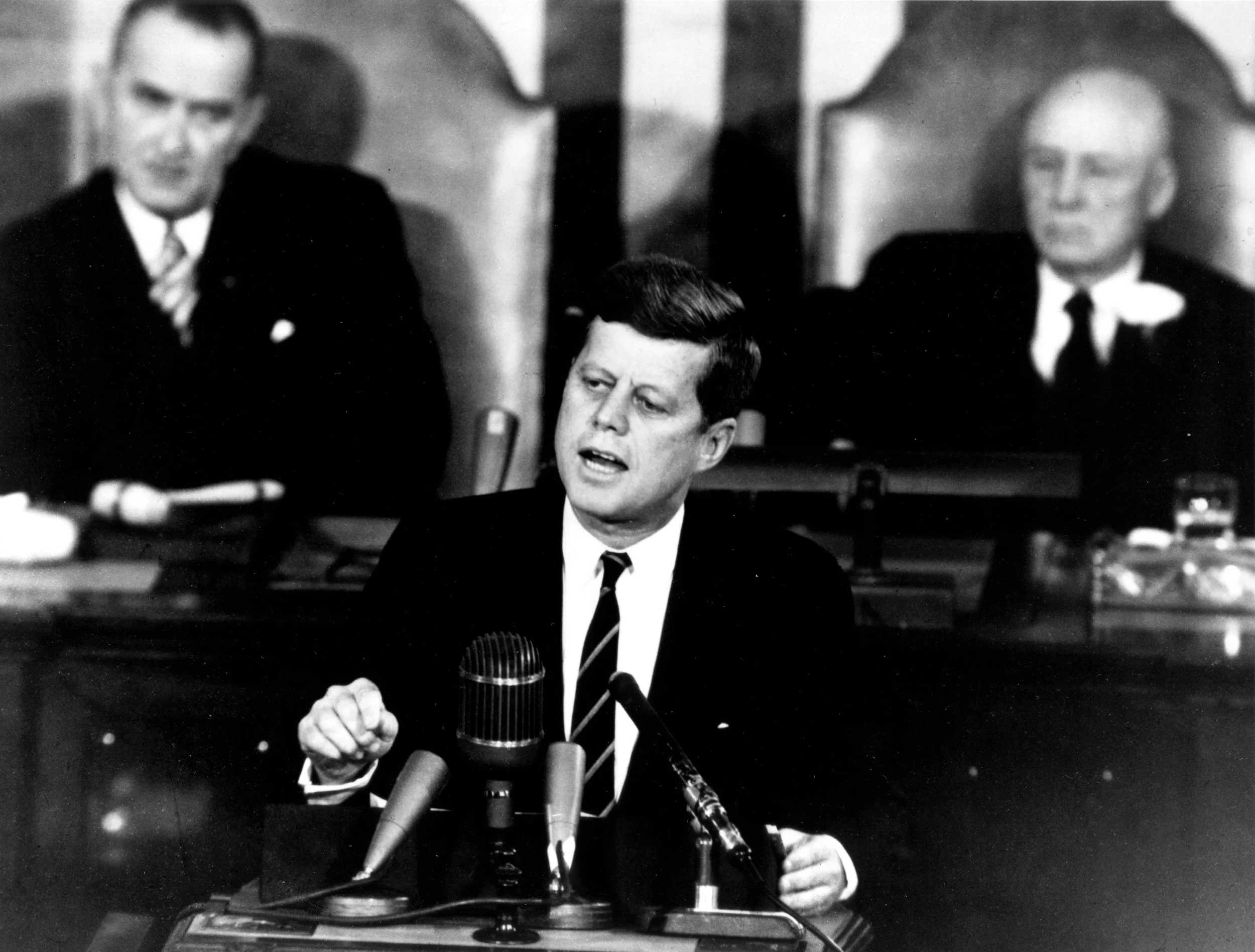
President Kennedy Addresses Congress May 25, 1961. Shown in the background are, (left) Vice President Lyndon Johnson, and (right) Speaker of the House Sam T. Rayburn. Image #: 70-H-1075.
In early 1997, I started the process of applying to the U.S. Naval Academy. I was a junior in high school, yet I was somehow undaunted by the steps involved in this application—one of which is obtaining an official nomination, which typically comes from your U.S. Representative or either of your state’s two U.S. Senators. I applied to all three of these elected officials for my nomination.
That was the first time I paid serious attention to the name “John Glenn.”
He was U.S. Senator John Glenn at the time, but he was also, of course, the first American to orbit the Earth, a feat which he accomplished in 1962. He did it again in 1998, at the age of 77. He was also a U.S. Marine Corps combat pilot and a whole lot more.
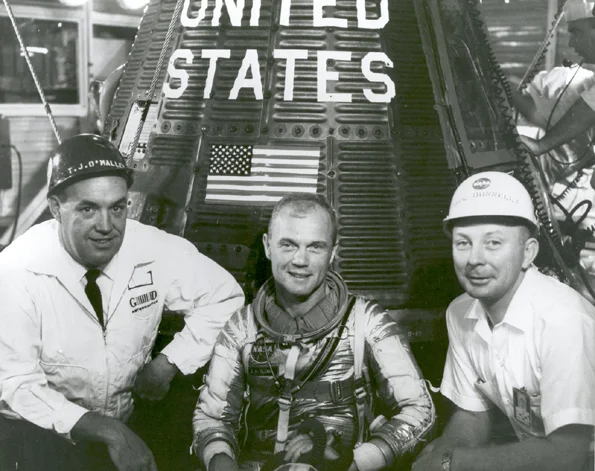
January 24, 1962: John Glenn With T.J. O'Malley and Paul Donnelly in Front of Friendship 7. Grouped together with astronaut John H. Glenn, Jr., beside "Friendship 7" spacecraft are left to right: T.J. O'Malley, chief test conductor for General Dynamics; Glenn; and Paul Donnelly.
Image # : 62-MA6-58.
Glenn died on Dec. 8, 2016, at the Ohio State University Wexner Medical Center in Columbus, less than 100 miles from the small town of Cambridge, Ohio, where he was born in 1921.
He was 95 years old.
I received both a nomination from Glenn and an appointment to the U.S. Naval Academy. I ended up choosing a different path, but I’m glad I had a reason back then to learn a little bit about him.
His life was, certainly, remarkable. It’s inspiring. And I think the Cleveland Plain Dealer’s editorial board said it well: “The most fitting tribute Americans can pay to this American hero … is to live up to the optimism of Glenn's vision.”
But I think there’s another aspect of Glenn’s optimism and the U.S. space program in general that holds a bigger lesson for all of us.
Let’s go back to May 25, 1961—about nine months before Glenn orbited the Earth for the first time. President John F. Kennedy, in a speech before a joint session of the U.S. Congress, said, “… I believe this nation should commit itself to achieving the goal, before this decade is out, of landing a man on the Moon and returning him safely to the Earth.”
That’s not just a big goal. That’s what we now call a “moonshot.”
It was a compelling vision that, with the appropriate resources dedicated to it, harnessed the ingenuity of thousands and the curiosity of millions.
And it’s that type of purpose that can galvanize people into an organization that’s fighting for something big. Something meaningful.
When I work with executives, we often talk about goals and objectives. That’s great; these are important. Keep setting goals.
But I’m afraid that there’s not much about quarterly reports or even big financial targets that really motivate the average employee.
For that, you need a moonshot. You need a vision that helps people see the connection between their everyday activities and something bigger than themselves.
If you ask people in your organization about their job, they’ll probably tell you what they actually do, something technical or something about their functional role.
That’s good, but it’s not great.
If you truly have an organizational moonshot, an audacious vision that you’re committed to achieve, you should be able to go around and ask your people what they do and have them respond with your equivalent of “I’m helping to put a man on the moon.”
So as we remember the legacy of John Glenn, let’s also remember the power of the moonshot—in our lives and in the lives of the people in our organizations.
Find this thought provoking? Leave a comment, like and share!
About Ben Baran
Ben Baran, Ph.D., is probably one of the few people in the world who is equally comfortable in a university classroom, a corporate boardroom and in full body armor carrying a U.S. government-issued M4 assault rifle. Visit: www.benbaran.com.

Are You “Rewarding A While Hoping For B?”
Incentives matter. Rewards motivate people to behave in certain ways. Using incentives, therefore, is one great way to influence the form, direction and intensity of how people act.
Goals also matter. They help us clarify where we’re headed and how to focus our efforts. Setting difficult, specific goals, therefore, is one of the best ways to motivate yourself and others (see the numerous studies on the topic, particularly those by Gary Latham and Edwin Locke).
But goals and incentives can—and sometimes do—run amuck.
And when that happens, it’s often in the form of

Incentives matter. Rewards motivate people to behave in certain ways. Using incentives, therefore, is one great way to influence the form, direction and intensity of how people act.
Goals also matter. They help us clarify where we’re headed and how to focus our efforts. Setting difficult, specific goals, therefore, is one of the best ways to motivate yourself and others (see the numerous studies on the topic, particularly those by Gary Latham and Edwin Locke).
But goals and incentives can—and sometimes do—run amuck.
And when that happens, it’s often in the form of “rewarding A while hoping for B,” a topic described thoroughly in the classic management article by Steven Kerr.
That is, we often forget that it’s not just about what you’re rewarding formally; it’s also about what you’re rewarding informally. And it’s in the unintended informal rewards that we can run into trouble.
Here’s a simple example: You assign a task to one of your direct reports. He quickly responds with a sub-par product with multiple errors. You’re frustrated, but you know that you can fix the errors about 10 times more quickly than he can. So you tell him that it’s not sufficient, but then you go ahead and fix the product yourself—leaving him with no more tasks to complete that day.
What have you done?
In addition to missing a training opportunity, you’ve informally rewarded your direct report for sub-par effort. By not having him go through the pain of fixing the problem, he now knows that he can get by with little effort. That leaves you at the office at 7 p.m., while he’s already home or at happy hour.
Did you mean to reward poor performance? Of course not. But in a way, you did.
Here’s another simple example: You set a team goal of 1,000 error-free shipments of one of your new products. If that occurs, everyone on the team will receive a $3,000 bonus. One of your people finds an error after one of the products ships, but it’s an error that the customer might not notice for quite a while. Have you rewarded that employee to speak up and report the problem, or have you rewarded silence?
Here’s a bigger example: Wells Fargo. As you likely know, between about 2011 and 2016, the company set goals for its lower-level bank employees to sell additional products to its customers—a practice known as cross-selling. There’s nothing inherently wrong with that. What company doesn’t want its customers to purchase and use more than one or two or three or more of its products or services?
But what happened at Wells Fargo is that the incentives and goals were such that people—more than 5,000—found numerous “creative” ways to cross-sell. These methods included widespread opening of accounts for customers who didn’t request them and even using fake customers to pad one’s sales numbers.
Here’s a Wall Street Journal recap of some of the highlights.
Clearly, this was an error of management and leadership at a grand scale. It’s hard to claim that such a problem might be due to a few “bad apple” employees given that at least 5,000 were involved.
Instead, it’s the barrel—the system. And in particular, it’s the incentive and goal-setting systems set in place by senior leaders—the “barrel makers.” They, along with the direct violators, are culpable.
Incentives and goals are important aspects to guiding people’s effort at work. When properly aligned with organizational objectives, they can powerfully harness people’s ingenuity for the good of the team.
But it’s equally important to remember that incentives and goals may have unintended consequences. So let’s be on guard for those ways—both big and small—in which we might be “rewarding A while hoping for B.”
Find this thought provoking? Leave a comment, like and share!
About Ben Baran
Ben Baran, Ph.D., is probably one of the few people in the world who is equally comfortable in a university classroom, a corporate boardroom and in full body armor carrying a U.S. government-issued M4 assault rifle. More at www.benbaran.com and www.agilityconsulting.com.

On Strength Training and Leadership
Goals are everywhere, but they rarely correspond with behavior. To illustrate, here’s a quick story.
I started taking strength training seriously in January 2013. I was serving in Afghanistan, and neither my military base nor the weather was conducive for my go-to physical exercise, running.
So I dove into educating myself and practicing getting strong by focusing on kettlebell training and the “big lifts” in the world of barbells: squat, bench press, and deadlift.
I made some progress, but I hit a plateau after a few months. This is common, but my plateau seemed unusually stubborn. I found this troubling, particularly given that my goal was to join the “1,000 Pound Club” by the time I was set to leave my base in late November. This means that the clock was ticking, reminding me of the dwindling of time left for me to squat, bench press, and deadlift a combined 1,000 lbs.
Then, I started reading

Goals are everywhere, but they rarely correspond with behavior. To illustrate, here’s a quick story.
I started taking strength training seriously in January 2013. I was serving in Afghanistan, and neither my military base nor the weather was conducive for my go-to physical exercise, running.
So I dove into educating myself and practicing getting strong by focusing on kettlebell training and the “big lifts” in the world of barbells: squat, bench press, and deadlift.
I made some progress, but I hit a plateau after a few months. This is common, but my plateau seemed unusually stubborn. I found this troubling, particularly given that my goal was to join the “1,000 Pound Club” by the time I was set to leave my base in late November. This means that the clock was ticking, reminding me of the dwindling of time left for me to squat, bench press, and deadlift a combined 1,000 lbs.
Then, I started reading more from the renowned strength and conditioning coach and writer Dan John (he’s full of great advice and philosophical musings, as is Pavel Tsatsouline).
At that moment in Afghanistan, one of Dan John’s most deceptively profound statements resonated with me like a quick slap to the face:
“The goal is to keep the goal the goal.”
Up until that point, I had been combining my strength training with some periodic treadmill running and other “cardio” exercise. But Dan John’s statement, “The goal is to keep the goal the goal,” illustrated how I was doing all kinds of things that weren’t conducive to my goal. In addition to my regular treadmill running, I wasn’t consuming enough protein each day, and I wasn’t getting enough sleep.
So I changed. I aligned my schedule, my training program and my diet to that goal. I forged new habits and stuck to them. And on Nov. 8, 2013, I squatted 315, bench pressed 275 and deadlifted 425—for a total of 1,015 lbs.
I’m not sharing any of that to brag. Not at all. Although I’m probably a little stronger than the average person and it was a nice personal milestone, it’s all relative. In the world of serious lifting, I’m really weak.
So what does this have to do with leadership?
I’m sharing that personal experience because I think it has a great deal to do with what I see people struggle with over and over and over again.
Leaders set goals and busy themselves with setting priorities. Organizations have numerous metrics to assess performance. That’s good, in and of itself.
It’s necessary to have goals and ways to measure them, but it’s not sufficient if they don’t influence behavior.
All too often, I encounter executives who are distracted. They have goals—indeed, often brilliant, strategic ones—but they fail to execute. It’s because they aren’t keeping the goal the goal. They fail to separate what they can do or even should do with what they must do. Their “priorities” are more often than not just lists of more stuff to do.
There’s a Russian or Chinese (or West Virginian, for that matter) proverb that states: “He who chases two rabbits, misses both.”
It seems to me that distractions and “being busy” are killing both effectiveness and efficiency for leaders and organizations everywhere. Looking critically at my own life, I can find many examples.
But in an increasingly turbulent world—one in which we have increasingly greater numbers of flashy things vying for our attention—it seems like we could all perform at a higher level if we paused, identified what really matters and held ourselves accountable for behaving in ways that align with our top priority.
Namely, I think that whether you’re trying to pick up something heavy or lead a team or guide an organization in a new strategic direction, it’s helpful to remember that goals are meaningless unless you truly commit to both the goal and what it’s going to take to achieve it—and what you’re going to prune from your list of activities (what’s your “to don’t” list?).
So here’s to picking up something heavy, developing a new product, launching a new business or inspiring a team to go beyond what they thought possible—all while keeping the goal the goal.
Find this thought provoking? Leave a comment, like and share!
About Ben Baran
Ben Baran, Ph.D., is probably one of the few people in the world who is equally comfortable in a university classroom, a corporate boardroom and in full body armor carrying a U.S. government-issued M4 assault rifle. Visit: www.benbaran.com.