
I’ve moved my blogging to Substack!
Feel free to check out any of the content I have here, but also be sure to check out my newest content at Reckoning and Elevating What Works.

What Ohio Manufacturers are Doing to Address Talent Needs
On Nov. 1, 2018, about 450 people from manufacturing, education, the public sector, and other organizations at the intersection of workforce matters and the manufacturing industry met in Columbus, Ohio, at the Ohio Manufacturers’ Workforce Summit 2018.

On Nov. 1, 2018, about 450 people from manufacturing, education, the public sector, and other organizations at the intersection of workforce matters and the manufacturing industry met in Columbus, Ohio, at the Ohio Manufacturers’ Workforce Summit 2018.
The daylong event, organized by The Ohio Manufacturers’ Association (OMA), featured speakers and panelists who discussed best practices, lessons learned, and other tools or initiatives being used by manufacturing companies and their partners to develop and attract the talent they need.

This was my first time at such an event. I chose to attend this year due to my roles as both a business professor at Cleveland State University and as a co-founder and principal of Indigo Anchor, a management consulting firm with a number of manufacturers as clients. Many of my clients have shared with me their struggles with finding the talent they need for their companies. And as a professor in manufacturing-centric Northeast Ohio, I hear similar concerns from both executives and mid-career professionals in my graduate business classes.
Below is a summary of what I heard and learned during the Summit, along with my grateful recognition of those who contributed to the event as speakers or panelists.
Eric Burkland, president of The OMA, began the day with opening remarks focused on the OMA Workforce Roadmap. This framework has four components: (1) sector leadership and leadership capacity building, (2) advocacy at both the state and federal levels with regard to manufacturing issues, (3) marketing with regard to manufacturing as a career, and (4) education innovation to strengthen the manufacturing talent pipeline.
Burkland highlighted MakingOhio.com, an OMA initiative designed to provide information about manufacturing jobs and career pathways. Such efforts, Burkland noted, are central to Ohio’s economic strength overall given that manufacturing is the largest industry sector in the state, employing one in every 10 Ohioans.
Key take-away point 1: Strong manufacturing equals a strong Ohio. Addressing talent needs in manufacturing benefits from a collaborative approach; an example of that is the initiative led by The OMA.
Next, Scot McLemore, manager of talent acquisition and deployment at Honda North America Inc., moderated a session titled, “Industry-Driven Sector Partnerships: A Proven Workforce Model.” The session featured four panelists: Shawn Hendrix, president at Nissen Chemitec America Inc.; Amy Meyer, vice president of corporate development at Rhinestahl AMG; and Kip Winzeler, chief operating officer at Altenloh Brink & Co. US Inc./Trufast.
A key theme that emerged during this session is the need for manufacturers to work together to develop their workforce, particularly with regard to the future talent and the pipeline that supports it.
“We are all struggling with this labor shortage,” said Hendrix. “It’s motivating to meet with educators … we just need to clearly communicate what our needs are.”
“The people are there … the issue is the pipeline,” said Brigham.
Winzeler highlighted how sector partnerships must be both geography and community-driven. Furthermore, such efforts “must be a long-term game.” In terms of timeline, Hendrix suggested that manufacturers and their talent-pipeline partners should realize that they might not reap the full benefits of their efforts until eight to 10 years after beginning any partnerships.
Both Meyer and Brigham discussed how building a talent pipeline in manufacturing must be a holistic effort. For example, noted Meyer, manufacturing jobs are “much more than labor,” and include functions such as accounting, human resources, and more.
“We’ve got to start recruiting to a career opportunity, not just jobs,” said Brigham. He and other panelists noted how recruiting for manufacturing jobs involves educating not only potential job candidates about the manufacturing industry, but also including their parents in the conversation. Such educational efforts can help to correct common misunderstandings about manufacturing. For example, modern manufacturing is often very clean and technical—not dirty and monotonous.
Key take-away point 2: Ensuring sufficient talent for manufacturing requires a long-term focus in partnerships with educators, an educational campaign about modern manufacturing for both job candidates and their families, and a collaborative approach among manufacturers—even if they are otherwise competitors.
The next session, ”Innovative New Tools for Partnerships,” began with a presentation by Lisa Morales Cook, senior vice president for brand planning at Fahlgren Mortine. Her discussion focused upon the results of a study that sought to explore how to build the workforce pipeline for the next generation of manufacturers.
Key findings from the study included:
Perceptions of manufacturing are generally favorable, but they lack clarity. Some people perceive manufacturing as a “dirty, dark, and dangerous place to work,” which presents a barrier to recruiting efforts.
Messages about pay, benefits, and job stability are well-received by potential job applicants. The relatively high pay for manufacturing—which in Ohio in 2015 averaged $81,000 per year compared with $63,000 per year for other jobs—generally surprised study participants.
Job seekers today research opportunities considerably, suggesting that employers need to provide detailed information about jobs and the organization overall. They will want to know about the career paths, job types, time it might take to earn certain salaries, and more.
The manufacturing workplace is somewhat mysterious for today’s job seekers. The modern manufacturing environment is more often one in which 1,000 people are doing 1,000 different jobs—not one in which there are 1,000 people doing the same job. As such, the variety of job types and skills in manufacturing needs more exposure.
Finally, manufacturers would benefit from clarifying leadership and growth opportunities in their organizations.
Many of these findings connect with the notion of an employer brand and the idea that orienting new employees starts in the pre-hire phase.
Key take-away point 3: Manufacturers must actively work to change perceptions about what work “looks like” in their organizations if they are to recruit talent effectively.
Gerry Hanley, assistant vice chancellor for academic technology services at California State University, Office of the Chancellor, then shared how The OMA has partnered with Skills Commons to provide free training resources for their employees and workforce partners.
Such resources include courses on becoming an effective instructor, which can help current experts teach transfer their knowledge and skills to others. Others include training materials for specific occupations, soft-skills training, and recruitment resources.
Key take-away point 4: Before paying for manufacturing-specific training, research and evaluate how free online courses may meet your needs.
Following lunch, JobsOhio team members Cheryl Hay, director of project talent acquisition, and Lenee’ Pezzano manager of strategic talent delivery, presented in a session titled, “Connecting Economic Development Strategies with Industry Sector Partnerships.”
One key for successful development of a talent pipeline in manufacturing, Hay noted, was to find, prescreen, and train talent—and to consider these issues before the need for talent is urgent. Echoing ideas from earlier in the day, she also discussed how marketing is important to help drive excitement about manufacturing as a career.
Pezzano added by outlining several elements that could be considered best practices when approaching sector partnerships. These include using data (such as research available from the Bureau of Labor Statistics and other studies) to inform approaches, having an industry intermediary to help guide the process, developing concepts first before trying to get funding, and ensuring that all program content is industry-informed and experiential.
Key take-away point 5: Manufacturers must think ahead regarding the talent they will need in the future—not just the talent they need right now. For example, many companies would love to have highly experienced computer numeric controlled (CNC) machinists available to hire right now. That’s understandable and important, but manufacturers should also be thinking about how they can support the development of, for example, more CNC machinists in the future—and how they might acquire a wide variety of skilled labor that they might need in a year to several years from now. Such efforts should stem from the organization’s strategy, and developing partnerships is an important component in building such a talent pipeline.
The final session I attended—unfortunately, I had to leave prior to the final segment in order to make it back to Cleveland State University to teach in the evening—was a breakout session on “Manufacturers’ Role in Training Program Improvement.”
This session featured Mara Lynne Banfield, director of curriculum and instruction at Mahoning County Career and Technical Center; Matt Joing, plant manager at Butech Bliss and vice president of Mahoning Valley Manufacturers Coalition; and Rebecca Kusner, founder of R4 Workforce.
In the session, the presenters shared various factors related to how manufacturers can contribute to the quality of training programs in an effort to better equip their current or future talent. Examples of such factors included integrating the skills needed in the professional manufacturing environment into the academic setting, developing a deep understanding of the skills needed for employees to be successful, and combining training efforts with a nuanced understanding of what different businesses need.
Key take-away point 6: Manufacturers should work with any training partners to conduct a careful diagnosis of their needs, which should include an understanding of the knowledge, skills, abilities, and other characteristics needed in the job.
To summarize, The OMA Workforce Summit 2018 provided a wealth of insight regarding many elements of the talent pipeline for manufacturers in Ohio. Many of these would likely apply beyond Ohio, and I hope that some of these ideas may spark additional thought and insight among those in manufacturing who are also looking for ways to deal with their labor shortages. Second, thank you to those who contributed to the event as speakers or panelists.
If you attended this event and would like to add to the conversation—or if you simply have additional insights to share—please leave a comment below.
Join the Movement
Our vision is to create—through The Indigo Anchor Manufacturing Excellence Study™—a comprehensive network of manufacturing business leaders and researchers united by our common interest. By participating, you’ll have access to the latest manufacturing insights, giving you a competitive edge. Less guesswork, more knowledge. And that gives you both speed and confidence. Get involved today by taking a quick (about 15 minutes) online survey. In that survey, we ask about your perspective regarding a variety of market trends and your organization. CLICK HERE to take the survey.
About Indigo Anchor
Indigo Anchor is a management consulting firm that improves engineering teams within manufacturing environments, resulting in faster engineering, an improved company overall, and less frustration. With a focus on people, processes, and tools, Indigo Anchor helps turn engineering teams into a competitive advantage. The firm has more than 40 years of combined business and military leadership experience, which it applies to the top priorities of its clients. For more information, visit: www.indigoanchor.com
About Ben Baran
Ben Baran, Ph.D., is probably one of the few people in the world who is equally comfortable in a university classroom, a military uniform, or in a corporate boardroom advising top management teams. A co-founder and principal at the consulting firm Indigo Anchor, he's also an award-winning business professor and published scholar at Cleveland State University and a commander in the U.S. Navy Reserve. He regularly consults leaders and organizations across a wide range of sectors and industries. Visit: www.indigoanchor.com and www.benbaran.com.

Agile HR: Trends and Opportunities
The future of human resources (HR) lies at the intersection of strategy, data analytics, design thinking, and a new set of practices and mindsets ushered in by the world of agile methods and organizational agility writ large.
And the time is ripe for HR professionals to have the bandwidth necessary to devote themselves to such matters. Numerous HR services—particularly those that are

The future of human resources (HR) lies at the intersection of strategy, data analytics, design thinking, and a new set of practices and mindsets ushered in by the world of agile methods and organizational agility writ large.
And the time is ripe for HR professionals to have the bandwidth necessary to devote themselves to such matters. Numerous HR services—particularly those that are more compliance and administrative in nature—have been prime candidates for outsourcing for years. Automation, furthermore, has the potential to eliminate or reduce further many repetitive HR tasks.
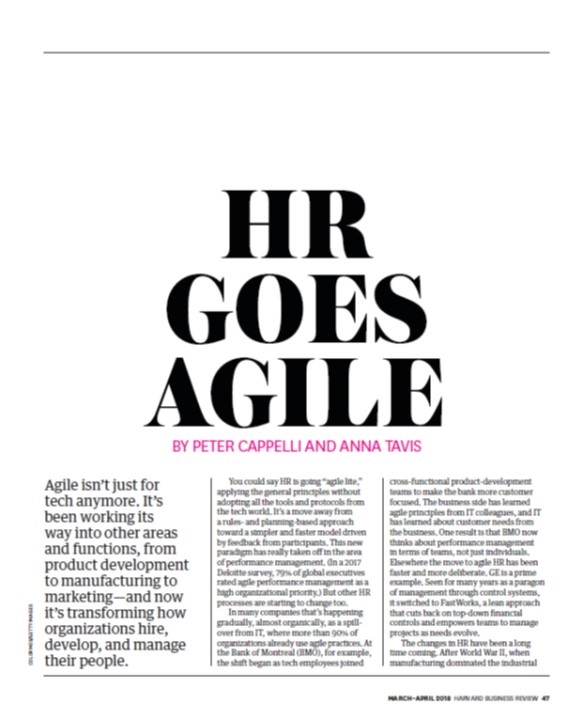
In the March-April 2018 issue of Harvard Business Review, Peter Cappelli and Anna Tavis outline a number of ways in which HR is adopting agile principles. In their article, “HR Goes Agile,” Cappelli and Tavis highlight how HR practices are beginning to trend away from the old approaches governed by rules and plans. Taking cues from agile, they contend, HR is increasingly moving toward a feedback-driven approach characterized by simplicity and speed.
Here are some highlights from their article.
First, a number of big trends are fundamentally influencing HR. These include increasingly rare lifelong employment and an environment marked by rapid change, which drives rapidly changing skill requirements.
Second, the strategic imperative now is rapid innovation, and this applies to HR. In a fast-paced world, top-down planning doesn’t work very well. Instead, nimble, user-driven methods such as rapid prototyping, team-based decisions, and “sprints” centered on specific tasks.
Third, such changes in the larger business environment are driving changes in specific practices, many of which are either HR-driven or used by HR. These include:
Performance appraisals, in which the clear trend is toward having higher-frequency, sometimes project-based feedback versus the typical annual review. The emphasis here is on quick feedback to enable “course corrections.” Elements of agile methods and design thinking can also inform the organization’s approach toward performance appraisal design, with a specific emphasis on involving employees in the prototyping, testing, and iterative improvement process.
Coaching, in which organizations are realizing that they must invest time in developing manager’s skills. In a world driven by high-quality feedback to drive fast improvement, managers need to build a robust set of communication and coaching skills.
Teams, in which work may be best organized by projects instead of by functions or other aspects of formal hierarchy. Here, methodologies such as Scrum are proving useful, as well as norms and rituals that support multi-directional feedback, lower-level decision-making, and supervisors who facilitate healthy teams—not just individual performance.
Compensation, in which incentives may be used to reinforce values such as learning and sharing knowledge. Another potential implication is the use of quick bonuses instead of annual merit-based raises.
Recruiting, in which the use of cross-functional teams with hiring managers who rotate on and off depending on whether they’re hiring can drive the acquisition effort for specific sets of jobs. Prioritization is also key, because not all vacancies are created equal: Some should be filled before others.
Learning and development, in which efforts become tailored to the job and the person in real-time. IBM appears to be at the forefront of these efforts, using “cognitive” (artificial intelligence) approaches to drive training. Additional value may be created by training the organization on specialized topics within the world of agile principles and methods.
My take on this is that these are excellent points—and all in HR should heed them.
But there’s much more, some of which I’ve written about previously. What remains somewhat unexplored is how HR can specifically help the organization overall become more nimble, more agile. Becoming agile itself may be a start, but HR should also continue to work to better define how its practices and strategies can drive innovation and responsiveness to change overall. Related topics and bodies of knowledge including strategy, data analytics, and design thinking play critical roles as well.
What’s clear is that these are exciting times. And perhaps within this context, HR has an opportunity to—in the words of management scholar Gary Hamel— create organizations that are both “fit for the future” and “fit for human beings.”
About Ben Baran
Ben Baran, Ph.D., is probably one of the few people in the world who is equally comfortable in a university classroom, a corporate boardroom and in full body armor carrying a U.S. government-issued M4 assault rifle. He regularly consults leaders and organizations across a wide range of sectors and industries. Visit: www.benbaran.com.

Human Resource Management and The Great Unlearning
Exciting changes in the world of human resources (HR) abound. As noted by Stephen Barley (University of California Santa Barbara), Beth Bechky, and Frances Milliken (both of New York University) in their recent article in Academy of Management Discoveries,
“Few people would deny that the nature of work and employment has changed over the last four decades, not only in the United States but in many countries worldwide. Moreover, the nature of work is likely to continue to change as we move further into the 21st century.”
Such changes make HR work continually dynamic, with evolving practices with regard to new technologies, the increasing prevalence of contingent workers, and more. Barley and his coauthors also mention the rise of artificial intelligence and the rise of project-based work as fundamental shifts that will influence careers and even how people think about themselves in relation to their organizations and society.
These changes alone are enough to keep HR leaders and other executives up at night.
Yet I wonder

Exciting changes in the world of human resources (HR) abound. As noted by Stephen Barley (University of California Santa Barbara), Beth Bechky, and Frances Milliken (both of New York University) in their recent article in Academy of Management Discoveries,
“Few people would deny that the nature of work and employment has changed over the last four decades, not only in the United States but in many countries worldwide. Moreover, the nature of work is likely to continue to change as we move further into the 21st century.”
Such changes make HR work continually dynamic, with evolving practices with regard to new technologies, the increasing prevalence of contingent workers, and more. Barley and his coauthors also mention the rise of artificial intelligence and the rise of project-based work as fundamental shifts that will influence careers and even how people think about themselves in relation to their organizations and society.
These changes alone are enough to keep HR leaders and other executives up at night.
Yet I wonder if there are additional, perhaps even more fundamental shifts underway that will forever alter how people behave and interact at work.
Those changes have to do with a recognition of the ingenious beauty of human organizing, the remarkable capacity that we all have to iterate toward something better, and the foolishness—and downright arrogance—that can accompany our best managerial attempts to control.
Teams and organizations are increasingly finding benefits in valuing:
- Individuals and interactions over processes and tools
- Working [solutions] over comprehensive documentation
- Customer collaboration over contract negotiation
- Responding to change over following a plan
If those values look familiar, you’ve likely seen them in the Agile Manifesto, which includes these values and a set of principles for software development.
But here’s the thing—these values and principles have been around for decades prior to their articulation in the Agile Manifesto. That’s because they’re based in how people actually work, not in how various management systems of the 20th Century forced them to obey.
As noted in The Wharton School’s Aug. 1 article, Has Agile Management’s Moment Arrived?,
“The agile approach is one that uses teams to work through a process designed to respond to unpredictability; that allows for and encourages changes in direction; that gives teams great authority and transparency; and that builds in customer or user response to the end product or service while it is still being developed.”
Because agile management thrives in a state of uncertainty, it is highly likely to continue to spread into other sectors and functions, far beyond that of software development.
Case in point: General Electric, which has been implementing similar principles for the past few years with regard to its manufacturing—within a program called “FastWorks.”
And given that agile methods, including those advocated by Scrum, are continuing to increase in popularity, I see a tremendous opportunity—and threat—ahead for the world of HR.
Namely, in successful organizations, HR will be a central component of what I’m starting to think of as “The Great Unlearning.”
The Great Unlearning is what’s required of organizations that are fundamentally committed to a different way of working, a way that’s characterized by how humans actually interact best.
Going back to Barley and his coauthors’ recent work, in addition to discussing fundamental shifts in the world of work, they also astutely highlight how most of management knowledge and practice comes from research and assumptions developed decades ago. They write:
“… it is surprising how little organization and management studies have had to say about the phenomenon. Our field’s lack of attention to the ways in which work is changing is problematic because organization studies and organizational behavior grew out of industrial sociology and industrial and organizational psychology in the 1960s and 1970s.”
For HR leaders, The Great Unlearning means that they will have to undo much of what we have taken for granted as management dogma. For example, if an organization does much of its work based upon project-based teamwork, what might that mean in terms of:
- The employer relationship—will there be much of a need for permanent employees in the future?
- Compensation—what is the value of hourly wages if results are truly project-based?
- Recruiting and selection—how do you find people who can perform in an interdependent, team-based environment?
- Development—how do you help the millions of workers who are deeply accustomed to traditional ways of working adapt to new structures and ways of working? How do you help an organization nurture a culture in which new values matter more than those of the past?
- And much more.
The Great Unlearning for HR also includes HR as a profession taking a hard look at itself in the mirror. Although people have been preaching—rightly, in my opinion—about how HR needs to transform for the past two decades (Dave Ulrich’s 1998 Harvard Business Review article comes to mind), has it really happened?
In most organizations that I know, HR is still the compliance department, the place where you go to find out about your benefits, the people who give you stuff to sign. In today's business environment, HR must unlearn its own ways of working. HR must also help organizations unlearn the behaviors that have been taken-for-granted by employees since the Industrial Revolution.
In short, it seems that The Great Unlearning for HR includes both a threat and an opportunity for HR leaders.
It’s threatening for HR leaders who prefer to maintain the status quo.
It’s an opportunity for HR leaders who are willing to take the risks necessary to make their organizations primed for the future.
About Ben Baran
Ben Baran, Ph.D., is probably one of the few people in the world who is equally comfortable in a university classroom, a corporate boardroom and in full body armor carrying a U.S. government-issued M4 assault rifle. Visit: www.benbaran.com.
Ben is also the author of the e-book, The Navy’s 11: Reflections and tips for leaders everywhere based upon the U.S. Navy’s Leadership Principles. It’s full of ...
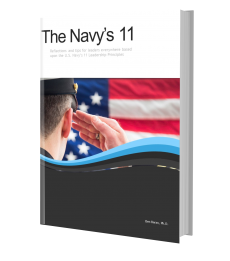
- Leadership guidance, based upon the U.S. Navy's Leadership Principles, which have been used to create and sustain the greatest navy known to humankind;
- Real-world examples, based upon my nearly 20 years of experience with the U.S. Navy and a decade of academic research combined with business consulting;
- Actionable tips, meant to help you implement the leadership principles in your daily life and work; and
- Much more!
Click here to get your FREE copy today.
What Everyone in HR Needs to Know About Change: Part 2
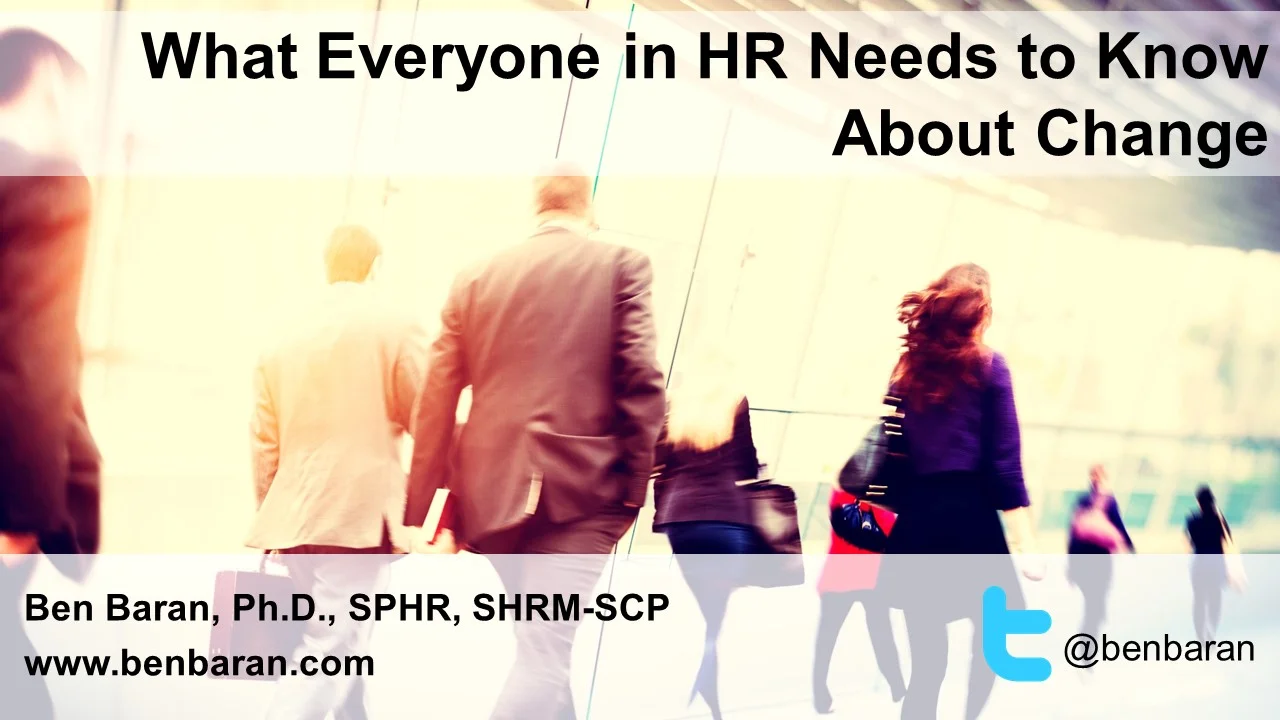
Recently, I had the wonderful opportunity to engage with hundreds of people from around the world as part of a webcast titled, "What Everyone in HR Needs to Know About Change." The Human Capital Institute (HCI) hosted the webcast, and afterward, HCI gave me the recorded version so that I could share it with people who weren't able to join the live presentation.
Here it is--enjoy.
Recently, I had the wonderful opportunity to engage with hundreds of people from around the world as part of a webcast titled, "What Everyone in HR Needs to Know About Change." The Human Capital Institute (HCI) hosted the webcast, and afterward, HCI gave me the recorded version so that I could share it with people who weren't able to join the live presentation.
Here it is--enjoy.
Also, here is a PDF of the slides from the same presentation.
Find this thought provoking? Leave a comment, like and share!
About Ben Baran
Ben Baran, Ph.D., is probably one of the few people in the world who is equally comfortable in a university classroom, a corporate boardroom and in full body armor carrying a U.S. government-issued M4 assault rifle. Visit: www.benbaran.com.

What Everyone in HR Needs to Know About Change
Models for planning and executing organizational change abound—for example, Kotter’s eight steps, among many others. These models are helpful in highlighting many of the critical aspects of organizational change, and I highly recommend immersing yourself in them.
That being said, I find that such models often deal more with planned organizational change than with unplanned or continuous organizational change.
And in an increasingly turbulent world, it’s important for human resources (HR) professionals and the HR function overall to

Models for planning and executing organizational change abound—for example, Kotter’s eight steps, among many others. These models are helpful in highlighting many of the critical aspects of organizational change, and I highly recommend immersing yourself in them.
That being said, I find that such models often deal more with planned organizational change than with unplanned or continuous organizational change.
And in an increasingly turbulent world, it’s important for human resources (HR) professionals and the HR function overall to take a more fluid, proactive and strategic approach toward change. The realities of the business environment continue to drive changes within organizations, and it’s time for HR to get up to speed.
From what I’ve observed and experienced in HR during the past decade, the HR profession has an opportunity to contribute meaningfully to how organizations adapt. But we in HR may need to consider organizational change from a slightly different angle. We must start with connecting with the organization’s strategy, and we can then use that direction to guide what we do. Furthermore, we’d be well served to think about what we do a little bit differently, adopting some of what’s working well elsewhere, to get things done quickly.
Specifically, those of us in HR would benefit from the following regarding our approach to organizational change:
1. Know your terrain.
It’s critical for HR professionals to understand their environment, or their terrain, both within and outside of their organization. While it’s important to know what people in HR care about, it’s even more important for HR people to know what their top leaders outside of HR care about—what are the main concerns of the c-suite? We in HR also must start thinking much more than we do currently about the environment outside of the organization—where does your organization compete? How does it win? What are the big trends in your industry, and how can HR address them? These questions and others like them allow HR professionals to better understand what’s ahead and anticipate change.
2. Think like a startup.
The ambiguity of working in a startup is extreme. Everyone has advice; most of it seems plausible, yet some of it is contradictory. Yet you must forge ahead and create that which has never existed. Given the nature of startups, it’s worth thinking about how they deal with ambiguity and change to see what lessons we may glean for HR. I advocate for a more strategic, proactive, entrepreneurial and agile HR function that will quickly add value to the business. In addition, startups can deal with change in a more iterative fashion, taking some of the lessons we know from design thinking to develop fast prototypes, test them and continually improve—instead of letting the perfect become the enemy of the good.
3. Embrace agility.
As organizations attempt to cope with a turbulent business environment, they may need to move from continually seeking equilibrium to being nimble. Agility, generally speaking, is the capability to sense and respond quickly to the forces of change at all levels within the organization. HR would be well served to assess its own agility, along with the agile capabilities of the organization overall. But agility isn’t about reckless flexibility. Rather, we all need some “North Star” to cling onto as our organizations adapt and evolve. As such, HR can help provide stability through working with top management to clarify and communicate continually its core values. Additionally, “agile HR” involves moving from some of our tried and true dogma (e.g., job descriptions) to practices that reflect how people actually work (e.g., project and team charters).
I see the next 10 years as ones in which HR will likely go through a number of dramatic shifts—because if it doesn’t, it may become a victim of accelerated obsolescence. And when it comes to remaining relevant through a different understanding of change, having an increased focus on (a) knowing the terrain, (b) thinking like a startup and (c) embracing agility will serve the HR function and those who work within it well.

I’ll be discussing these topics in much more detail next Tuesday, April 18, from 3 to 4 p.m. EDT in a webcast with the Human Capital Institute. Click here for more details.
I’d love to have you join the conversation.
UPDATE: The webcast was great--hundreds of people joined me for a wonderful conversation. Click here to access the full recording and the slides I used.
Find this thought provoking? Leave a comment, like and share!
About Ben Baran
Ben Baran, Ph.D., is probably one of the few people in the world who is equally comfortable in a university classroom, a corporate boardroom and in full body armor carrying a U.S. government-issued M4 assault rifle. Visit: www.benbaran.com.

Two Ways HR Can Rise Up
I spend a fair amount of time around the human resources (HR) profession. Sometimes, that’s in the form of consulting and problem-solving alongside HR leaders; other times it’s through research or teaching graduate students. I’m also an HR officer in the U.S. Navy Reserve, and I maintain my HR certifications like thousands of other HR people.
But I’m often critical of HR. That’s not at all because I think HR people aren’t doing good work; rather, I think every profession should be critical of itself in an attempt to improve continually and stay relevant. We should all be on the lookout for how we can get better at what we do and how we do it.
In particular for HR, I see two areas in which HR could improve substantially.

I spend a fair amount of time around the human resources (HR) profession. Sometimes, that’s in the form of consulting and problem-solving alongside HR leaders; other times it’s through research or teaching graduate students. I’m also an HR officer in the U.S. Navy Reserve, and I maintain my HR certifications like thousands of other HR people.
But I’m often critical of HR. That’s not at all because I think HR people aren’t doing good work; rather, I think every profession should be critical of itself in an attempt to improve continually and stay relevant. We should all be on the lookout for how we can get better at what we do and how we do it.
In particular for HR, I see two areas in which HR could improve substantially. This isn’t to say that HR people aren’t thinking about these things or that many HR departments are already well on their way. But it is to say that considerable room for improvement exists profession-wide.
These two areas—or two ways in which HR can rise up—are:
- Its connection to business strategy and
- Its use of analytics.
First, HR must improve in terms of its connection to business strategy. I hear about employee engagement committees focused primarily on planning company picnics. I hear about HR departments being the last to know about major organizational changes. I hear executives complain that HR in their own company is a gate-keeper, not a service provider.
Being more strategic as an HR person or as an HR function implies special mindset. As Dave Ulrich writes, HR needs to understand the context of their business. They need to understand how their organization competes and wins in the marketplace. Such an understanding is critical because it informs, as Ulrich discusses, a stakeholder view of HR in which the HR function has five main groups that it serves:
- Employees,
- Line managers,
- Customers,
- Investors and the
- Community at large.
With such a mindset, HR people can transform their conversation from one of the tactical and administrative to one of strategy and business results. If you feel that your HR function doesn’t get the respect it deserves in your organization, having a strategic mindset and aligning what you do as a function with the business strategy is a great place to start.
HR professionals, in particular those who lead any HR function, should know and be able to articulate how their priorities and activities align with helping the organization win.
Second, HR must embrace analytics. The world is awash with data, and it’s increasingly becoming apparent that HR must focus on analyzing the right data in the right way to inform decision making. It’s no surprise that the Society for Industrial and Organizational Psychology named “Leveraging and Maximizing Big Data and Applying the Correct Analytics to Make Better Business Decisions” as its top workplace trend for 2016.
From my interactions, HR can improve greatly in this area, but it’s going to require many people in HR to become comfortable with data. It’s going to require them to, in many cases, obtain new skills related to the use of data and analytics.
If you’re wondering what on earth HR analytics is all about, here are a few references that might be helpful in getting you started:
- Josh Bersin’s article in Forbes
- “Change your company with better HR analytics,” an article on the Harvard Business Review blog
- An overview from the Association for Talent Development
HR people and the HR function have, in my opinion, so much to offer their organizations. They’re becoming increasingly essential for organizations as they navigate the modern world of work, but to realize that potential, they’ve got to be strategic in focus and evidence-based in their decision-making.
And so, I encourage everyone in the world of HR to adopt a strategic posture and embrace the world of talent or HR analytics. There are many ways, of course, that HR can add value in organizations, but these are two areas in which it seems that HR can, in particular, rise up.
Love it? Hate it? Find it thought provoking? Leave a comment, like and share!
About Ben Baran
Ben Baran, Ph.D., is probably one of the few people in the world who is equally comfortable in a university classroom, a corporate boardroom and in full body armor carrying a U.S. government-issued M4 assault rifle. Visit: www.benbaran.com.

Orienting New Employees Starts Well Before You Meet Them
My fascination with the military—and the U.S. Navy, in particular—started before I was 10 years old. And during the decade between then and when I was commissioned as an officer in 2002, I acquired a whole set of ideas about what actually being in the Navy would be like.
These ideas came from books, movies, stories from veterans and myriad other information sources around me.
Some of those ideas turned out to be accurate; others weren’t. For example, most of what you experience on a day-to-day basis in the U.S. Navy—especially if you’re a ship driver like I was—bears little to no resemblance to Maverick’s job as a fighter pilot in the 1986 movie Top Gun.
But other patterns of behavior such as respect for rank structure, commitment to teammates, and aspects of selfless leadership that I’d learned about turned out to be

My fascination with the military—and the U.S. Navy, in particular—started before I was 10 years old. And during the decade between then and when I was commissioned as an officer in 2002, I acquired a whole set of ideas about what actually being in the Navy would be like.
These ideas came from books, movies, stories from veterans and myriad other information sources around me.
Some of those ideas turned out to be accurate; others weren’t. For example, most of what you experience on a day-to-day basis in the U.S. Navy—especially if you’re a ship driver like I was—bears little to no resemblance to Maverick’s job as a fighter pilot in the 1986 movie Top Gun.
But other patterns of behavior such as respect for rank structure, commitment to teammates, and aspects of selfless leadership that I’d learned about turned out to be fairly true. And certainly the overarching ideas of duty to one’s country and mission accomplishment, which attracted me in the first place to military service, are indeed a large part of military culture.
The same process occurs with other organizations, even if they are not as large or embedded in broader society as the U.S. military. Organizations project messages through their current and former employees, their formal recruiting communications and various other formal or informal, intentional and unintentional ways. People then interpret and assign meaning to those messages, and, here’s the key—they may begin at that moment to form ideas about what it would be like to be a member of the organization.
They also begin forming ideas about what types of behavior might be acceptable or unacceptable and about what norms or routines they might expect.
Orienting new employees, therefore, starts well before you meet them.
What’s more, this process also influences who even is more or less likely to express interest in joining your organization, focusing your pool of applicants. It’s the first part of the “attraction-selection-attrition” framework first discussed in 1987 by Ben Schneider (in this article).
All of this points to the importance of an organization’s brand—not in terms of its products or services, although that’s very important for different reasons—but its brand as an employer.
When people think about your organization, do they think about it as a potentially ideal place to work?
If not, who are you attracting in your recruitment efforts?
And from what sources are people learning about the internal culture of your organization? Friends? Family members? Glassdoor? LinkedIn?
And, perhaps even more importantly, who is controlling that message?
These questions are important to consider, because without a strong employer brand that’s linked to your organization’s strategy, your recruiting efforts run the risk of being suboptimal.
Furthermore, creating a strong employer brand can complement the orientation or socialization process for new employees. This happens when an organization consistently projects an employer brand that attracts people with specific values or preferences that are congruent with what the organization needs.
Many organizations, in my experience, fail to capitalize on the opportunity for setting expectations and socializing employees during their first few days or weeks. Still fewer have a deep, strategic view of this process that includes the employer brand and what types of people it hopes to attract into its workforce.
Therefore, most organizations and human resources (HR) functions have the opportunity to strengthen this critical initial part of the talent-management pipeline.
Perhaps, the opportunity also exists for HR as a function to learn even more from its partners in marketing—because HR should not just be concerned with internal, administrative matters.
Instead, HR must also look outward, with a strategic focus on acquiring the talent needed both today and tomorrow. And clarifying a strong employer brand that helps to orient future employees might be a place to start.
Find this thought provoking? Leave a comment, like and share!
About Ben Baran
Ben Baran, Ph.D., is probably one of the few people in the world who is equally comfortable in a university classroom, a corporate boardroom and in full body armor carrying a U.S. government-issued M4 assault rifle. Visit: www.benbaran.com.
The Rise of HR … Agility
It’s easy to fall into patterns and comfortable routines.
Some of those are great. Take, for example, dental hygiene. Or strength training.
But if our routines too often keep us around the same people, we run the risk of stagnating. It’s even worse if we’re isolated—or insulated, depending on how you look at it—from other ideas.
That’s one reason why I enjoy professional conferences. Even if you’re around people in a similar area of expertise or interest, you’ll learn a great deal from their different perspectives and experiences.
Last week, I spent a few days at the annual conference of the Society for Industrial and Organizational Psychology (SIOP) in Anaheim, Calif. And in between all of the
It’s easy to fall into patterns and comfortable routines.
Some of those are great. Take, for example, dental hygiene. Or strength training.
But if our routines too often keep us around the same people, we run the risk of stagnating. It’s even worse if we’re isolated—or insulated, depending on how you look at it—from other ideas.
That’s one reason why I enjoy professional conferences. Even if you’re around people in a similar area of expertise or interest, you’ll learn a great deal from their different perspectives and experiences.
Last week, I spent a few days at the annual conference of the Society for Industrial and Organizational Psychology (SIOP) in Anaheim, Calif. And in between all of the catching up with wonderful friends and making new ones, I managed to gain some new perspectives on what I do professionally.
For context, it’s important to note that SIOP conferences tend to be about half professors and half industry professionals. And although I’m firmly planted in the world of academia in addition to my consulting work, I tend to gravitate toward conference sessions that are geared more toward those in industry than those of us in academia.
Why?
Quite simply, it gives me some insight into what’s on the minds of people on the front lines of leadership development, talent management, human resources (HR) and other related areas.

I attended a number of interesting sessions, but the one that stuck out to me most was a panel discussion that featured Dave Ulrich, William Schiemann and Libby Sartain.
They’re the editors of the recent book The Rise of HR: Wisdom from 73 Thought Leaders.
Given that I teach HR classes and often consult in HR or areas of relevance to HR, I thought I’d benefit from what they had to say. I was right.
Here are some of the highlights from that session, from my perspective:
- The Rise of HR is a book with 73 essays on the future of HR. It’s free. Anyone can download it. Simply visit www.theriseofhr.com. Did I mention that it’s free?
- Much of what I see as the future of HR seems to be validated by others. For example, HR leaders must continually be aware of their strategic context.
- As Ulrich mentioned during the session, doing HR well requires “managing paradoxes” well. Think about the tension between stability and change, or between globalization and localization, for example.
- At the heart of the idea of managing paradoxes is agility. Leaders at all levels need to be able to sense and respond to the forces of change around them, and in HR, leaders have the opportunity to build organizations with agile capabilities too. In Ulrich’s words, “The war for talent is won through the organizations we create.”
Here’s more from Ulrich talking about The Rise of HR.
Given my interest in the intersection of leadership, organizational change and HR, it’s my point of view that HR leaders must (a) demonstrate agility themselves and (b) actively work toward creating agile organizations. Practically speaking, this means that HR professionals need to:
- Stop acting like gate keepers. Be service providers instead. (Read more.)
- Stay in touch with what top leaders see as the most disruptive trends. (Read more.)
- Understand and master organizational change. (Read more here and here.)
- Lead boldly. (Read more.)
And getting back to my original point, HR professionals at all levels need to reach out beyond their current horizons, letting fresh ideas inoculate them from the stagnation of isolation.
With that approach, we’ll all be well equipped to thrive in this increasingly turbulent—and exciting—world of work.
Find this thought provoking? Leave a comment, like and share!
About Ben Baran
Ben Baran, Ph.D., is probably one of the few people in the world who is equally comfortable in a university classroom, a corporate boardroom and in full body armor carrying a U.S. government-issued M4 assault rifle. Visit: www.benbaran.com.

Should We Abolish Performance Reviews?
In four weeks from today, I’ll be enjoying the company of thousands of organizational psychologists at this year’s annual conference of the Society for Industrial and Organizational Psychology (SIOP) in Anaheim, Calif. This is a fun-loving crowd. It’s probably also one of the few crowds in which you’ll find passionate debates about topics such as psychometrics, leadership assessments or classical test theory.
At last year’s conference, in fact, a structured debate took place on the topic of performance appraisals. Yes, you read that correctly.

In four weeks from today, I’ll be enjoying the company of thousands of organizational psychologists at this year’s annual conference of the Society for Industrial and Organizational Psychology (SIOP) in Anaheim, Calif. This is a fun-loving crowd. It’s probably also one of the few crowds in which you’ll find passionate debates about topics such as psychometrics, leadership assessments or classical test theory.
At last year’s conference, in fact, a structured debate took place on the topic of performance appraisals. Yes, you read that correctly.
You might know of performance appraisals as performance reviews. Many managers think of them as administrative burdens accompanied by awkward conversations.
The debate I attended was standing-room only.
Being a little bit taller than average (I’m 6’1”), I stood in the back and watched over the heads of bright-eyed graduate students and opinionated professionals alike as a handful of the field’s most well-respected people argued their sides of the story. I’m over-generalizing, but the extreme sides of the arguments regarding performance reviews were:
- Abolish them! Managers hate them. Employees hate them. They do nothing to promote job performance. And they might even make performance worse. Focus instead on coaching and real-time continual feedback.
- Keep them! When they’re well-designed and executed, performance appraisals help employees know where they stand. And they’re essential for documenting both good and not-so-good performance, which is most-welcomed evidence to have on hand in the human resources department for legal reasons.
Both sides of this argument tended to agree that research suggests that it’s essential to have high-quality, feedback-rich conversations between employees and their supervisors. And maybe it’s a copout, but I tend to think that an organization can have both—a formal appraisal system and a productive coaching environment. That happens to be the position that organizational psychologist Gary Latham takes in his book, Becoming the Evidence-Based Manager (I highly recommend it).
One of the most beneficial outcomes of a productive coaching and developmental relationship between a supervisor and an employee is that it can enhance the employee’s perception that the performance review process is fair. If you’ve ever dealt with people who thought they were performing well until their annual performance review meeting, you know what I mean.

At the same time, I’m left wondering about two distinct situations:
- In some organizations, completing the administrative performance review process has become the end itself—not a means for improving performance. The pieces of paper and process are well-designed, but they rarely coincide with high-quality coaching or development. They also take an inordinate amount of time to complete. I’m thinking of a real organization—the U.S. Navy—and it’s one in which I’ve written, edited or otherwise touched hundreds of such evaluations during the past 14 years. How could this type of organization start to revitalize its approach toward performance appraisal and developmental coaching?
- In other organizations, no formal performance appraisal or feedback system is in place. In such a circumstance, what might be the ideal way to both document performance and help employees truly flourish in their roles? Or should nothing be done?
Regardless of the “right” answer, the area of performance appraisal seems to be a distinct opportunity for leaders in human resources and beyond to make an impact. Because if we’re going to have organizations that meet the challenges of today’s turbulent world, we’re going to need to be creative in how we address the delicate, fascinating topic of human performance—what it looks like and how to support it in the right way.
I’m certainly just one of many who are thinking about this, and opinions abound (see articles in Forbes, The Washington Post and the BBC).
But what do you think?
Find this thought provoking? Leave a comment, like and share!
About Ben Baran
Ben Baran, Ph.D., is probably one of the few people in the world who is equally comfortable in a university classroom, a corporate boardroom and in full body armor carrying a U.S. government-issued M4 assault rifle. Visit: www.benbaran.com.

What HR People Need to Know About Change
In a recent post and in some of my research, I’ve been exploring the role that human resources (HR) plays in organizational change. This includes both HR as a function and HR professionals themselves as they get involved (either proactively or reactively) in change efforts.
And there’s one key aspect of organizational change that I think is helpful for HR people to consider.

In a recent post and in some of my research, I’ve been exploring the role that human resources (HR) plays in organizational change. This includes both HR as a function and HR professionals themselves as they get involved (either proactively or reactively) in change efforts.
And there’s one key aspect of organizational change that I think is helpful for HR people to consider. Namely, not all change is created equal, and the nature of change should likely dictate to some degree how HR should respond.
At a basic level, there are two types of organizational change: episodic and continuous.[i] There are additional ways to categorize change,[ii] but let’s focus on these two types.
Episodic change is intentional, event-driven adaptation. In my experience, this is what most people tend to think about when they think about change. A few examples include managing succession of top leaders, instituting new policies or procedures after a crisis, integrating organizations after a merger or acquisition and other planned changes.
In these types of instances, HR leaders are probably likely to find themselves in the role of a change agent. They’ll be visible drivers and supporters of change processes from announcement of the change through its institutionalization.
Continuous change, however, refers to ongoing adaptations. From the perspective of HR, a few examples include integrating survey feedback into leadership practices, aligning incentive systems with desired cultural changes, developing leadership development systems and other adaptations or improvements that build long-term adaptability. This type of change is much more of a process than an event.
In these types of instances, HR leaders might be more likely to be in the role of an adaptation mechanism than a change agent. That is, they function as facilitators, as educators, as ambassadors of change instead of as the driver or leader of the change. While potentially less visible than the role of change agent, the role of adaptation mechanism is arguably just as important and impactful for the adaptability of the organization.
By recognizing a little bit more about the type of change they’re facing, I think, HR leaders are better equipped with insight about what role they should play. And that match between their role and the situation is at the heart of agility—being able to sense and respond to the forces of change.
Related to this topic, I recently had the pleasure of being interviewed for a podcast on “HR's Role in Fostering Agile Behaviors During Changing Times” with the Human Capital Institute. In that interview, we discussed:
- The problems HR leaders and practitioners face with regard to change management and agility
- The concept of design-thinking and how can it be used in change management
- What can HR practitioners do on a more personal level in dealing with individual’s resistance to change
To check out that podcast (it’s only about seven minutes long), click on the video below or click here.
Furthermore, I’m looking forward to learning more about this topic from HR executives and other smart colleagues at the 2016 Human Capital Summit in New Orleans, March 29-30. The theme of that conference is “Agile Talent Strategies for Managing Change and Shifting Priorities,” and I’d love to see you there. Click here for more about the conference.
What else can HR leaders do to facilitate adaptation within their organizations? Are there different strategies for managing change that work better in some situations than in others? Leave a comment below!
Find this thought provoking? Like and share!
About Ben Baran
Ben Baran, Ph.D., is probably one of the few people in the world who is equally comfortable in a university classroom, a corporate boardroom and in full body armor carrying a U.S. government-issued M4 assault rifle. Visit: www.benbaran.com.
[i] Karl E. Weick and Robert E. Quinn, “Organizational Change and Development,” Annual Review of Psychology 50, no. 1 (1999): 361–86.
[ii] Donde Ashmos Plowman et al., “Radical Change Accidentally: The Emergence and Amplification of Small Change,” Academy of Management Journal 50, no. 3 (2007): 515–43.

What’s HR’s Role in Change Management?
Is human resources (HR) the organizational function that must lead when dealing with organizational change?
Or is managing change a fundamental leadership competency that a wide array of people from every function should have or develop? If that’s the case, should HR professionals themselves try to be change agents?
What works best in organizations that are dealing with a particularly turbulent business environment?
These are a few of the questions that I had the pleasure of discussing last week in a lively conversation in Cincinnati with

Is human resources (HR) the organizational function that must lead when dealing with organizational change?
Or is managing change a fundamental leadership competency that a wide array of people from every function should have or develop? If that’s the case, should HR professionals themselves try to be change agents?
What works best in organizations that are dealing with a particularly turbulent business environment?
These are a few of the questions that I had the pleasure of discussing last week in a lively conversation in Cincinnati with Jenna Filipkowski, who is the director of research at the Human Capital Institute (HCI). She’s planning some research targeted at these and related questions, so I encourage you to be on the lookout for that given its relevance for today’s HR professional.
But in the meantime, I think that we have some insight that’s useful to consider regarding the role of HR in dealing with organizational change.
Namely, if we look at the Society for Human Resource Management (SHRM) Competency Model (download a full copy if you’re curious), what does it include regarding change and the related concept of agility?
The SHRM Competency Model is a detailed, researched-based description of the nine categories of competencies required of today’s HR professional. It includes sub-competencies, related behaviors and a whole lot more. Below, I summarize what the SHRM Competency Model includes related to (1) change and (2) agility.

Change and the SHRM Competency Model
The word “change” or “changing” appears 19 times in the full SHRM Competency model. Here’s a summary of those mentions.
- Within the competency of “Human Resource Expertise,” one of the sub-competencies is “change management.” In that same competency, one of the proficiency standards for mid-level HR professionals is “Implements change based on proven change-management techniques” as is “Interprets both policies and changes to policy” and “Recommends policy changes to support business needs.” Clearly, change management appears to be part of what HR professionals need to know and practice, at least at the mid-level of one’s HR career.
- Within the competency of “Consultation,” one of the example behaviors of those who exhibit the highest level of proficiency is “Generates specific organizational interventions (e.g., culture change, change management, restructuring, training, etc.) to support organizational objectives.”
- “Change management” also appears as a sub-competency within the “Leadership & Navigation” competency, with an associated behavior of “Serves as a transformational leader for the organization by leading change.” This also appears as a proficiency standard for mid-level HR professionals within this competency, listed as “Supports critical large-scale organizational changes.” At the senior level within this competency, a proficient HR professional according to SHRM “Serves as a change agent for the organization,” and at the executive level, he or she “Identifies the need for and facilitates strategic organizational change,” “Oversees critical large-scale organizational changes with the support of business leaders,” “Ensures appropriate accountability for the implementation of plans and change initiatives,” “Sets tone for maintaining or changing organizational culture” and “Gains buy-in for organizational change across senior leadership with agility.”
- Finally, within the competency of “Critical Evaluation,” an associated behavior is “Assesses the impact of changes to law on organizational human resource management functions,” and a proficiency standard at the senior level is “Creates and/or dissects organizational issues, changes, or opportunities.”
Taken together, it appears that dealing with or managing or leading change is an important part of what HR leaders should be doing, at least according to the SHRM Competency Model. But what about agility?
Agility and the SHRM Competency Model
Agility, which I typically define as the ability to sense and respond quickly to the forces of change, is an increasingly talked-about topic. For example, McKinsey Quarterly recently devoted its cover and three associated articles to agility (click here for more).
In the SHRM Competency Model, “agility” appears three times.
First, within the competency of “Leadership & Navigation,” an associated behavior listed is “Demonstrates agility and expertise when leading organizational initiatives or when supporting the initiatives of others.”
Next, as quoted above, an executive-level proficiency standard within “Leadership & Navigation” is “Gains buy-in for organizational change across senior leadership with agility.”
Finally, “Strategic Agility” is listed as a sub-competency within the overall competency of “Business Acumen.”
Beyond that, agility does not seem to appear within the SHRM Competency Model. But that by no means indicates that the SHRM Competency Model doesn’t value the concept of agility—particularly if you tend to see agility as a fundamental part of being good at all of the other areas related to change more broadly. In fact, it could be argued that “HR agility” is at the root of all of many if not all of the HR competencies related to change and change management.
What we do know for certain is that the ever-evolving world of organizations requires HR to continue to evolve as well.
It’s also clear that professionals in HR and talent management have an increasingly relevant opportunity to be agile leaders, and I’m looking forward to see what that continues to mean and look like for the HR profession. On that note, I’ll be joining other HR professionals at the 2016 Human Capital Summit in New Orleans, March 29-30. The theme of that conference is “Agile Talent Strategies for Managing Change and Shifting Priorities,” and I’d love to see you there. Click here for more about the conference.
Should HR professionals be change agents? Or does that belong elsewhere in the organization? How should HR professionals deal with their profession as it changes? Leave a comment below!
Find this thought provoking? Like and share!
About Ben Baran
Ben Baran, Ph.D., is probably one of the few people in the world who is equally comfortable in a university classroom, a corporate boardroom and in full body armor carrying a U.S. government-issued M4 assault rifle. Visit: www.benbaran.com.

HR in 2016: Top Industry Insights from SHRM, Bersin and SIOP
One increasingly common trend is, well, trend reports. Professional organizations, research firms and consultancies frequently publish what they see as the latest developments or top predictions for the future. Depending on the source, these trend reports can be thought-provoking and insightful.
At the very least, I find it interesting to see what various leaders see on the horizon.
Recently, three

One increasingly common trend is, well, trend reports. Professional organizations, research firms and consultancies frequently publish what they see as the latest developments or top predictions for the future. Depending on the source, these trend reports can be thought-provoking and insightful.
At the very least, I find it interesting to see what various leaders see on the horizon.
Recently, three such organizations published their trend reports for 2016—all focusing on the workplace and human resources (HR) topics. These three organizations are the Society for Human Resource Management (SHRM), Bersin by Deloitte, and the Society for Industrial and Organizational Psychology (SIOP).
Below, I’ve summarized each and provided links for the full reports.
SHRM—What HR Needs to Know in 2016
The approach. SHRM used its competency model to organize its report. As such, the report outlines key areas within each of SHRM’s HR competency areas, with notable writers and researchers providing their thoughts.
- Leadership and Navigation: It’s All About Teams
- Relationship Management: The New Flexibility
- Consultation: Preparing Your Company for the New Overtime Rules
- HR Expertise: Facing the Future of Work
- Critical Evaluation: Put Your Analytics into Action
- Global and Cultural Effectiveness: Recruiting Is Social and Talent Is Local
- Ethical Practice: HR Must Champion a Principled Culture
- Business Acumen: Building a Better HR
I recommend checking out the complete report, as each of these areas has its own article. Click here for more from SHRM.
Bersin by Deloitte—Predictions for 2016: A Bold New World of Talent, Learning, Leadership, and HR Technology Ahead
The approach. It isn’t exactly clear how the author(s) derived the 10 areas highlighted in this report, but I infer from the introduction that the 10 areas came from a qualitative, narrative categorization of what they have seen, researched or experienced during the past year. (If you have insight on the methodology, please feel free to leave a comment.)
- Digital HR Arrives—Changing the Way HR Organizations Design and Deliver Employee Solutions
- The Need to Improve the Employee Experience and Harness People Data Drive the Stampede to Replace Dated HR Systems
- New Models of Talent Management Emerge—Creating a New Generation of Talent Management Platforms
- The Rush to Replace and Reengineer Performance Management Accelerates around the World
- Engagement, Retention, and Culture Persist as Top Priorities—With New Feedback and Analytics Systems Coming to Market
- Global Leadership Development, Coupled with Career and Talent Mobility, Takes on a Fresh New Focus. Mentoring and Coaching Grow Rapidly
- The Revolution in Corporate Learning Continues as a New Model Evolves
- Diversity and Inclusion Merge with Key HR and Business Strategies—To Move Well Beyond Compliance and Become a Strategic Part of Business
- People Analytics Accelerates Its Growth—Evolving to a Mainstream Program in the HR Function
- The HR Profession Leaps Forward as a New Breed of HR Leaders Enter the Stage
Click here for more from the Bersin by Deloitte report (you’ll need to provide some information in order to download a copy of the report).
SIOP—Top 10 Workplace Trends 2016
The approach. SIOP derived its list by asking its members for their predictions. Then, they asked their members to rank-order the items on the list. About 700 of the organization’s members participated (full disclosure, I was one of them).
#10. Using Social Media to Make Employment-Related Decisions
#9. Building Healthy, Diverse Workforces
#8. Work–Life Balance Across Generations
#7. Increased Focus on Business Agility and Flexibility in Work and Business Processes
#6. Increasing Focus on Health and Wellness in the Workplace
#5. Employee Engagement
#4. Changing Nature of Performance Management and Development
#3. Managing Virtual Teams
#2. Trends in Technology Are Changing the Way Work Is Done
#1. Leveraging and Maximizing Big Data and Applying the Correct Analytics to Make Better Business Decisions
Click here to see more details about this list.
So are there any themes that cut across multiple reports? From what I can tell, it seems like there are a few, such as:
- Technology is changing HR and the way people work (Bersin, SIOP)
- Evolving views and practices for performance management (Bersin, SIOP)
- Workforce well-being and diversity (Bersin, SIOP, SHRM)
- Using data and analytics for people-related planning and operations (Bersin, SIOP, SHRM)
- Agility and flexibility for processes, planning and leadership across the organization (Bersin, SIOP, SHRM)
- Engagement and culture (Bersin, SIOP, SHRM)
- New models for leadership and teams (Bersin, SIOP, SHRM)
Which of these HR trends do you see as most prevalent in your industry or organization? Are there any that surprised you or any that you think are missing from these lists? Leave a comment below!
Find this thought provoking? Like and share!
By the way, we’re collecting data for our own unique type of ongoing study: The VUCA Report. I’d love to have your insights.
About Ben Baran
Ben Baran, Ph.D., is probably one of the few people in the world who is equally comfortable in a university classroom, a corporate boardroom and in full body armor carrying a U.S. government-issued M4 assault rifle. Visit: www.benbaran.com.

Can HR Drive High Reliability?
Positive thinking is sometimes overrated. In fact, too much positive thinking can be disastrous. While optimism can help people and organizations bounce back from tough times, when allowed to dominate the psyche during good times, it can blind us to the possibility of what could go wrong.
It’s important, periodically, to think creatively about potential doom.

Positive thinking is sometimes overrated. In fact, too much positive thinking can be disastrous. While optimism can help people and organizations bounce back from tough times, when allowed to dominate the psyche during good times, it can blind us to the possibility of what could go wrong.
It’s important, periodically, to think creatively about potential doom.
Such “preoccupation with failure” is one pattern of behavior that helps some organizations have far fewer accidents than we would expect given what they do. For example, plenty could go wrong in a nuclear power plant or aboard a naval aircraft carrier. But few errors devolve into disasters in either, in part because its people explicitly know what failure could look like and catch small problems before they become catastrophes.
These types of organizations are “high-reliability organizations,” and I think there’s something that human resources (HR) departments could learn from them.
In particular, what might happen if we tried to apply the five hallmarks of high reliability to HR practices? This is a topic that I addressed in “High-Reliability HR: Preparing the Organization for Catastrophes,” which appeared in the Winter 2016 issue of People & Strategy.
To summarize some of the key points of that article, consider the following five hallmarks of high reliability:
- Preoccupation with failure: What could go wrong?
- Reluctance to simplify interpretations: What’s the true cause?
- Sensitivity to operations: Are we in touch with the ground-level reality?
- Commitment to resilience: How do we recover?
- Deference to expertise: Who knows best?
I argue that HR could play a pivotal role in helping an organization adopt these principles. For example, HR could help with scenario planning based upon identified risks, developing leaders who promote a climate of healthy questioning, assisting with reporting and analyzing near misses, training employees on actions to take during catastrophes and implementing hiring practices that select employees with the specialized skills needed by the organization.
Some may say that HR has no place in disaster planning or emergency preparedness, suggesting that such efforts need to be solely under the purview of business continuity, security or risk management functions.
But shouldn’t HR be concerned holistically about the human side of the organization’s survival and success? Isn’t HR as a function positioned well to act as custodians of a culture that moves the organization toward high-reliability?
Or maybe we should go back to calling HR the “personnel” department.
Regardless, it’s worth it for us as HR professionals to liberate our thinking as we think about what the HR function is and how it contributes to the overall organization in the 21st Century. My full article on this topic applies the high-reliability HR framework to the topic of an active shooter on a college campus, and it’s meant to provoke a conversation about the potential role of HR in ensuring a secure enterprise.
To download the full article, click here.
Does HR have a role in helping the organization prepare for disasters and bounce back when they occur? Leave a comment below!
Find this thought provoking? Like and share!
About Ben Baran
Ben Baran, Ph.D., is probably one of the few people in the world who is equally comfortable in a university classroom, a corporate boardroom and in full body armor carrying a U.S. government-issued M4 assault rifle. Visit: www.benbaran.com.

The HR Mindset That Wins Friends and Influences CEOs
During a recent conversation I had with a senior executive, I brought up some of my efforts to promote strategic thinking and using data to guide decision-making among human resources (HR) professionals. She nodded in agreement, but then she interrupted.
“You know, there’s one thing I hate about our HR department,” she said. “They think like gate keepers, when they should be thinking like service providers.”
She went on to describe how

During a recent conversation I had with a senior executive, I brought up some of my efforts to promote strategic thinking and using data to guide decision-making among human resources (HR) professionals. She nodded in agreement, but then she interrupted.
“You know, there’s one thing I hate about our HR department,” she said. “They think like gate keepers, when they should be thinking like service providers.”
She went on to describe how the HR department in her organization tends to always be about forcing compliance, hindering processes and creating administrative obstacles. It was almost, from her perspective, that the HR department was so focused on justifying its own existence that it had institutionalized a “gate-keeper” mindset. HR at this organization seems to be operating on assumptions that communicated to others outside of HR that:
- You don’t know what we know.
- You need us to get what you want.
- You must follow our process.
This mindset is anathema to agility, which is the ability to sense and respond quickly to the needs around us.
Like my executive friend said, we need HR professionals to adopt the mindset of a service provider. (Of course, many do already, but clearly there’s room for improvement.)
A true “service-provider” mindset is one that prizes a focus on customers, both external and internal to the organization. For HR professionals, the customer is often internal: senior executives, hiring managers and, indeed, every current employee. External customers that interact with HR directly or indirectly include job candidates and any potential future employee.
So how might an organization’s HR function adopt—or further enhance—a service mindset?
One area of research that applies here is the literature on “service climate,” which essentially refers to the degree to which employees think their managers and leaders expect, support and reward excellent customer service.
Frankly, top leaders must make service a priority. This means that top HR leaders, should, among other steps:
- Talk about being servants to the rest of the organization
- Publicize good examples of people demonstrating outstanding service to internal and external customers
- Consider building customer service into performance feedback and review processes
- Systematically assess the perceptions that other functions in the organization have of HR
- Promote HR professionals who demonstrate outstanding customer service
Interestingly, research also suggests that HR functions that adopt this mindset may also drive better customer experiences for the organization’s external customers—particularly in service-related businesses. This can happen if HR, for example, helps set high standards for customer service, ensures adequate staffing, reinforces the message that customers are important and helps to ensure that tools and technology for customer service are in place for employees to use. (A quick Google Scholar search of Ben Schneider’s work on service climate will reveal a wealth of related research.)
The HR function does have compliance responsibilities, but enforcing standards does not have to be mutually exclusive with a service mindset. A service mindset is about both the “what” and the “how” of what people see as important. And regarding compliance, HR professionals who see themselves as educators and build healthy, service-oriented relationships with line managers will likely make much more progress than the “gate keepers.”
Leaders in HR and talent management have an increasingly relevant opportunity to be agile leaders, and developing a service mindset is one place to start. I’ll be joining other HR professionals at the 2016 Human Capital Summit in New Orleans, March 29-30. The theme of that conference is “Agile Talent Strategies for Managing Change and Shifting Priorities,” and I’d love to see you there. Click here for more about the conference.
In the meantime, do you see HR as a “gate keeper” or “service provider?” How else can HR adopt a service mindset and be more agile in helping the organization overall? Leave a comment below!
Find this thought provoking? Like and share!
About Ben Baran
Ben Baran, Ph.D., is probably one of the few people in the world who is equally comfortable in a university classroom, a corporate boardroom and in full body armor carrying a U.S. government-issued M4 assault rifle. Visit: www.benbaran.com.

Why CEOs (Might) Hate HR
In the American television comedy series "The Office," the hostility between Michael Scott, regional manager of the mythical paper company Dunder Mifflin’s branch in Scranton, Pa., and Toby Flenderson, the branch’s human resources director, is a recurring theme.
During one particularly humorous scene, Michael learns suddenly that Toby—who had left the office previously—has returned.
Michael’s reaction?
In the American television comedy series "The Office," the hostility between Michael Scott, regional manager of the mythical paper company Dunder Mifflin’s branch in Scranton, Pa., and Toby Flenderson, the branch’s human resources director, is a recurring theme.
During one particularly humorous scene, Michael learns suddenly that Toby—who had left the office previously—has returned.
Michael’s reaction?

“No! God! No. God, please, no. No. No. No!”
Is that how your CEO reacts to HR?
One reason the conflict between Michael and Toby is funny to most of us is that it plays on a stereotype of HR as a rule-bound, stultifying function that usually only makes life more difficult for the rest of the organization.
I’m pleased that this stereotype is becoming less accurate, as many HR leaders are becoming more aware of how they must continually add value to the overall organization.
But many executives still don’t see that value, hence the continual discussion of how HR can “get a seat at the table.”
From my observations and conversations, one of the biggest reasons CEOs might not recognize the value of HR is straight-forward, yet simultaneously difficult to overcome: CEOs need HR leaders who think strategically.
This is straight-forward because it appears to have a clear solution. Namely, HR leaders need to start thinking about their functions and their organizations from a strategic perspective. This involves understanding how the organization competes and creates value. But this is a difficult issue to overcome because it involves a different way of thinking—and that’s tough to develop.
Regardless, I’ve been on a bit of a mission during the past few months.

That mission is to promote more strategic thinking among professionals in the world of HR and related functions such as training and talent development. I’ve done so through giving a handful of talks outside of the realm of academia, and that’s given me the opportunity not only meet some wonderful people, but also to share an approach toward strategic thinking.
These have included the 2015 HR Indiana Annual Conference and the 2015 Central Indiana Chapter of the Association for Talent Development Learning Summit.
Specifically, my message is about HR and related functions becoming more agile.
From the feedback I’ve received, HR leaders have found this approach thought-provoking and useful. So, what’s my approach? It has five main parts.
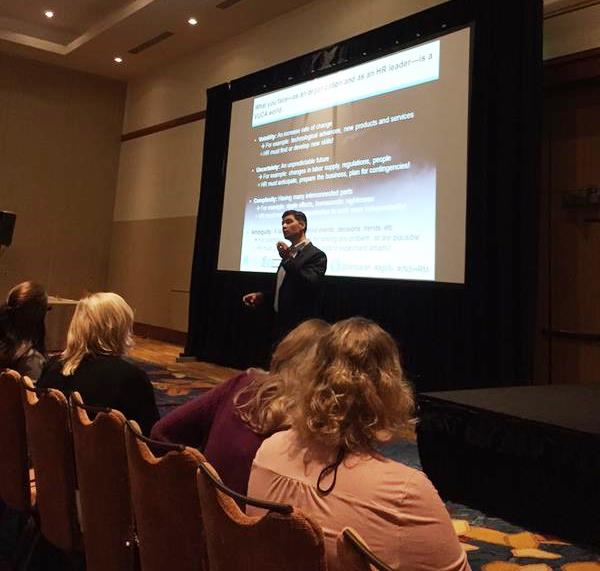
- Our world—and our organizations—operate in an environment of volatility, uncertainty, complexity and ambiguity (VUCA).
- HR professionals must continually study their environments, both internal and external to their organizations, so that they can anticipate and act quickly. Vigilance trumps complacency.
- In short, HR needs to become more agile—having the capability to sense and respond to the VUCA forces that they and their organizations face.
- Being agile means that HR leaders should proactively anticipate how they can help their organization's people perform optimally given what they face today and what they will face tomorrow.
- When HR leaders can connect their practices to the strategic needs of their organizations, top executives will sit up and take notice. Proactively doing this on a continual basis will move HR leaders into the sphere of being strategic business partners for the organization.
Certainly a great deal can go into making these approaches a reality. But here are a few questions HR professionals can ask about their own work and their functions as a whole:
- Are your workforce planning and talent development plans developed with multiple contingencies and scenario planning in mind?
- In what way and how often are you communicating with your key internal and external stakeholders?
- Are the criteria for identifying and selecting talent aligned with what the organization will need in the future, in addition to what’s needed today?
- How do you or your function stay aware of emerging trends in your organization’s industry as well as your profession (i.e., HR, talent development, etc.)?
- In what way does your work reflect a focus on your customers, both internally and externally
- How can you better align what you provide as HR leaders with your customers’ needs?
- To what degree are your practices and decisions based upon valid data and analysis?
This is clearly a complex topic, but it’s one that HR needs to continue tackling in order to help organizations thrive in the modern world of work. And if it does, HR will in many ways lead the organizations of the future.
But if it does not, everyone in HR risks becoming Toby Flenderson.
Do CEOs hate or love HR? Why or why not?
How can HR become even more agile and drive strategic-level results? Leave a comment below!
Find this thought provoking? Like and share!
About Ben Baran
Ben Baran, Ph.D., is probably one of the few people in the world who is equally comfortable in a university classroom, a corporate boardroom and in full body armor carrying a U.S. government-issued M4 assault rifle. Visit: www.benbaran.com.

Hiring the Right People in a Labor Market Flush with Talent: The Importance of Valid Selection Practices
It’s about supply and demand, human-resource style. Remember when the unemployment rate in the United States was less than 5%? According to the U.S. Department of Labor’s Bureau of Labor Statistics, that describes about five of the past 10 years. That also describes times when employers spent much of their energy on recruiting talent, or wooing top performers to apply for jobs.But times have changed. The unemployment rate now sits at 8.9%, which means employers everywhere are coping with huge numbers of job applicants for a small number of job openings. Recruiting is still important, and valid selection is always important. In a labor market flush with talent, however, figuring out whom to hire from the crowd is all the more crucial—and tricky.
So what really has changed?

It’s about supply and demand, human-resource style. Remember when the unemployment rate in the United States was less than 5%? According to the U.S. Department of Labor’s Bureau of Labor Statistics, that describes about five of the past 10 years. That also describes times when employers spent much of their energy on recruiting talent, or wooing top performers to apply for jobs.But times have changed. The unemployment rate now sits at 8.9%, which means employers everywhere are coping with huge numbers of job applicants for a small number of job openings. Recruiting is still important, and valid selection is always important. In a labor market flush with talent, however, figuring out whom to hire from the crowd is all the more crucial—and tricky.
So what really has changed? It’s something called the “selection ratio.” Simply put, the selection ratio is the number of people you can hire divided by the number of job applicants (read more). In a tough economy, lots of people are vying for a small number of jobs. Companies that used to have 40 applicants for 20 jobs (a selection ratio of 0.5) now may have 400 applicants for 10 jobs (a selection ratio of 0.025).
In other words, the labor supply is increasing, but the labor demand is shrinking. Therefore, many employers have the opportunity, theoretically, to make huge gains in terms of human capital. This assumption depends upon a crucial, often-overlooked and taken-for-granted part of the hiring process: that the procedures organizations are using to make hiring decisions must actually work. Namely, the methods used to choose new employees must adequately distinguish people who have what it takes to succeed from those who don’t.
Industrial psychologists have investigated personnel selection for decades. Although describing the nuances of designing a valid selection system is beyond the scope of this article, a number of general guidelines hold true across most industries and job types.
- Conduct a proper job analysis. This involves figuring out what exactly constitutes performance regarding the job position in question, helping the hiring manager to know what types of knowledge, skills, abilities, and other characteristics (KSAOs) a successful job applicant should embody.
- Understand the legal aspects of hiring. For example, employers should pay attention only to those aspects of applicants that are relevant to the job, or “bona fide occupational qualifications.” Consult an attorney well-versed in employment law to clarify any other concerns, including compliance with the Uniform Guidelines on Employee Selection Procedures (read more).
- Conduct structured interviews. Many hiring managers assume that they can gauge the quality of job applicants through an informal conversation and a handshake. Quite simply, this is a big myth. And thousands of pages of rigorous research provide evidence to this effect. Structured interviews should function like any test: They should have specific questions designed to assess specific KSAOs, and hiring managers should conduct them in the same way for all job applicants who pass initial résumé screening. Here’s a decent guide for conducting structured interviews from the U.S. Office of Personnel Management.
- Consider the use of psychological tests and other selection hurdles. The decision to use these types of selection procedures depend on a variety of factors, and most organizations should consult an expert for further guidance.
Overall, a labor market with large numbers of qualified job seekers can be a very good situation for employers. It gives organizations the opportunity to build their human capital with less of a need for recruiting. But to truly capitalize on the current nature of human-resource supply and demand, employers must understand and implement valid selection procedures. Otherwise, it’s just a shot in the dark—resulting in random selection that is unfair, potentially illegal, and bad for both organizations and employees.