
I’ve moved my blogging to Substack!
Feel free to check out any of the content I have here, but also be sure to check out my newest content at Reckoning and Elevating What Works.

Announcing The Indigo Podcast: An Exploration of Human Flourishing at Work and Beyond
When Chris Everett and I formed Indigo Anchor in 2018, we knew we would be a different kind of management consulting firm. We would not be interested in fancy suits, not interested in churning out reports that were unhinged from real change. Nor would we be interested in peddling the latest organizational pop psychology.
What we wanted to do was bring evidence-based approaches and strategies from academia, the military, and successful enterprise organizations to clients that were truly ready for the change required for improvement.
Fast forward to 2019, we’ve stayed true to these values and have had tremendous success where our competitors have previously failed. And we’ve received validation that we are indeed “different.” We are “bold” … “challenging” … “funny” … “intense.” We’ve had clients laugh, cry,

When Chris Everett and I formed Indigo Anchor in 2018, we knew we would be a different kind of management consulting firm. We would not be interested in fancy suits, not interested in churning out reports that were unhinged from real change. Nor would we be interested in peddling the latest organizational pop psychology.
What we wanted to do was bring evidence-based approaches and strategies from academia, the military, and successful enterprise organizations to clients that were truly ready for the change required for improvement.
Fast forward to 2019, we’ve stayed true to these values and have had tremendous success where our competitors have previously failed. And we’ve received validation that we are indeed “different.” We are “bold” … “challenging” … “funny” … “intense.” We’ve had clients laugh, cry, cheer, yell, and yet ultimately succeed when they thought success was elusive. We’ve gotten results for every client on every engagement leaving them with increased revenue, increased profits, happier employees, and happier boards of directors. When approached, we only take on the work if we know we can leave the organization better than we found it.
We’ve turned work away when organizations have floundered in describing the results they’re seeking, when they’ve wanted a solution that won’t fix their problem, or when their ask has been unrealistic.
While we’re obsessed with quantifiable results, we also have a soft side that revels in the complexities of humanity with all of its intangibles and idiosyncrasies. We are lovers of people and community. We have a higher purpose beyond the bottom line, and that is to see people flourish at work and beyond.
In many of our engagements, clients have taken us aside to tell us how the communication and leadership skills we’ve taught has helped them in their marriages, with their children, and with their extended families.
So, we started thinking to ourselves that we and our clients should have a place to learn from each other and invite others to do the same. We did not want this to be a sales pitch or marketing ploy for our company; however, we wanted the community to be distinct.
How were we going to do this? Forum-style like Reddit? Conversations or groups on LinkedIn? Start a Facebook page? As we discussed our options, preferences, and talents as well as who our audience would be and their preferences, we landed on the format of a podcast.
Why a podcast?
We liked the idea of podcasting for several reasons: it’s interactive and it’s digestible when you live a busy life on the go. We saw it as a way to extend beyond ourselves and engage in conversations that are essential to building community. We also anticipated that our audience likely includes those who already listen to podcasts and would enjoy that format.
We are proud to announce The Indigo Podcast, which is set to launch Nov. 4, 2019. It’s an informative, real, quirky, and somewhat irreverent resource for executives, managers, leaders, and anyone else interested in flourishing … in the world of work and beyond.
During the last several months, we have been putting our heads together to come up with the best content that would be the most useful to our audience. We’ve recorded several episodes already.
In every episode, we’re seeking to do some combination of the following:
promote the flourishing of people and organizations
bridge the gap between social science and management practice
provide an antidote or counterpoint to the ever-increasing overly simplistic reductionist approaches to work and life
feed the curiosity of people who want to make the world a better place through work
inspire listeners to become lifelong learners and bold difference-makers
Initially, the podcast will feature me along with my fellow co-founder and principal at Indigo Anchor, Chris Everett. We will also feature interviews with respected experts and other people of interest. The first several episodes will be on the subjects of thriving in the face of bad management, flourishing in a turbulent operating environment, agility and why it matters, and exploring why managers derail and how to avoid it.
Our style is rather different from many of the business, management, or leadership podcasts that currently exist. Most notably, we recognize that the world is messy and that solutions often require a nuanced view of reality. Most of life does not lend itself to lists of easy steps to follow or “silver bullets” that fix everything. Our conversations, therefore, are fairly in-depth. And while we often provide perspectives and evidence-based ideas that our listeners will find immediately useful, our overall goal is to help our listeners think, learn, and maybe even laugh a little.
We’re hoping that listeners and subscribers will find our podcast to be a refreshing resource for proven tools in the areas of management, leadership, human resources, organizational behavior, dealing with change, organizational culture, hiring, process improvement, organizational agility, and related topics.
The Indigo Podcast launches Nov. 4, 2019 on iTunes/Apple Podcasts, Spotify, GooglePlay, Stitcher, TuneIn, and Castbox.
To learn more about The Indigo Podcast, visit: https://www.indigotogether.com/indigopodcast
Indigo Anchor is a management consulting firm serving clients across a wide range of industries, sectors, sizes, and locations. Visit: https://www.indigoanchor.com/
Ben Baran, Ph.D., is probably one of the few people in the world who is equally comfortable in a university classroom, a military uniform, or in a corporate boardroom advising top management teams. He is an award-winning assistant professor of management at Cleveland State University, a co-founder and principal of the consulting firm Indigo Anchor LLC, and a commander in the U.S. Navy Reserve. He regularly consults leaders and organizations across a wide range of sectors and industries. He earned his undergraduate degree from Villanova University and his master’s in industrial and organizational psychology and Ph.D. in organizational science from The University of North Carolina at Charlotte. Connect with Ben on LinkedIn. For more, visit: www.benbaran.com
For additional information, contact Ben Baran at ben@indigoanchor.com

Agile HR: Trends and Opportunities
The future of human resources (HR) lies at the intersection of strategy, data analytics, design thinking, and a new set of practices and mindsets ushered in by the world of agile methods and organizational agility writ large.
And the time is ripe for HR professionals to have the bandwidth necessary to devote themselves to such matters. Numerous HR services—particularly those that are

The future of human resources (HR) lies at the intersection of strategy, data analytics, design thinking, and a new set of practices and mindsets ushered in by the world of agile methods and organizational agility writ large.
And the time is ripe for HR professionals to have the bandwidth necessary to devote themselves to such matters. Numerous HR services—particularly those that are more compliance and administrative in nature—have been prime candidates for outsourcing for years. Automation, furthermore, has the potential to eliminate or reduce further many repetitive HR tasks.
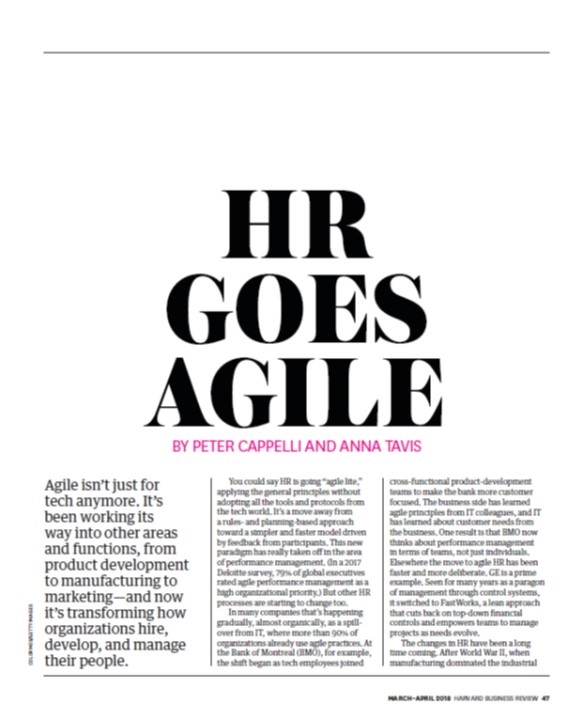
In the March-April 2018 issue of Harvard Business Review, Peter Cappelli and Anna Tavis outline a number of ways in which HR is adopting agile principles. In their article, “HR Goes Agile,” Cappelli and Tavis highlight how HR practices are beginning to trend away from the old approaches governed by rules and plans. Taking cues from agile, they contend, HR is increasingly moving toward a feedback-driven approach characterized by simplicity and speed.
Here are some highlights from their article.
First, a number of big trends are fundamentally influencing HR. These include increasingly rare lifelong employment and an environment marked by rapid change, which drives rapidly changing skill requirements.
Second, the strategic imperative now is rapid innovation, and this applies to HR. In a fast-paced world, top-down planning doesn’t work very well. Instead, nimble, user-driven methods such as rapid prototyping, team-based decisions, and “sprints” centered on specific tasks.
Third, such changes in the larger business environment are driving changes in specific practices, many of which are either HR-driven or used by HR. These include:
Performance appraisals, in which the clear trend is toward having higher-frequency, sometimes project-based feedback versus the typical annual review. The emphasis here is on quick feedback to enable “course corrections.” Elements of agile methods and design thinking can also inform the organization’s approach toward performance appraisal design, with a specific emphasis on involving employees in the prototyping, testing, and iterative improvement process.
Coaching, in which organizations are realizing that they must invest time in developing manager’s skills. In a world driven by high-quality feedback to drive fast improvement, managers need to build a robust set of communication and coaching skills.
Teams, in which work may be best organized by projects instead of by functions or other aspects of formal hierarchy. Here, methodologies such as Scrum are proving useful, as well as norms and rituals that support multi-directional feedback, lower-level decision-making, and supervisors who facilitate healthy teams—not just individual performance.
Compensation, in which incentives may be used to reinforce values such as learning and sharing knowledge. Another potential implication is the use of quick bonuses instead of annual merit-based raises.
Recruiting, in which the use of cross-functional teams with hiring managers who rotate on and off depending on whether they’re hiring can drive the acquisition effort for specific sets of jobs. Prioritization is also key, because not all vacancies are created equal: Some should be filled before others.
Learning and development, in which efforts become tailored to the job and the person in real-time. IBM appears to be at the forefront of these efforts, using “cognitive” (artificial intelligence) approaches to drive training. Additional value may be created by training the organization on specialized topics within the world of agile principles and methods.
My take on this is that these are excellent points—and all in HR should heed them.
But there’s much more, some of which I’ve written about previously. What remains somewhat unexplored is how HR can specifically help the organization overall become more nimble, more agile. Becoming agile itself may be a start, but HR should also continue to work to better define how its practices and strategies can drive innovation and responsiveness to change overall. Related topics and bodies of knowledge including strategy, data analytics, and design thinking play critical roles as well.
What’s clear is that these are exciting times. And perhaps within this context, HR has an opportunity to—in the words of management scholar Gary Hamel— create organizations that are both “fit for the future” and “fit for human beings.”
About Ben Baran
Ben Baran, Ph.D., is probably one of the few people in the world who is equally comfortable in a university classroom, a corporate boardroom and in full body armor carrying a U.S. government-issued M4 assault rifle. He regularly consults leaders and organizations across a wide range of sectors and industries. Visit: www.benbaran.com.

On the Origins of VUCA and How it Affects Decision Making
It’s not just you; it’s not just me. The acronym VUCA is more popular than ever.
According to Google Trends, interest in the term is at an all-time high, following a distinct trend upward in the past several years.
Like many ideas, however, VUCA as a framework for understanding turbulence in one’s environment wasn’t an overnight sensation. The acronym—which stands for
It’s not just you; it’s not just me. The acronym VUCA is more popular than ever.

According to Google Trends, interest in the term is at an all-time high, following a distinct trend upward in the past several years.
Like many ideas, however, VUCA as a framework for understanding turbulence in one’s environment wasn’t an overnight sensation. The acronym—which stands for volatility, uncertainty, complexity, and ambiguity—began decades ago with attempts to help develop strategic leaders at the U.S. Army War College.
One of the earliest references to VUCA that I’ve found is in a 1992 article in the Journal of Management Development by Herbert Barber titled, “Developing strategic leadership: The US Army War College experience.” In the article, he describes how the U.S. Army War College and The Army Research Institute for the Behavioral and Social Sciences sponsored a conference in February 1991 that brought together both scholars and practitioners to discuss leadership at the top of complex organizations. One of the aspects of strategic leadership upon which participants at the conference focused was the environment, or the context in which strategic leaders must operate. Even in 1991, the environment described by conference participants was one fraught with turbulence, from geopolitical uncertainty to technological advancement.
Crediting even earlier work in 1986 by leadership scholars Warren Bennis and Burton Nanus, Barber describes how the U.S. Army War College decided to use the VUCA acronym as a way to help their students (typically senior military officers) characterize the turbulence they would face as they took on increasingly strategic leadership positions. The recent popularity of the acronym stems in large part from increased application within civilian sectors, as leaders outside the military have found it useful in helping them make sense of their challenges and opportunities.
So what do the four components of VUCA mean? Here’s a brief summary of the explanations that I typically use.
Volatility is about the increasing pace of change. Although we can find examples from throughout history of people being astonished by the pace of change, two relatively recent factors are driving unprecedented change: (1) technological advancement and (2) globalization. Those factors, combined with the speed of innovation and increased competition, make for a world filled with many examples of exponential—not linear—change.
Uncertainty is about the unpredictability of the future. Predicting what the “next big thing” will be has always been difficult, but given the increasingly fast pace of change it’s getting even harder. Furthermore, people use new technologies in novel and interesting ways—ways that could never have been predicted even by their original creators (Twitter is a good example).
Complexity is about the interconnected nature of organizations, industries, markets, and geographies. Readers of the sociologist Charles Perrow may think of the concepts “interactive complexity” and “tight coupling” that he uses to describe how unpredictable and fast chain reactions can occur, particularly when risky technologies are involved.
Ambiguity is about what the famed military theorist Carl von Clausewitz called “the fog of war.” It’s about those confusing situations in which multiple plausible interpretations exist about what’s going on or what it means. It’s about those times when a group of smart people are all looking at the same data yet coming to different conclusions about what it means—and here’s the key—they all sound right.
Aside from overwhelming leaders with what the future holds, though, how is the VUCA construct helpful?
I’ve found it to be helpful in my conversations with executives in a few ways.
First, it provides a language and a framework for having a meaningful conversation about what an organization faces, both internally and externally. What are our knowns? What are our unknowns? And might there be unknown unknowns? Having those conversations is a critical step in the sensemaking process for leadership teams. And as my good friend and consulting partner Mike Richardson says, “conversation flow leads to cash flow!”
Second, it helps leaders understand the mindset and behavioral shift that they need to enact when entering the “land of VUCA.” Namely, VUCA problems are ones in which best practices—and even good practices—likely don’t apply. When encountering VUCA, one cannot reliably depend upon the past as a guide for the future.
As such, an understanding of VUCA can assist with understanding a specific domain of decision-making. And to help make sense of how to make decisions within a VUCA environment, the Cynefin framework is useful.
For those who aren’t familiar, the Cynefin framework originated around the turn of the century at IBM, specifically led by Dave Snowden. Since then, it’s become a useful way for leaders to help make sense of what types of problems they face and how to deal with them.
A complete description of the Cynefin framework is beyond the scope of this article, however, as depicted below, it categorizes four types of problems: simple, complicated, complex, and chaos. These all exist outside of disorder—those instances in which no clarity exists about which domain applies.
A sketch, by Edwin Stoop of Sketching Maniacs, of the Cynefin framework
Simple problems are solved using best practices, and complicated problems are solved using good practices (or a limited range of good options).
Complex problems are those in the land of VUCA. These are problems that aren’t solved by doing what worked well in the past (best practices), and there really don’t seem to be any good answers. Instead, experimentation is critical. This is the domain of probing, trying something, and then sensing and responding accordingly.
Chaos describes true crisis situations. These situations call for direct action in an immediate attempt to stop the bleeding (or the organizational equivalent), figure out some next steps, and move the problem into another domain.
So the next time you’re facing VUCA—in your life or in your organization—resist the temptation to treat it like a best practice. Instead, make friends with experimentation, embrace smart (i.e., small, fast, cheap) failure, and continually learn. Such an orientation toward leadership and decision making also requires a deep commitment to building trust, agility, and resilience within your team, because without those elements, you’ll never be able to create, fail, or learn effectively together.
About Ben Baran
Ben Baran, Ph.D., is probably one of the few people in the world who is equally comfortable in a university classroom, a military uniform, or in a corporate boardroom advising top management teams. A co-founder and principal at the consulting firm Indigo Anchor, he's also an award-winning business professor and published scholar at Cleveland State University and a commander in the U.S. Navy Reserve. He regularly consults leaders and organizations across a wide range of sectors and industries. Visit: www.indigoanchor.com and www.benbaran.com.
References:
Barber, H. F. (1992). Developing strategic leadership: The US Army War College experience. Journal of Management Development, 11(6), 4–12. https://doi.org/10.1108/02621719210018208
Bennis, W. G., & Nanus, B. (1986). Leaders: The Strategies for Taking Charge. New York: Harper & Row.

Human Resource Management and The Great Unlearning
Exciting changes in the world of human resources (HR) abound. As noted by Stephen Barley (University of California Santa Barbara), Beth Bechky, and Frances Milliken (both of New York University) in their recent article in Academy of Management Discoveries,
“Few people would deny that the nature of work and employment has changed over the last four decades, not only in the United States but in many countries worldwide. Moreover, the nature of work is likely to continue to change as we move further into the 21st century.”
Such changes make HR work continually dynamic, with evolving practices with regard to new technologies, the increasing prevalence of contingent workers, and more. Barley and his coauthors also mention the rise of artificial intelligence and the rise of project-based work as fundamental shifts that will influence careers and even how people think about themselves in relation to their organizations and society.
These changes alone are enough to keep HR leaders and other executives up at night.
Yet I wonder

Exciting changes in the world of human resources (HR) abound. As noted by Stephen Barley (University of California Santa Barbara), Beth Bechky, and Frances Milliken (both of New York University) in their recent article in Academy of Management Discoveries,
“Few people would deny that the nature of work and employment has changed over the last four decades, not only in the United States but in many countries worldwide. Moreover, the nature of work is likely to continue to change as we move further into the 21st century.”
Such changes make HR work continually dynamic, with evolving practices with regard to new technologies, the increasing prevalence of contingent workers, and more. Barley and his coauthors also mention the rise of artificial intelligence and the rise of project-based work as fundamental shifts that will influence careers and even how people think about themselves in relation to their organizations and society.
These changes alone are enough to keep HR leaders and other executives up at night.
Yet I wonder if there are additional, perhaps even more fundamental shifts underway that will forever alter how people behave and interact at work.
Those changes have to do with a recognition of the ingenious beauty of human organizing, the remarkable capacity that we all have to iterate toward something better, and the foolishness—and downright arrogance—that can accompany our best managerial attempts to control.
Teams and organizations are increasingly finding benefits in valuing:
- Individuals and interactions over processes and tools
- Working [solutions] over comprehensive documentation
- Customer collaboration over contract negotiation
- Responding to change over following a plan
If those values look familiar, you’ve likely seen them in the Agile Manifesto, which includes these values and a set of principles for software development.
But here’s the thing—these values and principles have been around for decades prior to their articulation in the Agile Manifesto. That’s because they’re based in how people actually work, not in how various management systems of the 20th Century forced them to obey.
As noted in The Wharton School’s Aug. 1 article, Has Agile Management’s Moment Arrived?,
“The agile approach is one that uses teams to work through a process designed to respond to unpredictability; that allows for and encourages changes in direction; that gives teams great authority and transparency; and that builds in customer or user response to the end product or service while it is still being developed.”
Because agile management thrives in a state of uncertainty, it is highly likely to continue to spread into other sectors and functions, far beyond that of software development.
Case in point: General Electric, which has been implementing similar principles for the past few years with regard to its manufacturing—within a program called “FastWorks.”
And given that agile methods, including those advocated by Scrum, are continuing to increase in popularity, I see a tremendous opportunity—and threat—ahead for the world of HR.
Namely, in successful organizations, HR will be a central component of what I’m starting to think of as “The Great Unlearning.”
The Great Unlearning is what’s required of organizations that are fundamentally committed to a different way of working, a way that’s characterized by how humans actually interact best.
Going back to Barley and his coauthors’ recent work, in addition to discussing fundamental shifts in the world of work, they also astutely highlight how most of management knowledge and practice comes from research and assumptions developed decades ago. They write:
“… it is surprising how little organization and management studies have had to say about the phenomenon. Our field’s lack of attention to the ways in which work is changing is problematic because organization studies and organizational behavior grew out of industrial sociology and industrial and organizational psychology in the 1960s and 1970s.”
For HR leaders, The Great Unlearning means that they will have to undo much of what we have taken for granted as management dogma. For example, if an organization does much of its work based upon project-based teamwork, what might that mean in terms of:
- The employer relationship—will there be much of a need for permanent employees in the future?
- Compensation—what is the value of hourly wages if results are truly project-based?
- Recruiting and selection—how do you find people who can perform in an interdependent, team-based environment?
- Development—how do you help the millions of workers who are deeply accustomed to traditional ways of working adapt to new structures and ways of working? How do you help an organization nurture a culture in which new values matter more than those of the past?
- And much more.
The Great Unlearning for HR also includes HR as a profession taking a hard look at itself in the mirror. Although people have been preaching—rightly, in my opinion—about how HR needs to transform for the past two decades (Dave Ulrich’s 1998 Harvard Business Review article comes to mind), has it really happened?
In most organizations that I know, HR is still the compliance department, the place where you go to find out about your benefits, the people who give you stuff to sign. In today's business environment, HR must unlearn its own ways of working. HR must also help organizations unlearn the behaviors that have been taken-for-granted by employees since the Industrial Revolution.
In short, it seems that The Great Unlearning for HR includes both a threat and an opportunity for HR leaders.
It’s threatening for HR leaders who prefer to maintain the status quo.
It’s an opportunity for HR leaders who are willing to take the risks necessary to make their organizations primed for the future.
About Ben Baran
Ben Baran, Ph.D., is probably one of the few people in the world who is equally comfortable in a university classroom, a corporate boardroom and in full body armor carrying a U.S. government-issued M4 assault rifle. Visit: www.benbaran.com.
Ben is also the author of the e-book, The Navy’s 11: Reflections and tips for leaders everywhere based upon the U.S. Navy’s Leadership Principles. It’s full of ...
- Leadership guidance, based upon the U.S. Navy's Leadership Principles, which have been used to create and sustain the greatest navy known to humankind;
- Real-world examples, based upon my nearly 20 years of experience with the U.S. Navy and a decade of academic research combined with business consulting;
- Actionable tips, meant to help you implement the leadership principles in your daily life and work; and
- Much more!
Click here to get your FREE copy today.

Wellness? How About Comprehensive Employee Fitness
Within the military, attention in recent years has been shifting among senior military leaders toward a model of health for service members that included the idea of resilience. Notably, in 2011, a whole special issue of the high-visibility journal American Psychologist focused on the U.S. Army’s idea of “Comprehensive Soldier Fitness,” or CSF. In the opening article, then U.S. Army Chief of Staff General George Casey Jr. described it this way:
“… the Army is leveraging the science of psychology in order to improve our force’s resilience. More specifically, we are moving beyond a “treatment-centric” approach to one that focuses on prevention and on the enhancement of the psychological strengths already present in our soldiers. Rooted in recent work in positive psychology, CSF is a “strengths-based” resiliency program that shows promise for our workforce and its support network so our soldiers can “be” better before deploying to combat so they will not have to “get” better after they return.”[i]
Although I’m a Sailor (i.e., in the Navy; more specifically, the Navy Reserve) and not a Soldier, the notion of resilience has seeped across the branches of service. And while most of the personnel burden for the wars in both Iraq and Afghanistan has fallen upon the Army, the Navy has also begun to appreciate the notion of resilience. That’s good, because resilient service members will be better equipped to handle the increasingly dynamic nature of their work, and, when they eventually leave military service, they’ll have yet another skill that transfers to the civilian workplace.
It’s also a concept that’s critical for leaders working in any industry that’s either beginning to experience—or is in the throes of—what’s becoming the turbulent, modern business environment. Work organizations that embraced a concept of “comprehensive employee fitness” would surely benefit through the more engaged, more motivated workforce that would result.

Within the military, attention in recent years has been shifting among senior military leaders toward a model of health for service members that included the idea of resilience. Notably, in 2011, a whole special issue of the high-visibility journal American Psychologist focused on the U.S. Army’s idea of “Comprehensive Soldier Fitness,” or CSF. In the opening article, then U.S. Army Chief of Staff General George Casey Jr. described it this way:
“… the Army is leveraging the science of psychology in order to improve our force’s resilience. More specifically, we are moving beyond a “treatment-centric” approach to one that focuses on prevention and on the enhancement of the psychological strengths already present in our soldiers. Rooted in recent work in positive psychology, CSF is a “strengths-based” resiliency program that shows promise for our workforce and its support network so our soldiers can “be” better before deploying to combat so they will not have to “get” better after they return.”[i]
Although I’m a Sailor (i.e., in the Navy; more specifically, the Navy Reserve) and not a Soldier, the notion of resilience has seeped across the branches of service. And while most of the personnel burden for the wars in both Iraq and Afghanistan has fallen upon the Army, the Navy has also begun to appreciate the notion of resilience. That’s good, because resilient service members will be better equipped to handle the increasingly dynamic nature of their work, and, when they eventually leave military service, they’ll have yet another skill that transfers to the civilian workplace.
It’s also a concept that’s critical for leaders working in any industry that’s either beginning to experience—or is in the throes of—what’s becoming the turbulent, modern business environment. Work organizations that embraced a concept of “comprehensive employee fitness” would surely benefit through the more engaged, more motivated workforce that would result.
Potential Aspects of Comprehensive Employee Fitness
If we look at the psychological research behind the idea of Comprehensive Soldier Fitness, we can get an idea of what it might mean across other contexts—including in civilian organizations.
The fundamental concepts are: grit, hardiness, adaptability, agility, and resilience. To be clear, researchers haven’t reached a total consensus on how all of these ideas are different or similar. But there’s consensus that all of them have positive outcomes. And for the sake of becoming a resilient person and developing into a person who thrives in the face of what’s becoming a world characterized by continual, rapid change, it’s important to become familiar with these ideas. So let’s take a quick look under the hood of each one.
Grit: Just Keep Swimming
Grit is about picking long-term goals and going after them with gusto, regardless of the obstacles. When I think of “grit,” I think of John Wayne. (Thanks, Hollywood.) Grit isn’t about one’s mental ability. It’s not about one’s intelligence quotient, or IQ. But what’s great about grit is that it captures that ever-important quality of stick-to-itiveness, something that I think we can all relate with as a key to success from our childhood, from school, from our careers.
That’s why, in part, that grit is starting to get more serious attention from researchers. For example, Angela Duckworth, a psychologist at the University of Pennsylvania, has been studying grit for a number of years. Her research confirms the value of grit as a predictor of success above and beyond that of IQ and one’s personality.[ii]
That’s not to say that talent is irrelevant. What it means is that if you’re going to be a high achiever, you’ve got to have not only some level of talent, but you’ve also got to have the perseverance and long-term orientation to set big goals and keep chasing them—doggedly, day after day after day.
It’s a lot like the fish Dory, the lovably absent-minded character from Disney’s Finding Nemo, who said, “When life gets you down, do you wanna know what you’ve gotta do? Just keep swimming. Just keep swimming. Just keep swimming.”[iii]
Hardiness: Always Find Meaning
Hardiness is a personal quality or characteristic that develops early in our lives, but likely becomes shaped or even strengthened by life events. Whereas grit has to do with tenaciously pursuing future goals, hardiness is about having purpose and meaning in life. Paul Bartone, a senior research fellow at National Defense University who has studied hardiness extensively, puts it this way, saying that hardiness “involves the creation of meaning in life, even life that is sometimes painful or absurd, and having the courage to live life fully despite its inherent pain and futility. It is a global perspective that affects how one views the self, others, work, and even the physical world.”[iv]
Any adult who has tried to do anything remotely difficult experiences failure at some point or another. Many of us fail over and over again. If we have grit, we keep going. If we are hardy, we find meaning in the journey.
Not surprisingly, hardiness is another characteristic that tends to predict high performance, specifically leader performance, above and beyond IQ.[v]
Adaptability: Accept External Changes
Adaptability describes the ability to change in order to fit with external demands. Elaine Pulakos, president of Personnel Decisions Research Institutes and a well-known researcher within the field of industrial/organizational psychology, has studied adaptability as it relates to job performance along with other researchers. Their findings include uncovering eight different dimensions of adaptability as it pertains to peoples’ behavior at work.
Namely, adaptability tends to involve one or more of the following dimensions: handling emergencies, handling work stress, solving problems creatively, dealing with uncertain situations, learning, interpersonal adaptability, cultural adaptability, and physically oriented adaptability.[vi]
As such, being adaptable involves being able to “fit” within numerous types of different circumstances. And with an ever-changing organizational landscape, having employees with these types of abilities will surely set organizations apart from those that do not.
Agility: Become Proactively Nimble
Agility allows people (and, and many argue, whole organizations) to create and implement strategies that allow one to deal with continuous change.[vii] It’s about having nimbleness and a proactive posture about oneself that supports continual effectiveness. Clearly, agility is a characteristic that’s important for all employees, leaders, teams, and organizations in a rapidly changing world.
My colleague Nick Horney, who co-founded the consulting firm Agility Consulting and Training in 2001, puts it this way with regard to leaders:
“Leadership agility is the capability of a leader to dynamically sense and respond to changes in the business environment with actions that are focused, fast and flexible. It is about a leader’s ability to prepare all employees … to shift their mindsets and supporting skills from ‘I know change is coming, but I can’t really see the potential changes that might impact our organization’ to ‘I see change coming and am prepared and already doing something about it.’[viii]
Resilience: Thrive Amidst Adversity
Finally, there’s resilience. Whereas agility reflects a certain perspective toward change and volatility, resilience is more about how we deal with and react to adversity.[ix] Given this difference, it’s no wonder that the U.S. Army is partnering with researchers to uncover how to build resilience among its people. And while preparing for and enduring the year-long deployment I spent in Afghanistan, it became clear to me that resilience is a fundamental concept and aspect of personal, inner strength that’s necessary for thriving in adverse circumstances.
One part of resilience is about your attitude. That is, we always have the ability to choose how we react to a situation. That’s true, and it’s important to remember because that concept will get you through many a tough circumstance.
But it’s also important to remember that adversity also really can affect us—deeply, personally, suddenly, unexpectedly. We don’t simply experience stressful circumstances, make a choice to not let it bother us, and move on. We can own our attitude, but we need resilience to make it for the long haul.
A fascinating, related concept regarding how people react to adversity is that of “posttraumatic growth.”[x] Such an approach is rather different from the notion of posttraumatic stress, which is most commonly referred to in the context of posttraumatic stress disorder, or PTSD. Stories of PTSD among returning veterans continue to surface, and it’s certainly an issue with which the military and its supporting organizations (e.g., the U.S. Department of Veterans Affairs) need to deal. But it’s not the whole story.
Posttraumatic growth has to do with the fact that people who encounter highly stressful situations are by no means guaranteed to develop PTSD; rather, some people can grow as a result of their trauma and become more resilient over time. As such, experiencing adversity may boost resilience among some people, and those changes may be more dramatic among those who were less resilient beforehand.[xi] This idea is one that I think has great merit and should receive continued attention by both researchers and those on the frontlines of dealing with adversity or helping those who do.
The takeaway for the rest of us?
Adversity can make us stronger.
Below, I outline more key details that highlight the similarities and differences among grit, hardiness, adaptability, agility, and resilience. As you already likely understand, the concepts are certainly related. One way I like to think about is as follows: Having grit, hardiness, and adaptability will make you more agile and resilient. And being agile and resilient will allow you to succeed in times of turbulence and adversity, respectively.
- Grit helps you set long-term goals and drive persistently toward them when you encounter obstacles and want to quit.
- Hardiness helps you find meaning and live with a purpose when the world around you seems cruel, unfair, or meaningless.
- Adaptability helps you bend, change, or otherwise adjust when external demands change or require different behavior.
- Agility helps you proactively create novel pathways toward effectiveness when change becomes increasingly rapid and unpredictable.
- Resilience helps you cope, press through, recover, and become stronger when adversity strikes through truly disruptive change, tragedy, or unexpected turmoil.
So how might an organization go about increasing its comprehensive employee fitness?
Is it about selecting the right people? Developing and training the people you currently have?
Yes and yes.
A full roadmap for such a program is beyond the scope of this post, as my hope is simply to introduce the idea and concepts.
Yet a central take-away point is that it’s not about avoiding hardship or adversity. It’s about coping with them proactively—and even more, it’s about using those experiences as a source for lessons about what works, what doesn’t, and about how we are often much stronger than we ever imagine.
About Ben Baran
Ben Baran, Ph.D., is probably one of the few people in the world who is equally comfortable in a university classroom, a corporate boardroom and in full body armor carrying a U.S. government-issued M4 assault rifle. Visit: www.benbaran.com.
Ben is also the author of the e-book, The Navy’s 11: Reflections and tips for leaders everywhere based upon the U.S. Navy’s Leadership Principles. It’s full of ...

- Leadership guidance, based upon the U.S. Navy's Leadership Principles, which have been used to create and sustain the greatest navy known to humankind;
- Real-world examples, based upon my nearly 20 years of experience with the U.S. Navy and a decade of academic research combined with business consulting;
- Actionable tips, meant to help you implement the leadership principles in your daily life and work; and
- Much more!
Click here to get your FREE copy today.
References and Further Reading
[i] George W. Casey, “Comprehensive Soldier Fitness: A Vision for Psychological Resilience in the U.S. Army.,” American Psychologist 66, no. 1 (2011): 1–3, doi:10.1037/a0021930.
[ii] Angela L. Duckworth et al., “Grit: Perseverance and Passion for Long-Term Goals.,” Journal of Personality and Social Psychology 92, no. 6 (2007): 1087–1101, doi:10.1037/0022-3514.92.6.1087.
[iii] “The Best Dory Quotes,” Disney Blogs, accessed June 3, 2014, http://blogs.disney.com/oh-my-disney/2013/06/26/the-best-dory-quotes/.
[iv] Paul T. Bartone, “Resilience under Military Operational Stress: Can Leaders Influence Hardiness?,” Military Psychology 18, no. S (2006): S131.
[v] Paul T. Bartone et al., “Big Five Personality Factors, Hardiness, and Social Judgment as Predictors of Leader Performance,” Leadership & Organization Development Journal 30, no. 6 (2009): 498–521.
[vi] Elaine D. Pulakos et al., “Adaptability in the Workplace: Development of a Taxonomy of Adaptive Performance.,” Journal of Applied Psychology 85, no. 4 (2000): 612–24, doi:10.1037//0021-9010.85.4.612.
[vii] Cynthia A. Lengnick-Hall, Tammy E. Beck, and Mark L. Lengnick-Hall, “Developing a Capacity for Organizational Resilience through Strategic Human Resource Management,” Human Resource Management Review 21, no. 3 (September 2011): 243–55, doi:10.1016/j.hrmr.2010.07.001; Joseph McCann, “Organizational Effectiveness: Changing Concepts for Changing Environments.,” Human Resource Planning 27, no. 1 (January 2004): 42–50.
[viii] Nick Horney, Bill Pasmore, and Tom O’Shea, “Leadership Agility: A Business Imperative for a VUCA World,” Human Resource Planning 33, no. 4 (2010): 34.
[ix] Anthony D. Ong et al., “Psychological Resilience, Positive Emotions, and Successful Adaptation to Stress in Later Life.,” Journal of Personality and Social Psychology 91, no. 4 (2006): 730–49, doi:10.1037/0022-3514.91.4.730.
[x] Richard G. Tedeschi and Lawrence G. Calhoun, Trauma & Transformation: Growing in the Aftermath of Suffering (Thousand Oaks, Calif.: Sage Publications, 1995).
[xi] Richard G. Tedeschi and Richard J. McNally, “Can We Facilitate Posttraumatic Growth in Combat Veterans?,” American Psychologist 66, no. 1 (2011): 19–24, doi:10.1037/a0021896.

The Death Star Aimed at Your Scrum Team
I worry about many companies that are starting to use scrum for project management or product development.
I worry not because scrum doesn’t work. It surely can, and when done right, it can be a highly invigorating and effective process for all involved.
I worry about companies that are starting to use scrum for two reasons:

I worry about many companies that are starting to use scrum for project management or product development.
Note: You may already know this, but scrum is a team-based methodology for solving complex problems. It’s based upon a highly transparent and visible workflow, and it relies heavily upon the candid use of evidence to experiment and iterate. A full discussion of scrum is beyond the scope of this post; click here for an overview.
I worry not because scrum doesn’t work. It surely can, and when done right, it can be a highly invigorating and effective process for all involved.
I worry about companies that are starting to use scrum for two reasons:
First, some companies try to introduce scrum without guidance from someone who has been there and done that. Regardless of the intelligence of the team members, it’s exceedingly difficult to “do scrum” void of firsthand experience. It’s simply too different from the status quo for the vast majority of people to really “get” from only reading about it. Great companies with great leaders—like a current manufacturing client working with me and my world-class partners Mike Richardson and Chris Everett—understand this and get the coaching and support necessary to make the transition to scrum. Everett puts it this way, “You can read a ton about boxing, but that’s not going to help you a whole lot in the ring.”
Second, and perhaps even more commonly, many companies introduce scrum without sufficient understanding among top management about how their own behavior must change to support scrum and overall organizational agility. This is the top of what Richardson calls the “T-shaped” approach to agility. The horizontal part of the “T” is all about executive processes and behaviors, with the verticals (there can and should be more than one) being core business processes. Those executive processes and behaviors at the top of the “T”—either intentional or unintentional—can become a “Death Star” aimed at the verdant, energized world created by the new scrum team.
One example of this is “dark work.” Dark work comprises all of those tasks or projects that are unplanned and simply added on top of all the other tasks or projects that the team and others have already vetted for strategic importance and workload feasibility. It’s the unplanned “Hey, could you take a look at this?” or “Excuse me, would you help with this project?” If a team is using scrum correctly, its members are carefully and continually reviewing and prioritizing their task list. They’re making estimates based upon workload capacity—which itself is an estimate based upon their conversations. But if dark work creeps in, it can cause a team member to falter in delivering to other team members, eventually leading to a breakdown in the overall process.
The key to success is two-fold:
Scrum requires agile behaviors across the top of the organizational chart, starting with a hard look at strategy and strategic initiatives. Prioritization here is critical, too. If everything is a priority, nothing is a priority. Top management needs to understand not only how their scrum teams are operating, but they also need to become more nimble themselves. This requires an honest appraisal of their current state along with an unvarnished, no-kidding set of agile operating principles to which they hold themselves and each other accountable.
With regard to the “Death Star” of dark work specifically, executives need to realize that interrupting the scrum process has consequences. If the dark work really is a necessity—it can certainly happen—executives shouldn’t be surprised if the scrum team then reprioritizes its work due to the workload change.
One of the most rewarding aspects of scrum, from my experience, is seeing the creative energy that it can bring to those involved. It’s a method of doing work, I think, that’s much closer to how humans work best than what happens in most organizations.
At the same time, top leaders must be mindful that allowing a scrum team to flourish requires much more than simply giving a team the permission to work in a different way.
It also requires agility within the top management team.
And that often starts with every executive realizing that change always starts with one person in particular—the man or woman in the mirror.
Find this thought provoking? Leave a comment, like and share!
About Ben Baran
Ben Baran, Ph.D., is probably one of the few people in the world who is equally comfortable in a university classroom, a corporate boardroom and in full body armor carrying a U.S. government-issued M4 assault rifle. Visit: www.benbaran.com.

What Everyone in HR Needs to Know About Change
Models for planning and executing organizational change abound—for example, Kotter’s eight steps, among many others. These models are helpful in highlighting many of the critical aspects of organizational change, and I highly recommend immersing yourself in them.
That being said, I find that such models often deal more with planned organizational change than with unplanned or continuous organizational change.
And in an increasingly turbulent world, it’s important for human resources (HR) professionals and the HR function overall to

Models for planning and executing organizational change abound—for example, Kotter’s eight steps, among many others. These models are helpful in highlighting many of the critical aspects of organizational change, and I highly recommend immersing yourself in them.
That being said, I find that such models often deal more with planned organizational change than with unplanned or continuous organizational change.
And in an increasingly turbulent world, it’s important for human resources (HR) professionals and the HR function overall to take a more fluid, proactive and strategic approach toward change. The realities of the business environment continue to drive changes within organizations, and it’s time for HR to get up to speed.
From what I’ve observed and experienced in HR during the past decade, the HR profession has an opportunity to contribute meaningfully to how organizations adapt. But we in HR may need to consider organizational change from a slightly different angle. We must start with connecting with the organization’s strategy, and we can then use that direction to guide what we do. Furthermore, we’d be well served to think about what we do a little bit differently, adopting some of what’s working well elsewhere, to get things done quickly.
Specifically, those of us in HR would benefit from the following regarding our approach to organizational change:
1. Know your terrain.
It’s critical for HR professionals to understand their environment, or their terrain, both within and outside of their organization. While it’s important to know what people in HR care about, it’s even more important for HR people to know what their top leaders outside of HR care about—what are the main concerns of the c-suite? We in HR also must start thinking much more than we do currently about the environment outside of the organization—where does your organization compete? How does it win? What are the big trends in your industry, and how can HR address them? These questions and others like them allow HR professionals to better understand what’s ahead and anticipate change.
2. Think like a startup.
The ambiguity of working in a startup is extreme. Everyone has advice; most of it seems plausible, yet some of it is contradictory. Yet you must forge ahead and create that which has never existed. Given the nature of startups, it’s worth thinking about how they deal with ambiguity and change to see what lessons we may glean for HR. I advocate for a more strategic, proactive, entrepreneurial and agile HR function that will quickly add value to the business. In addition, startups can deal with change in a more iterative fashion, taking some of the lessons we know from design thinking to develop fast prototypes, test them and continually improve—instead of letting the perfect become the enemy of the good.
3. Embrace agility.
As organizations attempt to cope with a turbulent business environment, they may need to move from continually seeking equilibrium to being nimble. Agility, generally speaking, is the capability to sense and respond quickly to the forces of change at all levels within the organization. HR would be well served to assess its own agility, along with the agile capabilities of the organization overall. But agility isn’t about reckless flexibility. Rather, we all need some “North Star” to cling onto as our organizations adapt and evolve. As such, HR can help provide stability through working with top management to clarify and communicate continually its core values. Additionally, “agile HR” involves moving from some of our tried and true dogma (e.g., job descriptions) to practices that reflect how people actually work (e.g., project and team charters).
I see the next 10 years as ones in which HR will likely go through a number of dramatic shifts—because if it doesn’t, it may become a victim of accelerated obsolescence. And when it comes to remaining relevant through a different understanding of change, having an increased focus on (a) knowing the terrain, (b) thinking like a startup and (c) embracing agility will serve the HR function and those who work within it well.

I’ll be discussing these topics in much more detail next Tuesday, April 18, from 3 to 4 p.m. EDT in a webcast with the Human Capital Institute. Click here for more details.
I’d love to have you join the conversation.
UPDATE: The webcast was great--hundreds of people joined me for a wonderful conversation. Click here to access the full recording and the slides I used.
Find this thought provoking? Leave a comment, like and share!
About Ben Baran
Ben Baran, Ph.D., is probably one of the few people in the world who is equally comfortable in a university classroom, a corporate boardroom and in full body armor carrying a U.S. government-issued M4 assault rifle. Visit: www.benbaran.com.

The Rise of HR … Agility
It’s easy to fall into patterns and comfortable routines.
Some of those are great. Take, for example, dental hygiene. Or strength training.
But if our routines too often keep us around the same people, we run the risk of stagnating. It’s even worse if we’re isolated—or insulated, depending on how you look at it—from other ideas.
That’s one reason why I enjoy professional conferences. Even if you’re around people in a similar area of expertise or interest, you’ll learn a great deal from their different perspectives and experiences.
Last week, I spent a few days at the annual conference of the Society for Industrial and Organizational Psychology (SIOP) in Anaheim, Calif. And in between all of the
It’s easy to fall into patterns and comfortable routines.
Some of those are great. Take, for example, dental hygiene. Or strength training.
But if our routines too often keep us around the same people, we run the risk of stagnating. It’s even worse if we’re isolated—or insulated, depending on how you look at it—from other ideas.
That’s one reason why I enjoy professional conferences. Even if you’re around people in a similar area of expertise or interest, you’ll learn a great deal from their different perspectives and experiences.
Last week, I spent a few days at the annual conference of the Society for Industrial and Organizational Psychology (SIOP) in Anaheim, Calif. And in between all of the catching up with wonderful friends and making new ones, I managed to gain some new perspectives on what I do professionally.
For context, it’s important to note that SIOP conferences tend to be about half professors and half industry professionals. And although I’m firmly planted in the world of academia in addition to my consulting work, I tend to gravitate toward conference sessions that are geared more toward those in industry than those of us in academia.
Why?
Quite simply, it gives me some insight into what’s on the minds of people on the front lines of leadership development, talent management, human resources (HR) and other related areas.

I attended a number of interesting sessions, but the one that stuck out to me most was a panel discussion that featured Dave Ulrich, William Schiemann and Libby Sartain.
They’re the editors of the recent book The Rise of HR: Wisdom from 73 Thought Leaders.
Given that I teach HR classes and often consult in HR or areas of relevance to HR, I thought I’d benefit from what they had to say. I was right.
Here are some of the highlights from that session, from my perspective:
- The Rise of HR is a book with 73 essays on the future of HR. It’s free. Anyone can download it. Simply visit www.theriseofhr.com. Did I mention that it’s free?
- Much of what I see as the future of HR seems to be validated by others. For example, HR leaders must continually be aware of their strategic context.
- As Ulrich mentioned during the session, doing HR well requires “managing paradoxes” well. Think about the tension between stability and change, or between globalization and localization, for example.
- At the heart of the idea of managing paradoxes is agility. Leaders at all levels need to be able to sense and respond to the forces of change around them, and in HR, leaders have the opportunity to build organizations with agile capabilities too. In Ulrich’s words, “The war for talent is won through the organizations we create.”
Here’s more from Ulrich talking about The Rise of HR.
Given my interest in the intersection of leadership, organizational change and HR, it’s my point of view that HR leaders must (a) demonstrate agility themselves and (b) actively work toward creating agile organizations. Practically speaking, this means that HR professionals need to:
- Stop acting like gate keepers. Be service providers instead. (Read more.)
- Stay in touch with what top leaders see as the most disruptive trends. (Read more.)
- Understand and master organizational change. (Read more here and here.)
- Lead boldly. (Read more.)
And getting back to my original point, HR professionals at all levels need to reach out beyond their current horizons, letting fresh ideas inoculate them from the stagnation of isolation.
With that approach, we’ll all be well equipped to thrive in this increasingly turbulent—and exciting—world of work.
Find this thought provoking? Leave a comment, like and share!
About Ben Baran
Ben Baran, Ph.D., is probably one of the few people in the world who is equally comfortable in a university classroom, a corporate boardroom and in full body armor carrying a U.S. government-issued M4 assault rifle. Visit: www.benbaran.com.

What 280 Executives Said They Face
Turbulence ahead.
That’s one key message I learned while writing the inaugural issue of The VUCA Report™, which outlines findings from an ongoing study I’m spearheading here through The Strategic Agility Institute.
This study essentially focuses on two elements: (a) the forces of change that executives face and (b) what they’re doing about it. We were fortunate to have had 280 responses
Turbulence ahead.
That’s one key message I learned while writing the inaugural issue of The VUCA Report™, which outlines findings from an ongoing study I’m spearheading here through The Strategic Agility Institute.
This study essentially focuses on two elements: (a) the forces of change that executives face and (b) what they’re doing about it. We were fortunate to have had 280 responses (from almost as many different organizations) to analyze for this first issue of The VUCA Report™.
Thank you to everyone who participated in this global, collaborative effort.
Regarding the forces of change, we built upon the “VUCA” framework, which was first coined by social scientists at the U.S. Army War College in the early 1990s. VUCA stands for four aspects of turbulence, so to speak: volatility, uncertainty, complexity and ambiguity.
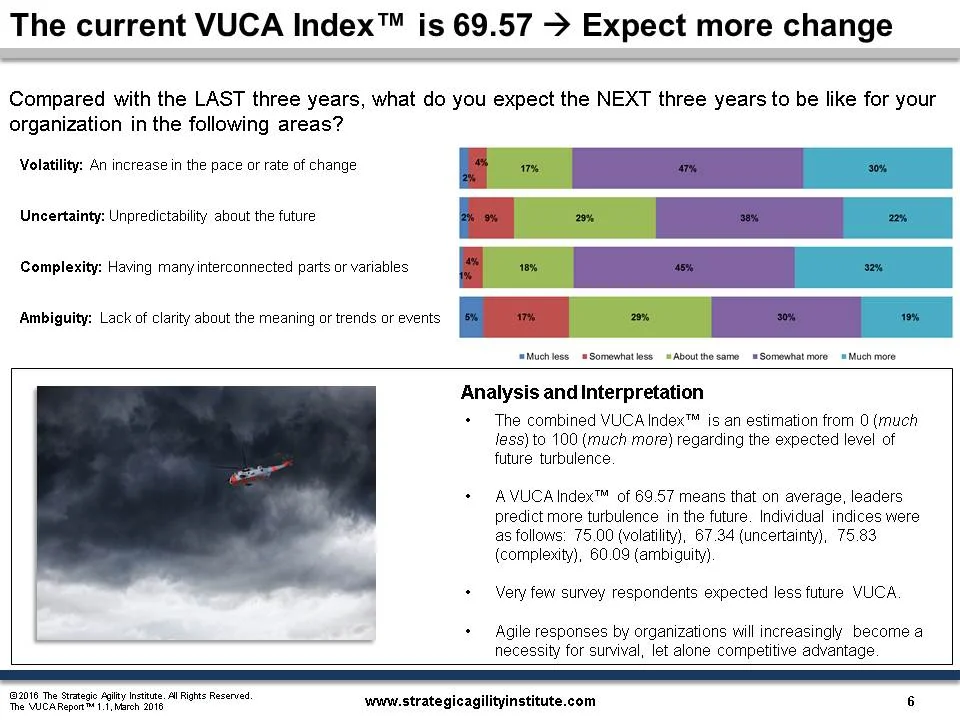
Our analysis of the data suggests that VUCA will continue to increase, with a current VUCA Index™ of 69.57. This is an estimate from 0 (much less) to 100 (much more) regarding the expected level of future turbulence.
Additionally, we asked the 280 executives in our sample about their perceptions of 35 disruptive trends. These 35 trends fell across five categories: (a) technological advances, (b) economic and financial issues, (c) environmental and societal concerns, (d) geopolitics, regulations and security issues and (e) workforce dynamics.
It’s important to note that our data were from executives across all functions and numerous industries, so we’re relatively confident about what these data reveal. Interestingly, of the 10 most highly rated disruptive trends, five of them were in the category of workforce dynamics.
Leaders in the world of human resources, talent management and organizational development: Take heed.
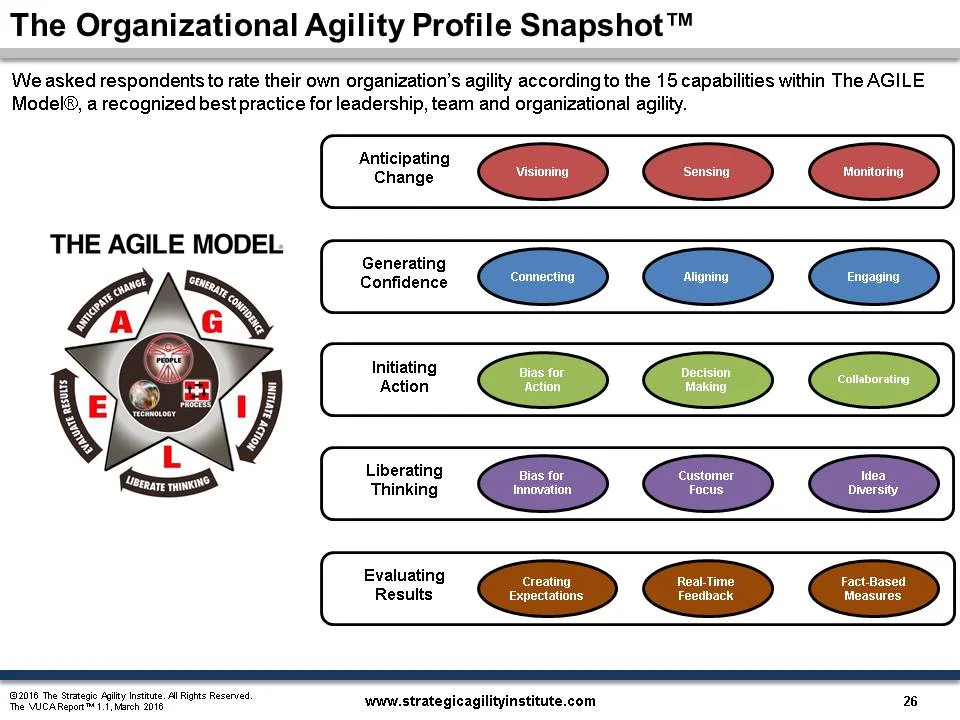
We then turned our focus to agility, which describes the ability to sense and respond to change quickly at the leader, team and organizational levels. Our experience—and that of many others—strongly suggests that agility is the antidote to VUCA. As such we asked our respondents to rate their own organization across the 15 capabilities within The AGILE Model®. On average, our respondents rated their capabilities in the areas of bias for action and customer focus as relatively strong—but they rated their capabilities in decision making and real-time feedback as relatively weak.
Finally, we included three open-ended items in the survey to gather our respondents’ thoughts across three questions related to agile practices. These questions are displayed below along with a word cloud for each that depicts the top keywords from the responses.
What is the most important practice that your organization is CURRENTLY doing that is helping you become more agile?
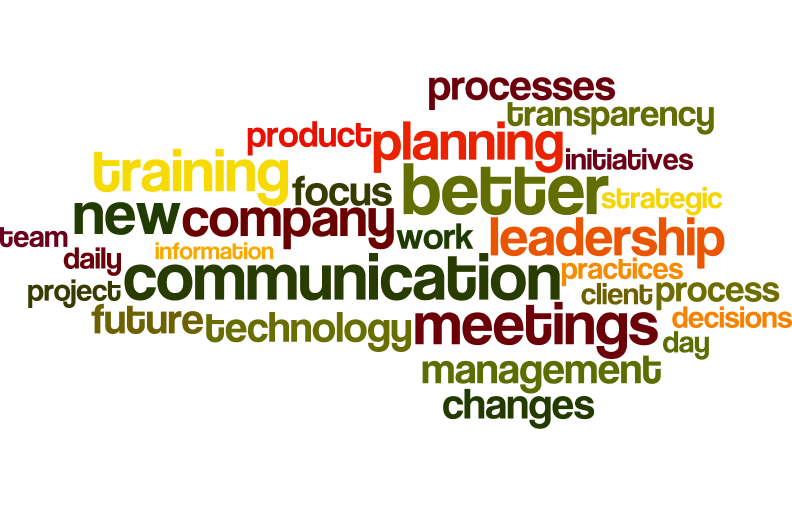
What is the most important practice that your organization SHOULD DO in the future to help you become more agile?

What is the biggest OBSTACLE keeping your organization from becoming more agile?

The full version of The VUCA Report™, of course, contains much more detail and analysis that you may find interesting and useful. We’re providing it to the entire world for the premium price of … nothing.
It’s totally free.
All we ask is that you take the survey that’s collecting data for the next version—Volume 1, Issue 2—of The VUCA Report™. After taking the survey, you’ll be immediately provided with a link that you can use to download this inaugural issue.
Click here to take the survey and download your copy of the inaugural issue of The VUCA Report™.
Together, we hope that The VUCA Report™ and other initiatives that we’re spearheading here at The Strategic Agility Institute will help us all become increasingly focused, fast and flexible in this VUCA world.
Find this thought provoking? Leave a comment, like and share!
About Ben Baran
Ben Baran, Ph.D., is probably one of the few people in the world who is equally comfortable in a university classroom, a corporate boardroom and in full body armor carrying a U.S. government-issued M4 assault rifle. Visit: www.benbaran.com.