
I’ve moved my blogging to Substack!
Feel free to check out any of the content I have here, but also be sure to check out my newest content at Reckoning and Elevating What Works.

What 280 Executives Said They Face
Turbulence ahead.
That’s one key message I learned while writing the inaugural issue of The VUCA Report™, which outlines findings from an ongoing study I’m spearheading here through The Strategic Agility Institute.
This study essentially focuses on two elements: (a) the forces of change that executives face and (b) what they’re doing about it. We were fortunate to have had 280 responses
Turbulence ahead.
That’s one key message I learned while writing the inaugural issue of The VUCA Report™, which outlines findings from an ongoing study I’m spearheading here through The Strategic Agility Institute.
This study essentially focuses on two elements: (a) the forces of change that executives face and (b) what they’re doing about it. We were fortunate to have had 280 responses (from almost as many different organizations) to analyze for this first issue of The VUCA Report™.
Thank you to everyone who participated in this global, collaborative effort.
Regarding the forces of change, we built upon the “VUCA” framework, which was first coined by social scientists at the U.S. Army War College in the early 1990s. VUCA stands for four aspects of turbulence, so to speak: volatility, uncertainty, complexity and ambiguity.
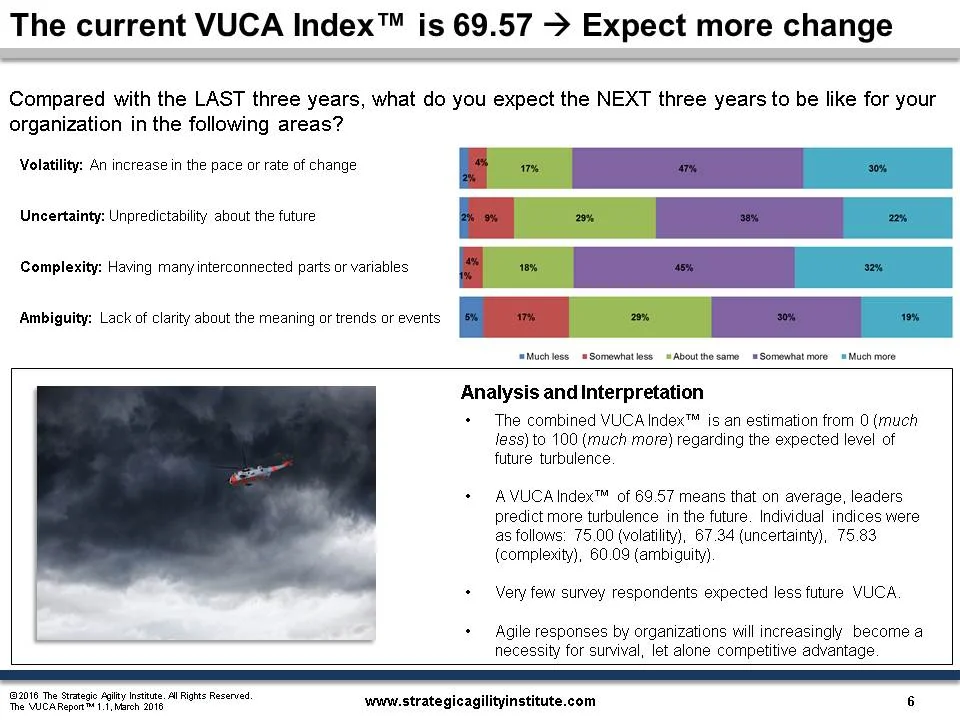
Our analysis of the data suggests that VUCA will continue to increase, with a current VUCA Index™ of 69.57. This is an estimate from 0 (much less) to 100 (much more) regarding the expected level of future turbulence.
Additionally, we asked the 280 executives in our sample about their perceptions of 35 disruptive trends. These 35 trends fell across five categories: (a) technological advances, (b) economic and financial issues, (c) environmental and societal concerns, (d) geopolitics, regulations and security issues and (e) workforce dynamics.
It’s important to note that our data were from executives across all functions and numerous industries, so we’re relatively confident about what these data reveal. Interestingly, of the 10 most highly rated disruptive trends, five of them were in the category of workforce dynamics.
Leaders in the world of human resources, talent management and organizational development: Take heed.
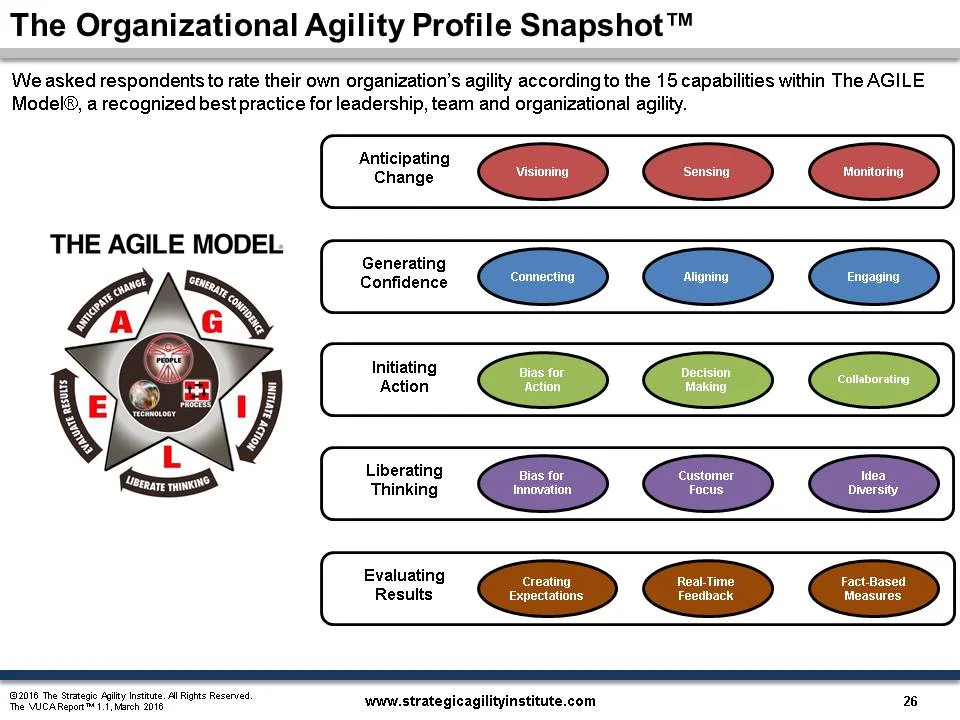
We then turned our focus to agility, which describes the ability to sense and respond to change quickly at the leader, team and organizational levels. Our experience—and that of many others—strongly suggests that agility is the antidote to VUCA. As such we asked our respondents to rate their own organization across the 15 capabilities within The AGILE Model®. On average, our respondents rated their capabilities in the areas of bias for action and customer focus as relatively strong—but they rated their capabilities in decision making and real-time feedback as relatively weak.
Finally, we included three open-ended items in the survey to gather our respondents’ thoughts across three questions related to agile practices. These questions are displayed below along with a word cloud for each that depicts the top keywords from the responses.
What is the most important practice that your organization is CURRENTLY doing that is helping you become more agile?
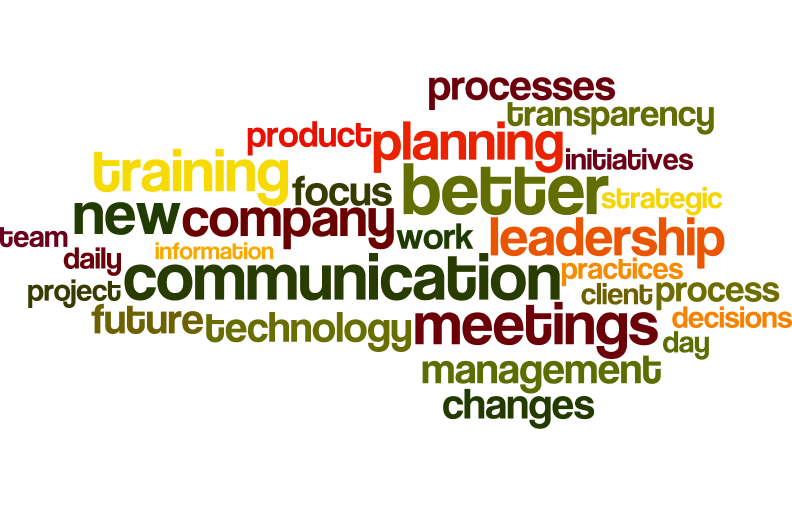
What is the most important practice that your organization SHOULD DO in the future to help you become more agile?

What is the biggest OBSTACLE keeping your organization from becoming more agile?

The full version of The VUCA Report™, of course, contains much more detail and analysis that you may find interesting and useful. We’re providing it to the entire world for the premium price of … nothing.
It’s totally free.
All we ask is that you take the survey that’s collecting data for the next version—Volume 1, Issue 2—of The VUCA Report™. After taking the survey, you’ll be immediately provided with a link that you can use to download this inaugural issue.
Click here to take the survey and download your copy of the inaugural issue of The VUCA Report™.
Together, we hope that The VUCA Report™ and other initiatives that we’re spearheading here at The Strategic Agility Institute will help us all become increasingly focused, fast and flexible in this VUCA world.
Find this thought provoking? Leave a comment, like and share!
About Ben Baran
Ben Baran, Ph.D., is probably one of the few people in the world who is equally comfortable in a university classroom, a corporate boardroom and in full body armor carrying a U.S. government-issued M4 assault rifle. Visit: www.benbaran.com.

HR in 2016: Top Industry Insights from SHRM, Bersin and SIOP
One increasingly common trend is, well, trend reports. Professional organizations, research firms and consultancies frequently publish what they see as the latest developments or top predictions for the future. Depending on the source, these trend reports can be thought-provoking and insightful.
At the very least, I find it interesting to see what various leaders see on the horizon.
Recently, three

One increasingly common trend is, well, trend reports. Professional organizations, research firms and consultancies frequently publish what they see as the latest developments or top predictions for the future. Depending on the source, these trend reports can be thought-provoking and insightful.
At the very least, I find it interesting to see what various leaders see on the horizon.
Recently, three such organizations published their trend reports for 2016—all focusing on the workplace and human resources (HR) topics. These three organizations are the Society for Human Resource Management (SHRM), Bersin by Deloitte, and the Society for Industrial and Organizational Psychology (SIOP).
Below, I’ve summarized each and provided links for the full reports.
SHRM—What HR Needs to Know in 2016
The approach. SHRM used its competency model to organize its report. As such, the report outlines key areas within each of SHRM’s HR competency areas, with notable writers and researchers providing their thoughts.
- Leadership and Navigation: It’s All About Teams
- Relationship Management: The New Flexibility
- Consultation: Preparing Your Company for the New Overtime Rules
- HR Expertise: Facing the Future of Work
- Critical Evaluation: Put Your Analytics into Action
- Global and Cultural Effectiveness: Recruiting Is Social and Talent Is Local
- Ethical Practice: HR Must Champion a Principled Culture
- Business Acumen: Building a Better HR
I recommend checking out the complete report, as each of these areas has its own article. Click here for more from SHRM.
Bersin by Deloitte—Predictions for 2016: A Bold New World of Talent, Learning, Leadership, and HR Technology Ahead
The approach. It isn’t exactly clear how the author(s) derived the 10 areas highlighted in this report, but I infer from the introduction that the 10 areas came from a qualitative, narrative categorization of what they have seen, researched or experienced during the past year. (If you have insight on the methodology, please feel free to leave a comment.)
- Digital HR Arrives—Changing the Way HR Organizations Design and Deliver Employee Solutions
- The Need to Improve the Employee Experience and Harness People Data Drive the Stampede to Replace Dated HR Systems
- New Models of Talent Management Emerge—Creating a New Generation of Talent Management Platforms
- The Rush to Replace and Reengineer Performance Management Accelerates around the World
- Engagement, Retention, and Culture Persist as Top Priorities—With New Feedback and Analytics Systems Coming to Market
- Global Leadership Development, Coupled with Career and Talent Mobility, Takes on a Fresh New Focus. Mentoring and Coaching Grow Rapidly
- The Revolution in Corporate Learning Continues as a New Model Evolves
- Diversity and Inclusion Merge with Key HR and Business Strategies—To Move Well Beyond Compliance and Become a Strategic Part of Business
- People Analytics Accelerates Its Growth—Evolving to a Mainstream Program in the HR Function
- The HR Profession Leaps Forward as a New Breed of HR Leaders Enter the Stage
Click here for more from the Bersin by Deloitte report (you’ll need to provide some information in order to download a copy of the report).
SIOP—Top 10 Workplace Trends 2016
The approach. SIOP derived its list by asking its members for their predictions. Then, they asked their members to rank-order the items on the list. About 700 of the organization’s members participated (full disclosure, I was one of them).
#10. Using Social Media to Make Employment-Related Decisions
#9. Building Healthy, Diverse Workforces
#8. Work–Life Balance Across Generations
#7. Increased Focus on Business Agility and Flexibility in Work and Business Processes
#6. Increasing Focus on Health and Wellness in the Workplace
#5. Employee Engagement
#4. Changing Nature of Performance Management and Development
#3. Managing Virtual Teams
#2. Trends in Technology Are Changing the Way Work Is Done
#1. Leveraging and Maximizing Big Data and Applying the Correct Analytics to Make Better Business Decisions
Click here to see more details about this list.
So are there any themes that cut across multiple reports? From what I can tell, it seems like there are a few, such as:
- Technology is changing HR and the way people work (Bersin, SIOP)
- Evolving views and practices for performance management (Bersin, SIOP)
- Workforce well-being and diversity (Bersin, SIOP, SHRM)
- Using data and analytics for people-related planning and operations (Bersin, SIOP, SHRM)
- Agility and flexibility for processes, planning and leadership across the organization (Bersin, SIOP, SHRM)
- Engagement and culture (Bersin, SIOP, SHRM)
- New models for leadership and teams (Bersin, SIOP, SHRM)
Which of these HR trends do you see as most prevalent in your industry or organization? Are there any that surprised you or any that you think are missing from these lists? Leave a comment below!
Find this thought provoking? Like and share!
By the way, we’re collecting data for our own unique type of ongoing study: The VUCA Report. I’d love to have your insights.
About Ben Baran
Ben Baran, Ph.D., is probably one of the few people in the world who is equally comfortable in a university classroom, a corporate boardroom and in full body armor carrying a U.S. government-issued M4 assault rifle. Visit: www.benbaran.com.