
I’ve moved my blogging to Substack!
Feel free to check out any of the content I have here, but also be sure to check out my newest content at Reckoning and Elevating What Works.

Agile HR: Trends and Opportunities
The future of human resources (HR) lies at the intersection of strategy, data analytics, design thinking, and a new set of practices and mindsets ushered in by the world of agile methods and organizational agility writ large.
And the time is ripe for HR professionals to have the bandwidth necessary to devote themselves to such matters. Numerous HR services—particularly those that are

The future of human resources (HR) lies at the intersection of strategy, data analytics, design thinking, and a new set of practices and mindsets ushered in by the world of agile methods and organizational agility writ large.
And the time is ripe for HR professionals to have the bandwidth necessary to devote themselves to such matters. Numerous HR services—particularly those that are more compliance and administrative in nature—have been prime candidates for outsourcing for years. Automation, furthermore, has the potential to eliminate or reduce further many repetitive HR tasks.
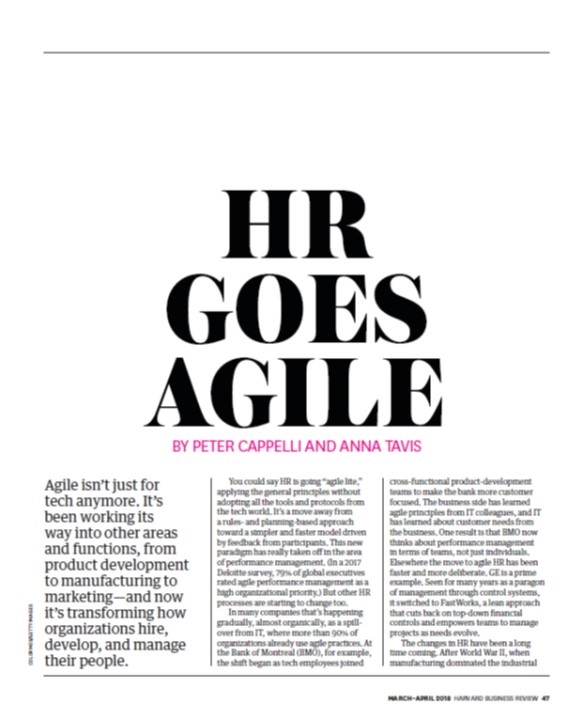
In the March-April 2018 issue of Harvard Business Review, Peter Cappelli and Anna Tavis outline a number of ways in which HR is adopting agile principles. In their article, “HR Goes Agile,” Cappelli and Tavis highlight how HR practices are beginning to trend away from the old approaches governed by rules and plans. Taking cues from agile, they contend, HR is increasingly moving toward a feedback-driven approach characterized by simplicity and speed.
Here are some highlights from their article.
First, a number of big trends are fundamentally influencing HR. These include increasingly rare lifelong employment and an environment marked by rapid change, which drives rapidly changing skill requirements.
Second, the strategic imperative now is rapid innovation, and this applies to HR. In a fast-paced world, top-down planning doesn’t work very well. Instead, nimble, user-driven methods such as rapid prototyping, team-based decisions, and “sprints” centered on specific tasks.
Third, such changes in the larger business environment are driving changes in specific practices, many of which are either HR-driven or used by HR. These include:
Performance appraisals, in which the clear trend is toward having higher-frequency, sometimes project-based feedback versus the typical annual review. The emphasis here is on quick feedback to enable “course corrections.” Elements of agile methods and design thinking can also inform the organization’s approach toward performance appraisal design, with a specific emphasis on involving employees in the prototyping, testing, and iterative improvement process.
Coaching, in which organizations are realizing that they must invest time in developing manager’s skills. In a world driven by high-quality feedback to drive fast improvement, managers need to build a robust set of communication and coaching skills.
Teams, in which work may be best organized by projects instead of by functions or other aspects of formal hierarchy. Here, methodologies such as Scrum are proving useful, as well as norms and rituals that support multi-directional feedback, lower-level decision-making, and supervisors who facilitate healthy teams—not just individual performance.
Compensation, in which incentives may be used to reinforce values such as learning and sharing knowledge. Another potential implication is the use of quick bonuses instead of annual merit-based raises.
Recruiting, in which the use of cross-functional teams with hiring managers who rotate on and off depending on whether they’re hiring can drive the acquisition effort for specific sets of jobs. Prioritization is also key, because not all vacancies are created equal: Some should be filled before others.
Learning and development, in which efforts become tailored to the job and the person in real-time. IBM appears to be at the forefront of these efforts, using “cognitive” (artificial intelligence) approaches to drive training. Additional value may be created by training the organization on specialized topics within the world of agile principles and methods.
My take on this is that these are excellent points—and all in HR should heed them.
But there’s much more, some of which I’ve written about previously. What remains somewhat unexplored is how HR can specifically help the organization overall become more nimble, more agile. Becoming agile itself may be a start, but HR should also continue to work to better define how its practices and strategies can drive innovation and responsiveness to change overall. Related topics and bodies of knowledge including strategy, data analytics, and design thinking play critical roles as well.
What’s clear is that these are exciting times. And perhaps within this context, HR has an opportunity to—in the words of management scholar Gary Hamel— create organizations that are both “fit for the future” and “fit for human beings.”
About Ben Baran
Ben Baran, Ph.D., is probably one of the few people in the world who is equally comfortable in a university classroom, a corporate boardroom and in full body armor carrying a U.S. government-issued M4 assault rifle. He regularly consults leaders and organizations across a wide range of sectors and industries. Visit: www.benbaran.com.

The Death Star Aimed at Your Scrum Team
I worry about many companies that are starting to use scrum for project management or product development.
I worry not because scrum doesn’t work. It surely can, and when done right, it can be a highly invigorating and effective process for all involved.
I worry about companies that are starting to use scrum for two reasons:

I worry about many companies that are starting to use scrum for project management or product development.
Note: You may already know this, but scrum is a team-based methodology for solving complex problems. It’s based upon a highly transparent and visible workflow, and it relies heavily upon the candid use of evidence to experiment and iterate. A full discussion of scrum is beyond the scope of this post; click here for an overview.
I worry not because scrum doesn’t work. It surely can, and when done right, it can be a highly invigorating and effective process for all involved.
I worry about companies that are starting to use scrum for two reasons:
First, some companies try to introduce scrum without guidance from someone who has been there and done that. Regardless of the intelligence of the team members, it’s exceedingly difficult to “do scrum” void of firsthand experience. It’s simply too different from the status quo for the vast majority of people to really “get” from only reading about it. Great companies with great leaders—like a current manufacturing client working with me and my world-class partners Mike Richardson and Chris Everett—understand this and get the coaching and support necessary to make the transition to scrum. Everett puts it this way, “You can read a ton about boxing, but that’s not going to help you a whole lot in the ring.”
Second, and perhaps even more commonly, many companies introduce scrum without sufficient understanding among top management about how their own behavior must change to support scrum and overall organizational agility. This is the top of what Richardson calls the “T-shaped” approach to agility. The horizontal part of the “T” is all about executive processes and behaviors, with the verticals (there can and should be more than one) being core business processes. Those executive processes and behaviors at the top of the “T”—either intentional or unintentional—can become a “Death Star” aimed at the verdant, energized world created by the new scrum team.
One example of this is “dark work.” Dark work comprises all of those tasks or projects that are unplanned and simply added on top of all the other tasks or projects that the team and others have already vetted for strategic importance and workload feasibility. It’s the unplanned “Hey, could you take a look at this?” or “Excuse me, would you help with this project?” If a team is using scrum correctly, its members are carefully and continually reviewing and prioritizing their task list. They’re making estimates based upon workload capacity—which itself is an estimate based upon their conversations. But if dark work creeps in, it can cause a team member to falter in delivering to other team members, eventually leading to a breakdown in the overall process.
The key to success is two-fold:
Scrum requires agile behaviors across the top of the organizational chart, starting with a hard look at strategy and strategic initiatives. Prioritization here is critical, too. If everything is a priority, nothing is a priority. Top management needs to understand not only how their scrum teams are operating, but they also need to become more nimble themselves. This requires an honest appraisal of their current state along with an unvarnished, no-kidding set of agile operating principles to which they hold themselves and each other accountable.
With regard to the “Death Star” of dark work specifically, executives need to realize that interrupting the scrum process has consequences. If the dark work really is a necessity—it can certainly happen—executives shouldn’t be surprised if the scrum team then reprioritizes its work due to the workload change.
One of the most rewarding aspects of scrum, from my experience, is seeing the creative energy that it can bring to those involved. It’s a method of doing work, I think, that’s much closer to how humans work best than what happens in most organizations.
At the same time, top leaders must be mindful that allowing a scrum team to flourish requires much more than simply giving a team the permission to work in a different way.
It also requires agility within the top management team.
And that often starts with every executive realizing that change always starts with one person in particular—the man or woman in the mirror.
Find this thought provoking? Leave a comment, like and share!
About Ben Baran
Ben Baran, Ph.D., is probably one of the few people in the world who is equally comfortable in a university classroom, a corporate boardroom and in full body armor carrying a U.S. government-issued M4 assault rifle. Visit: www.benbaran.com.

What Everyone in HR Needs to Know About Change
Models for planning and executing organizational change abound—for example, Kotter’s eight steps, among many others. These models are helpful in highlighting many of the critical aspects of organizational change, and I highly recommend immersing yourself in them.
That being said, I find that such models often deal more with planned organizational change than with unplanned or continuous organizational change.
And in an increasingly turbulent world, it’s important for human resources (HR) professionals and the HR function overall to

Models for planning and executing organizational change abound—for example, Kotter’s eight steps, among many others. These models are helpful in highlighting many of the critical aspects of organizational change, and I highly recommend immersing yourself in them.
That being said, I find that such models often deal more with planned organizational change than with unplanned or continuous organizational change.
And in an increasingly turbulent world, it’s important for human resources (HR) professionals and the HR function overall to take a more fluid, proactive and strategic approach toward change. The realities of the business environment continue to drive changes within organizations, and it’s time for HR to get up to speed.
From what I’ve observed and experienced in HR during the past decade, the HR profession has an opportunity to contribute meaningfully to how organizations adapt. But we in HR may need to consider organizational change from a slightly different angle. We must start with connecting with the organization’s strategy, and we can then use that direction to guide what we do. Furthermore, we’d be well served to think about what we do a little bit differently, adopting some of what’s working well elsewhere, to get things done quickly.
Specifically, those of us in HR would benefit from the following regarding our approach to organizational change:
1. Know your terrain.
It’s critical for HR professionals to understand their environment, or their terrain, both within and outside of their organization. While it’s important to know what people in HR care about, it’s even more important for HR people to know what their top leaders outside of HR care about—what are the main concerns of the c-suite? We in HR also must start thinking much more than we do currently about the environment outside of the organization—where does your organization compete? How does it win? What are the big trends in your industry, and how can HR address them? These questions and others like them allow HR professionals to better understand what’s ahead and anticipate change.
2. Think like a startup.
The ambiguity of working in a startup is extreme. Everyone has advice; most of it seems plausible, yet some of it is contradictory. Yet you must forge ahead and create that which has never existed. Given the nature of startups, it’s worth thinking about how they deal with ambiguity and change to see what lessons we may glean for HR. I advocate for a more strategic, proactive, entrepreneurial and agile HR function that will quickly add value to the business. In addition, startups can deal with change in a more iterative fashion, taking some of the lessons we know from design thinking to develop fast prototypes, test them and continually improve—instead of letting the perfect become the enemy of the good.
3. Embrace agility.
As organizations attempt to cope with a turbulent business environment, they may need to move from continually seeking equilibrium to being nimble. Agility, generally speaking, is the capability to sense and respond quickly to the forces of change at all levels within the organization. HR would be well served to assess its own agility, along with the agile capabilities of the organization overall. But agility isn’t about reckless flexibility. Rather, we all need some “North Star” to cling onto as our organizations adapt and evolve. As such, HR can help provide stability through working with top management to clarify and communicate continually its core values. Additionally, “agile HR” involves moving from some of our tried and true dogma (e.g., job descriptions) to practices that reflect how people actually work (e.g., project and team charters).
I see the next 10 years as ones in which HR will likely go through a number of dramatic shifts—because if it doesn’t, it may become a victim of accelerated obsolescence. And when it comes to remaining relevant through a different understanding of change, having an increased focus on (a) knowing the terrain, (b) thinking like a startup and (c) embracing agility will serve the HR function and those who work within it well.

I’ll be discussing these topics in much more detail next Tuesday, April 18, from 3 to 4 p.m. EDT in a webcast with the Human Capital Institute. Click here for more details.
I’d love to have you join the conversation.
UPDATE: The webcast was great--hundreds of people joined me for a wonderful conversation. Click here to access the full recording and the slides I used.
Find this thought provoking? Leave a comment, like and share!
About Ben Baran
Ben Baran, Ph.D., is probably one of the few people in the world who is equally comfortable in a university classroom, a corporate boardroom and in full body armor carrying a U.S. government-issued M4 assault rifle. Visit: www.benbaran.com.

Two Ways HR Can Rise Up
I spend a fair amount of time around the human resources (HR) profession. Sometimes, that’s in the form of consulting and problem-solving alongside HR leaders; other times it’s through research or teaching graduate students. I’m also an HR officer in the U.S. Navy Reserve, and I maintain my HR certifications like thousands of other HR people.
But I’m often critical of HR. That’s not at all because I think HR people aren’t doing good work; rather, I think every profession should be critical of itself in an attempt to improve continually and stay relevant. We should all be on the lookout for how we can get better at what we do and how we do it.
In particular for HR, I see two areas in which HR could improve substantially.

I spend a fair amount of time around the human resources (HR) profession. Sometimes, that’s in the form of consulting and problem-solving alongside HR leaders; other times it’s through research or teaching graduate students. I’m also an HR officer in the U.S. Navy Reserve, and I maintain my HR certifications like thousands of other HR people.
But I’m often critical of HR. That’s not at all because I think HR people aren’t doing good work; rather, I think every profession should be critical of itself in an attempt to improve continually and stay relevant. We should all be on the lookout for how we can get better at what we do and how we do it.
In particular for HR, I see two areas in which HR could improve substantially. This isn’t to say that HR people aren’t thinking about these things or that many HR departments are already well on their way. But it is to say that considerable room for improvement exists profession-wide.
These two areas—or two ways in which HR can rise up—are:
- Its connection to business strategy and
- Its use of analytics.
First, HR must improve in terms of its connection to business strategy. I hear about employee engagement committees focused primarily on planning company picnics. I hear about HR departments being the last to know about major organizational changes. I hear executives complain that HR in their own company is a gate-keeper, not a service provider.
Being more strategic as an HR person or as an HR function implies special mindset. As Dave Ulrich writes, HR needs to understand the context of their business. They need to understand how their organization competes and wins in the marketplace. Such an understanding is critical because it informs, as Ulrich discusses, a stakeholder view of HR in which the HR function has five main groups that it serves:
- Employees,
- Line managers,
- Customers,
- Investors and the
- Community at large.
With such a mindset, HR people can transform their conversation from one of the tactical and administrative to one of strategy and business results. If you feel that your HR function doesn’t get the respect it deserves in your organization, having a strategic mindset and aligning what you do as a function with the business strategy is a great place to start.
HR professionals, in particular those who lead any HR function, should know and be able to articulate how their priorities and activities align with helping the organization win.
Second, HR must embrace analytics. The world is awash with data, and it’s increasingly becoming apparent that HR must focus on analyzing the right data in the right way to inform decision making. It’s no surprise that the Society for Industrial and Organizational Psychology named “Leveraging and Maximizing Big Data and Applying the Correct Analytics to Make Better Business Decisions” as its top workplace trend for 2016.
From my interactions, HR can improve greatly in this area, but it’s going to require many people in HR to become comfortable with data. It’s going to require them to, in many cases, obtain new skills related to the use of data and analytics.
If you’re wondering what on earth HR analytics is all about, here are a few references that might be helpful in getting you started:
- Josh Bersin’s article in Forbes
- “Change your company with better HR analytics,” an article on the Harvard Business Review blog
- An overview from the Association for Talent Development
HR people and the HR function have, in my opinion, so much to offer their organizations. They’re becoming increasingly essential for organizations as they navigate the modern world of work, but to realize that potential, they’ve got to be strategic in focus and evidence-based in their decision-making.
And so, I encourage everyone in the world of HR to adopt a strategic posture and embrace the world of talent or HR analytics. There are many ways, of course, that HR can add value in organizations, but these are two areas in which it seems that HR can, in particular, rise up.
Love it? Hate it? Find it thought provoking? Leave a comment, like and share!
About Ben Baran
Ben Baran, Ph.D., is probably one of the few people in the world who is equally comfortable in a university classroom, a corporate boardroom and in full body armor carrying a U.S. government-issued M4 assault rifle. Visit: www.benbaran.com.

The Agile Crimson Tide
The Alabama Crimson Tide lost on Monday evening, giving the Clemson Tigers their first national college football championship in 35 years.
But within the world of American college football, it’s undeniable that the University of Alabama’s football program—under head coach Nick Saban—is a powerhouse.
So despite the fact that Crimson Tide fans everywhere are in a state of mourning this week, there’s an interesting lesson to be learned from how Alabama has adapted its approach to the game of football during the past five years. It’s a lesson in

The Alabama Crimson Tide lost on Monday evening, giving the Clemson Tigers their first national college football championship in 35 years.
But within the world of American college football, it’s undeniable that the University of Alabama’s football program—under head coach Nick Saban—is a powerhouse.
So despite the fact that Crimson Tide fans everywhere are in a state of mourning this week, there’s an interesting lesson to be learned from how Alabama has adapted its approach to the game of football during the past five years. It’s a lesson in sensing and responding to the forces of change, and it’s about having the ability to improve continually—even when, overall, you’re still winning most of the time.
I won’t belabor the details of what Saban noticed or what he changed in his approach toward the game—those points are well-documented by ESPN Senior Staff Writer Chris Low. Instead, here are few excerpts from Low’s observations about Saban and how they contain lessons about agility for the rest of us:
“‘I might not like it, but it ain't the way ball is now,’ Saban said of the blueprint that won the first three of his four national championships at Alabama. ‘It's unbelievable how much the game has changed, and it's really hard to coach defense now. But hey, it's on me—regardless of the way I think football should be played—if I don't change with it.’”
Saban readily accepts the fact that we typically have little to no control over the external realities within which we must operate. Good strategy is about having an approach that corresponds with external reality, not having wishful thinking about what the world should be like.
“But while Saban might be old school and might have strong convictions about the direction of the game, the one thing he's not is stubborn. He's smart enough to know that nothing stays the same, especially when you're in the business of chasing championships.”
I’m fortunate to have the opportunity to work frequently with some extraordinarily smart executives, researchers and students. But smart doesn’t always equal agile. Sometimes, people can fall too much in love with their own beliefs about what creates success or what should be done that they fail to recognize that the game has changed around them. And if they finally realize that they must change, it’s often too late for it to really make a difference. Being a little bit suspicious of your success is a good thing.
“‘It just points out how [Saban] is always looking at everything, how to find a better way to do things,’ [former Alabama offensive coordinator Lane] Kiffin said. ‘In the offseason, he's flying us to different places to go learn things and bringing in coaches all the time, which again, that's unusual, because someone like him ... why does he want to learn from someone else? He's the best coach in college football, but that's why he continues to be the best coach.’”
Staying at the top of your game—either as an individual contributor, a middle manager or a senior executive—demands that you (a) have a growth mindset toward your own knowledge and skills and (b) intentionally immerse yourself in useful information. Complacency and comfort are dangerous because they lead to what Robert Quinn, in his book Building the Bridge as You Walk On It, called “slow death.” Or, similarly, it can lead to what Jim Collins, in his book How The Mighty Fall, called “hubris born of success.”
Either way, being agile—as an organization, team, leader, or in virtually any other capacity—demands that you stay on guard. And Saban’s approach with The Crimson Tide is a good reminder of what that “looks like.” It suggests a few good bits of advice, including:
- Don’t change just for change’s sake, but be wary of the status quo.
- Continually watch for subtle forces of change that affect how you win.
- Be prepared to let go of what used to work and adopt new strategies.
- Learn from other people and help your team do the same.
Adopting these habits may not result in you being the highest paid state employee in Alabama. But these routines will help you deal with the change around you much faster and better than those who don’t.
And even if you never win a national championship in anything, I’d wager that being nimble makes the uncertainty of the future a bit less scary and bit more fun.
Find this thought provoking? Leave a comment, like and share!
About Ben Baran
Ben Baran, Ph.D., is probably one of the few people in the world who is equally comfortable in a university classroom, a corporate boardroom and in full body armor carrying a U.S. government-issued M4 assault rifle. Visit: www.benbaran.com.

When Drowning Prevention Meets Business Strategy
My children love the water. They swim, they splash, they laugh.
My children, like most children, are fast. They dart, they scurry, they hide.
Therefore, when my children encounter water, it can be an exhausting experience for my wife and me. We must be vigilant.
The pool we frequent has lifeguards. But their vigilance will never match mine.
Unless, of course, we’re talking about

My children love the water. They swim, they splash, they laugh.
My children, like most children, are fast. They dart, they scurry, they hide.
Therefore, when my children encounter water, it can be an exhausting experience for my wife and me. We must be vigilant.
The pool we frequent has lifeguards. But their vigilance will never match mine.
Unless, of course, we’re talking about lifeguards at Great Wolf Lodge. Their vigilance surpasses mine 99 percent of the time (at least when it comes to paying attention to all of the children in an area, not just my own).
And one reason, I suspect, has to do with business strategy.
For the unfamiliar, Great Wolf Lodge is a large, growing chain of indoor, family-friendly water parks. They’re open year-round, and children of all ages can swim, go down slides and splash around with a host of water-related valves and buckets. My children love it.
But Great Wolf Lodge realizes that regardless of how fun they make the water park or how attentive they are to the overall customer experience, there’s a chink in their armor.
They have an Achilles heel.
There’s a specific type of failure that could severely damage their reputation and their business.
It’s drowning, leading to the death of a child.
The entire business model of Great Wolf Lodge depends on the safety of the children and a fun experience for everyone. If the safety of the experience—either real or perceived—came into question within the minds of potential customers, their business would suffer dramatically. (And the safety of children is intrinsically good, of course.)
And so, back to the lifeguards. During the times I’ve visited Great Wolf Lodge, I couldn’t help but notice that they:
- Avoid eye contact with people outside of the water
- Continually scan their gaze back and forth on their area, focusing on the water itself, not on individual children
- Seem to rotate on shifts more frequently than lifeguards at most pools
- Get tested unexpectedly by training personnel who nonchalantly toss a dummy child into the water and time how fast the lifeguard reacts
In this way, Great Wolf Lodge lifeguards and their managers are preoccupied with failure. They have specifically identified what they must avoid as an organization. And they have constructed hiring, training, cultural norms and incentives to guide behavior accordingly.

Photo from: https://www.greatwolf.com/culture
To be fair, Great Wolf Lodge doesn’t have a zero-incident safety record. I highly doubt any park of its magnitude does. But it’s also fair to say that the probability of any specific child having a serious incident at Great Wolf Lodge is very, very low. That’s the way it should be. Safety is boring. It’s a non-event.
For businesses not in the amusement park industry, however, I think there are some lessons to be learned from Great Wolf Lodge, its lifeguards and its preoccupation with drowning.
These lessons include:
- Focusing on the positive might be warm and fuzzy, but it’s critical to identify what your organization must avoid
- Avoiding failure—and really risk management in general to some degree—involves creatively thinking about what could go wrong
- Once you’ve identified these potential internal weaknesses or external threats, you should consider what you can do about them
- Leaders can use these risky areas of their operations as a focusing mechanism for employee behavior through hiring practices, training and incentives
- Managing for non-events requires ongoing vigilance, which must be shared and replenished
The key is to figure out what “a drowning child” looks like in your organization, and then to identify how it can be detected as quickly as possible. Having a reliable organization doesn’t mean that you’ll never encounter a “drowning child,” but it does mean that your people will recognize what it looks like and take mitigating actions—before it becomes a catastrophe.
Find this thought provoking? Leave a comment, like and share!
About Ben Baran
Ben Baran, Ph.D., is probably one of the few people in the world who is equally comfortable in a university classroom, a corporate boardroom and in full body armor carrying a U.S. government-issued M4 assault rifle. Visit: www.benbaran.com.

Why CEOs (Might) Hate HR
In the American television comedy series "The Office," the hostility between Michael Scott, regional manager of the mythical paper company Dunder Mifflin’s branch in Scranton, Pa., and Toby Flenderson, the branch’s human resources director, is a recurring theme.
During one particularly humorous scene, Michael learns suddenly that Toby—who had left the office previously—has returned.
Michael’s reaction?
In the American television comedy series "The Office," the hostility between Michael Scott, regional manager of the mythical paper company Dunder Mifflin’s branch in Scranton, Pa., and Toby Flenderson, the branch’s human resources director, is a recurring theme.
During one particularly humorous scene, Michael learns suddenly that Toby—who had left the office previously—has returned.
Michael’s reaction?

“No! God! No. God, please, no. No. No. No!”
Is that how your CEO reacts to HR?
One reason the conflict between Michael and Toby is funny to most of us is that it plays on a stereotype of HR as a rule-bound, stultifying function that usually only makes life more difficult for the rest of the organization.
I’m pleased that this stereotype is becoming less accurate, as many HR leaders are becoming more aware of how they must continually add value to the overall organization.
But many executives still don’t see that value, hence the continual discussion of how HR can “get a seat at the table.”
From my observations and conversations, one of the biggest reasons CEOs might not recognize the value of HR is straight-forward, yet simultaneously difficult to overcome: CEOs need HR leaders who think strategically.
This is straight-forward because it appears to have a clear solution. Namely, HR leaders need to start thinking about their functions and their organizations from a strategic perspective. This involves understanding how the organization competes and creates value. But this is a difficult issue to overcome because it involves a different way of thinking—and that’s tough to develop.
Regardless, I’ve been on a bit of a mission during the past few months.

That mission is to promote more strategic thinking among professionals in the world of HR and related functions such as training and talent development. I’ve done so through giving a handful of talks outside of the realm of academia, and that’s given me the opportunity not only meet some wonderful people, but also to share an approach toward strategic thinking.
These have included the 2015 HR Indiana Annual Conference and the 2015 Central Indiana Chapter of the Association for Talent Development Learning Summit.
Specifically, my message is about HR and related functions becoming more agile.
From the feedback I’ve received, HR leaders have found this approach thought-provoking and useful. So, what’s my approach? It has five main parts.
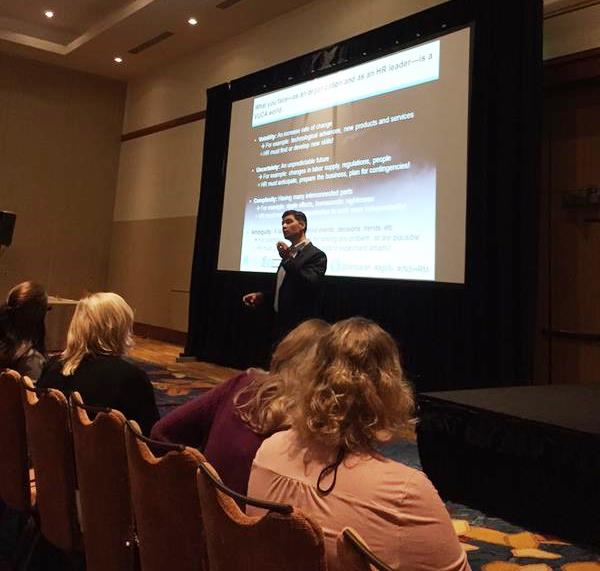
- Our world—and our organizations—operate in an environment of volatility, uncertainty, complexity and ambiguity (VUCA).
- HR professionals must continually study their environments, both internal and external to their organizations, so that they can anticipate and act quickly. Vigilance trumps complacency.
- In short, HR needs to become more agile—having the capability to sense and respond to the VUCA forces that they and their organizations face.
- Being agile means that HR leaders should proactively anticipate how they can help their organization's people perform optimally given what they face today and what they will face tomorrow.
- When HR leaders can connect their practices to the strategic needs of their organizations, top executives will sit up and take notice. Proactively doing this on a continual basis will move HR leaders into the sphere of being strategic business partners for the organization.
Certainly a great deal can go into making these approaches a reality. But here are a few questions HR professionals can ask about their own work and their functions as a whole:
- Are your workforce planning and talent development plans developed with multiple contingencies and scenario planning in mind?
- In what way and how often are you communicating with your key internal and external stakeholders?
- Are the criteria for identifying and selecting talent aligned with what the organization will need in the future, in addition to what’s needed today?
- How do you or your function stay aware of emerging trends in your organization’s industry as well as your profession (i.e., HR, talent development, etc.)?
- In what way does your work reflect a focus on your customers, both internally and externally
- How can you better align what you provide as HR leaders with your customers’ needs?
- To what degree are your practices and decisions based upon valid data and analysis?
This is clearly a complex topic, but it’s one that HR needs to continue tackling in order to help organizations thrive in the modern world of work. And if it does, HR will in many ways lead the organizations of the future.
But if it does not, everyone in HR risks becoming Toby Flenderson.
Do CEOs hate or love HR? Why or why not?
How can HR become even more agile and drive strategic-level results? Leave a comment below!
Find this thought provoking? Like and share!
About Ben Baran
Ben Baran, Ph.D., is probably one of the few people in the world who is equally comfortable in a university classroom, a corporate boardroom and in full body armor carrying a U.S. government-issued M4 assault rifle. Visit: www.benbaran.com.