
I’ve moved my blogging to Substack!
Feel free to check out any of the content I have here, but also be sure to check out my newest content at Reckoning and Elevating What Works.

Agile HR: Trends and Opportunities
The future of human resources (HR) lies at the intersection of strategy, data analytics, design thinking, and a new set of practices and mindsets ushered in by the world of agile methods and organizational agility writ large.
And the time is ripe for HR professionals to have the bandwidth necessary to devote themselves to such matters. Numerous HR services—particularly those that are

The future of human resources (HR) lies at the intersection of strategy, data analytics, design thinking, and a new set of practices and mindsets ushered in by the world of agile methods and organizational agility writ large.
And the time is ripe for HR professionals to have the bandwidth necessary to devote themselves to such matters. Numerous HR services—particularly those that are more compliance and administrative in nature—have been prime candidates for outsourcing for years. Automation, furthermore, has the potential to eliminate or reduce further many repetitive HR tasks.
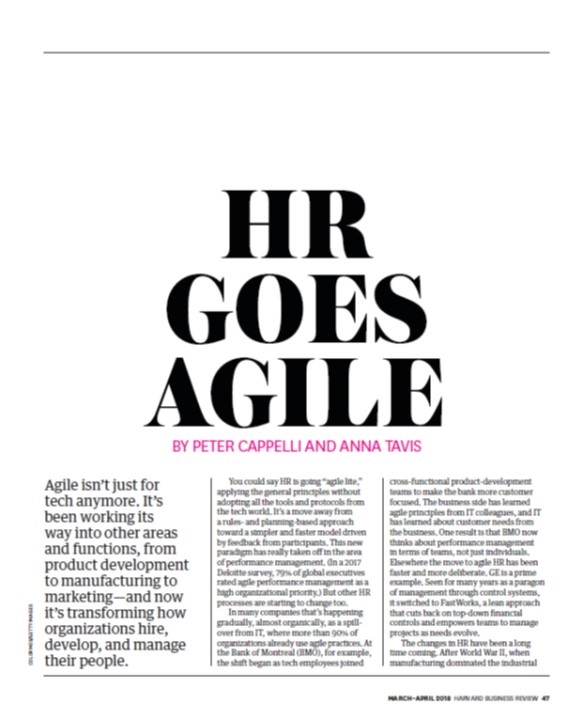
In the March-April 2018 issue of Harvard Business Review, Peter Cappelli and Anna Tavis outline a number of ways in which HR is adopting agile principles. In their article, “HR Goes Agile,” Cappelli and Tavis highlight how HR practices are beginning to trend away from the old approaches governed by rules and plans. Taking cues from agile, they contend, HR is increasingly moving toward a feedback-driven approach characterized by simplicity and speed.
Here are some highlights from their article.
First, a number of big trends are fundamentally influencing HR. These include increasingly rare lifelong employment and an environment marked by rapid change, which drives rapidly changing skill requirements.
Second, the strategic imperative now is rapid innovation, and this applies to HR. In a fast-paced world, top-down planning doesn’t work very well. Instead, nimble, user-driven methods such as rapid prototyping, team-based decisions, and “sprints” centered on specific tasks.
Third, such changes in the larger business environment are driving changes in specific practices, many of which are either HR-driven or used by HR. These include:
Performance appraisals, in which the clear trend is toward having higher-frequency, sometimes project-based feedback versus the typical annual review. The emphasis here is on quick feedback to enable “course corrections.” Elements of agile methods and design thinking can also inform the organization’s approach toward performance appraisal design, with a specific emphasis on involving employees in the prototyping, testing, and iterative improvement process.
Coaching, in which organizations are realizing that they must invest time in developing manager’s skills. In a world driven by high-quality feedback to drive fast improvement, managers need to build a robust set of communication and coaching skills.
Teams, in which work may be best organized by projects instead of by functions or other aspects of formal hierarchy. Here, methodologies such as Scrum are proving useful, as well as norms and rituals that support multi-directional feedback, lower-level decision-making, and supervisors who facilitate healthy teams—not just individual performance.
Compensation, in which incentives may be used to reinforce values such as learning and sharing knowledge. Another potential implication is the use of quick bonuses instead of annual merit-based raises.
Recruiting, in which the use of cross-functional teams with hiring managers who rotate on and off depending on whether they’re hiring can drive the acquisition effort for specific sets of jobs. Prioritization is also key, because not all vacancies are created equal: Some should be filled before others.
Learning and development, in which efforts become tailored to the job and the person in real-time. IBM appears to be at the forefront of these efforts, using “cognitive” (artificial intelligence) approaches to drive training. Additional value may be created by training the organization on specialized topics within the world of agile principles and methods.
My take on this is that these are excellent points—and all in HR should heed them.
But there’s much more, some of which I’ve written about previously. What remains somewhat unexplored is how HR can specifically help the organization overall become more nimble, more agile. Becoming agile itself may be a start, but HR should also continue to work to better define how its practices and strategies can drive innovation and responsiveness to change overall. Related topics and bodies of knowledge including strategy, data analytics, and design thinking play critical roles as well.
What’s clear is that these are exciting times. And perhaps within this context, HR has an opportunity to—in the words of management scholar Gary Hamel— create organizations that are both “fit for the future” and “fit for human beings.”
About Ben Baran
Ben Baran, Ph.D., is probably one of the few people in the world who is equally comfortable in a university classroom, a corporate boardroom and in full body armor carrying a U.S. government-issued M4 assault rifle. He regularly consults leaders and organizations across a wide range of sectors and industries. Visit: www.benbaran.com.

Using the Premortem to Drive HR Agility
When the unexpected strikes, our brains often start working like we’re being chased by a wild animal. Levels of hormones—specifically, adrenaline, norepinephrine and cortisol—increase, resulting in a range of reactions including increased heartrate, elevated blood pressure and tunnel-vision like focus on the threat.
This is great if you actually are being chased by a lion. The threat is singular, and your immediate actions are likely singular as well (for example, run fast to shelter).
But it’s not so great if you’re facing a complex problem in your organization.
When the unexpected strikes, our brains often start working like we’re being chased by a wild animal. Levels of hormones—specifically, adrenaline, norepinephrine and cortisol—increase, resulting in a range of reactions including increased heartrate, elevated blood pressure and tunnel-vision like focus on the threat.
This is great if you actually are being chased by a lion. The threat is singular, and your immediate actions are likely singular as well (for example, run fast to shelter).
But it’s not so great if you’re facing a complex problem in your organization.
That’s because solving complex problems often requires the ability to consider many sources of information and to sort through the ambiguity of the situation with other people. It requires a calm mindset and critical thinking to deliver the best solution, not just the first one that comes to mind.
HR leaders can often find themselves in tough, stressful circumstances. These situations demand agility, the ability to sense and respond quickly.
Consider, for example:
- A key executive suddenly announces she is quitting.
- A recently sacked employee files a lawsuit for wrongful termination.
- The CEO decides to begin massive layoffs.
- A sudden surge in demand requires increases in labor.
- A system breach compromises sensitive employee data.
These aren’t unlikely scenarios, and many HR leaders deal with them frequently. But are these situations—and other unexpected events—always handled with the utmost agility? Certainly, there’s room for improvement.
One way in which HR leaders can become more agile is by taking deliberate steps to anticipate change, taking the time to focus on what could go wrong and how prepared they are to deal with those specific issues.
The premortem is a specific tool that can help.
Most of us are familiar with the postmortem, in which a group discusses what went well and what didn’t go well after an event. The premortem, though, takes the idea of thinking about what could have gone wrong—in advance.
The psychologist Gary Klein has written about the premortem within the context of projects, highlighting how premortems can help leaders improve project planning. (I also highly recommend his book Sources of Power.)
Within the HR world, a premortem might look something like this:
- An HR director gathers his team and discusses the plan to address a potential issue, such as the departure of a key executive. He then asks them to imagine that it’s six months (or some other relevant time reference) in the future and the plan has been implemented.
- The HR director then asks everyone to imagine that the plan didn’t work well at all. Each person then takes a few minutes to write down the reasons they think the plan failed.
- Each person shares his or her reasons until all of them are documented.
- Then, the HR director uses that information to strengthen the plan.
This is just one simple example. But the reason a premortem can help drive HR agility is that it can allow the team to think about problems and solutions before the unexpected strikes, before their nervous systems become awash in potentially judgment-clouding stress hormones. It can allow the team to set in place a variety of systems that can help them perform well in a specific situation they may face.
Daniel Levitin, a neuroscientist at McGill University, discussed this concept more broadly, suggesting that pre-planned responses can help you stay calm in stressful circumstances.
His TED talk on the topic is below.
HR agility can come in many shapes and sizes, but the premortem is one tool that HR leaders could begin using to create different patterns of thinking for themselves and their teams. It can be a helpful part of anticipating change, allowing them to be more responsive to disruption when it occurs.
Because for so many of the unexpected situations that can unfold, it’s not a matter of if they will occur.
It’s a matter of when.
About Ben Baran
Ben Baran, Ph.D., is probably one of the few people in the world who is equally comfortable in a university classroom, a corporate boardroom and in full body armor carrying a U.S. government-issued M4 assault rifle. Visit: www.benbaran.com.