
I’ve moved my blogging to Substack!
Feel free to check out any of the content I have here, but also be sure to check out my newest content at Reckoning and Elevating What Works.

Take the High Road in Office Politics
If you haven’t worked in the military or alongside the military as part of a larger operation, you may think that the danger of being in a warzone or the importance of the overall mission may supersede the political games people often play in organizations.
I wish that were true.
I was part of NATO Training Mission-Afghanistan (NTM-A) from December 2012 to December 2013. I quickly learned upon my arrival was that NTM-A comprised myriad types of people
If you haven’t worked in the military or alongside the military as part of a larger operation, you may think that the danger of being in a warzone or the importance of the overall mission may supersede the political games people often play in organizations.

I wish that were true.
I was part of NATO Training Mission-Afghanistan (NTM-A) from December 2012 to December 2013. I quickly learned upon my arrival was that NTM-A comprised myriad types of people from myriad groups around the world. In general, however, there were three groups: the military and members of national police forces (from many countries), U.S. Department of Defense (DoD) civilians, and civilian contractors. Many of the DoD civilians were part of a group known as Ministry of Defense Advisors, or MoDAs.
The MoDAs were participants in a special program that trained experienced government civil servants and retired military personnel to be advisors to the governments of Iraq and Afghanistan.
Doug (not his real name) was a MoDA. He was a GS-15, which refers to the U.S. government pay grades for civilians. It also means that he was roughly the civilian equivalent of a U.S. Army colonel or U.S. Navy captain. That’s important because it means he outranked me at the time by two levels. Doug was also former military, so he knew about rank structure, and he frequently used it to his advantage.
Being a relatively friendly (I think) person who advised Afghans in similar areas as Doug, I would sometimes discuss matters with Doug and work with him on various issues. One of my main areas that I was working upon was literacy, because about 70 percent of the Afghan National Police either couldn’t read at all or couldn’t read at a level high enough for them to do their job. That makes it kind of hard to enforce laws and be a good police officer.
The Afghan police colonel whom I advised—a friendly, animated, jet-black-bearded man in his 40s or early 50s of Pashtun ethnicity—needed his boss at the Afghan Ministry of Interior to authorize him to do anything related to literacy training for the police. This highlights one of the many frustrating aspects about working within the Afghan governmental structures: Everything was highly centralized. That means that decision-making happened at a much higher level than is typical in most U.S. organizations.
Instead of a colonel just “getting things done,” he’d need to get his boss to approve, and often he’d need his boss’ boss to approve. One wrong misstep would cost the colonel his job, and maybe more. This fact made progress slow and significantly concentrated power at higher levels within the Afghan bureaucracy.
Doug’s job was to mentor my Afghan colonel’s boss, who was an overweight, clean-shaven lieutenant general of Hazara background who had a habit of avoiding direct eye contact and often looked rather sleepy. Because Doug mentored him, I could sometimes get my Afghan colonel to do things by asking Doug to tell his Afghan lieutenant general to tell my guy to take action. So Doug and I had a limited-yet-amicable history of working together.
The problem was that Doug had the habit of often trying to get people who didn’t directly work for him (like me) to do work that he should be doing himself. One week in late July 2013, Doug mentioned to me that his Afghan lieutenant general would be convening a “literacy working group” on the following Saturday to address literacy training issues within the police. I replied that it sounded like a good idea, and that he should tell his lieutenant general to be sure to invite my Afghan colonel. Although he didn’t directly say it, Doug implied that I should be at the meeting as well.
The problem with me attending that meeting, however, was three-fold. First, the meeting was at the Ministry of Interior, a location to which my unit didn’t typically travel. So going there would present a logistical issue in terms of transportation. Second, if I attended the meeting, I would be implicitly reinforcing the notion that NTM-A would do most of the work—work that needed to transition to the Afghans. Third, and most importantly, being present at the meeting would perpetuate the notion—both on the Afghan and NTM-A sides—that literacy training for the police was an issue to be relegated to one single, relatively powerless Afghan colonel. Instead, the lieutenant general at the Ministry of Interior, Doug’s guy, needed to own the program for it to be successful.
As such, Saturday came and went. I didn’t attend the meeting. I fully expected that Doug would be annoyed that I didn’t do what he wanted, but for the good of the program overall, I was fine with that. I also fully expected Doug to confront me on my lack of attendance the following day. I discussed this on Sunday morning with my Dutch officemate, a friendly major with an equal appreciation for cigarettes and coffee. Sure enough, within the next 30 minutes, my phone rang. I could tell by the phone number that appeared on my phone that it was Doug.
I looked over at my Dutch colleague and said, “Watch this.”
“Good morning, Doug! How are you doing, my friend?” I said with over-caffeinated exuberance.
Silence.
An awkward pause.
“Lieutenant Commander Baran, we missed you at the meeting yesterday.” I could tell that my friendliness had taken him off guard. “Oh, wow, Doug, I didn’t know I was invited.”
Another awkward pause. “Well, your guy was there, and it was all about literacy, which is your thing.”
“So, Doug, is this literacy working group going to meet again?,” I said. “Because if so, it really needs to be driven by your guy’s office.”
“Yeah, I’ll let you know. I think they have another meeting planned soon.”
“Sounds great, Doug. Keep me in the loop for sure. Have a great day.”
“You too, commander.”
Click.
The conversation took less than 45 seconds. If I had gone with my default attitude—my initial evaluation of the situation—I would have most likely been annoyed and somewhat confrontational. That would have come through in both what I said and how I said it. The conversation would have likely turned out poorly, and my working relationship with Doug would have suffered.
More importantly, our mission with the Afghans would have suffered as a result.
But because I deliberately chose to shift my attitude toward something positive, it caught Doug off guard. Much like a jiu jitsu fighter uses his opponent’s momentum to win the match, taking the high road with a positive attitude can quickly shift how people react to us.
Doug and I continued to have a productive working relationship after this small incident. I’m confident that it had much to do with the attitude that I chose to own as it pertained to him and our work together.
Don’t get me wrong—it’s hard to choose your attitude in situations like this. I’ve failed in this exercise far more times than I’ve succeeded.
But being the “bigger person” frequently involves swallowing your pride and truly considering the long-term implications of how you interact with and treat those around you.
About Ben Baran
Ben Baran, Ph.D., is probably one of the few people in the world who is equally comfortable in a university classroom, a corporate boardroom and in full body armor carrying a U.S. government-issued M4 assault rifle. Visit: www.benbaran.com.
Ben is also the author of the e-book, The Navy’s 11: Reflections and tips for leaders everywhere based upon the U.S. Navy’s Leadership Principles. It’s full of ...

- Leadership guidance, based upon the U.S. Navy's Leadership Principles, which have been used to create and sustain the greatest navy known to humankind;
- Real-world examples, based upon my nearly 20 years of experience with the U.S. Navy and a decade of academic research combined with business consulting;
- Actionable tips, meant to help you implement the leadership principles in your daily life and work; and
- Much more!
Click here to get your FREE copy today.
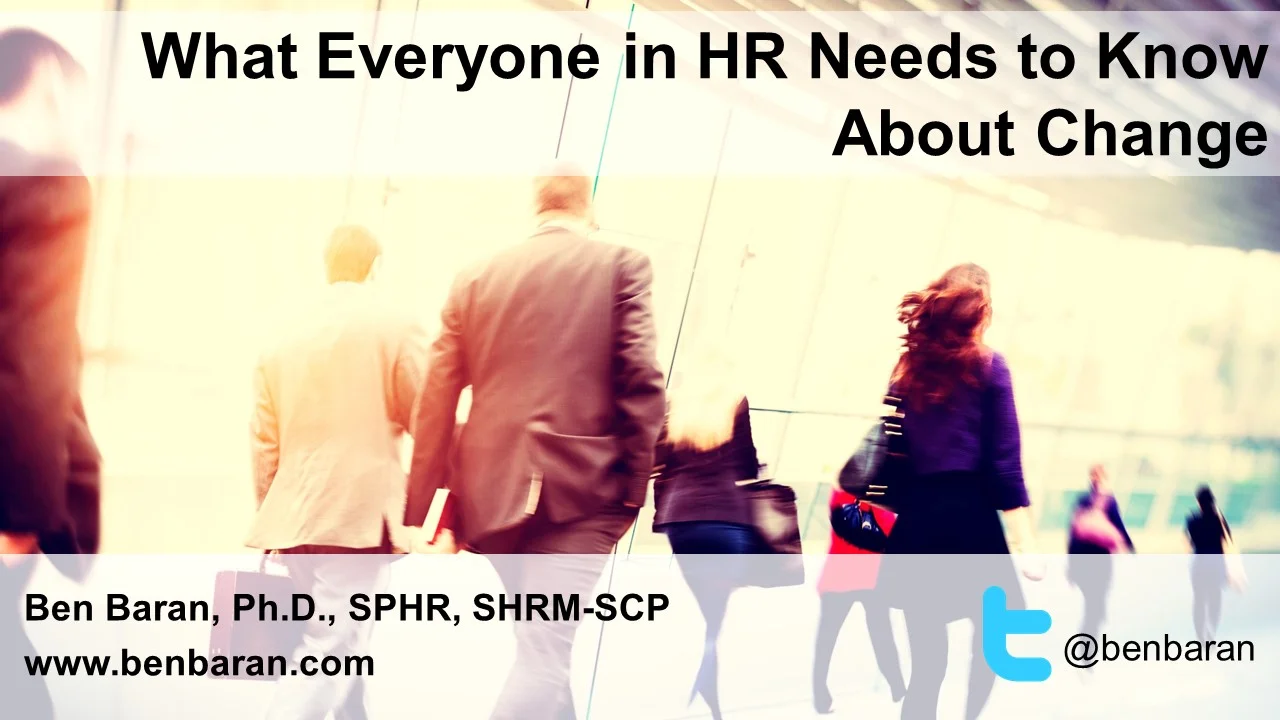
What Everyone in HR Needs to Know About Change: Part 2
Recently, I had the wonderful opportunity to engage with hundreds of people from around the world as part of a webcast titled, "What Everyone in HR Needs to Know About Change." The Human Capital Institute (HCI) hosted the webcast, and afterward, HCI gave me the recorded version so that I could share it with people who weren't able to join the live presentation.
Here it is--enjoy.

Recently, I had the wonderful opportunity to engage with hundreds of people from around the world as part of a webcast titled, "What Everyone in HR Needs to Know About Change." The Human Capital Institute (HCI) hosted the webcast, and afterward, HCI gave me the recorded version so that I could share it with people who weren't able to join the live presentation.
Here it is--enjoy.
Also, here is a PDF of the slides from the same presentation.
Find this thought provoking? Leave a comment, like and share!
About Ben Baran
Ben Baran, Ph.D., is probably one of the few people in the world who is equally comfortable in a university classroom, a corporate boardroom and in full body armor carrying a U.S. government-issued M4 assault rifle. Visit: www.benbaran.com.

Leadership is a Game of Inches
The 1999 movie Any Given Sunday tells the story of a fictional American football team, with much of the focus on the team’s head coach. To be honest, I don’t remember much about the plot aside from one scene.
In that scene, the coach, played by the actor Al Pacino, delivers a speech to his team. He says:
“You know, when you get old in life things get taken from you. I mean that's, that’s—that’s part of life. But you only learn that when you start losing stuff. You find out life’s this game of inches. So is football. Because

The 1999 movie Any Given Sunday tells the story of a fictional American football team, with much of the focus on the team’s head coach. To be honest, I don’t remember much about the plot aside from one scene.
In that scene, the coach, played by the actor Al Pacino, delivers a speech to his team. He says:
“You know, when you get old in life things get taken from you. I mean that's, that’s—that’s part of life. But you only learn that when you start losing stuff. You find out life’s this game of inches. So is football. Because in either game, life or football, the margin for error is so small—I mean, one-half a step too late, or too early, and you don’t quite make it. One-half second too slow, too fast, you don’t quite catch it.
“The inches we need are everywhere around us. They’re in every break of the game, every minute, every second.
“On this team, we fight for that inch. On this team, we tear ourselves and everyone else around us to pieces for that inch. We claw—with our fingernails—for that inch. Because we know when we add up all those inches, that’s gonna make the ____in' difference between winning and losing—between livin' and dyin'.
“I’ll tell you this: In any fight, it’s the guy who’s willing to die who’s gonna win that inch. And I know if I’m gonna have any life anymore, it’s because I’m still willin' to fight and die for that inch.”
In my work as a business professor and management consultant, I’ve come to believe that leadership is also a game of inches.
Everywhere around us in our organizations—and among our friends and family members, for that matter—exist opportunities to make a difference, to introduce new patterns of communication and thinking, to connect and align people with goals and visions for the future.
But we often fail to capitalize on those opportunities.
One reason, I think, is that we place “leadership” on some sort of pedestal, with some sort of romantic notion that “leaders” are “great people” who do “great things.” Sometimes that certainly is the case. But it’s also true that leadership is often in the little moments—fleeting opportunities to influence the people around us in a positive way. In this way, leadership doesn’t have to be grandiose or flashy or even specifically planned. It can include:
- Looking one of your team members, peers or even your supervisor in the eyes and telling him or her that you value his or her contributions;
- Listening to people with the intent to understand them, not simply thinking about what you’re going to say next or how you can fix their problem;
- Taking a moment to encourage someone who is going through a tough time;Sharing a personal story of wins or (even better) losses that taught you a lesson;
- Clarifying expectations about who is responsible for specific outcomes;
- Reducing ambiguity about what success “looks like” and how people fit into team goals;
- Encouraging dissent and courageous, respectful conversations about what’s not working well;
- Explaining the procedures behind your decisions that affect people’s work or rewards;
- Stepping aside and letting someone else lead a project or conversation;
- Following others who are doing something worthwhile;
- Running effective, satisfying meetings;
- And being a role model for the behavior you value in numerous other small moments that happen either in one-on-one situations or with larger groups.
Even though many of these little moments of leadership might be small or mundane, they can be mighty.
Because when we “add up all those inches”—to paraphrase the Any Given Sunday coach—that can make the difference between winning and losing, either as an individual leader or as an organization.
If we wait until the perfect time to “lead,” we can end up missing these small, everyday opportunities.
But if we act instead by being the change we want to see around us, the ripple effects can be far-reaching.
And after all, isn’t that what leadership is all about?
Find this thought provoking? Leave a comment, like and share!
About Ben Baran
Ben Baran, Ph.D., is probably one of the few people in the world who is equally comfortable in a university classroom, a corporate boardroom and in full body armor carrying a U.S. government-issued M4 assault rifle. Visit: www.benbaran.com.
The Rise of HR … Agility
It’s easy to fall into patterns and comfortable routines.
Some of those are great. Take, for example, dental hygiene. Or strength training.
But if our routines too often keep us around the same people, we run the risk of stagnating. It’s even worse if we’re isolated—or insulated, depending on how you look at it—from other ideas.
That’s one reason why I enjoy professional conferences. Even if you’re around people in a similar area of expertise or interest, you’ll learn a great deal from their different perspectives and experiences.
Last week, I spent a few days at the annual conference of the Society for Industrial and Organizational Psychology (SIOP) in Anaheim, Calif. And in between all of the
It’s easy to fall into patterns and comfortable routines.
Some of those are great. Take, for example, dental hygiene. Or strength training.
But if our routines too often keep us around the same people, we run the risk of stagnating. It’s even worse if we’re isolated—or insulated, depending on how you look at it—from other ideas.
That’s one reason why I enjoy professional conferences. Even if you’re around people in a similar area of expertise or interest, you’ll learn a great deal from their different perspectives and experiences.
Last week, I spent a few days at the annual conference of the Society for Industrial and Organizational Psychology (SIOP) in Anaheim, Calif. And in between all of the catching up with wonderful friends and making new ones, I managed to gain some new perspectives on what I do professionally.
For context, it’s important to note that SIOP conferences tend to be about half professors and half industry professionals. And although I’m firmly planted in the world of academia in addition to my consulting work, I tend to gravitate toward conference sessions that are geared more toward those in industry than those of us in academia.
Why?
Quite simply, it gives me some insight into what’s on the minds of people on the front lines of leadership development, talent management, human resources (HR) and other related areas.

I attended a number of interesting sessions, but the one that stuck out to me most was a panel discussion that featured Dave Ulrich, William Schiemann and Libby Sartain.
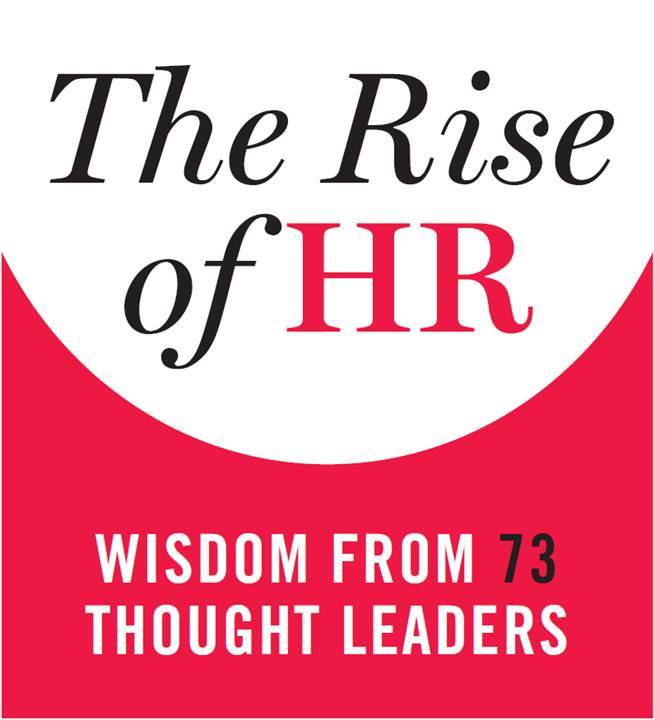
They’re the editors of the recent book The Rise of HR: Wisdom from 73 Thought Leaders.
Given that I teach HR classes and often consult in HR or areas of relevance to HR, I thought I’d benefit from what they had to say. I was right.
Here are some of the highlights from that session, from my perspective:
- The Rise of HR is a book with 73 essays on the future of HR. It’s free. Anyone can download it. Simply visit www.theriseofhr.com. Did I mention that it’s free?
- Much of what I see as the future of HR seems to be validated by others. For example, HR leaders must continually be aware of their strategic context.
- As Ulrich mentioned during the session, doing HR well requires “managing paradoxes” well. Think about the tension between stability and change, or between globalization and localization, for example.
- At the heart of the idea of managing paradoxes is agility. Leaders at all levels need to be able to sense and respond to the forces of change around them, and in HR, leaders have the opportunity to build organizations with agile capabilities too. In Ulrich’s words, “The war for talent is won through the organizations we create.”
Here’s more from Ulrich talking about The Rise of HR.
Given my interest in the intersection of leadership, organizational change and HR, it’s my point of view that HR leaders must (a) demonstrate agility themselves and (b) actively work toward creating agile organizations. Practically speaking, this means that HR professionals need to:
- Stop acting like gate keepers. Be service providers instead. (Read more.)
- Stay in touch with what top leaders see as the most disruptive trends. (Read more.)
- Understand and master organizational change. (Read more here and here.)
- Lead boldly. (Read more.)
And getting back to my original point, HR professionals at all levels need to reach out beyond their current horizons, letting fresh ideas inoculate them from the stagnation of isolation.
With that approach, we’ll all be well equipped to thrive in this increasingly turbulent—and exciting—world of work.
Find this thought provoking? Leave a comment, like and share!
About Ben Baran
Ben Baran, Ph.D., is probably one of the few people in the world who is equally comfortable in a university classroom, a corporate boardroom and in full body armor carrying a U.S. government-issued M4 assault rifle. Visit: www.benbaran.com.

For Those About to Lead
For those about to lead, I salute you.
The vast majority of people go with the flow. Many people—even those whom we often dub “leaders”—fulfill their roles by finding out what others expect of them and meeting those expectations. This includes many heads of state—current, former and aspiring—military generals and admirals, university presidents and chief executives.
There’s nothing inherently wrong with going with the flow, depending on

For those about to lead, I salute you.
The vast majority of people go with the flow. Many people—even those whom we often dub “leaders”—fulfill their roles by finding out what others expect of them and meeting those expectations. This includes many heads of state—current, former and aspiring—military generals and admirals, university presidents and chief executives.
There’s nothing inherently wrong with going with the flow, depending on where the flow is headed.
There’s nothing inherently wrong with doing what’s expected, depending on the nature of those expectations.
But leadership is something different.
Leadership is about exploration, adaptation, guiding others through uncharted waters. It’s about sensing and responding quickly to the forces of change; it’s about agility.
Consider an example from May 1804.
As the keelboat turned her bow into the stream, Lewis and his party cut themselves off from civilization. There would be no more incoming letters, no orders, no commissions, no fresh supplies, no reinforcements, nothing reaching them, until they returned.
The captains expected to be gone two years, maybe more. In all that time in whatever lay ahead of them, whatever decisions had to be made, they would receive no guidance from their superiors. This was an independent command, such as the U.S. Army had not previously seen and never would again. Lewis and Clark were as free as Columbus, Magellan, or Cook to make their mark on the sole basis of their judgments and abilities.
Such is the description of the first moments of the famous expedition of Meriwether Lewis and William Clark, who, upon the orders of no one other than the third President of the United States Thomas Jefferson, embarked upon one of history’s greatest expeditions—as documented by Stephen Ambrose in his 1996 bestselling book Undaunted Courage (p. 139).
Lewis and Clark, in their journey across the North American continent in the early 1800s, truly didn’t know what to expect. Consider that President Thomas Jefferson himself, for example, believed that the expedition might encounter mastodons upon the prairie (Ambrose, 1996, p. 91).
These two leaders and their team had only themselves, their supplies and educated guesses about what they might face. The rest they would have to deal with in real time, in an environment of complete self-reliance.
When we truly lead, we are taking risks; we are being vulnerable—to judgment, to criticism, to both passive and active rebellion, and to failure.
It’s simply easier and safer to do nothing. But the solution to most of what ails our organizations and our society often boils to doing things differently. And as such, the answer always requires leaders and leadership.
And so, regardless of whether you’re setting out with an expedition party exploring a new geography or charting a new course for your team, department or organization, I salute you for giving it a shot.
Go boldly—either out in front or by following someone else who’s doing something worthwhile—and chart new waters.
And never forget that going boldly doesn’t have to be big or even public. Small positive disruptions, repeated over time, can indeed yield radical change.
Find this thought provoking? Leave a comment, like and share!
About Ben Baran
Ben Baran, Ph.D., is probably one of the few people in the world who is equally comfortable in a university classroom, a corporate boardroom and in full body armor carrying a U.S. government-issued M4 assault rifle. Visit: www.benbaran.com.

What HR People Need to Know About Change
In a recent post and in some of my research, I’ve been exploring the role that human resources (HR) plays in organizational change. This includes both HR as a function and HR professionals themselves as they get involved (either proactively or reactively) in change efforts.
And there’s one key aspect of organizational change that I think is helpful for HR people to consider.

In a recent post and in some of my research, I’ve been exploring the role that human resources (HR) plays in organizational change. This includes both HR as a function and HR professionals themselves as they get involved (either proactively or reactively) in change efforts.
And there’s one key aspect of organizational change that I think is helpful for HR people to consider. Namely, not all change is created equal, and the nature of change should likely dictate to some degree how HR should respond.
At a basic level, there are two types of organizational change: episodic and continuous.[i] There are additional ways to categorize change,[ii] but let’s focus on these two types.
Episodic change is intentional, event-driven adaptation. In my experience, this is what most people tend to think about when they think about change. A few examples include managing succession of top leaders, instituting new policies or procedures after a crisis, integrating organizations after a merger or acquisition and other planned changes.
In these types of instances, HR leaders are probably likely to find themselves in the role of a change agent. They’ll be visible drivers and supporters of change processes from announcement of the change through its institutionalization.
Continuous change, however, refers to ongoing adaptations. From the perspective of HR, a few examples include integrating survey feedback into leadership practices, aligning incentive systems with desired cultural changes, developing leadership development systems and other adaptations or improvements that build long-term adaptability. This type of change is much more of a process than an event.
In these types of instances, HR leaders might be more likely to be in the role of an adaptation mechanism than a change agent. That is, they function as facilitators, as educators, as ambassadors of change instead of as the driver or leader of the change. While potentially less visible than the role of change agent, the role of adaptation mechanism is arguably just as important and impactful for the adaptability of the organization.
By recognizing a little bit more about the type of change they’re facing, I think, HR leaders are better equipped with insight about what role they should play. And that match between their role and the situation is at the heart of agility—being able to sense and respond to the forces of change.
Related to this topic, I recently had the pleasure of being interviewed for a podcast on “HR's Role in Fostering Agile Behaviors During Changing Times” with the Human Capital Institute. In that interview, we discussed:
- The problems HR leaders and practitioners face with regard to change management and agility
- The concept of design-thinking and how can it be used in change management
- What can HR practitioners do on a more personal level in dealing with individual’s resistance to change
To check out that podcast (it’s only about seven minutes long), click on the video below or click here.
Furthermore, I’m looking forward to learning more about this topic from HR executives and other smart colleagues at the 2016 Human Capital Summit in New Orleans, March 29-30. The theme of that conference is “Agile Talent Strategies for Managing Change and Shifting Priorities,” and I’d love to see you there. Click here for more about the conference.
What else can HR leaders do to facilitate adaptation within their organizations? Are there different strategies for managing change that work better in some situations than in others? Leave a comment below!
Find this thought provoking? Like and share!
About Ben Baran
Ben Baran, Ph.D., is probably one of the few people in the world who is equally comfortable in a university classroom, a corporate boardroom and in full body armor carrying a U.S. government-issued M4 assault rifle. Visit: www.benbaran.com.
[i] Karl E. Weick and Robert E. Quinn, “Organizational Change and Development,” Annual Review of Psychology 50, no. 1 (1999): 361–86.
[ii] Donde Ashmos Plowman et al., “Radical Change Accidentally: The Emergence and Amplification of Small Change,” Academy of Management Journal 50, no. 3 (2007): 515–43.

Leadership to Change the World
Recently, I did something that changed the world. It might have been an encouraging word, a provocative question, a smile.
But honestly, I have no idea what it was.
Recently, you did something that changed the world. It might have been an offer to help, an attentive ear, a cup of coffee.
But you, like me, probably don’t know exactly what you did either.
You see, everything we do can either

Recently, I did something that changed the world. It might have been an encouraging word, a provocative question, a smile.
But honestly, I have no idea what it was.
Recently, you did something that changed the world. It might have been an offer to help, an attentive ear, a cup of coffee.
But you, like me, probably don’t know exactly what you did either.
You see, everything we do can either breathe life or death, hope or despair into the people around us. And when we change the people around us by acting differently, we indeed change the world.
Across my spectrum of professional roles, I work with myriad college students, business executives and military personnel. Most of that deals with the function of human resources or the academic field of organizational behavior.
Regardless, the common element across it all is leadership.
Unfortunately, though, leadership has been over-glorified as something momentous. It’s not. It’s often more about perspiration—empathy-driven hard work—than inspiration. Most of the time, it has to do with “lollipop moments.”
Take a moment to learn about that from Drew Dudley in the video below.
If we’re to change the world—or put a “dent in the universe” as Steve Jobs once said—we must start by examining our interactions with those around us.
Are we using those opportunities to life each other up, to make each other’s universe a little more hospitable?
We spend most of our waking hours at work. So if we really want to make a difference in the world, we should start by focusing on how we ourselves can be positive forces of disruption in our organizations.
And if enough people started thinking that way in an organization—about each other, about their customers, about the work itself—they’d be unstoppable. They’d be able to sense and respond quickly to change, displaying a level of agility that most organizations would find impossible. They'd be engaged, driven by purpose.
Your leadership doesn’t have to be big. It could start with something small—like a lollipop.
What are some little ways in which we can change our world at work? Leave a comment below!
Find this thought provoking? Like and share!
About Ben Baran
Ben Baran, Ph.D., is probably one of the few people in the world who is equally comfortable in a university classroom, a corporate boardroom and in full body armor carrying a U.S. government-issued M4 assault rifle. Visit: www.benbaran.com.

Feed Them Radishes! And 3 More Ways to Stifle Change
We are creatures of habit. We continually seek—or create—routines. The structures of our days and our weeks give us predictability, and that makes us comfortable.
None of this is inherently bad. In fact, routines and habits let us free our minds to work on other, more complex problems. If we had to think actively about everything in our day, deliberately evaluating every decision from the time we roll out of bed until we return to the pillow, we’d be overwhelmed.
What does this have to do with agility, human resources, leadership and change?
Everything.
We are creatures of habit. We continually seek—or create—routines. The structures of our days and our weeks give us predictability, and that makes us comfortable.
None of this is inherently bad. In fact, routines and habits let us free our minds to work on other, more complex problems. If we had to think actively about everything in our day, deliberately evaluating every decision from the time we roll out of bed until we return to the pillow, we’d be overwhelmed.

What does this have to do with agility, human resources, leadership and change?
Everything.
When we ask people to change, we’re asking them to focus their energy and make different choices.
We’re asking them to be deliberate about specific aspects of their day—features that used to be routine—and do them differently.
And when we do that too often or throw too many changes at people at one time, it’s exhausting and overwhelming for them. That’s one big reason why change is hard.
And what does that have to do with radishes?
Dan Heath, coauthor of Switch, discusses that below.
To summarize, Heath discusses in that clip an experiment in which one group is allowed to eat radishes while being tempted by cookies. The other group just gets cookies and is allowed to eat them. People from both groups are then asked to complete a puzzle of sorts—but there is no solution to the puzzle.
The main finding is that the radish eaters were much more likely to quit working on the puzzle faster than the cookie eaters, with a possible conclusion being that the self-control they had to exert depleted their ability to keep persisting at the impossible task.
The study is titled, “Ego depletion: Is the active self a limited resource?” Four researchers at Case Western Reserve University published it in the Journal of Personality and Social Psychology in 1998, and more than 2,800 other studies have cited it since then.
Reading this study more closely provides some insight regarding at least four ways to stifle change.
If you really want to stifle change, then:
- Feed people radishes. No one likes radishes. (OK, maybe, if they’re cut in very thin slices.)
- Ensure the old way of doing things is easier than the new way. This will tempt people with the status quo, making change seem overly difficult.
- Change too many things at once. This will also make people tired of exerting effort in new directions, making them less likely to persist in creating new habits.
- Make the change ambiguous and full of choices. This will also deplete people’s resources by forcing them to exert brain power and make decisions.
Regarding agility, it’s important to remember that being agile is about sensing and responding quickly to one’s environment. It’s not about changing for change’s sake; it’s not about bending in every direction whenever the wind blows.
That’d be exhausting, pointless and reckless.
Leaders in human resources often find themselves assisting with change management across the organization. In addition to keeping “radishes” in mind, they should be proactive in educating senior leaders about agility before change becomes necessary. That way, they can help the organization change in systematic ways—not exhausting people with excessive ambiguity and numerous new routines being thrown at employees at once.
In addition to radishes, what else stifles change in your organization? Leave a comment below!
About Ben Baran
Ben Baran, Ph.D., is probably one of the few people in the world who is equally comfortable in a university classroom, a corporate boardroom and in full body armor carrying a U.S. government-issued M4 assault rifle. Visit: www.benbaran.com.