
I’ve moved my blogging to Substack!
Feel free to check out any of the content I have here, but also be sure to check out my newest content at Reckoning and Elevating What Works.

The Big Lie That’s Hindering Your Agility
I’ve seen it in almost every work-related team—both those in which I’ve been a member, and those I’ve coached or led.
It’s a blind spot that we all have. It’s a big lie we all tell ourselves.
It makes us feel good, secure, worthy. It’s psychologically soothing; it’s comfortable.

I’ve seen it in almost every work-related team—both those in which I’ve been a member, and those I’ve coached or led.
It’s a blind spot that we all have. It’s a big lie we all tell ourselves.
It makes us feel good, secure, worthy. It’s psychologically soothing; it’s comfortable.
But it’s blocking our access to the truth. It’s hurting our ability to make optimal decisions. And it’s certainly keeping us from sensing and responding rapidly to change, which is the essence of being an agile leader.
This big lie that we all tell ourselves is as follows:
My team would be extraordinary if only my teammates changed the way they act. It’s not my fault; I’m doing great. It’s about them—they need to communicate better, work harder, hold themselves more accountable.
If that’s the lie, then what’s the truth?
The truth is that being an agile leader demands honesty and humility about ourselves. We must have the strength to reflect on what’s going on—especially in the face of failure or underperformance—and look in the mirror. We must ask ourselves:
What can I do differently to bring out the best in others?
What are those things that I’m just not great at doing, and have I told my team about them?
How must I adapt my communication, my routines, my style to match the situation?
Am I wrong?
Do I really know what I think I know?
Because without such humility, we delude ourselves. We might be able to get away with it for a while when the situation is routine and predictable, when everything is a “known known.” But this arrogance—when deployed in environments characterized by volatility, uncertainty, complexity, and ambiguity (VUCA)—will lead to failure.
In the face of VUCA, humility and transparency must reign supreme. And that starts with each of us being honest about ourselves.
Our tendency to overlook our own faults and to believe that failure originates from anything other than ourselves is natural. It’s also natural for us to attribute success to ourselves—isn’t that convenient? But in addition to becoming a blind spot that can hurt our ability to perform at a high level with others in a VUCA environment, overlooking our own role in underperforming teams or failure hurts our credibility. Namely, by refusing to recognize my own faults, it’s difficult for others to take me seriously when I provide feedback to them.
Such behavior isn’t agile leadership. It’s hypocritical leadership.
To get a better handle on what you’re doing that could be hindering your team’s productivity, I suggest asking for feedback from those around you. Keep in mind, however, that most of us are also predisposed to lie to each other about such matters. Most of us don’t like making other people feel bad, so we tend to gloss over negative feedback. That’s not necessarily a bad thing; it’s complicated. And I’m not advocating recklessly brutal honesty.
But in requesting honest feedback from people about your own behavior, you need to realize that people need to feel safe to do so. One way to do this is through a multirater (commonly known as a “360”) assessment, in which people can provide feedback anonymously (assuming the group is large enough). Such a step can be a good start.
Beyond that, however, it’s about creating a team culture in which everyone knows where the team is heading and in which everyone truly knows in their guts that tough love is sometimes required to get the best out of each other—regardless of titles, age, experience level, and so forth.
How do you create that feeling of safety and freedom to provide honest feedback?
A lot of it has to do with the idea of psychological safety, which Amy Edmonson introduced in her seminal 1999 article in Administrative Science Quarterly. In that research, she found that psychological safety was associated with team learning behavior—characterized by behaviors such as open discussion of different opinions, testing assumptions, and experimentation—which was in turn associated with team performance. To create psychological safety in a team, Edmonson’s data suggested, leaders must:
Provide a compelling team vision and goals
Ensure the team has adequate resources, information, and rewards,
Adopt a supportive, coaching-oriented leadership style, and
Respond to questions and challenges in a non-defensive manner.
Going hand-in-hand with all of these is a posture of humility. No leader knows everything, so when we’re acting as a leader, we should openly acknowledge this reality.
Of course, the most likely case is that in most teams, everyone could be doing something a bit differently to support the team’s objectives. But instead of starting with the issues that we have with each other, it’s better to start with ourselves.
After all, over whom do we really have the most control?
It’s ourselves.
So let’s open ourselves to the possibility that being a humble leader may actually increase our strength, making the teams we lead better able to cope with VUCA and thrive.
About Ben Baran
Ben Baran, Ph.D., is probably one of the few people in the world who is equally comfortable in a university classroom, a corporate boardroom and in full body armor carrying a U.S. government-issued M4 assault rifle. He regularly consults leaders and organizations across a wide range of sectors and industries. Visit: www.benbaran.com.
Reference
Edmonson, A. 1999. Psychological safety and learning behavior in work teams. Administrative Science Quarterly, 44(2), 350-383.

On the Origins of VUCA and How it Affects Decision Making
It’s not just you; it’s not just me. The acronym VUCA is more popular than ever.
According to Google Trends, interest in the term is at an all-time high, following a distinct trend upward in the past several years.
Like many ideas, however, VUCA as a framework for understanding turbulence in one’s environment wasn’t an overnight sensation. The acronym—which stands for
It’s not just you; it’s not just me. The acronym VUCA is more popular than ever.

According to Google Trends, interest in the term is at an all-time high, following a distinct trend upward in the past several years.
Like many ideas, however, VUCA as a framework for understanding turbulence in one’s environment wasn’t an overnight sensation. The acronym—which stands for volatility, uncertainty, complexity, and ambiguity—began decades ago with attempts to help develop strategic leaders at the U.S. Army War College.
One of the earliest references to VUCA that I’ve found is in a 1992 article in the Journal of Management Development by Herbert Barber titled, “Developing strategic leadership: The US Army War College experience.” In the article, he describes how the U.S. Army War College and The Army Research Institute for the Behavioral and Social Sciences sponsored a conference in February 1991 that brought together both scholars and practitioners to discuss leadership at the top of complex organizations. One of the aspects of strategic leadership upon which participants at the conference focused was the environment, or the context in which strategic leaders must operate. Even in 1991, the environment described by conference participants was one fraught with turbulence, from geopolitical uncertainty to technological advancement.
Crediting even earlier work in 1986 by leadership scholars Warren Bennis and Burton Nanus, Barber describes how the U.S. Army War College decided to use the VUCA acronym as a way to help their students (typically senior military officers) characterize the turbulence they would face as they took on increasingly strategic leadership positions. The recent popularity of the acronym stems in large part from increased application within civilian sectors, as leaders outside the military have found it useful in helping them make sense of their challenges and opportunities.
So what do the four components of VUCA mean? Here’s a brief summary of the explanations that I typically use.
Volatility is about the increasing pace of change. Although we can find examples from throughout history of people being astonished by the pace of change, two relatively recent factors are driving unprecedented change: (1) technological advancement and (2) globalization. Those factors, combined with the speed of innovation and increased competition, make for a world filled with many examples of exponential—not linear—change.
Uncertainty is about the unpredictability of the future. Predicting what the “next big thing” will be has always been difficult, but given the increasingly fast pace of change it’s getting even harder. Furthermore, people use new technologies in novel and interesting ways—ways that could never have been predicted even by their original creators (Twitter is a good example).
Complexity is about the interconnected nature of organizations, industries, markets, and geographies. Readers of the sociologist Charles Perrow may think of the concepts “interactive complexity” and “tight coupling” that he uses to describe how unpredictable and fast chain reactions can occur, particularly when risky technologies are involved.
Ambiguity is about what the famed military theorist Carl von Clausewitz called “the fog of war.” It’s about those confusing situations in which multiple plausible interpretations exist about what’s going on or what it means. It’s about those times when a group of smart people are all looking at the same data yet coming to different conclusions about what it means—and here’s the key—they all sound right.
Aside from overwhelming leaders with what the future holds, though, how is the VUCA construct helpful?
I’ve found it to be helpful in my conversations with executives in a few ways.
First, it provides a language and a framework for having a meaningful conversation about what an organization faces, both internally and externally. What are our knowns? What are our unknowns? And might there be unknown unknowns? Having those conversations is a critical step in the sensemaking process for leadership teams. And as my good friend and consulting partner Mike Richardson says, “conversation flow leads to cash flow!”
Second, it helps leaders understand the mindset and behavioral shift that they need to enact when entering the “land of VUCA.” Namely, VUCA problems are ones in which best practices—and even good practices—likely don’t apply. When encountering VUCA, one cannot reliably depend upon the past as a guide for the future.
As such, an understanding of VUCA can assist with understanding a specific domain of decision-making. And to help make sense of how to make decisions within a VUCA environment, the Cynefin framework is useful.
For those who aren’t familiar, the Cynefin framework originated around the turn of the century at IBM, specifically led by Dave Snowden. Since then, it’s become a useful way for leaders to help make sense of what types of problems they face and how to deal with them.
A complete description of the Cynefin framework is beyond the scope of this article, however, as depicted below, it categorizes four types of problems: simple, complicated, complex, and chaos. These all exist outside of disorder—those instances in which no clarity exists about which domain applies.
A sketch, by Edwin Stoop of Sketching Maniacs, of the Cynefin framework
Simple problems are solved using best practices, and complicated problems are solved using good practices (or a limited range of good options).
Complex problems are those in the land of VUCA. These are problems that aren’t solved by doing what worked well in the past (best practices), and there really don’t seem to be any good answers. Instead, experimentation is critical. This is the domain of probing, trying something, and then sensing and responding accordingly.
Chaos describes true crisis situations. These situations call for direct action in an immediate attempt to stop the bleeding (or the organizational equivalent), figure out some next steps, and move the problem into another domain.
So the next time you’re facing VUCA—in your life or in your organization—resist the temptation to treat it like a best practice. Instead, make friends with experimentation, embrace smart (i.e., small, fast, cheap) failure, and continually learn. Such an orientation toward leadership and decision making also requires a deep commitment to building trust, agility, and resilience within your team, because without those elements, you’ll never be able to create, fail, or learn effectively together.
About Ben Baran
Ben Baran, Ph.D., is probably one of the few people in the world who is equally comfortable in a university classroom, a military uniform, or in a corporate boardroom advising top management teams. A co-founder and principal at the consulting firm Indigo Anchor, he's also an award-winning business professor and published scholar at Cleveland State University and a commander in the U.S. Navy Reserve. He regularly consults leaders and organizations across a wide range of sectors and industries. Visit: www.indigoanchor.com and www.benbaran.com.
References:
Barber, H. F. (1992). Developing strategic leadership: The US Army War College experience. Journal of Management Development, 11(6), 4–12. https://doi.org/10.1108/02621719210018208
Bennis, W. G., & Nanus, B. (1986). Leaders: The Strategies for Taking Charge. New York: Harper & Row.

What 280 Executives Said They Face
Turbulence ahead.
That’s one key message I learned while writing the inaugural issue of The VUCA Report™, which outlines findings from an ongoing study I’m spearheading here through The Strategic Agility Institute.
This study essentially focuses on two elements: (a) the forces of change that executives face and (b) what they’re doing about it. We were fortunate to have had 280 responses
Turbulence ahead.
That’s one key message I learned while writing the inaugural issue of The VUCA Report™, which outlines findings from an ongoing study I’m spearheading here through The Strategic Agility Institute.
This study essentially focuses on two elements: (a) the forces of change that executives face and (b) what they’re doing about it. We were fortunate to have had 280 responses (from almost as many different organizations) to analyze for this first issue of The VUCA Report™.
Thank you to everyone who participated in this global, collaborative effort.
Regarding the forces of change, we built upon the “VUCA” framework, which was first coined by social scientists at the U.S. Army War College in the early 1990s. VUCA stands for four aspects of turbulence, so to speak: volatility, uncertainty, complexity and ambiguity.
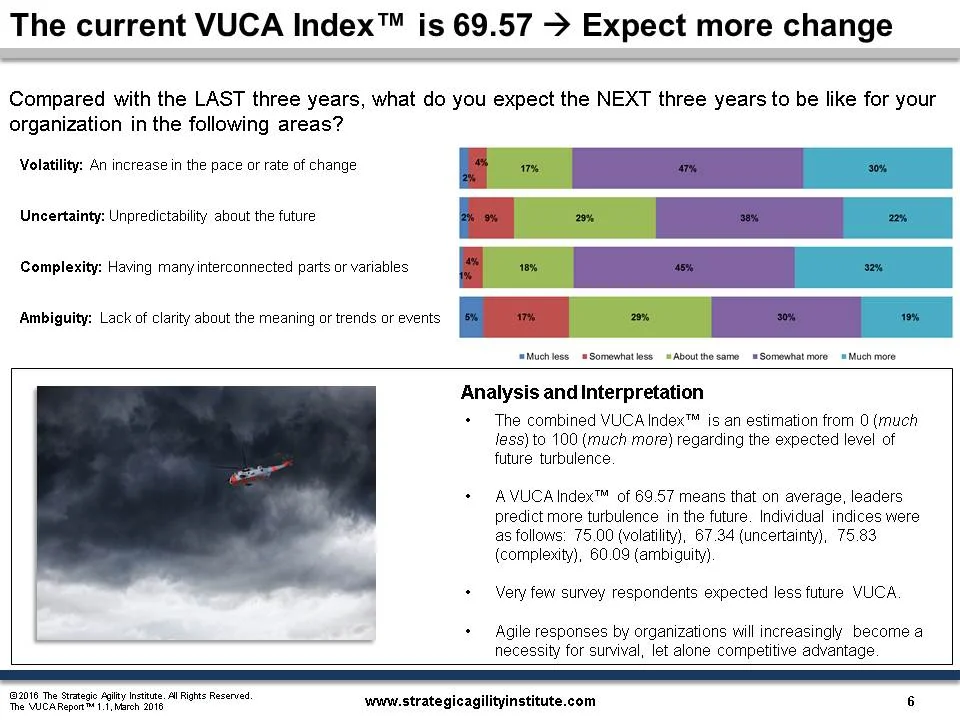
Our analysis of the data suggests that VUCA will continue to increase, with a current VUCA Index™ of 69.57. This is an estimate from 0 (much less) to 100 (much more) regarding the expected level of future turbulence.
Additionally, we asked the 280 executives in our sample about their perceptions of 35 disruptive trends. These 35 trends fell across five categories: (a) technological advances, (b) economic and financial issues, (c) environmental and societal concerns, (d) geopolitics, regulations and security issues and (e) workforce dynamics.
It’s important to note that our data were from executives across all functions and numerous industries, so we’re relatively confident about what these data reveal. Interestingly, of the 10 most highly rated disruptive trends, five of them were in the category of workforce dynamics.
Leaders in the world of human resources, talent management and organizational development: Take heed.
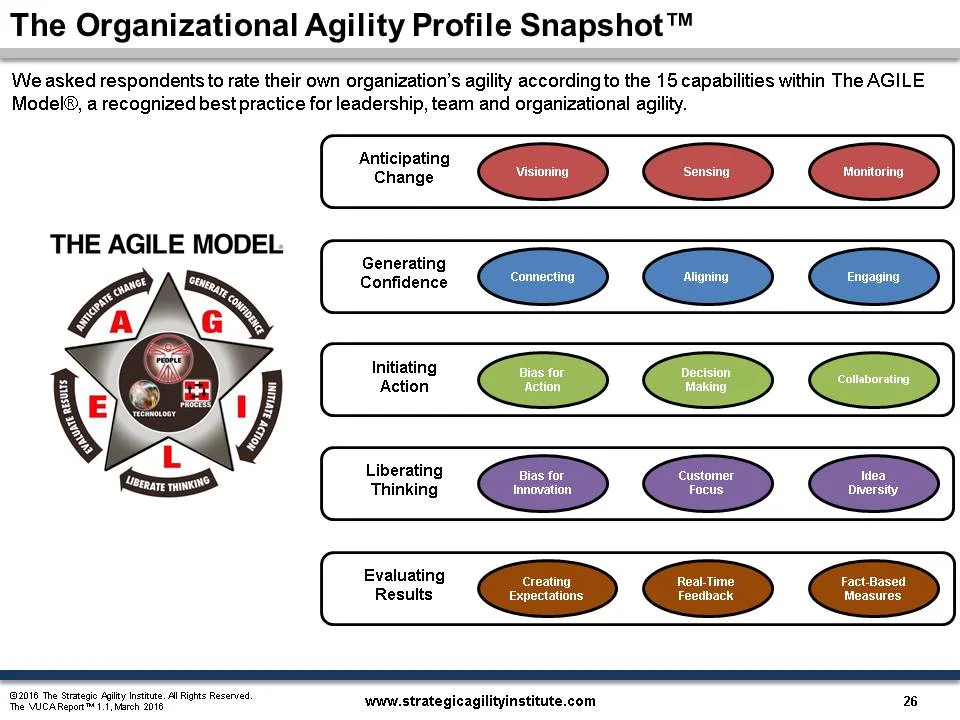
We then turned our focus to agility, which describes the ability to sense and respond to change quickly at the leader, team and organizational levels. Our experience—and that of many others—strongly suggests that agility is the antidote to VUCA. As such we asked our respondents to rate their own organization across the 15 capabilities within The AGILE Model®. On average, our respondents rated their capabilities in the areas of bias for action and customer focus as relatively strong—but they rated their capabilities in decision making and real-time feedback as relatively weak.
Finally, we included three open-ended items in the survey to gather our respondents’ thoughts across three questions related to agile practices. These questions are displayed below along with a word cloud for each that depicts the top keywords from the responses.
What is the most important practice that your organization is CURRENTLY doing that is helping you become more agile?
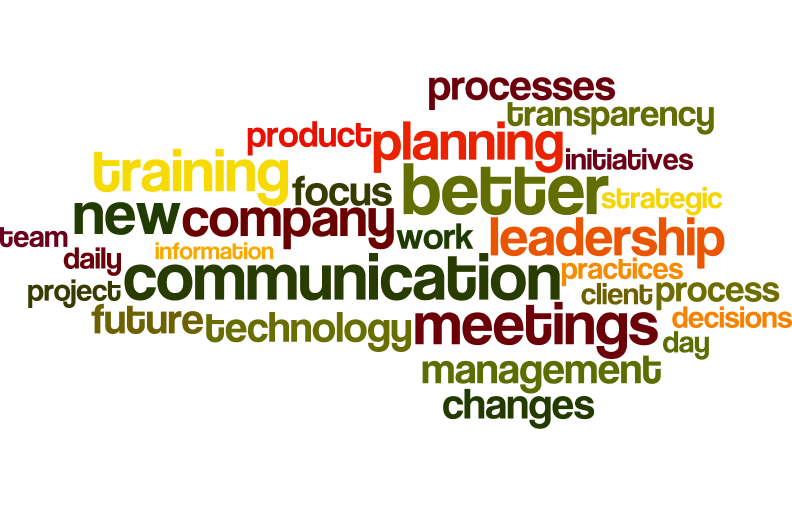
What is the most important practice that your organization SHOULD DO in the future to help you become more agile?

What is the biggest OBSTACLE keeping your organization from becoming more agile?

The full version of The VUCA Report™, of course, contains much more detail and analysis that you may find interesting and useful. We’re providing it to the entire world for the premium price of … nothing.
It’s totally free.
All we ask is that you take the survey that’s collecting data for the next version—Volume 1, Issue 2—of The VUCA Report™. After taking the survey, you’ll be immediately provided with a link that you can use to download this inaugural issue.
Click here to take the survey and download your copy of the inaugural issue of The VUCA Report™.
Together, we hope that The VUCA Report™ and other initiatives that we’re spearheading here at The Strategic Agility Institute will help us all become increasingly focused, fast and flexible in this VUCA world.
Find this thought provoking? Leave a comment, like and share!
About Ben Baran
Ben Baran, Ph.D., is probably one of the few people in the world who is equally comfortable in a university classroom, a corporate boardroom and in full body armor carrying a U.S. government-issued M4 assault rifle. Visit: www.benbaran.com.