
I’ve moved my blogging to Substack!
Feel free to check out any of the content I have here, but also be sure to check out my newest content at Reckoning and Elevating What Works.

Reflections on Deep Squats, Mobility, and Afghan Toilets
“I f&#$ing love squats,” snarled the bald, 6-foot-3-inch, 240lb-plus, weight-belt wearing U.S. Army soldier, who resembled Shrek minus the green hue. I watched as he then proceeded to balance about 100lbs less than his bodyweight on his big shoulders and … “squat.” Only it wasn’t a squat.
It was what I see about 99 percent of the guys in the gym do when they think they are “squatting.” Instead of lowering himself until his hips descended just below his knees, he maybe came down about 12 inches, making about a 20-degree bend in his knee, before returning to an upright position. Sorry folks, that’s not a squat.

“I f&#$ing love squats,” snarled the bald, 6-foot-3-inch, 240lb-plus, weight-belt wearing U.S. Army soldier, who resembled Shrek minus the green hue. I watched as he then proceeded to balance about 100lbs less than his bodyweight on his big shoulders and … “squat.” Only it wasn’t a squat.
It was what I see about 99 percent of the guys in the gym do when they think they are “squatting.” Instead of lowering himself until his hips descended just below his knees, he maybe came down about 12 inches, making about a 20-degree bend in his knee, before returning to an upright position. Sorry folks, that’s not a squat.
The common reason people like to give for not squatting all the way down—to parallel or below—is that it’s “bad for your knees.” These might be the same people who will likely tell you that drinking Guinness is like “drinking a meal.” The facts are that (a) squatting properly all the way down isn't bad for your knees and (b) Guinness is one of the lighter beers one can drink, with fewer calories than regular Budweiser, Heineken, or Miller Genuine Draft.
I have a theory about the typical American and European aversion to deep squats and the related lack of hip mobility from which they suffer. It has to do with cultural norms that drive lifestyle habits. Those habits, over time, change how our bodies tend to operate. But it has nothing to do with the natural construction of our bodies.
In Afghanistan, local people squat all the time. And these are deep squats—with their buttocks suspended near their heels about an inch above the ground. In this respect, they've retained an ability that comes naturally to small children.
Afghans squat while hanging out on the side of the road.



They squat while heating water for tea.

They squat while selling sunglasses.
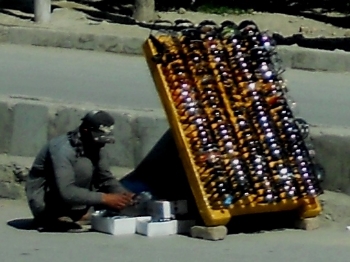
They squat while cooking on the sidewalk.

And they squat while fixing bicycles.
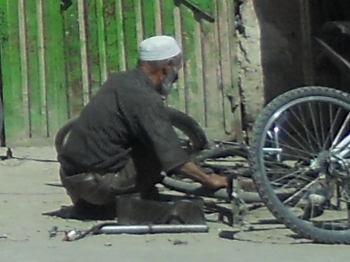
Afghans can hold a squat that would make most Americans wince with pain and sweat with effort after just a few moments. I've heard the same is true across many Asian cultures. It could have something to do with their lack of furniture. Or it could have something to do with their toilets.
This is an Afghan toilet. It’s similar to those you might find in other parts of Asia. If you’re looking for a seat, you can keep searching until your eyes fall out. There isn't one.
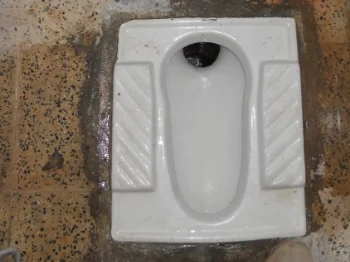
Using such a toilet, as you can imagine, requires one to hold a deep squat for a few minutes. And using such a toilet from a very young age would almost guarantee a sustained level of hip mobility into adulthood that many fitness gurus would envy. The good news for the rest of us who use toilets that have seats is that we can regain that mobility and learn to squat properly.
Afghans and others who squat naturally aren't born with some freaky musculoskeletal properties that allow them to squat in such a manner. All children do this, so the common lack of hip mobility in adults must be an acquired disability. Learning to perform deep squats properly is good for your joints and your overall ability to move your body in useful ways.
So getting back to our “squat”-loving soldier, what should he do? Well, the first thing he should do is stop spreading his nonsensical bro-science to the smaller guys who follow him around the gym mopping up the “wisdom” he spills ad nauseam about “getting huge.” The second thing he should do is focus on practicing the movement the right way, not “working out” to failure.
What would that practice look like? Here’s a great outline of a series of drills from strength coach Dan John. Following a similar philosophy, here’s what’s worked for me:
- Face-the-wall squats (more info)
- Goblet squats with a kettlebell (a dumbbell would work too)
- Single front squats with a kettlebell
- Double front squats with kettlebells
- Back squats with a barbell, starting with very light weight and using my iPhone to take video selfies for immediate feedback on my form
So get motivated to regain your childhood mobility and start squatting the right way. It’ll take time and practice, but it’s worth it for your overall strength and physical well-being. And by following some of the ideas mentioned and linked to above, you won’t even need to switch to an Afghan toilet.
That’s unless you want to, of course—your call.
Safety disclaimer: Although I went to graduate school for a long time and some people call me “doctor,” I’m not a medical doctor. Always check with your physician prior to starting any kind of physical fitness regimen. That just makes good sense.

Seven Reasons why Kettlebells are my Fitness Weapon of Choice
If you’ve ever wondered what those “funny-looking weights with a handle on top” sitting in the corner of your gym are, here’s a quick introduction. Those are kettlebells. And they’re not funny looking. Kettlebells are the gym-equipment equivalent of an AC/DC rock song. They’re a United States Marine Corp KA-BAR® fighting knife. They’re black coffee; they’re straight whiskey. Kettlebells are bare-bones, stripped-down hunks of cold steel that provide endless opportunities for the user to become stronger physically and tougher mentally.
I’ve been rather active most of my life, but the most prominent exercise to which I’ve devoted myself during most of those years has been running.

If you’ve ever wondered what those “funny-looking weights with a handle on top” sitting in the corner of your gym are, here’s a quick introduction. Those are kettlebells. And they’re not funny looking. Kettlebells are the gym-equipment equivalent of an AC/DC rock song. They’re a United States Marine Corp KA-BAR® fighting knife. They’re black coffee; they’re straight whiskey. Kettlebells are bare-bones, stripped-down hunks of cold steel that provide endless opportunities for the user to become stronger physically and tougher mentally.
I’ve been rather active most of my life, but the most prominent exercise to which I’ve devoted myself during most of those years has been running. I’ve run a marathon and a bunch of half-marathons, along with a handful of other races. I’ve burned through many pairs of shoes. Running has almost always been my go-to workout, along with occasional weightlifting and bodyweight exercises such as pullups and pushups.
But my pursuit of fitness through running took a turn for the worse when I reported for duty in December 2012 at a small, crowded military base in central Kabul, Afghanistan. On the day I checked in, a mixture of slushy snow, mud, and ice covered everything. Regardless of the season, it was crowded. The air is dusty in Kabul. And treadmills are boring. My running prospects were looking dreadful.
Thankfully, my older brother had introduced me to kettlebells a few years ago. I had learned a few basic exercises; however, I wasn’t consistent in my workouts with them. But given the poor running conditions that I faced living in Kabul, I chose to hit the gym. And I headed straight toward the pile of kettlebells.
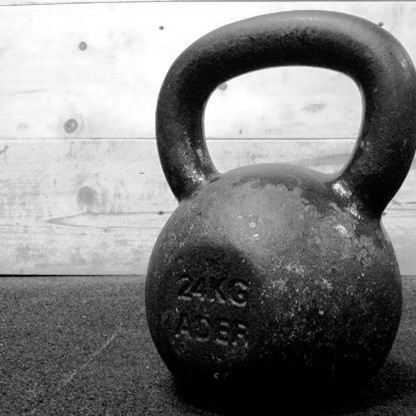
During the past eight months, I’ve become good friends with these unforgiving chunks of forged iron. By most kettlebell fitness standards—set by those who know far more than I—I’ve made significant progress. For example, I can confidently exceed 200 snatches in 10 minutes with a 24kg kettlebell on any given day.
So, based upon my experience, here are seven reasons I’ve decided that kettlebells are my fitness weapon of choice.
- They’re compact. A kettlebell is just one, solid piece of equipment. It barely takes up any floor space. It doesn’t require a bench, a stool, a bar, or any medieval torture-chamber arrangement of pulleys and cables to make it work. It’s a self-contained tool.
- They’re durable. I have six kettlebells at home. Unless I soak them in a vat of acid for a few months, they’ll always be ready for use. They won’t break. They don’t need maintenance.
- They’re versatile. These compact, handled cannonballs deliver full-body workouts through a variety of tried-and-true movements. Want strong legs? How about shoulders and arms of steel? Want to lose weight? Need to gain hip mobility? Kettlebells can help with all of those goals and more.
- They’re effective. If your goal is to get strong, start with kettlebells. And that strength is the foundation of being an athlete of any sort. When used properly and across a consistent schedule, you’ll find that your entire body will become stronger and your joints will become more mobile. Don’t believe me? Try doing a Turkish getup. You will then know the meaning of “full-body exercise.”
- They’re challenging. Even though I’ve been something of a gym rat for the past eight months, I continue to find new ways to be challenged by the 24kg kettlebell. We don’t have any bigger ones here at my gym, but that’s not a big deal. Once I became very comfortable with some of the basic exercises, I started incorporating them into multi-movement exercises. In kettlebell parlance, those are called complexes. I checked my pulse after one of my favorites the other day—172 beats per minute.
- They’re complementary. No, kettlebells aren’t going to tell you that your hair looks nice. That’s “complimentary.” Rather, kettlebell training goes well with—or complements—other types of training. For example, right now my training consists of both kettlebell exercises and classic “big lifts” using barbells (e.g., squats, deadlifts, bench press, overhead press, and bent-over rows). The kettlebells keep my conditioning up to par while continuing to expand my skill and strength. I’ve also found that yes, it’s true—“kettlebells and deadlifts go together like vodka and pickles.”
- It’s fun to say “pood.” Kettlebells are steeped in history, much of which comes from Russia and the former Soviet Union. They came to the United States largely through the advocacy of Pavel Tsatsouline, a former fitness instructor for the Soviet special forces. If you’re serious about fitness at all, start by reading and doing pretty much everything Pavel suggests. I don’t care if you’re male or female, young or old. But back to “pood,” one of my favorite words. A pood is an old Russian unit of measurement. It’s about 16kg, or 35lbs. Kettlebells are sometimes referred to in poods; for example, the 24kg kettlebell is a “one and a half pood.” Pood. It’s just fun to say.
There are myriad ways to work out and get fit. Kettlebells aren’t magic; they’re just another tool. But they’re a wonderfully helpful tool, and one I greatly enjoy. I highly recommend them for anyone who’s serious about their own well-being. Add them to your arsenal, and you’ll likely find that they also become your fitness weapon of choice.
Where would one start? That’s easy. Buy a copy of Pavel’s book, Enter the Kettlebell! And do what he says to do, following the plans he outlines in the book.
Go get strong!
Safety disclaimer: Although I went to graduate school for a long time and some people call me “doctor,” I’m not a medical doctor. Always check with your physician prior to starting any kind of physical fitness regimen. That just makes good sense.