
I’ve moved my blogging to Substack!
Feel free to check out any of the content I have here, but also be sure to check out my newest content at Reckoning and Elevating What Works.

You Should Be Embarrassed
I recently read something that I wrote a few years ago. It was dreadful.
The writing was vague, bloated, constipated. How could I have thought—and I did, at the time of writing it—that it was good?
I was embarrassed.
But I’m perfectly fine with that. In fact, I’m

I recently read something that I wrote a few years ago. It was dreadful.
The writing was vague, bloated, constipated. How could I have thought—and I did, at the time of writing it—that it was good?
I was embarrassed.
But I’m perfectly fine with that. In fact, I’m happy about it.
That’s because if you’re not periodically at least a little bit embarrassed about something you produced or did a year or two ago, then you have a big problem. It’s a red flag signaling the possibility that you haven’t learned, you haven’t grown or you haven’t honed your skills.
Although they’re relatively arbitrary in and of themselves, various dates on the calendar sometimes prompt me to reflect—my birthday and the winter holidays come to mind. I think that’s fairly common among most of us. And that periodic time for reflection is an opportunity not just to think about what’s next, but also to think about where you’ve been and how you’ve developed.
If that reflection causes you to wince a bit, great. That simply means that you’ve moved to a higher playing field, one in which you have a new perspective allowing you to notice the difference between what you once thought was your “best” and that of which you are now capable.
A little bit of embarrassment about your prior levels of performance also opens the door for you to appreciate how far you’ve come, what you’ve done and what you’ve learned.
So I invite you to reflect. Think about where you were last year at this time and what you were doing. Take a look at some of the work you produced. Some of it may surprise you for its quality, but there’s a chance that some if it may surprise you for its mediocrity.
And I invite you face the mediocrity of your past and to be a little embarrassed. Embrace the realization that we’re all works in progress—and that embarrassment about the past might mean that you’re moving in the right direction.
Find this thought provoking? Leave a comment, like and share!
About Ben Baran
Ben Baran, Ph.D., is probably one of the few people in the world who is equally comfortable in a university classroom, a corporate boardroom and in full body armor carrying a U.S. government-issued M4 assault rifle. Visit: www.benbaran.com.

Never Give Up, Never Stop Learning
Although I teach courses on various topics related to leadership, I’m quick to admit it: Learning a lot about leadership won’t necessarily make you a great leader.
Similarly, just because someone has 20 years of experience doing something doesn’t necessarily make him or her an expert. It’s quite possible—and common—for people to have the same experience, 20 years in a row.
What oftentimes elevates truly great leaders above the rest is their tenacity, their commitment to never give up—and to never stop learning. It’s their ability to persevere through adversity with an open mind, applying the lessons they acquire along the way.
One such leader whom I’ve always enjoyed listening to and reading about is United States Marine Corps General James Mattis (ret.). Among recent military leaders, Mattis is a legend, particularly if you talk with other U.S. Marines.
Stories about his selfless, direct style of leadership abound.
Additionally,

Photo By: Lance Cpl. Jesus Sepulveda Torre. The appearance of U.S. Department of Defense (DoD) visual information does not imply or constitute DoD endorsement.
Although I teach courses on various topics related to leadership, I’m quick to admit it: Learning a lot about leadership won’t necessarily make you a great leader.
Similarly, just because someone has 20 years of experience doing something doesn’t necessarily make him or her an expert. It’s quite possible—and common—for people to have the same experience, 20 years in a row.
What oftentimes elevates truly great leaders above the rest is their tenacity, their commitment to never give up—and to never stop learning. It’s their ability to persevere through adversity with an open mind, applying the lessons they acquire along the way.
One such leader whom I’ve always enjoyed listening to and reading about is United States Marine Corps General James Mattis (ret.). Among recent military leaders, Mattis is a legend, particularly if you talk with other U.S. Marines.
Stories about his selfless, direct style of leadership abound.
Additionally, his use of the “knife hand”—basically pointing for emphasis with all of one’s fingers outstretched and the hand oriented such that the little finger is closest to the ground, like the sharp edge of a knife—is equally legendary.
So I couldn’t help but pause for a moment recently when the Marines released a video of Mattis talking about leadership. In the video, he answers a number of questions related to leadership. At the end, he even addresses the lethality of his knife hand.
He’s quick to point out that it was the spirit of the people he led, his Marines, that kept him motivated throughout his career.
And in no uncertain terms, he says that the key to improving continually as a leader is that “You have to assume that you must keep improving.” For Mattis, this is simply a given. Leaders must “maintain this body, mind and spirit improvement at all times.”
But above all, I’m impressed with his humble-yet-confident demeanor. People tend to follow those who know where they’re headed, but at the same time they’re inspired by those who are humble enough to share recognition with the team for getting stuff done.
Or, as Mattis says, “You’re not going to win any fights as a leader. Your troops are going to win those fights.”
Take a few minutes to listen to these and other bits of timeless leadership wisdom in the video below.
Although none of us will go through the same situations as Mattis and it’s unlikely that any of us will achieve his level of regard among any group of leaders, not to mention leaders in the U.S. Marine Corps, there’s plenty that we can learn from his style.
And if we do, I think we’ll be just a little better equipped than we were before to adapt to change and to perform well in adversity.
That’s not to say that it’s easy. Quite to the contrary, leadership is hard. It’s often vastly different from the somewhat romantic vision that we sometimes have of it. But just because it’s difficult doesn’t mean that leadership can’t be effective.
Because, as Mattis says, “Difficulty is an excuse that the Marine Corps will never accept.”
What excuses do you accept? What do you tolerate, in yourself, in those around you, in your organization?
And what, during the next week or so, can we all do to re-identify what’s important, to re-commit to never giving up and never stopping our process of learning?
Find this thought provoking? Leave a comment, like and share!
About Ben Baran
Ben Baran, Ph.D., is probably one of the few people in the world who is equally comfortable in a university classroom, a corporate boardroom and in full body armor carrying a U.S. government-issued M4 assault rifle. Visit: www.benbaran.com.
On Gratitude, Agility and Career Transitions
When I was a teenager, I thought I had it all figured out: My life and career would be a logical series of steps and accomplishments. I’d go to college, earn an officer’s commission in the U.S. Navy, see the world. Then, I’d probably go to law school and enjoy another set of logical steps of accomplishments toward “success” in the civilian world.
Reality, of course, is different.
Life—and careers—are often full of twists and turns, punctuated by triumphs and failures. Some of those ups and downs are big and public, most are

When I was a teenager, I thought I had it all figured out: My life and career would be a logical series of steps and accomplishments. I’d go to college, earn an officer’s commission in the U.S. Navy, see the world. Then, I’d probably go to law school and enjoy another set of logical steps of accomplishments toward “success” in the civilian world.
Reality, of course, is different.
Life—and careers—are often full of twists and turns, punctuated by triumphs and failures. Some of those ups and downs are big and public, most are small and private. It’s a journey that I’ve found to be best accomplished by a sense of agility, by being nimble and trying to make a positive difference in whatever opportunity arises.
In those early years, I never would have predicted that in the next two decades I would have:
- Spent my most rewarding tour of duty in the Navy as a reservist called back to active duty in the landlocked country of Afghanistan,
- Earned a master’s degree in industrial/organizational psychology and a Ph.D. in organizational science (I was a political science and communication studies double major as an undergraduate), or
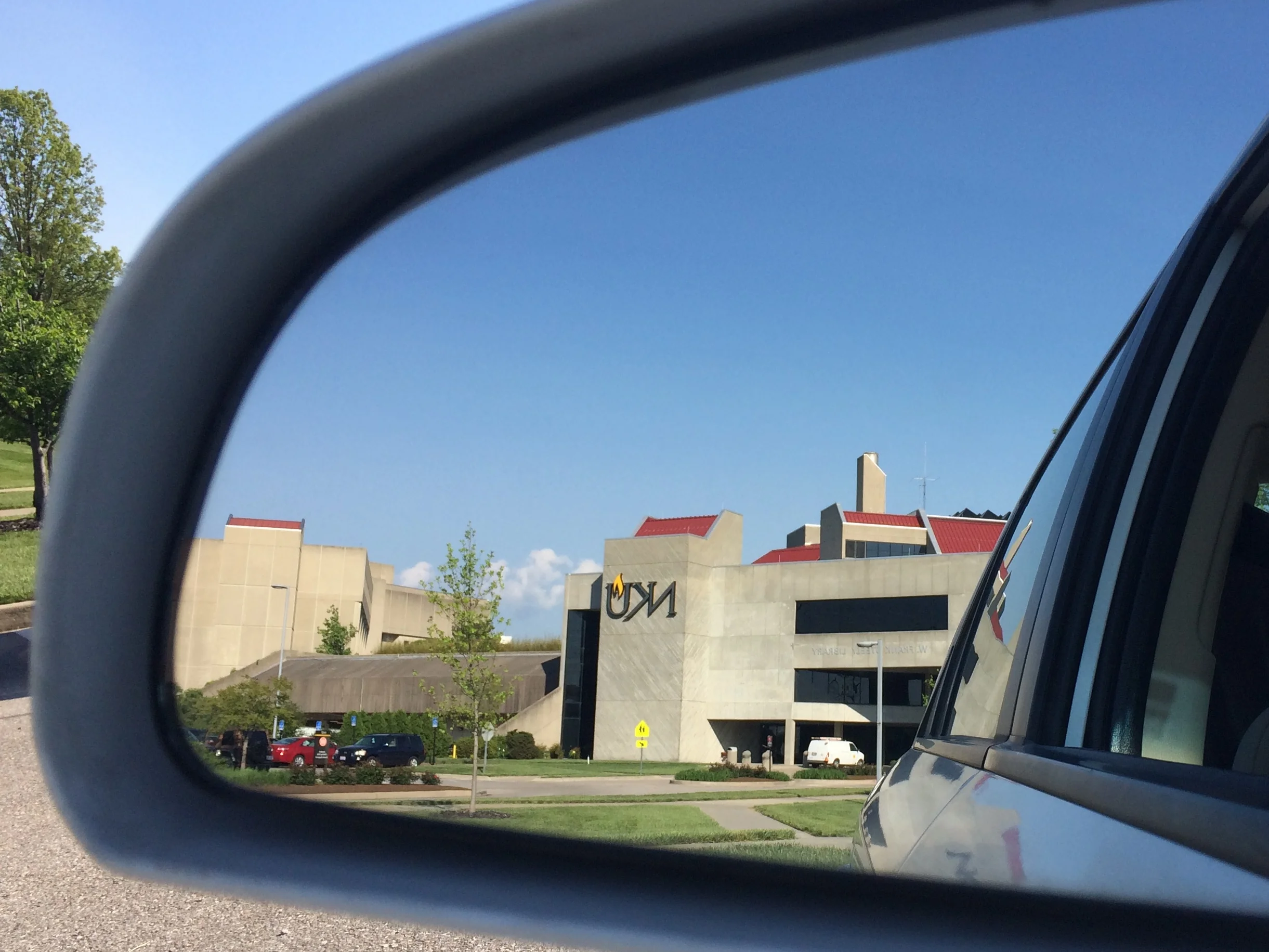
- Served for five years as a member of the faculty of the Haile/US Bank College of Business at Northern Kentucky University (NKU).
And it’s on this last point—my role as an assistant professor in the Department of Management at NKU—that I’d like to focus. Although I haven’t been on campus since the spring semester ended a few months ago, this week is technically my last one at NKU. I’m moving on to a tremendously exciting opportunity as a member of the faculty of the Monte Ahuja College of Business at Cleveland State University.
As I look back at the various roles I’ve held and organizations within which I’ve served, I’m reminded of how each experience taught me something new, making me simultaneously more confident and more humble than before. I’m also reminded of how so much of these experiences is shaped by special people and numerous small interactions that together have made me a better person.
Regarding NKU, then, I’d like to do something I haven’t done before, or at least in this way. I’d like to express my gratitude to those people—fellow professors, staff members, administrators, students, and other members of the campus community—who, more than anything, infused me with additional passion for higher education.
NKU is full of smart, hard-working and caring people. People who:
- Debate at length different ways to improve student learning,
- Teach with passion and celebrate when students succeed,
- Support each other’s efforts to innovate or try new things,
- Get to know each other personally and professionally, and
- Engage the community throughout Northern Kentucky and the greater Cincinnati area through research and learning through service.
I’m particularly grateful for all of the members of the Department of Management, the Executive Leadership and Organizational Change program and the Haile/US Bank College of Business at large for their personal and collective support of me, my development and my work.
Their support to me was unwavering, despite the odd challenges that I posed. For example, during my entire time at NKU, I lived 250 miles away. My department leaders understood this and helped when possible to make my teaching schedule work well given my situation. And when I told them that I’d have to leave for one year to serve in Afghanistan, their response was nothing short of total support and gratitude for my military service.
Thank you, NKU.
As I make this transition, I think an underlying lesson that I’ve learned is that gratitude and agility go hand-in-hand. To be agile as leaders or in our careers, we have to lean on those around us. We have to build and maintain relationships. We must be open and humble to learn from others.
And to keep all of that going for the long term, we must be grateful for the people we have the privilege to work alongside during this journey of life. All of you amazing NKU people will forever be my colleagues and friends.
Now as for my colleagues at Cleveland State University, I can hardly wait to learn from you and figure out ways to contribute positively through what we do together.
In the words of one of my former bosses, John Bland at The University of North Carolina at Charlotte, for whom I’m also grateful: Onward!
Find this thought provoking? Leave a comment, like and share!
About Ben Baran
Ben Baran, Ph.D., is probably one of the few people in the world who is equally comfortable in a university classroom, a corporate boardroom and in full body armor carrying a U.S. government-issued M4 assault rifle. Visit: www.benbaran.com.