
I’ve moved my blogging to Substack!
Feel free to check out any of the content I have here, but also be sure to check out my newest content at Reckoning and Elevating What Works.

One Resolution to Rule Them All
Change is hard. And even though you’re the one person over whose behavior you theoretically should have the most control, changing yourself is often exceedingly difficult.
Nonetheless, many of us doggedly pursue self-betterment. We set goals, hoping that we’ll achieve them along with whatever benefits they bring. We fantasize about the possibility of becoming someone closer to our idealized version of ourselves.
And during late December, many of us set resolutions for the next year.
Yet time and time again, most of us find our resolutions quickly broken. If you need evidence of this, simply go to any fitness center for a few days in early January and take note of how many people are there. Then, go back in early February. The crowds will almost always be gone.
There’s one resolution, though, that can rule them all. It’s one that I’ve found helpful when trying to change myself in a small way.
That resolution is simply this:

Change is hard. And even though you’re the one person over whose behavior you theoretically should have the most control, changing yourself is often exceedingly difficult.
Nonetheless, many of us doggedly pursue self-betterment. We set goals, hoping that we’ll achieve them along with whatever benefits they bring. We fantasize about the possibility of becoming someone closer to our idealized version of ourselves.
And during late December, many of us set resolutions for the next year.
Yet time and time again, most of us find our resolutions quickly broken. If you need evidence of this, simply go to any fitness center for a few days in early January and take note of how many people are there. Then, go back in early February. The crowds will almost always be gone.
There’s one resolution, though, that can rule them all. It’s one that I’ve found helpful when trying to change myself in a small way.
That resolution is simply this: Pick one new good habit and stick to it no matter what. Make yourself a slave to it.
Practice your new habit when you feel like it.
Practice your new habit when you don’t feel like it.
But whatever happens, stick to it.
Another way to think about this is to make a resolution to keep one resolution. Don’t try to change everything about your life or all of your habits—that’s exhausting and won’t work. Pick one manageable aspect of your life, something that you can do every day or every week.
And stick to it.
For example, one of my resolutions last year at this time was to write a blog post every week. Sometimes I felt like it—the ideas and the words came easily. Other times, it was tough. There were a few times when I woke up at 4 a.m. on a weekend to make sure I wrote my post.
Over time, though, it got easier. It became a good habit, one that I’m beginning to take for granted. It’s no longer a “change”—it’s simply something I do every week.
As you think about 2017, I encourage you to think about New Year’s Resolutions. But I encourage you even more to think about focusing your efforts on just a few resolutions, or even just one. Pick one habit, something that you can easily measure (e.g., “Did I do this—yes or no?”), and implement it.
Because when everything is a priority, nothing is a priority.
By the way, this applies to your professional life just as much as to your personal life. How do you think your employees or coworkers feel when you pile on a long list of new procedures or strategic initiatives?
Instead, focus. Pick one new good habit. And in 2017, make it part of your life—no matter what.
Find this thought provoking? Leave a comment, like and share!
About Ben Baran
Ben Baran, Ph.D., is probably one of the few people in the world who is equally comfortable in a university classroom, a corporate boardroom and in full body armor carrying a U.S. government-issued M4 assault rifle. Visit: www.benbaran.com.

Forget Goals. What’s Your Moonshot?
In early 1997, I started the process of applying to the U.S. Naval Academy. I was a junior in high school, yet I was somehow undaunted by the steps involved in this application—one of which is obtaining an official nomination, which typically comes from your U.S. Representative or either of your state’s two U.S. Senators. I applied to all three of these elected officials for my nomination.
That was the first time I paid serious attention to the name “John Glenn.”
He was U.S. Senator John Glenn at the time, but he was also, of course, the first American to orbit the Earth, a feat which he accomplished in 1962. He did it again in 1998, at the age of 77. He was also a U.S. Marine Corps combat pilot and
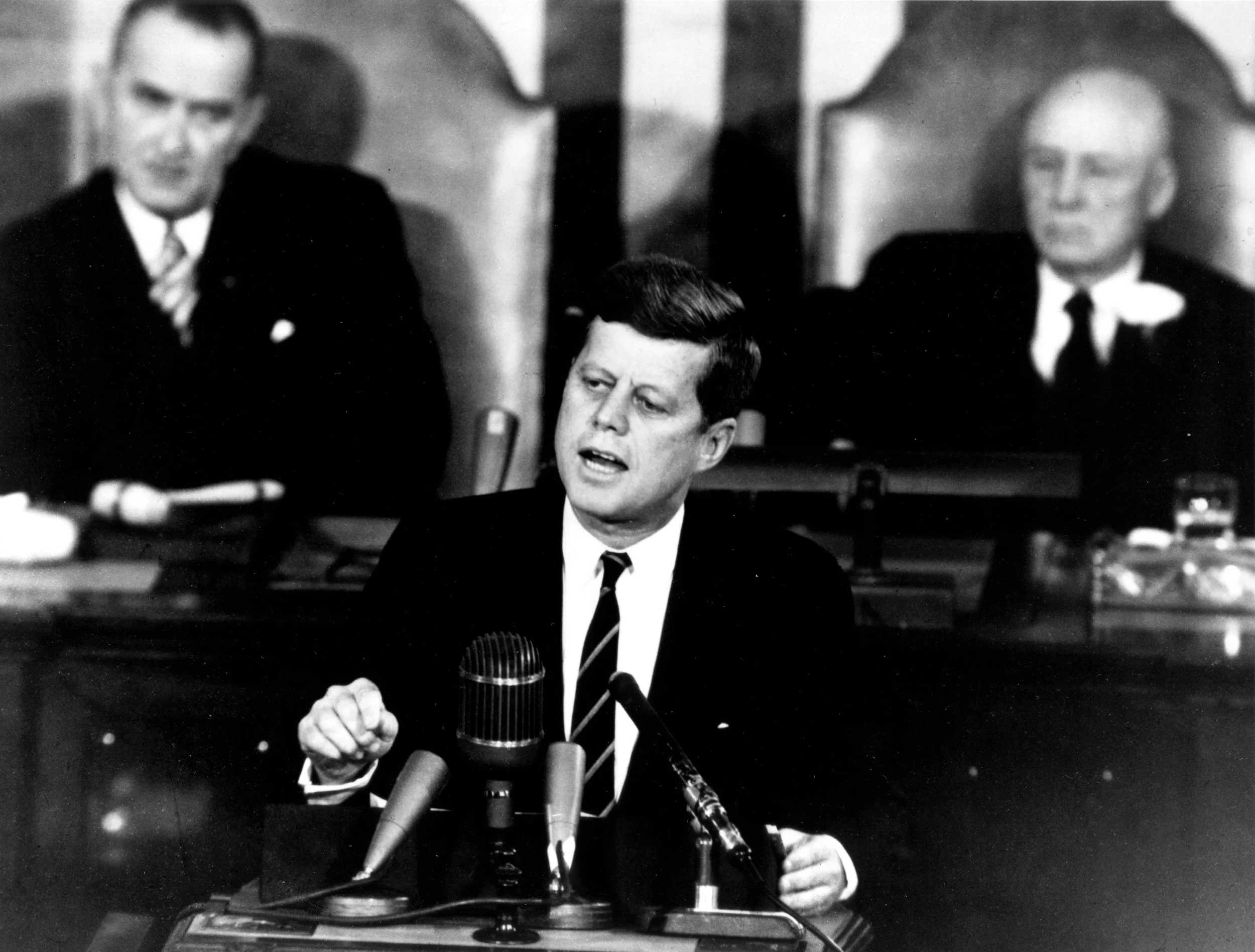
President Kennedy Addresses Congress May 25, 1961. Shown in the background are, (left) Vice President Lyndon Johnson, and (right) Speaker of the House Sam T. Rayburn. Image #: 70-H-1075.
In early 1997, I started the process of applying to the U.S. Naval Academy. I was a junior in high school, yet I was somehow undaunted by the steps involved in this application—one of which is obtaining an official nomination, which typically comes from your U.S. Representative or either of your state’s two U.S. Senators. I applied to all three of these elected officials for my nomination.
That was the first time I paid serious attention to the name “John Glenn.”
He was U.S. Senator John Glenn at the time, but he was also, of course, the first American to orbit the Earth, a feat which he accomplished in 1962. He did it again in 1998, at the age of 77. He was also a U.S. Marine Corps combat pilot and a whole lot more.
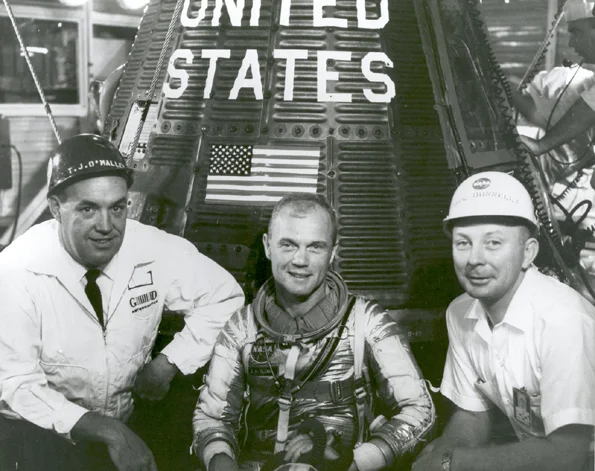
January 24, 1962: John Glenn With T.J. O'Malley and Paul Donnelly in Front of Friendship 7. Grouped together with astronaut John H. Glenn, Jr., beside "Friendship 7" spacecraft are left to right: T.J. O'Malley, chief test conductor for General Dynamics; Glenn; and Paul Donnelly.
Image # : 62-MA6-58.
Glenn died on Dec. 8, 2016, at the Ohio State University Wexner Medical Center in Columbus, less than 100 miles from the small town of Cambridge, Ohio, where he was born in 1921.
He was 95 years old.
I received both a nomination from Glenn and an appointment to the U.S. Naval Academy. I ended up choosing a different path, but I’m glad I had a reason back then to learn a little bit about him.
His life was, certainly, remarkable. It’s inspiring. And I think the Cleveland Plain Dealer’s editorial board said it well: “The most fitting tribute Americans can pay to this American hero … is to live up to the optimism of Glenn's vision.”
But I think there’s another aspect of Glenn’s optimism and the U.S. space program in general that holds a bigger lesson for all of us.
Let’s go back to May 25, 1961—about nine months before Glenn orbited the Earth for the first time. President John F. Kennedy, in a speech before a joint session of the U.S. Congress, said, “… I believe this nation should commit itself to achieving the goal, before this decade is out, of landing a man on the Moon and returning him safely to the Earth.”
That’s not just a big goal. That’s what we now call a “moonshot.”
It was a compelling vision that, with the appropriate resources dedicated to it, harnessed the ingenuity of thousands and the curiosity of millions.
And it’s that type of purpose that can galvanize people into an organization that’s fighting for something big. Something meaningful.
When I work with executives, we often talk about goals and objectives. That’s great; these are important. Keep setting goals.
But I’m afraid that there’s not much about quarterly reports or even big financial targets that really motivate the average employee.
For that, you need a moonshot. You need a vision that helps people see the connection between their everyday activities and something bigger than themselves.
If you ask people in your organization about their job, they’ll probably tell you what they actually do, something technical or something about their functional role.
That’s good, but it’s not great.
If you truly have an organizational moonshot, an audacious vision that you’re committed to achieve, you should be able to go around and ask your people what they do and have them respond with your equivalent of “I’m helping to put a man on the moon.”
So as we remember the legacy of John Glenn, let’s also remember the power of the moonshot—in our lives and in the lives of the people in our organizations.
Find this thought provoking? Leave a comment, like and share!
About Ben Baran
Ben Baran, Ph.D., is probably one of the few people in the world who is equally comfortable in a university classroom, a corporate boardroom and in full body armor carrying a U.S. government-issued M4 assault rifle. Visit: www.benbaran.com.