
I’ve moved my blogging to Substack!
Feel free to check out any of the content I have here, but also be sure to check out my newest content at Reckoning and Elevating What Works.

Two Ways HR Can Rise Up
I spend a fair amount of time around the human resources (HR) profession. Sometimes, that’s in the form of consulting and problem-solving alongside HR leaders; other times it’s through research or teaching graduate students. I’m also an HR officer in the U.S. Navy Reserve, and I maintain my HR certifications like thousands of other HR people.
But I’m often critical of HR. That’s not at all because I think HR people aren’t doing good work; rather, I think every profession should be critical of itself in an attempt to improve continually and stay relevant. We should all be on the lookout for how we can get better at what we do and how we do it.
In particular for HR, I see two areas in which HR could improve substantially.

I spend a fair amount of time around the human resources (HR) profession. Sometimes, that’s in the form of consulting and problem-solving alongside HR leaders; other times it’s through research or teaching graduate students. I’m also an HR officer in the U.S. Navy Reserve, and I maintain my HR certifications like thousands of other HR people.
But I’m often critical of HR. That’s not at all because I think HR people aren’t doing good work; rather, I think every profession should be critical of itself in an attempt to improve continually and stay relevant. We should all be on the lookout for how we can get better at what we do and how we do it.
In particular for HR, I see two areas in which HR could improve substantially. This isn’t to say that HR people aren’t thinking about these things or that many HR departments are already well on their way. But it is to say that considerable room for improvement exists profession-wide.
These two areas—or two ways in which HR can rise up—are:
- Its connection to business strategy and
- Its use of analytics.
First, HR must improve in terms of its connection to business strategy. I hear about employee engagement committees focused primarily on planning company picnics. I hear about HR departments being the last to know about major organizational changes. I hear executives complain that HR in their own company is a gate-keeper, not a service provider.
Being more strategic as an HR person or as an HR function implies special mindset. As Dave Ulrich writes, HR needs to understand the context of their business. They need to understand how their organization competes and wins in the marketplace. Such an understanding is critical because it informs, as Ulrich discusses, a stakeholder view of HR in which the HR function has five main groups that it serves:
- Employees,
- Line managers,
- Customers,
- Investors and the
- Community at large.
With such a mindset, HR people can transform their conversation from one of the tactical and administrative to one of strategy and business results. If you feel that your HR function doesn’t get the respect it deserves in your organization, having a strategic mindset and aligning what you do as a function with the business strategy is a great place to start.
HR professionals, in particular those who lead any HR function, should know and be able to articulate how their priorities and activities align with helping the organization win.
Second, HR must embrace analytics. The world is awash with data, and it’s increasingly becoming apparent that HR must focus on analyzing the right data in the right way to inform decision making. It’s no surprise that the Society for Industrial and Organizational Psychology named “Leveraging and Maximizing Big Data and Applying the Correct Analytics to Make Better Business Decisions” as its top workplace trend for 2016.
From my interactions, HR can improve greatly in this area, but it’s going to require many people in HR to become comfortable with data. It’s going to require them to, in many cases, obtain new skills related to the use of data and analytics.
If you’re wondering what on earth HR analytics is all about, here are a few references that might be helpful in getting you started:
- Josh Bersin’s article in Forbes
- “Change your company with better HR analytics,” an article on the Harvard Business Review blog
- An overview from the Association for Talent Development
HR people and the HR function have, in my opinion, so much to offer their organizations. They’re becoming increasingly essential for organizations as they navigate the modern world of work, but to realize that potential, they’ve got to be strategic in focus and evidence-based in their decision-making.
And so, I encourage everyone in the world of HR to adopt a strategic posture and embrace the world of talent or HR analytics. There are many ways, of course, that HR can add value in organizations, but these are two areas in which it seems that HR can, in particular, rise up.
Love it? Hate it? Find it thought provoking? Leave a comment, like and share!
About Ben Baran
Ben Baran, Ph.D., is probably one of the few people in the world who is equally comfortable in a university classroom, a corporate boardroom and in full body armor carrying a U.S. government-issued M4 assault rifle. Visit: www.benbaran.com.

The Agile Crimson Tide
The Alabama Crimson Tide lost on Monday evening, giving the Clemson Tigers their first national college football championship in 35 years.
But within the world of American college football, it’s undeniable that the University of Alabama’s football program—under head coach Nick Saban—is a powerhouse.
So despite the fact that Crimson Tide fans everywhere are in a state of mourning this week, there’s an interesting lesson to be learned from how Alabama has adapted its approach to the game of football during the past five years. It’s a lesson in

The Alabama Crimson Tide lost on Monday evening, giving the Clemson Tigers their first national college football championship in 35 years.
But within the world of American college football, it’s undeniable that the University of Alabama’s football program—under head coach Nick Saban—is a powerhouse.
So despite the fact that Crimson Tide fans everywhere are in a state of mourning this week, there’s an interesting lesson to be learned from how Alabama has adapted its approach to the game of football during the past five years. It’s a lesson in sensing and responding to the forces of change, and it’s about having the ability to improve continually—even when, overall, you’re still winning most of the time.
I won’t belabor the details of what Saban noticed or what he changed in his approach toward the game—those points are well-documented by ESPN Senior Staff Writer Chris Low. Instead, here are few excerpts from Low’s observations about Saban and how they contain lessons about agility for the rest of us:
“‘I might not like it, but it ain't the way ball is now,’ Saban said of the blueprint that won the first three of his four national championships at Alabama. ‘It's unbelievable how much the game has changed, and it's really hard to coach defense now. But hey, it's on me—regardless of the way I think football should be played—if I don't change with it.’”
Saban readily accepts the fact that we typically have little to no control over the external realities within which we must operate. Good strategy is about having an approach that corresponds with external reality, not having wishful thinking about what the world should be like.
“But while Saban might be old school and might have strong convictions about the direction of the game, the one thing he's not is stubborn. He's smart enough to know that nothing stays the same, especially when you're in the business of chasing championships.”
I’m fortunate to have the opportunity to work frequently with some extraordinarily smart executives, researchers and students. But smart doesn’t always equal agile. Sometimes, people can fall too much in love with their own beliefs about what creates success or what should be done that they fail to recognize that the game has changed around them. And if they finally realize that they must change, it’s often too late for it to really make a difference. Being a little bit suspicious of your success is a good thing.
“‘It just points out how [Saban] is always looking at everything, how to find a better way to do things,’ [former Alabama offensive coordinator Lane] Kiffin said. ‘In the offseason, he's flying us to different places to go learn things and bringing in coaches all the time, which again, that's unusual, because someone like him ... why does he want to learn from someone else? He's the best coach in college football, but that's why he continues to be the best coach.’”
Staying at the top of your game—either as an individual contributor, a middle manager or a senior executive—demands that you (a) have a growth mindset toward your own knowledge and skills and (b) intentionally immerse yourself in useful information. Complacency and comfort are dangerous because they lead to what Robert Quinn, in his book Building the Bridge as You Walk On It, called “slow death.” Or, similarly, it can lead to what Jim Collins, in his book How The Mighty Fall, called “hubris born of success.”
Either way, being agile—as an organization, team, leader, or in virtually any other capacity—demands that you stay on guard. And Saban’s approach with The Crimson Tide is a good reminder of what that “looks like.” It suggests a few good bits of advice, including:
- Don’t change just for change’s sake, but be wary of the status quo.
- Continually watch for subtle forces of change that affect how you win.
- Be prepared to let go of what used to work and adopt new strategies.
- Learn from other people and help your team do the same.
Adopting these habits may not result in you being the highest paid state employee in Alabama. But these routines will help you deal with the change around you much faster and better than those who don’t.
And even if you never win a national championship in anything, I’d wager that being nimble makes the uncertainty of the future a bit less scary and bit more fun.
Find this thought provoking? Leave a comment, like and share!
About Ben Baran
Ben Baran, Ph.D., is probably one of the few people in the world who is equally comfortable in a university classroom, a corporate boardroom and in full body armor carrying a U.S. government-issued M4 assault rifle. Visit: www.benbaran.com.

Are You Liked, Respected or Really Useful?
There’s a conversation that typically happens at some point in leadership training for military officers about whether it’s better to be liked or respected as a leader. That is, do you want your people to enjoy your presence and to feel some sort of emotional attachment to you? Or do you want them to hold you in high regard for your abilities and behavior?
It’s a good conversation because it highlights a natural tension that exists when you’re in charge of people. On one hand, being liked is a source of power in and of itself. People don’t like working for jerks. On the other hand, being in a supervisory position often requires one to make hard decisions that may not sit well with some people, and if your goal is to make your people like you, it could affect your judgment and behavior negatively.
There’s no right answer, although sometimes I’ve noticed (at least in my own life in how I understood things and acted as a young leader) that in the military the “liked” versus “respected” distinction is treated too frequently as a strict dichotomy. It’s either one or the other.
In reality, though, I see this as an “and” proposition. It’s possible—even, dare I say, ideal—to be both.
But the bigger problem is

There’s a conversation that typically happens at some point in leadership training for military officers about whether it’s better to be liked or respected as a leader. That is, do you want your people to enjoy your presence and to feel some sort of emotional attachment to you? Or do you want them to hold you in high regard for your abilities and behavior?
It’s a good conversation because it highlights a natural tension that exists when you’re in charge of people. On one hand, being liked is a source of power in and of itself. People don’t like working for jerks. On the other hand, being in a supervisory position often requires one to make hard decisions that may not sit well with some people, and if your goal is to make your people like you, it could affect your judgment and behavior negatively.
There’s no right answer, although sometimes I’ve noticed (at least in my own life in how I understood things and acted as a young leader) that in the military the “liked” versus “respected” distinction is treated too frequently as a strict dichotomy. It’s either one or the other.
In reality, though, I see this as an “and” proposition. It’s possible—even, dare I say, ideal—to be both.
But the bigger problem is that pursuing either being liked or respected as goals is a fool’s errand. It’s kind of like pursuing happiness. These are outcomes—ends, not means—and they emerge from a variety of factors related to your behavior and how you develop relationships.
That’s where I think there’s another goal that’s clearer and more worthy of pursuit: Being really useful.
And the academic part of me requires that I give credit where credit is due for that idea. It may seem ridiculous, but this is an idea that’s a central premise in Thomas & Friends.
Yes, I’m referring to the children’s show about a group of trains, and the protagonist is a blue engine named Thomas. The engines encounter various challenges in their daily work, and Thomas sometimes gets himself into tough situations that have to get resolved through teamwork and other types of problem-solving and conflict management.
But if you watch just a few episodes, you’ll realize that there’s a goal underlying everything in the show. It’s subtly (and sometimes overtly) suggested as an engine’s raison d'être. It’s their reason for existence, and it’s an achievement to be celebrated.
That characteristic is being a Really Useful Engine. There’s even a song about it.
In the lyrics, you’ll notice that being really useful—helping other people with their work while at the same time performing your own job at a high level of competence—wins the approval of both one’s supervisor and coworkers.
So instead of focusing on necessarily trying to be liked or respected, I think it’s a good idea to focus instead on being really useful for the people around us, for our teams, for our organizations. Being really useful has numerous implications for behavior. If you’re trying to be really useful, you’re necessarily going to do things like:
- Build relationships and listen to people,
- Learn what people or your organization need,
- Work to solve other people’s problems—useful endeavors, not just enjoyable tasks,
- Seek feedback from others and
- Continually build and expand your own competence.
If you do those sorts of things, either as a leader of other people or as an individual contributor, I’m fairly sure that both liking and respect will follow.
Hey, it works for Thomas. And he is, after all, “The Really Useful Engine that we adore!”
Find this thought provoking? Leave a comment, like and share!
About Ben Baran
Ben Baran, Ph.D., is probably one of the few people in the world who is equally comfortable in a university classroom, a corporate boardroom and in full body armor carrying a U.S. government-issued M4 assault rifle. Visit: www.benbaran.com.

One Resolution to Rule Them All
Change is hard. And even though you’re the one person over whose behavior you theoretically should have the most control, changing yourself is often exceedingly difficult.
Nonetheless, many of us doggedly pursue self-betterment. We set goals, hoping that we’ll achieve them along with whatever benefits they bring. We fantasize about the possibility of becoming someone closer to our idealized version of ourselves.
And during late December, many of us set resolutions for the next year.
Yet time and time again, most of us find our resolutions quickly broken. If you need evidence of this, simply go to any fitness center for a few days in early January and take note of how many people are there. Then, go back in early February. The crowds will almost always be gone.
There’s one resolution, though, that can rule them all. It’s one that I’ve found helpful when trying to change myself in a small way.
That resolution is simply this:

Change is hard. And even though you’re the one person over whose behavior you theoretically should have the most control, changing yourself is often exceedingly difficult.
Nonetheless, many of us doggedly pursue self-betterment. We set goals, hoping that we’ll achieve them along with whatever benefits they bring. We fantasize about the possibility of becoming someone closer to our idealized version of ourselves.
And during late December, many of us set resolutions for the next year.
Yet time and time again, most of us find our resolutions quickly broken. If you need evidence of this, simply go to any fitness center for a few days in early January and take note of how many people are there. Then, go back in early February. The crowds will almost always be gone.
There’s one resolution, though, that can rule them all. It’s one that I’ve found helpful when trying to change myself in a small way.
That resolution is simply this: Pick one new good habit and stick to it no matter what. Make yourself a slave to it.
Practice your new habit when you feel like it.
Practice your new habit when you don’t feel like it.
But whatever happens, stick to it.
Another way to think about this is to make a resolution to keep one resolution. Don’t try to change everything about your life or all of your habits—that’s exhausting and won’t work. Pick one manageable aspect of your life, something that you can do every day or every week.
And stick to it.
For example, one of my resolutions last year at this time was to write a blog post every week. Sometimes I felt like it—the ideas and the words came easily. Other times, it was tough. There were a few times when I woke up at 4 a.m. on a weekend to make sure I wrote my post.
Over time, though, it got easier. It became a good habit, one that I’m beginning to take for granted. It’s no longer a “change”—it’s simply something I do every week.
As you think about 2017, I encourage you to think about New Year’s Resolutions. But I encourage you even more to think about focusing your efforts on just a few resolutions, or even just one. Pick one habit, something that you can easily measure (e.g., “Did I do this—yes or no?”), and implement it.
Because when everything is a priority, nothing is a priority.
By the way, this applies to your professional life just as much as to your personal life. How do you think your employees or coworkers feel when you pile on a long list of new procedures or strategic initiatives?
Instead, focus. Pick one new good habit. And in 2017, make it part of your life—no matter what.
Find this thought provoking? Leave a comment, like and share!
About Ben Baran
Ben Baran, Ph.D., is probably one of the few people in the world who is equally comfortable in a university classroom, a corporate boardroom and in full body armor carrying a U.S. government-issued M4 assault rifle. Visit: www.benbaran.com.

You Should Be Embarrassed
I recently read something that I wrote a few years ago. It was dreadful.
The writing was vague, bloated, constipated. How could I have thought—and I did, at the time of writing it—that it was good?
I was embarrassed.
But I’m perfectly fine with that. In fact, I’m

I recently read something that I wrote a few years ago. It was dreadful.
The writing was vague, bloated, constipated. How could I have thought—and I did, at the time of writing it—that it was good?
I was embarrassed.
But I’m perfectly fine with that. In fact, I’m happy about it.
That’s because if you’re not periodically at least a little bit embarrassed about something you produced or did a year or two ago, then you have a big problem. It’s a red flag signaling the possibility that you haven’t learned, you haven’t grown or you haven’t honed your skills.
Although they’re relatively arbitrary in and of themselves, various dates on the calendar sometimes prompt me to reflect—my birthday and the winter holidays come to mind. I think that’s fairly common among most of us. And that periodic time for reflection is an opportunity not just to think about what’s next, but also to think about where you’ve been and how you’ve developed.
If that reflection causes you to wince a bit, great. That simply means that you’ve moved to a higher playing field, one in which you have a new perspective allowing you to notice the difference between what you once thought was your “best” and that of which you are now capable.
A little bit of embarrassment about your prior levels of performance also opens the door for you to appreciate how far you’ve come, what you’ve done and what you’ve learned.
So I invite you to reflect. Think about where you were last year at this time and what you were doing. Take a look at some of the work you produced. Some of it may surprise you for its quality, but there’s a chance that some if it may surprise you for its mediocrity.
And I invite you face the mediocrity of your past and to be a little embarrassed. Embrace the realization that we’re all works in progress—and that embarrassment about the past might mean that you’re moving in the right direction.
Find this thought provoking? Leave a comment, like and share!
About Ben Baran
Ben Baran, Ph.D., is probably one of the few people in the world who is equally comfortable in a university classroom, a corporate boardroom and in full body armor carrying a U.S. government-issued M4 assault rifle. Visit: www.benbaran.com.

Be Vigilant for Your Moment
Despite its sometimes harsh weather and a professional football team that continually disappoints its fans, Cleveland, Ohio, is home to one of the world’s best orchestras.
And that’s not just my amateurish opinion. Gramophone magazine, for example, compiled a list of the 20 best orchestras in the world, based upon ratings from top music critics—whom, I would readily assume, know more about classical music than I.
The Cleveland Orchestra, on this list, is number seven.
It’s rated higher than the Los Angeles Philharmonic, the Boston Symphony Orchestra, the New York Philharmonic and a number of other great orchestras in the United States and around the world.
So the Cleveland Orchestra is, quite naturally, a point of pride for northeast Ohio.
And during the holiday season, the Cleveland Orchestra turns its attention to performing a variety of holiday tunes in its annual Christmas Concert series.
As I have in the past, I found this year’s performance to be splendid. But during the performance, I noticed something that got me thinking.
It was

Despite its sometimes harsh weather and a professional football team that continually disappoints its fans, Cleveland, Ohio, is home to one of the world’s best orchestras.
And that’s not just my amateurish opinion. Gramophone magazine, for example, compiled a list of the 20 best orchestras in the world, based upon ratings from top music critics—whom, I would readily assume, know more about classical music than I.
The Cleveland Orchestra, on this list, is number seven.
It’s rated higher than the Los Angeles Philharmonic, the Boston Symphony Orchestra, the New York Philharmonic and a number of other great orchestras in the United States and around the world.
So the Cleveland Orchestra is, quite naturally, a point of pride for northeast Ohio.
And during the holiday season, the Cleveland Orchestra turns its attention to performing a variety of holiday tunes in its annual Christmas Concert series.
As I have in the past, I found this year’s performance to be splendid. But during the performance, I noticed something that got me thinking.
It was the harp. And more specifically, the harpist.
During an orchestral performance, as you know or can imagine, each musician and his or her instrument fills a specific role. Most prominent, typically, is that of the violins and other stringed instruments. Those musicians, it seems to me, are actually producing sounds from their instruments for much more total time than some of the less frequently heard-from sections.
Which brings us back to the harp. From my seat in the front-left section of Severance Hall, I had a direct view of the side of the stage where the harp and organ were situated. I was able to watch the harpist closely.

In contrast to the violinists and violists and cellists, the harpist’s role is infrequent. It can be rather distinct and prominent in the music, but the harp’s role isn’t to provide the bulk of the musical structure that the orchestra as a whole creates.
So the harpist, as I noticed, must be extraordinarily vigilant. She was just as engaged in the music when she was not playing as when she was playing—she was reading every page of the music, positioning the harp and her hands in anticipation of her parts as they would arrive.
And when they did arrive—her moment to perform—she did so with perfect timing and results.
For me at least, there’s a lesson in the role of the harpist. Sometimes, it’s easy to think that our lives and careers are supposed to be like the violins—a continual production of excellence that everyone notices and appreciates. But that’s potentially misleading and inaccurate.
Because in reality, there’s probably a big part of our lives and careers and our lives that is more like that of the harpist. We have our roles—combined with our specific talents, skills, sets of knowledge—and every so often, we’re needed to perform. It’s our turn to pluck the strings, so to speak, and deliver what only we can in that moment.
The most important point, however, isn’t that our roles are probably more punctuated than we assume.
The most important point is that we must be ready.
We can’t disengage. We must know what’s going on around us; we need to be on the same sheet of music as those with whom we’re performing—our teams at work, our families, our friends. We need to know what our strengths are and how we can contribute.
There are times for performing, and there are times for watching.
And timing is everything.
So, be vigilant for your moment. We’re all counting on you. I, for one, can’t wait to hear your notes.
Find this thought provoking? Leave a comment, like and share!
About Ben Baran
Ben Baran, Ph.D., is probably one of the few people in the world who is equally comfortable in a university classroom, a corporate boardroom and in full body armor carrying a U.S. government-issued M4 assault rifle. Visit: www.benbaran.com.

Forget Goals. What’s Your Moonshot?
In early 1997, I started the process of applying to the U.S. Naval Academy. I was a junior in high school, yet I was somehow undaunted by the steps involved in this application—one of which is obtaining an official nomination, which typically comes from your U.S. Representative or either of your state’s two U.S. Senators. I applied to all three of these elected officials for my nomination.
That was the first time I paid serious attention to the name “John Glenn.”
He was U.S. Senator John Glenn at the time, but he was also, of course, the first American to orbit the Earth, a feat which he accomplished in 1962. He did it again in 1998, at the age of 77. He was also a U.S. Marine Corps combat pilot and
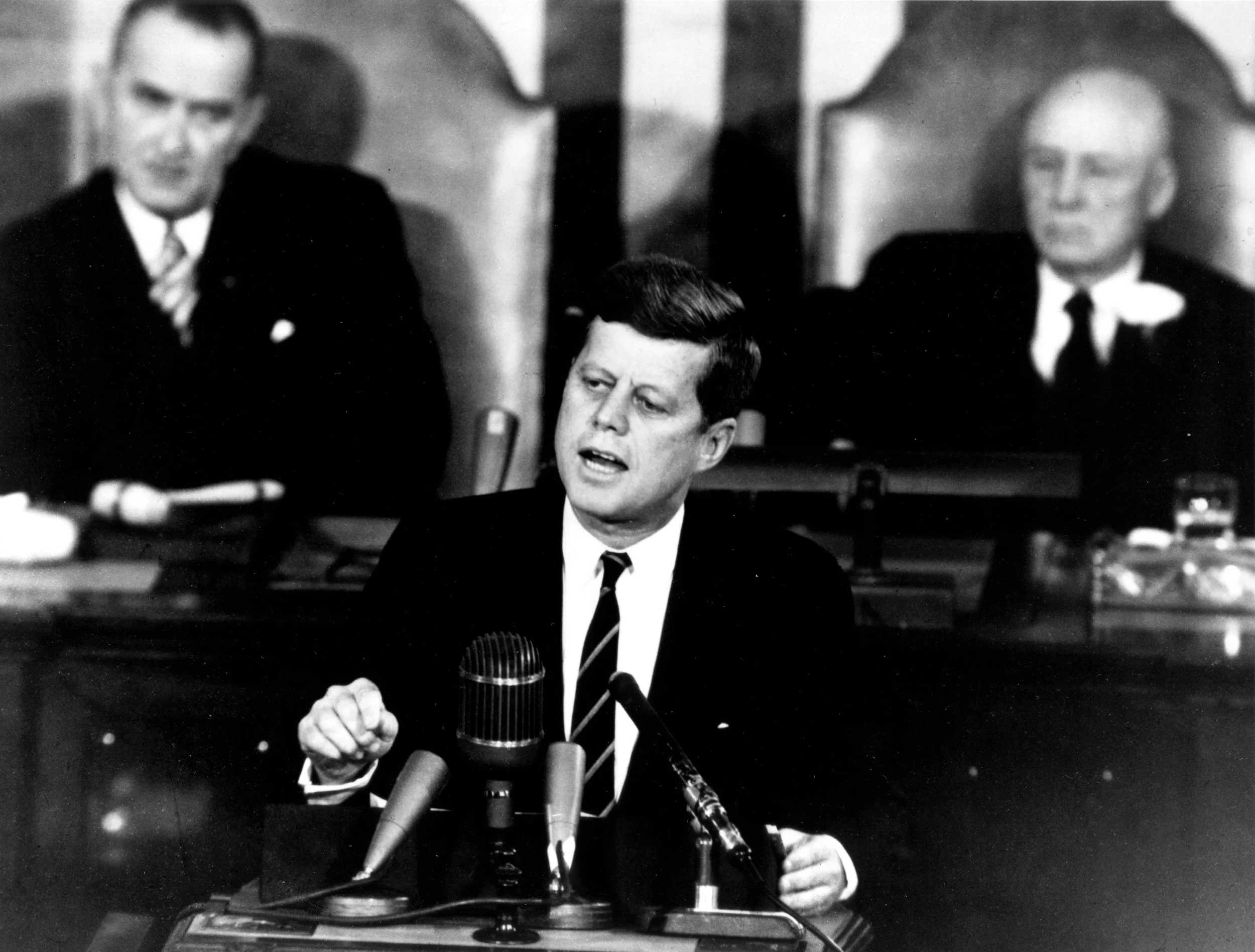
President Kennedy Addresses Congress May 25, 1961. Shown in the background are, (left) Vice President Lyndon Johnson, and (right) Speaker of the House Sam T. Rayburn. Image #: 70-H-1075.
In early 1997, I started the process of applying to the U.S. Naval Academy. I was a junior in high school, yet I was somehow undaunted by the steps involved in this application—one of which is obtaining an official nomination, which typically comes from your U.S. Representative or either of your state’s two U.S. Senators. I applied to all three of these elected officials for my nomination.
That was the first time I paid serious attention to the name “John Glenn.”
He was U.S. Senator John Glenn at the time, but he was also, of course, the first American to orbit the Earth, a feat which he accomplished in 1962. He did it again in 1998, at the age of 77. He was also a U.S. Marine Corps combat pilot and a whole lot more.

January 24, 1962: John Glenn With T.J. O'Malley and Paul Donnelly in Front of Friendship 7. Grouped together with astronaut John H. Glenn, Jr., beside "Friendship 7" spacecraft are left to right: T.J. O'Malley, chief test conductor for General Dynamics; Glenn; and Paul Donnelly.
Image # : 62-MA6-58.
Glenn died on Dec. 8, 2016, at the Ohio State University Wexner Medical Center in Columbus, less than 100 miles from the small town of Cambridge, Ohio, where he was born in 1921.
He was 95 years old.
I received both a nomination from Glenn and an appointment to the U.S. Naval Academy. I ended up choosing a different path, but I’m glad I had a reason back then to learn a little bit about him.
His life was, certainly, remarkable. It’s inspiring. And I think the Cleveland Plain Dealer’s editorial board said it well: “The most fitting tribute Americans can pay to this American hero … is to live up to the optimism of Glenn's vision.”
But I think there’s another aspect of Glenn’s optimism and the U.S. space program in general that holds a bigger lesson for all of us.
Let’s go back to May 25, 1961—about nine months before Glenn orbited the Earth for the first time. President John F. Kennedy, in a speech before a joint session of the U.S. Congress, said, “… I believe this nation should commit itself to achieving the goal, before this decade is out, of landing a man on the Moon and returning him safely to the Earth.”
That’s not just a big goal. That’s what we now call a “moonshot.”
It was a compelling vision that, with the appropriate resources dedicated to it, harnessed the ingenuity of thousands and the curiosity of millions.
And it’s that type of purpose that can galvanize people into an organization that’s fighting for something big. Something meaningful.
When I work with executives, we often talk about goals and objectives. That’s great; these are important. Keep setting goals.
But I’m afraid that there’s not much about quarterly reports or even big financial targets that really motivate the average employee.
For that, you need a moonshot. You need a vision that helps people see the connection between their everyday activities and something bigger than themselves.
If you ask people in your organization about their job, they’ll probably tell you what they actually do, something technical or something about their functional role.
That’s good, but it’s not great.
If you truly have an organizational moonshot, an audacious vision that you’re committed to achieve, you should be able to go around and ask your people what they do and have them respond with your equivalent of “I’m helping to put a man on the moon.”
So as we remember the legacy of John Glenn, let’s also remember the power of the moonshot—in our lives and in the lives of the people in our organizations.
Find this thought provoking? Leave a comment, like and share!
About Ben Baran
Ben Baran, Ph.D., is probably one of the few people in the world who is equally comfortable in a university classroom, a corporate boardroom and in full body armor carrying a U.S. government-issued M4 assault rifle. Visit: www.benbaran.com.

Siri, Drive the Kids to Soccer Practice
Touchscreen ordering at McDonald’s. Self-checkout at the grocery store.
Programmable logic controllers that guide manufacturing processes. Industrial robots that weld, assemble and, even, inspect.
And perhaps one that really sparks widespread imagination: driverless vehicles. We probably have some time before we can get a positive result from telling our iPhones, “Siri, drive the kids to soccer practice,” but

Touchscreen ordering at McDonald’s. Self-checkout at the grocery store.
Programmable logic controllers that guide manufacturing processes. Industrial robots that weld, assemble and, even, inspect.
And perhaps one that really sparks widespread imagination: driverless vehicles. We probably have some time before we can get a positive result from telling our iPhones, “Siri, drive the kids to soccer practice,” but numerous advancements are already underway. Take, for instance, the Google Self-Driving Car Project.
These are only a few of the ways in which automation, or the use of control systems that reduce human involvement in a process, is taking shape at the moment.
Automation, it seems, is one critical aspect of turbulence and change that’s affecting businesses and everyday life. It’s a trend that’s not going away—it’s not actually new, either, for that matter—and it’s one that business leaders need to continue watching.
The topic of automation writ large is far too broad to capture here, but here are a few considerations for business leaders on the topic:
- We are indeed in interesting times, as computing power continues to accelerate our ability to complete tasks with increasingly less direct human involvement.
- The tasks or processes that are the best candidates for automation are those that are relatively routine and repetitive.
- Some of the advantages of automation include the ability to use machines to complete dangerous or boring, repetitive tasks; potential labor cost savings and the ability to complete work beyond the realm of human abilities.
- Some of the disadvantages of automation include high initial costs and the need for continual maintenance of the system, which may involve highly technical monitoring.
- Not all tasks or processes can be automated, particularly those that involve non-routine types of work.
- Automation isn’t an all-or-nothing proposition. For example, consider the many aspects of driving your car that are already automated (depending on the age and model your vehicle, of course): cruise control, warning systems, climate control, and so on. Sometimes, the best returns in automation may come from automating parts of a system, not the entire system.
- Monitor your environment. Advances in automation may lead to increased capabilities or productivity of your competitors, so it’s critical to stay abreast of what’s going on in your industry. Read trade publications, attend conferences, and systematically evaluate potential automation candidates in your organization.
Additionally, keep in mind that advances in automation that affect your industry may not originate in your industry. As such, you’ll want to not only monitor your industry but also automation and its influence upon business more broadly.
The implications of automation certainly can capture the imagination. For example, many are concerned about the influence of automation on jobs and opportunities available to people for participation in the labor force.
Here are a few resources for further reading:
- How to Save Time and Money Through Automation (Forbes, Nov. 17, 2016)
- Robots and Automation May Not Take Your Desk Job After All (Harvard Business Review, Nov. 22, 2016)
- Preparing Your Workforce for the Automation Age (Harvard Business Review, Nov. 23, 2016)
- David Autor of the Massachusetts Institute of Technology wrote an excellent paper on automation and how it intersects with human capabilities and behavior
- Numerous podcasts and other resources from The Library of Economics and Liberty
Regardless of whether you’re excited, terrified or somewhere in between regarding the future of automation, business and work, it’s a reality that we all must face. It’s a trend that I intend to continue monitoring as we head into 2017—because it’s a big one.
As it is with all disruptive trends, although we cannot control everything about the future, we can anticipate, we can see the small signs and weak signals. The sooner we sense those forces of change, the sooner we can respond.
And sometimes, that’s what makes the difference between change being a disaster or an opportunity.
What are some of the most compelling examples of automation trends you're noticing? I'd love to hear about them.
Find this thought provoking? Leave a comment, like and share!
About Ben Baran
Ben Baran, Ph.D., is probably one of the few people in the world who is equally comfortable in a university classroom, a corporate boardroom and in full body armor carrying a U.S. government-issued M4 assault rifle. Visit: www.benbaran.com.

Why Gratitude is Smart Business for Leaders
One of the most prominent experiences I’ve had as an adult was the year I spent in Afghanistan, where I advised the Afghan National Police in 2013.
And one of the biggest reasons why it was a prominent experience is that it gave me a fresh perspective and sense of how good my life was in America. Being around poverty and people who had live through various levels of armed conflict for the past three decades has a way of making your “problems” seem a little less consequential. It makes you grateful for what you have.
But it doesn’t take a trip to Afghanistan to develop a sense of gratitude. In fact, I’ve come to realize how gratitude is a daily choice: You must
One of the most prominent experiences I’ve had as an adult was the year I spent in Afghanistan, where I advised the Afghan National Police in 2013.
And one of the biggest reasons why it was a prominent experience is that it gave me a fresh perspective and sense of how good my life was in America. Being around poverty and people who had lived through various levels of armed conflict for the past three decades has a way of making your “problems” seem a little less consequential. It makes you grateful for what you have.
But it doesn’t take a trip to Afghanistan to develop a sense of gratitude. In fact, I’ve come to realize how gratitude is a daily choice: You must consciously decide to be thankful, or you’ll quickly become complacent and focus only on what’s not going well in your life. Furthermore, there’s a difference between (a) feeling grateful for what you have in life overall and (b) expressing gratitude to others for something they’ve done.
While feeling grateful is intrinsically beneficial in boosting our positive outlook on life, the latter—expressing thanks to other people—is a small-yet-powerful way in which we can influence the people we lead or the people with whom we work.
And what’s more, thanking people who work for us or work with us is smart business.
Why?

Because when we thank other people for what they do, they’re more likely to feel socially valued. They’re also more likely to help us again and perform other, valuable social behaviors such as helping each other, talking positively about the organization, being polite and other critical tendencies that make teams and organizations run well.
So this holiday season, instead of or in addition to—hey, I’m not judging—overeating and braving the throngs of retail deal-seekers, set a goal of thanking the people around you at work. And when you do, consider a few of the following:
- Be sincere. This isn’t about manipulating people, and empty praise won’t work well very long anyway. People can often tell if you’re not genuine.
- Be specific. When thanking someone, describe to them the situation, what he or she actually did and the impact it had on you or the team. That way, the person can know exactly what behavior you noticed and appreciated. This will also help ensure that you’re thanking people for actions that truly deserve thanks.
- Be timely. If someone does something praiseworthy, tell him or her about it right away. It’ll mean more then than it will if you wait six months to mention it in a performance review or awards ceremony.
One of the best parts of expressing thanks to those around us is that it’s free. All it takes is some intentional effort and a sense of sincere appreciation.
Find this thought provoking? Leave a comment, like and share!
About Ben Baran
Ben Baran, Ph.D., is probably one of the few people in the world who is equally comfortable in a university classroom, a corporate boardroom and in full body armor carrying a U.S. government-issued M4 assault rifle. Visit: www.benbaran.com.

Advanced Manufacturing and Two Ways to Reward Agility
Modern factory floors fascinate me. There’s something about the clang and whoosh of the myriad machines, the hum of an overhead crane gliding along its tracks, the intricate yellow lines demarcating where it’s safe to walk and the ambiguous chemical aroma punctuating the air with hints of solvents or grease or paint or maybe all of them mixed together.
There’s something about the delicate dance of interdependent and interconnected parts and processes that somehow—amazingly—produce that which we and the entire world outside the factory walls often takes for granted.
When I’m in a factory, I still get the same sense of wonder and curiosity that I had when I was 8 or 9 years old, touring the Rohm and Haas plant in Louisville, Ky. And this week, I had the opportunity to visit one of Cleveland’s (and Ohio’s, for that matter) oldest and largest manufacturing firms: Lincoln Electric.

Modern factory floors fascinate me. There’s something about the clang and whoosh of the myriad machines, the hum of an overhead crane gliding along its tracks, the intricate yellow lines demarcating where it’s safe to walk and the ambiguous chemical aroma punctuating the air with hints of solvents or grease or paint or maybe all of them mixed together.
There’s something about the delicate dance of interdependent and interconnected parts and processes that somehow—amazingly—produce that which we and the entire world outside the factory walls often takes for granted.
When I’m in a factory, I still get the same sense of wonder and curiosity that I had when I was 8 or 9 years old, touring the Rohm and Haas plant in Louisville, Ky. And this week, I had the opportunity to visit one of Cleveland’s (and Ohio’s, for that matter) oldest and largest manufacturing firms: Lincoln Electric.

Although it’s old (founded in 1895) and large (about 10,000 total employees, $2.5 billion in revenue), Lincoln Electric has a distinct track record of innovative practices within the realms of strategy execution and incentive systems designed to channel its employees' motivation and effort.
It’s not surprising that it has long served as a case study for Harvard Business School.
But what I found most intriguing was how Lincoln Electric has structured agility—the capability to sense and respond to change—into two distinct parts of its measurement and evaluation systems.
First, Lincoln Electric’s managers systematically assess and rate their employees’ flexibility. These ratings—along with ratings on dimensions of teamwork and dependability, safety, quality and contributing to improvement efforts by providing recommendations—form what’s known as the employee’s “report card.” And this report card plays an important role in determining the employees’ bonuses, so it’s meaningful.
The feature of Lincoln Electric’s incentive system that’s probably most well-known is its piecework pay structure. For many workers, that means they get paid based upon how many items they actually produce—no hourly wage, no salary. This creates a powerful motive for workers to work quickly and efficiently. To ensure quality, mistakes matter. If an item fails any aspect of a quality check, the same employee (or group of employees) who put it together must fix the problem.
Many aspects of this system are intriguing, but what I like about the flexibility component of the report card at Lincoln Electric is that it’s strategic in nature. That’s because Lincoln Electric is a low-volume, high-mix manufacturer. Simply put, they make many different types of products in quantities that often vary. This has allowed them to meet their customers’ often-diverse needs, but it also means that they need their employees to become proficient in more than one area of expertise. They need their employees to be willing and able to jump in and help in other areas if needed. This is critical to maintaining their business model, and it’s critical for employee behavior. As such, including this type of flexibility (which I’d argue is closer to agility) is part of the evaluation and incentive structure sends a clear signal to their employees in terms of what’s expected and rewarded.
Second, Lincoln Electric’s commitment to agility extends to its supply chain. Not surprisingly, to support its diverse array of products, Lincoln Electric depends heavily on high-quality materials. And because their production volume is often variable, they depend not only on having high-quality materials, but also upon having those materials available in variable quantities. As such, Lincoln Electric requires flexibility from its suppliers.
And just like it does with its employees, Lincoln Electric systematically assesses the flexibility of its suppliers. This occurs as part of periodic evaluations in which its supply-chain leaders rate each supplier on a number of dimensions as part of an overall scorecard. Furthermore, Lincoln Electric works with its suppliers to ensure they have contingency plans in place to help them manage the unexpected—because that which affects the suppliers will certainly affect Lincoln Electric.
There’s surely much more detail and nuance involved in both Lincon Electric’s commitment to employee and supply-chain agility, but I think one big lesson that applies to organizations everywhere is this:
If you truly value an aspect of behavior, it’s not enough to talk about it. You must take the next step and measure it—and reward it.
This sounds simple enough, but I’m continually surprised by firms that hope for certain outcomes or changes in behavior yet are unwilling to systematically measure and incentivize those very same outcomes or behaviors.
Many companies claim to value agility, flexibility, responsiveness or nimbleness. But never forget—hope and expectations and slogans and posters and speeches won’t necessarily influence what people actually do. To create alignment between behaviors and strategy, the right incentives must exist.
Find this thought provoking? Leave a comment, like and share!
About Ben Baran
Ben Baran, Ph.D., is probably one of the few people in the world who is equally comfortable in a university classroom, a corporate boardroom and in full body armor carrying a U.S. government-issued M4 assault rifle. Visit: www.benbaran.com.

Leadership Advice for the New Administration
On the evening of Wednesday, Nov. 9, one day after the general election here in the United States, I met with my graduate students who are in my course on leadership and interpersonal effectiveness.
Up until this point, we hadn’t talked much about the U.S. presidential race in class. But I felt that on that one class the day after the election, it might make sense to do so. It just felt weird to not talk about it. Our course is about leadership, after all.
In particular, we’ve talked at length in the course about the agility required for leaders to pivot into new roles. This is particularly true for people who have never managed or led people before—that first-time manager job can be tough.
And although both Secretary Clinton and now President-Elect Trump have extensive experience leading people and projects, transitioning from presidential hopeful to President of the United States must surely be a dramatic shift personally and professionally.
For anyone.
And so, on Nov. 9, with my class, we

On the evening of Wednesday, Nov. 9, one day after the general election here in the United States, I met with my graduate students who are in my course on leadership and interpersonal effectiveness.
Up until this point, we hadn’t talked much about the U.S. presidential race in class. But I felt that on that one class the day after the election, it might make sense to do so. It just felt weird to not talk about it. Our course is about leadership, after all.
In particular, we’ve talked at length in the course about the agility required for leaders to pivot into new roles. This is particularly true for people who have never managed or led people before—that first-time manager job can be tough.
And although both Secretary Clinton and now President-Elect Trump have extensive experience leading people and projects, transitioning from presidential hopeful to President of the United States must surely be a dramatic shift personally and professionally.
For anyone.
And so, on Nov. 9, with my class, we discussed. We talked about, based upon what we’ve covered in the course so far, what advice we would give to the new administration, including the newly elected President, in making this transition from campaigning to governing.
We didn’t get into the politics of the matter.
We didn’t get into who’s right and who’s wrong.
Instead, I prefaced the conversation with a few observations:
- If you’re sad today, about 59 million other people aren’t
- If you’re happy today, about 59 million other people aren’t
- Things are usually neither as good nor as bad as they may seem at first
- The country isn’t even close to being at its peak of divisiveness, if you consider our entire history
- We always have myriad reasons for which to be grateful about living in the United States
We then focused the conversation on leadership. Namely, we zeroed in on a few key concepts that could assist the new administration as it transitions into power during the next few months.
Here are some of the excellent observations that emerged from our discussion. The new administration could benefit from, among other things, doing the following:
- Communicate differently. Remember that one’s words have consequences, and those consequences are often magnified when spoken from positions of authority. Also, move from generalities and begin speaking more precisely about goals and policies.
- Empathize. Although the nation isn’t as divided as it was in 1862, that’s not exactly a high bar for cohesion. People get inspired when they feel as though their leaders are listening to them and attempting to understand their situations. This, for the new administration, includes people of all backgrounds, status levels and ideologies. Trust must be earned, and it must begin with demonstrating respect.
- Share leadership and delegate. Remember that it’s OK to not know everything. Seek and rely upon experts for complicated decisions. Include people who think differently from you—maybe even very differently—in the conversation. Think carefully about whom you appoint to key positions, and demonstrate an openness to ideas and people who aren’t necessarily familiar at the moment.
- Flip your mindset from “me” to “we.” This bit of advice comes directly from the great book we’re reading in the course—Be the Boss Everyone Wants to Work For—by my good friend Bill Gentry. The new administration must broaden its message, recognizing that being a great leader requires an emphasis on the people you’re trying to lead—not on your own greatness.
Another bit of advice from my class? Maybe the newly elected President shouldn’t take a salary, or maybe he should donate all of it to a reputable charity.
I was particularly impressed with my class and their ideas on this tough, emotionally freighted topic. I have no idea if the new administration will do anything that resembles the ideas my class discussed or not. But the new regime would, I think, be wise to consider them.
Because regardless of your preferences, we’re all on the same ship. And although we Americans can fight and bicker and sling mud at each other with the best of them, we also have a proud tradition of peaceful transitions of power and of resilience.
So, let’s get to work.
Find this thought provoking? Leave a comment, like and share!
About Ben Baran
Ben Baran, Ph.D., is probably one of the few people in the world who is equally comfortable in a university classroom, a corporate boardroom and in full body armor carrying a U.S. government-issued M4 assault rifle. Visit: www.benbaran.com.

What a Professor Learned by Taking Online Classes
Taking classes while working full-time is tough. That’s one of the lessons I learned firsthand during the past two years.
But there’s more.
To begin, I’ve been a business professor since 2011, so I’ve had the opportunity to teach many students—about 1,000 to date. And I’ve taught in the three primary formats: solely face-to-face, solely online and in a hybrid structure, which is a combination of face-to-face and online. I’ve taught both graduate and undergraduate students, many of whom were extraordinarily busy with part- or full-time jobs, families and other time demands outside of their coursework.
I always knew that these students were busy, but from January 2015 to October 2016, my appreciation for their balancing-act of responsibilities grew.
Substantially.
That’s because during that time, I became the student. I became the juggler

Taking classes while working full-time is tough. That’s one of the lessons I learned firsthand during the past two years.
But there’s more.
To begin, I’ve been a business professor since 2011, so I’ve had the opportunity to teach many students—about 1,000 to date. And I’ve taught in the three primary formats: solely face-to-face, solely online and in a hybrid structure, which is a combination of face-to-face and online. I’ve taught both graduate and undergraduate students, many of whom were extraordinarily busy with part- or full-time jobs, families and other time demands outside of their coursework.
I always knew that these students were busy, but from January 2015 to October 2016, my appreciation for their balancing-act of responsibilities grew.
Substantially.
That’s because during that time, I became the student. I became the juggler of taking classes and raising kids and being a spouse and working full-time. And in addition to gaining some valuable knowledge from the coursework itself, I gained a new appreciation for what it’s like for many of my students.
The courses I took were all online through the U.S. Naval War College, and these courses were part of a curriculum that’s the U.S. military services expect their officers to complete (particularly as they become more senior). In addition to my professorial work, I’m an officer in the U.S. Navy Reserve, and it was time for me to buckle down and complete this requirement.
Overall, my experience taking these courses was highly positive—the U.S. Naval War College does a great job with distance education. As a positive unintended consequence, however, I think this experience made me a better professor. It gave me a fresh perspective. So, for the benefit of other educators (and those who take classes from them), here are a few specifics:
- Online courses must be especially well-organized. Given that professors don’t have the opportunity to discuss schedules and requirements in real-time with students, online courses must be designed with extraordinary attention to detail regarding what’s required and the course timeline. A careful, thorough syllabus is a great start, but whatever online platform used for the course must also be carefully designed to facilitate easy use for the student. For example, have clearly labeled links and folders. And a pleasant color scheme doesn’t hurt.
- Communication must be redundant and systematic. Sure, you may have everything spelled out in the syllabus, but instructors can’t “fire and forget” with online courses (if they care about student engagement and learning, that is). Send out a weekly e-mail that reminds students what’s going on, what’s due and other pertinent information.
- Student performance isn’t a perfect reflection of how much they know or care about the course. I don’t have any data at my fingertips, but I wonder if students who take online courses are also more likely to be students who are working full-time or trying to balance other activities than those students who go the traditional, face-to-face route. That seems plausible. At any rate, my experience taught me that to survive and turn assignments in on time, students (like me) often have to satisfice. That is, due to my other time demands, there were times when I turned in assignments that I knew weren’t my best work—far from it. I had to sacrifice quality to just get the darn paper done on time.
- Although some students may want a lot of feedback on their work, many others may not. The simple truth—and I’m talking to my fellow professors here—is that many students are simply trying to complete the course and get a decent grade. They might not care about “getting better” by learning from your extensive comments on their work, for example. One potential implication for professors, I think, might be to avoid the temptation to “over grade.” Provide students with their grades and some feedback, but don’t go crazy with trying to note every single way in which their work was deficient. Specifically tell students that they are absolutely invited to request additional feedback if they want it. That way, you can tailor your efforts as the instructor to the level of feedback that students want.
- For online courses, group projects are even trickier than in face-to-face courses. I’m not necessarily saying that instructors should never have group projects in online courses, but if you are, be absolutely sure that the assignments given to the group are carefully thought through. That includes thinking about the types of interaction that group members will need to have in order to complete their tasks. For example, highly complex, interdependent work is often best-suited for real-time discussion. But the people in an online course are often in the online course precisely because they have crazy schedules, so they are unlikely to find good times to talk with their fellow team members.
- Finally, some variety—and humanity—can be engaging. If every single one of the modules in an online course has exactly the same structure, it can be boring. I found it refreshing with some modules included a new video or interactive component related to the material. And it’s also helpful when the instructor finds ways to remind the students that a real human is behind the course.
As the higher-education landscape continue to shift and technologies continue to develop, online education will also evolve. Within such technologies and changes are great opportunities for students and educators alike.
But for those of us who design and administer courses online, it’s critical to empathize with our students and their learning experiences. And sometimes, it might take actually enrolling in a course to gain such empathy. At least for me, it did.
Find this thought provoking? Leave a comment, like and share!
About Ben Baran
Ben Baran, Ph.D., is probably one of the few people in the world who is equally comfortable in a university classroom, a corporate boardroom and in full body armor carrying a U.S. government-issued M4 assault rifle. Visit: www.benbaran.com.

You Already Won the Lottery
A few weeks ago, I was discussing the topic of stress and well-being with my students in class. Our focus was on the importance of monitoring your well-being and managing your stress when you’re in a leadership position. Being a manager and having to get work done through a team is tough work, and it’s often full of stressors which, left unchecked, can take a toll on the manager.
That toll can include negative outcomes such as:
- Irritability,
- Reduced productivity,
- Burnout
- And a host of physical symptoms, from higher blood pressure to weight gain.
So it’s critical for managers of all levels to take care of themselves, both mentally and physically.
As the class went on, I discussed the importance of self-care for managers and how it can include many techniques, but one that I find particularly interesting is something that’s free and relatively easy. That technique?
It’s

A few weeks ago, I was discussing the topic of stress and well-being with my students in class. Our focus was on the importance of monitoring your well-being and managing your stress when you’re in a leadership position. Being a manager and having to get work done through a team is tough work, and it’s often full of stressors which, left unchecked, can take a toll on the manager.
That toll can include negative outcomes such as:
- Irritability,
- Reduced productivity,
- Burnout
- And a host of physical symptoms, from higher blood pressure to weight gain.
So it’s critical for managers of all levels to take care of themselves, both mentally and physically.
As the class went on, I discussed the importance of self-care for managers and how it can include many techniques, but one that I find particularly interesting is something that’s free and relatively easy. That technique?
It’s gratitude.
It turns out that gratitude has a number of beneficial outcomes. It helps us build productive social relationships, and it seems to protect us from stress and depression. (See this report of two longitudinal studies on the topic.)
And overall, being grateful for the positive things we have in life is strongly linked to well-being.
Given this evidence regarding the role of gratitude, I took a moment in class to encourage gratitude.
“Take out a piece of paper,” I said, “and write down as many things as you can think of for which you are grateful in your life.”
Some people started writing right away; others froze motionless. A few others looked at me quizzically, as if to suggest, “I haven’t really done anything in my life yet, so what’s there to be so happy about?”
As they started this exercise, I looked at them all and thought about their situations and how it compares with millions of other people’s situations, either in the United States or around the world, particularly in war-torn or developing countries I’ve visited.
And then I said, “You are sitting in a college classroom in the United States of America. You have already won the lottery.”
Those who weren’t already busy creating their gratitude list now at least had a place to start.
And so, for the rest of us, what’s the implication? Well, you, too, have already won the lottery. You’re literate (almost 16 percent of adults in the world aren’t) and you’re part of the 40 percent of the world that currently has an internet connection. That’s pretty good, just to start. And beyond that, count yourself among a much smaller, even more fortunate group if you (1) live in relative safety, (2) have access to clean drinking water and (3) have reasonable access to health and dental care. That’s not even considering your education, your job-related skills, your valued relationships and numerous other aspects of your life that truly set you apart from many in the world.
For whatever reason, it’s easy to think about what we don’t have. But that’s unproductive. It’s only going to make you feel more stressed and lower your well-being.
Instead, take a few minutes every day and think about your gratitude list. Even better, write them down in a gratitude journal.
Because if you do, I’m fairly certain you’ll be happier and less stressed. And that’s yet another thing for which—you guessed it—you can be grateful.
Find this thought provoking? Leave a comment, like and share!
About Ben Baran
Ben Baran, Ph.D., is probably one of the few people in the world who is equally comfortable in a university classroom, a corporate boardroom and in full body armor carrying a U.S. government-issued M4 assault rifle. Visit: www.benbaran.com.

Never Give Up, Never Stop Learning
Although I teach courses on various topics related to leadership, I’m quick to admit it: Learning a lot about leadership won’t necessarily make you a great leader.
Similarly, just because someone has 20 years of experience doing something doesn’t necessarily make him or her an expert. It’s quite possible—and common—for people to have the same experience, 20 years in a row.
What oftentimes elevates truly great leaders above the rest is their tenacity, their commitment to never give up—and to never stop learning. It’s their ability to persevere through adversity with an open mind, applying the lessons they acquire along the way.
One such leader whom I’ve always enjoyed listening to and reading about is United States Marine Corps General James Mattis (ret.). Among recent military leaders, Mattis is a legend, particularly if you talk with other U.S. Marines.
Stories about his selfless, direct style of leadership abound.
Additionally,

Photo By: Lance Cpl. Jesus Sepulveda Torre. The appearance of U.S. Department of Defense (DoD) visual information does not imply or constitute DoD endorsement.
Although I teach courses on various topics related to leadership, I’m quick to admit it: Learning a lot about leadership won’t necessarily make you a great leader.
Similarly, just because someone has 20 years of experience doing something doesn’t necessarily make him or her an expert. It’s quite possible—and common—for people to have the same experience, 20 years in a row.
What oftentimes elevates truly great leaders above the rest is their tenacity, their commitment to never give up—and to never stop learning. It’s their ability to persevere through adversity with an open mind, applying the lessons they acquire along the way.
One such leader whom I’ve always enjoyed listening to and reading about is United States Marine Corps General James Mattis (ret.). Among recent military leaders, Mattis is a legend, particularly if you talk with other U.S. Marines.
Stories about his selfless, direct style of leadership abound.
Additionally, his use of the “knife hand”—basically pointing for emphasis with all of one’s fingers outstretched and the hand oriented such that the little finger is closest to the ground, like the sharp edge of a knife—is equally legendary.
So I couldn’t help but pause for a moment recently when the Marines released a video of Mattis talking about leadership. In the video, he answers a number of questions related to leadership. At the end, he even addresses the lethality of his knife hand.
He’s quick to point out that it was the spirit of the people he led, his Marines, that kept him motivated throughout his career.
And in no uncertain terms, he says that the key to improving continually as a leader is that “You have to assume that you must keep improving.” For Mattis, this is simply a given. Leaders must “maintain this body, mind and spirit improvement at all times.”
But above all, I’m impressed with his humble-yet-confident demeanor. People tend to follow those who know where they’re headed, but at the same time they’re inspired by those who are humble enough to share recognition with the team for getting stuff done.
Or, as Mattis says, “You’re not going to win any fights as a leader. Your troops are going to win those fights.”
Take a few minutes to listen to these and other bits of timeless leadership wisdom in the video below.
Although none of us will go through the same situations as Mattis and it’s unlikely that any of us will achieve his level of regard among any group of leaders, not to mention leaders in the U.S. Marine Corps, there’s plenty that we can learn from his style.
And if we do, I think we’ll be just a little better equipped than we were before to adapt to change and to perform well in adversity.
That’s not to say that it’s easy. Quite to the contrary, leadership is hard. It’s often vastly different from the somewhat romantic vision that we sometimes have of it. But just because it’s difficult doesn’t mean that leadership can’t be effective.
Because, as Mattis says, “Difficulty is an excuse that the Marine Corps will never accept.”
What excuses do you accept? What do you tolerate, in yourself, in those around you, in your organization?
And what, during the next week or so, can we all do to re-identify what’s important, to re-commit to never giving up and never stopping our process of learning?
Find this thought provoking? Leave a comment, like and share!
About Ben Baran
Ben Baran, Ph.D., is probably one of the few people in the world who is equally comfortable in a university classroom, a corporate boardroom and in full body armor carrying a U.S. government-issued M4 assault rifle. Visit: www.benbaran.com.

What Leaders Can Learn From Mr. Olympia
Imagine that you’re about to interview for the job of your dreams. Or that you’re about to give a high-stakes presentation. Or take an important test. Or simply focus on getting a few things done in the next hour.
What are you thinking? What are you telling yourself in your mind?
If you’re anything like 8-time Mr. Olympia Ronnie Coleman, you’re telling yourself, “Ain’t nothin’ to it but to do it.”
Coleman is widely considered one of the greatest bodybuilders of all time, which is impressive enough, but what I find compelling is how he talked. In particular, how he

Imagine that you’re about to interview for the job of your dreams. Or that you’re about to give a high-stakes presentation. Or take an important test. Or simply focus on getting a few things done in the next hour.
What are you thinking? What are you telling yourself in your mind?
If you’re anything like 8-time Mr. Olympia Ronnie Coleman, you’re telling yourself, “Ain’t nothin’ to it but to do it.”
Coleman is widely considered one of the greatest bodybuilders of all time, which is impressive enough, but what I find compelling is how he talked. In particular, how he talked to himself.
You can find plenty of evidence of this on YouTube, and in addition to being interesting, it’s often entertaining. He’s funny. He’d be kicked out of Planet Fitness in about 0.3 seconds.
And Coleman’s “self-talk,” as it’s called in the psychology literature, is easy to spot because he often does it aloud.
When approaching a massive weight that he was about to lift, he’d say things like:
- “Yeah, buddy!”
- “Nothin’ but a peanut.”
- “Light weight!”
- “Ain’t nothin’ to it but to do it.”
And then he’d go lift something about as heavy as my car.
But what’s really compelling is how our internal monologue—our self-talk, or our “mindchatter” as my friend Bill Gentry of the Center for Creative Leadership calls it—influences our performance as leaders and managers.
A few years ago, I was part of a research team that specifically looked at how executives talked to themselves. In our study, we analyzed a few hundred letters that senior executives wrote to themselves at the conclusion of a leadership development program. We then took our ratings of their self-talk in those letters and analyzed how it compared with how their own bosses and followers rated their leadership. Lo and behold, the best leaders had self-talk patterns that were positive, reflective and constructive in nature.
The ineffective leaders, on the other hand, tended to have pessimistic, negative self-talk. They also tended to report being more stressed than their positive self-talking, effective counterparts.
Much of the scientific research on the outcomes of self-talk comes from the world of sport psychology. And the findings in that realm tend to support what we found in the business world—positive self-talk is productive and useful.
So what might self-talk “look like?” For that, let’s turn to a study that constructed a measure of self-talk for athletes. They categorized self-talk into eight groups as listed below.
- Psych Up: Let’s go, Give 100%, Do your best
- Anxiety Control: Relax, Calm down, No stress
- Confidence: I feel strong, I can make it, I believe in me
- Instruction: Concentrate, Focus on your technique, Focus on what you need to do right now
- Worry: I’m wrong again, I cannot concentrate, I am not as good as the others
- Disengagement: I want to stop, I want to get out of here, I am fed up
- Somatic Fatigue: I am tired, Today I “suck,” My body is not in good condition
- Irrelevant Thoughts: I am thirsty, What will I do later tonight, I want to take a shower
If you truly reflect upon your own thoughts, I bet you’d be able to find examples from most if not all of these categories. We all “talk” to ourselves. The question is whether we’re positive and constructive or negative and destructive in our patterns of self-talk.
Regardless of whether we’re trying to do our best running a meeting or preparing for a tough conversation at work, it behooves us to be mindful of our self-talk. Literally forcing ourselves to use positive patterns of self-talk helps change our attitude and our mood, allowing us to do our best.
Because no matter what situations we face in this crazy life, we always have control over how we react and our resulting attitude. And a big part of changing our attitude is controlling what we allow to go on in our minds.
So the next time you face a tough management moment, I encourage you to first stop and think, “Ain’t nothing to it but to do it.”
Find this thought provoking? Leave a comment, like and share!
About Ben Baran
Ben Baran, Ph.D., is probably one of the few people in the world who is equally comfortable in a university classroom, a corporate boardroom and in full body armor carrying a U.S. government-issued M4 assault rifle. More at www.benbaran.com, www.agilityconsulting.com and www.strategicagilityinstitute.com.

Are You “Rewarding A While Hoping For B?”
Incentives matter. Rewards motivate people to behave in certain ways. Using incentives, therefore, is one great way to influence the form, direction and intensity of how people act.
Goals also matter. They help us clarify where we’re headed and how to focus our efforts. Setting difficult, specific goals, therefore, is one of the best ways to motivate yourself and others (see the numerous studies on the topic, particularly those by Gary Latham and Edwin Locke).
But goals and incentives can—and sometimes do—run amuck.
And when that happens, it’s often in the form of

Incentives matter. Rewards motivate people to behave in certain ways. Using incentives, therefore, is one great way to influence the form, direction and intensity of how people act.
Goals also matter. They help us clarify where we’re headed and how to focus our efforts. Setting difficult, specific goals, therefore, is one of the best ways to motivate yourself and others (see the numerous studies on the topic, particularly those by Gary Latham and Edwin Locke).
But goals and incentives can—and sometimes do—run amuck.
And when that happens, it’s often in the form of “rewarding A while hoping for B,” a topic described thoroughly in the classic management article by Steven Kerr.
That is, we often forget that it’s not just about what you’re rewarding formally; it’s also about what you’re rewarding informally. And it’s in the unintended informal rewards that we can run into trouble.
Here’s a simple example: You assign a task to one of your direct reports. He quickly responds with a sub-par product with multiple errors. You’re frustrated, but you know that you can fix the errors about 10 times more quickly than he can. So you tell him that it’s not sufficient, but then you go ahead and fix the product yourself—leaving him with no more tasks to complete that day.
What have you done?
In addition to missing a training opportunity, you’ve informally rewarded your direct report for sub-par effort. By not having him go through the pain of fixing the problem, he now knows that he can get by with little effort. That leaves you at the office at 7 p.m., while he’s already home or at happy hour.
Did you mean to reward poor performance? Of course not. But in a way, you did.
Here’s another simple example: You set a team goal of 1,000 error-free shipments of one of your new products. If that occurs, everyone on the team will receive a $3,000 bonus. One of your people finds an error after one of the products ships, but it’s an error that the customer might not notice for quite a while. Have you rewarded that employee to speak up and report the problem, or have you rewarded silence?
Here’s a bigger example: Wells Fargo. As you likely know, between about 2011 and 2016, the company set goals for its lower-level bank employees to sell additional products to its customers—a practice known as cross-selling. There’s nothing inherently wrong with that. What company doesn’t want its customers to purchase and use more than one or two or three or more of its products or services?
But what happened at Wells Fargo is that the incentives and goals were such that people—more than 5,000—found numerous “creative” ways to cross-sell. These methods included widespread opening of accounts for customers who didn’t request them and even using fake customers to pad one’s sales numbers.
Here’s a Wall Street Journal recap of some of the highlights.
Clearly, this was an error of management and leadership at a grand scale. It’s hard to claim that such a problem might be due to a few “bad apple” employees given that at least 5,000 were involved.
Instead, it’s the barrel—the system. And in particular, it’s the incentive and goal-setting systems set in place by senior leaders—the “barrel makers.” They, along with the direct violators, are culpable.
Incentives and goals are important aspects to guiding people’s effort at work. When properly aligned with organizational objectives, they can powerfully harness people’s ingenuity for the good of the team.
But it’s equally important to remember that incentives and goals may have unintended consequences. So let’s be on guard for those ways—both big and small—in which we might be “rewarding A while hoping for B.”
Find this thought provoking? Leave a comment, like and share!
About Ben Baran
Ben Baran, Ph.D., is probably one of the few people in the world who is equally comfortable in a university classroom, a corporate boardroom and in full body armor carrying a U.S. government-issued M4 assault rifle. More at www.benbaran.com and www.agilityconsulting.com.

On Human Connection, Vulnerability and Leadership
Years ago, as a young junior officer in the U.S. Navy, a few hundred of my peers and I shuffled into a large auditorium to hear an admiral speak. I don’t remember his name or his title. But I remember one phrase, one nugget of “wisdom” that he provided.
He said, “Leaders are people who know stuff.”
At the time this seemed like a simple, yet compelling insight. And it’s certainly the case that one source of people’s power and influence over others can be their expertise. In many situations, we follow those people who know the most (or at least seem to know the most) about how to solve problems.
We also tend to follow people who have definitive answers. People who are decisive, outspoken, direct.
But such tendencies grossly oversimplify

Years ago, as a young junior officer in the U.S. Navy, a few hundred of my peers and I shuffled into a large auditorium to hear an admiral speak. I don’t remember his name or his title. But I remember one phrase, one nugget of “wisdom” that he provided.
He said, “Leaders are people who know stuff.”
At the time this seemed like a simple, yet compelling insight. And it’s certainly the case that one source of people’s power and influence over others can be their expertise. In many situations, we follow those people who know the most (or at least seem to know the most) about how to solve problems.
We also tend to follow people who have definitive answers. People who are decisive, outspoken, direct.
But such tendencies grossly oversimplify the heart of leadership and what it means to connect with our fellow humans.
The implication of treating leaders and leadership as being about “knowing stuff” is that to be a leader, you need to have all of the answers. You need to know more than the people you’re trying to lead. And your knowledge, therefore, gives you the right to tell those people what to do.
Sorry, admiral, but this conceptualization of leadership is as sophisticated as my 3.5 year-old son—whom I caught wiping his nose on the couch cushion yesterday.
Clearly, it’s important to have professional expertise and competence if you want other people to follow you. There’s a great benefit to knowing “stuff,” to building specific sets of knowledge and skill. By all means, do this.
But leadership at a higher level is all about human connection. And that’s where another set of ideas kick in and truly start to matter. These are topics that often receive less attention than expertise or decisiveness. These include concepts such as
- Empathy.
- Compassion.
- Forgiveness.
- Vulnerability, and, dare I say …
- Love.
Vulnerability is particularly interesting. Being vulnerable is fundamentally about being open about who you are, your strengths and your weakness. And embracing who you are—not who you think you should be, not who other people want you to be—can be a tremendous source of confidence. It allows people to walk into the unknown, facing the ambiguity that characterizes so many of the problems in this world that require leadership.
Brené Brown, a research professor at the University of Houston Graduate College of Social Work, has studied this and related topics extensively. And, as she discusses in her popular TEDx talk below, vulnerability is about not only being courageous enough to see ourselves as we truly are, but it’s also about feeling worthy.
If you’re not one of the more than 26 million people who have already done so, take a few minutes to hear her talk. You won’t regret it.
Being vulnerable and willing to admit that you’re not perfect opens the door to new possibilities; it opens the door to creating new opportunities in the face of uncertainty. It’s a quality that specifically requires you to admit that sometimes you don’t “know stuff,” that other people might have better ideas than you do.
And leaders who do that, I think, are uniquely suited to lead others, particularly in times of change or adversity. They still must, of course, be willing to make tough decisions when necessary. They still must, of course, be competent and knowledgeable.
But thinking that leadership is only about being the smartest person in the room is short-sighted. And it’s fragile. It breaks down quickly when things change. Instead, what’s becoming increasingly clear is that being an agile, adaptive leader in times of turbulence demands courage, authenticity and the confident grace that comes with embracing the unknown.
Find this thought provoking? Leave a comment, like and share!
About Ben Baran
Ben Baran, Ph.D., is probably one of the few people in the world who is equally comfortable in a university classroom, a corporate boardroom and in full body armor carrying a U.S. government-issued M4 assault rifle. More at www.benbaran.com and www.agilityconsulting.com

The Courage to be Agile and Pivot
My morning routine gives me comfort. I get up at the exact same time almost every day. My coffee maker is set to turn on 15 minutes earlier, so I go downstairs, pour my coffee and fill my 1-liter water bottle. I then head to my home office and get oriented for the day’s activities.
After about 40 minutes, my coffee cup and water bottle are empty. Then, it’s time to get ready for some exercise. That lasts for about an hour, after which comes the remainder of my tasks to prepare for the day prior to the stampede of our four soon-to-awaken children.
And so on.
These are comfortable routines; they are generally productive habits.
But sometimes habits can become too comfortable. We can stick to routines for the sake of sticking to the routine—when in fact, change is necessary.
For example,

My morning routine gives me comfort. I get up at the exact same time almost every day. My coffee maker is set to turn on 15 minutes earlier, so I go downstairs, pour my coffee and fill my 1-liter water bottle. I then head to my home office and get oriented for the day’s activities.
After about 40 minutes, my coffee cup and water bottle are empty. Then, it’s time to get ready for some exercise. That lasts for about an hour, after which comes the remainder of my tasks to prepare for the day prior to the stampede of our four soon-to-awaken children.
And so on.
These are comfortable routines; they are generally productive habits.
But sometimes habits can become too comfortable. We can stick to routines for the sake of sticking to the routine—when in fact, change is necessary.
For example, I recently had a fairly ambitious exercise regimen outlined for the week ahead. I noticed some pain after a few days, but I ignored it. I wanted to stick to the plan.
Sticking to the plan, though, resulted in a level of pain that I couldn’t ignore, and I ended up having to take the whole next week off from exercise.
This was all because I was stubborn and refused to recognize that the game had changed. My original assumptions were invalid, but I pressed on anyway.
That’s why it takes courage to change, courage to pivot toward a new set of routines. It involves recognizing that some condition or something in the world around you has shifted. It then involve realizing that you must give up something comfortable and sail into uncharted waters. Goodbye, familiar routines.
The same process happens over and over again in teams and organizations. For example, consider the startup Gild Collective.
During the past 15 months, I’ve had the privilege of watching and documenting Gild Collective grow and evolve. This has involved much more than casual observation. In fact, I’ve surveyed the team of co-founders 45—yes, 45—times during these 15 months.
Like most startups, they’ve evolved quickly. And for a number of months, they settled into what seemed like a good set of routines. Their business focuses on making it easy for women to get together and create something beautiful—think art, accessories, and more—all while the group has great time and learns something about themselves and each other.
This was going well, but along the way, they discovered a potentially bigger opportunity—transforming their “get togethers” into professional workshops for the purpose of women’s leadership development.
They realized the game had changed; an opportunity presented itself. But it would require the courage to venture into the unknown, leaving behind their comfortable routines. It would require them, in startup parlance, to “pivot.”
They’ve had to forge new networks, and, above all, adapt to a new sense of who they were as leaders and who they were as a company.
That level of agility—sensing and responding to the forces of change—is hard. It takes courage. But it’s what it takes to succeed in a changing world. And in the case of Gild Collective, I’m happy to say, it’s working. Their new approach is resonating with recent clients (like Procter & Gamble), and many others are starting to notice what they’re doing. (Because their new focus aligns with my expertise, I’ve joined Gild Collective’s advisory board—I’m thrilled to have a role in helping them.)
So regardless of whether it’s with a startup, an established organization, or within your own daily life, I think it’s valuable to remember that quitting the old to take on the new—in other words, being agile—is courageous. We must be open to the possibility that the assumptions under which we made our original plans may have changed. Just because you planned a certain exercise regimen for the week doesn’t mean you should stick to it in the face of injury; just because your original business strategy demanded a certain focus and set of actions doesn’t mean you should stick to it if new information or opportunities emerge.
And by having the courage to pivot, we open ourselves to opportunities; we create the freedom within which we can innovate and evolve into the next chapter of our lives.
Find this thought provoking? Leave a comment, like and share!
About Ben Baran
Ben Baran, Ph.D., is probably one of the few people in the world who is equally comfortable in a university classroom, a corporate boardroom and in full body armor carrying a U.S. government-issued M4 assault rifle. Visit www.benbaran.com.

Orienting New Employees Starts Well Before You Meet Them
My fascination with the military—and the U.S. Navy, in particular—started before I was 10 years old. And during the decade between then and when I was commissioned as an officer in 2002, I acquired a whole set of ideas about what actually being in the Navy would be like.
These ideas came from books, movies, stories from veterans and myriad other information sources around me.
Some of those ideas turned out to be accurate; others weren’t. For example, most of what you experience on a day-to-day basis in the U.S. Navy—especially if you’re a ship driver like I was—bears little to no resemblance to Maverick’s job as a fighter pilot in the 1986 movie Top Gun.
But other patterns of behavior such as respect for rank structure, commitment to teammates, and aspects of selfless leadership that I’d learned about turned out to be

My fascination with the military—and the U.S. Navy, in particular—started before I was 10 years old. And during the decade between then and when I was commissioned as an officer in 2002, I acquired a whole set of ideas about what actually being in the Navy would be like.
These ideas came from books, movies, stories from veterans and myriad other information sources around me.
Some of those ideas turned out to be accurate; others weren’t. For example, most of what you experience on a day-to-day basis in the U.S. Navy—especially if you’re a ship driver like I was—bears little to no resemblance to Maverick’s job as a fighter pilot in the 1986 movie Top Gun.
But other patterns of behavior such as respect for rank structure, commitment to teammates, and aspects of selfless leadership that I’d learned about turned out to be fairly true. And certainly the overarching ideas of duty to one’s country and mission accomplishment, which attracted me in the first place to military service, are indeed a large part of military culture.
The same process occurs with other organizations, even if they are not as large or embedded in broader society as the U.S. military. Organizations project messages through their current and former employees, their formal recruiting communications and various other formal or informal, intentional and unintentional ways. People then interpret and assign meaning to those messages, and, here’s the key—they may begin at that moment to form ideas about what it would be like to be a member of the organization.
They also begin forming ideas about what types of behavior might be acceptable or unacceptable and about what norms or routines they might expect.
Orienting new employees, therefore, starts well before you meet them.
What’s more, this process also influences who even is more or less likely to express interest in joining your organization, focusing your pool of applicants. It’s the first part of the “attraction-selection-attrition” framework first discussed in 1987 by Ben Schneider (in this article).
All of this points to the importance of an organization’s brand—not in terms of its products or services, although that’s very important for different reasons—but its brand as an employer.
When people think about your organization, do they think about it as a potentially ideal place to work?
If not, who are you attracting in your recruitment efforts?
And from what sources are people learning about the internal culture of your organization? Friends? Family members? Glassdoor? LinkedIn?
And, perhaps even more importantly, who is controlling that message?
These questions are important to consider, because without a strong employer brand that’s linked to your organization’s strategy, your recruiting efforts run the risk of being suboptimal.
Furthermore, creating a strong employer brand can complement the orientation or socialization process for new employees. This happens when an organization consistently projects an employer brand that attracts people with specific values or preferences that are congruent with what the organization needs.
Many organizations, in my experience, fail to capitalize on the opportunity for setting expectations and socializing employees during their first few days or weeks. Still fewer have a deep, strategic view of this process that includes the employer brand and what types of people it hopes to attract into its workforce.
Therefore, most organizations and human resources (HR) functions have the opportunity to strengthen this critical initial part of the talent-management pipeline.
Perhaps, the opportunity also exists for HR as a function to learn even more from its partners in marketing—because HR should not just be concerned with internal, administrative matters.
Instead, HR must also look outward, with a strategic focus on acquiring the talent needed both today and tomorrow. And clarifying a strong employer brand that helps to orient future employees might be a place to start.
Find this thought provoking? Leave a comment, like and share!
About Ben Baran
Ben Baran, Ph.D., is probably one of the few people in the world who is equally comfortable in a university classroom, a corporate boardroom and in full body armor carrying a U.S. government-issued M4 assault rifle. Visit: www.benbaran.com.

Can Leadership Prevent Mistakes?
"While I was in the middle of the room, the attic floor and beams collapsed onto the second floor crashing down to the first floor where I was standing. The time between us entering the building and the time of the collapse was no longer than 90 seconds. I was knocked to the floor and was trapped under the debris. I suffered a head injury and a torn patellar tendon. The contents of the upstairs ended up in the first floor room and I could have been killed. By my judgment, approximately 80,000 gallons of water was pumped into that structure and we were ordered in anyway. This was after a previous call to evacuate 45 minutes earlier. This should not have happened!"
Mistakes happen. Sometimes, those mistakes hurt or kill people. I’ve studied them among fire fighters, who sometimes experience events like the one described above (which comes from Report 07-0001036, U.S. Department of Homeland Security, 2014). The mistakes that people in the fire service and other high-risk occupations make often have important safety implications. In other industries and occupations, mistakes may not hurt or kill people, but mistakes often derail projects or anger customers. They create conflict and they degrade the quality of what we make or do.
Mistakes aren’t exclusive to any industry or sector.
Mistakes also almost happen. These close calls or near misses—when discussed well and integrated into a learning program—can serve as powerful wakeup calls for people and teams.
Regardless of whether we’re talking about mistakes or near misses, learning from the past to improve future performance is

“While I was in the middle of the room, the attic floor and beams collapsed onto the second floor crashing down to the first floor where I was standing. The time between us entering the building and the time of the collapse was no longer than 90 seconds. I was knocked to the floor and was trapped under the debris. I suffered a head injury and a torn patellar tendon. The contents of the upstairs ended up in the first floor room and I could have been killed. By my judgment, approximately 80,000 gallons of water was pumped into that structure and we were ordered in anyway. This was after a previous call to evacuate 45 minutes earlier. This should not have happened! ”
Mistakes happen. Sometimes, those mistakes hurt or kill people. I’ve studied them among fire fighters, who sometimes experience events like the one described above (which comes from Report 07-0001036, U.S. Department of Homeland Security, 2014). The mistakes that people in the fire service and other high-risk occupations make often have important safety implications. In other industries and occupations, mistakes may not hurt or kill people, but mistakes often derail projects or anger customers. They create conflict and they degrade the quality of what we make or do.
Mistakes aren’t exclusive to any industry or sector.
Mistakes also almost happen. These close calls or near misses—when discussed well and integrated into a learning program—can serve as powerful wakeup calls for people and teams.
Regardless of whether we’re talking about mistakes or near misses, learning from the past to improve future performance is a fundamental management and leadership objective (Catino & Patriotta, 2013; Morris & Moore, 2000). But a common problem that I’ve seen in organizations is that we’re often apt to treat mistakes as problems with individual people. Sometimes an individual person is part of the problem, but pinning a mistake on a single person doesn’t necessarily help a team or organization learn. Instead, what’s required is a culture that embraces learning from mistakes in non-judgmental, non-punitive way.
One example of such an approach is in health care. Modern hospitals are systems in which extraordinary good and life-saving care happens daily. But they’re also places where mistakes hurt and even kill people.
Frequently.
And one person within the healthcare industry whose insights I’ve always enjoyed is Paul F. Levy, the former president and CEO of Beth Israel Deaconess Medical Center in Boston.
In the clip below, he discusses some of the nuances of teamwork and leadership as they pertain to mistakes in health care. Paraphrasing one of his senior leaders commenting on what to do about a doctor who made a serious mistake (starting at 7:00 in the video), he says,
“If we want to establish a culture in our organization that encourages and permits people to admit their mistakes and their near misses, we are more likely to establish that culture if we do not punish doctors who, with best of intentions, make a mistake. They’ve already suffered enough. ”
So, is there a way to make organizations error free? In this continually changing world, probably not. The key, instead, is to promote continual learning through what we do and what we say, catching small errors before they become big ones and taking the necessary steps to improve. That’s at the heart of building a team and organization that encourages open discussion of hazards and errors, of what almost went wrong and what could have happened.
Years ago, I had a much more punitive approach to dealing with mistakes than I do now. That’s because I’ve realized that leadership isn’t about being perfect or having a perfect team. It’s about unlocking people’s own ability to learn, to imagine, and to become something greater than they realized was possible.
Leadership, therefore, can’t prevent mistakes. But with an approach of humility, continuous improvement and open communication, it can help to build routines and patterns of learning that make mistakes less likely and less frequent.
Find this thought provoking? Leave a comment, like and share!
About Ben Baran
Ben Baran, Ph.D., is probably one of the few people in the world who is equally comfortable in a university classroom, a corporate boardroom and in full body armor carrying a U.S. government-issued M4 assault rifle. Visit: www.benbaran.com.
References
Catino, M., G. Patriotta. 2013. Learning from errors: Cognition, emotions and safety culture in the Italian air force. Organizational Studies, 34: 437-467.
Morris, M. W., P. C. Moore. 2000. The lessons we (don’t) learn: Counterfactual thinking and organizational accountability after a close call. Administrative Science Quarterly, 45: 737-765.
U.S. Department of Homeland Security. 2014. National Fire Fighter Near-Miss Reporting System. Retrieved from http://www.firefighternearmiss.com