
I’ve moved my blogging to Substack!
Feel free to check out any of the content I have here, but also be sure to check out my newest content at Reckoning and Elevating What Works.

Your Most Precious Resource
I recently heard someone quote a deceptively insightful short poem. Titled, “How did it get so late so soon,” it’s one of many gems penned by the late Theodor Geisel, and here it is.
"How did it get so late so soon?
It’s night before it’s afternoon.
December is here before it’s June.
My goodness how the time has flewn.
How did it get so late so soon?"
Geisel, more commonly known as Dr. Seuss, captures here the feeling that I get frequently when I think about seasons ending, new years beginning and everyone (including me) aging.
It’s not just about nostalgia; it’s not just about how even a 100-year lifetime is but a flash in the course of history.
It’s more than that.
It’s about how there’s one thing

I recently heard someone quote a deceptively insightful short poem. Titled, “How did it get so late so soon,” it’s one of many gems penned by the late Theodor Geisel, and here it is.
“How did it get so late so soon?
It’s night before it’s afternoon.
December is here before it’s June.
My goodness how the time has flewn.
How did it get so late so soon?”
Geisel, more commonly known as Dr. Seuss, captures here the feeling that I get frequently when I think about seasons ending, new years beginning and everyone (including me) aging.
It’s not just about nostalgia; it’s not just about how even a 100-year lifetime is but a flash in the course of history.
It’s more than that.
It’s about how there’s one thing that we all have in common, one thing that none of us can acquire. It’s about how there’s one thing that—according to Bruce Springsteen—“slips away, and leaves you with nothing mister, but boring stories of … glory days.”
That thing, of course, is time. It’s our most precious resource, but we all squander it daily. We waste time on failing projects. We allow ourselves to become distracted. We even trick ourselves into thinking that we’re doing valuable work when we’re really just avoiding less-desirable, yet more-critical tasks.
Even more importantly, we often fail to consider that every moment we spend doing something is a moment we aren’t spending doing something else. We hate quitting so much that we often would rather slog on in agony while not making progress toward other, more desirable goals.
Many leaders—even ones who are fairly successful—are just as guilty as the rest of us. But as the well-known management educator and writer Peter Drucker, in his 1966 classic book The Effective Executive, wrote,
“Effective executives, in my observation, do not start with their tasks. They start with their time. And they do not start out with planning. They start by finding out where their time actually goes. Then they attempt to manage their time and to cut back unproductive demands on their time.”
I find that high-performing managers and executives often make the mistake of performing tasks themselves because they can do it fast and do it right. This is fine in and of itself, but these tasks are often ones that can and should be offloaded to others. Investing time in training and mentoring others is important and saves time in the long run, but many executives struggle with the tradeoff—it takes time to train and mentor. So they continually put off delegating and take on more and more themselves.
This is a recipe for burnout. It’s a recipe for stagnation.
At a higher level, it’s also a recipe for missing what’s great in life. Face it: Someday, you are going to die. So am I. Recognizing our own mortality is good; it can help us focus on what’s really important—in our jobs, in our relationships, in our lives.
And while the skill to master one’s use of time is a lifelong quest, a few things that have helped me include:
- Being increasingly selective and intentional about saying “yes” to new projects,
- Recognizing when projects are failing and killing them quickly if appropriate,
- Challenging myself to devote all of my attention to an undesirable task for set periods of time,
- Checking e-mail less frequently instead of using e-mail as my to-do list, and
- Analyzing whether my priorities are aligned with my longer-term goals.
Because although the Rolling Stones—and I’m a fan—told me that “Time is on my side,” it quite clearly is not. So, in our limited time on this planet, I think it’s helpful to prune our activities as best as we can to focus on what gives us meaning and purpose. It’s tough, but I’m going to give it another shot.
In so doing, I’m reminded of what Henry David Thoreau wrote in Walden; or, Life in the Woods:
“I went to the woods because I wished live deliberately, to front only the essential facts of life, and see if I could not learn what it had to teach, and not, when I came to die, discover that I had not lived. I did not wish to live what was not life, living is so dear; nor did I wish to practise resignation, unless it was quite necessary. I wanted to live deep and suck out all the marrow of life, to live so sturdily and Spartan-like as to put to rout all that was not life, to cut a broad swath and shave close, to drive life into a corner, and reduce it to its lowest terms.”
Find this thought provoking? Leave a comment, like and share!
About Ben Baran
Ben Baran, Ph.D., is probably one of the few people in the world who is equally comfortable in a university classroom, a corporate boardroom and in full body armor carrying a U.S. government-issued M4 assault rifle. Visit: www.benbaran.com.
On Gratitude, Agility and Career Transitions
When I was a teenager, I thought I had it all figured out: My life and career would be a logical series of steps and accomplishments. I’d go to college, earn an officer’s commission in the U.S. Navy, see the world. Then, I’d probably go to law school and enjoy another set of logical steps of accomplishments toward “success” in the civilian world.
Reality, of course, is different.
Life—and careers—are often full of twists and turns, punctuated by triumphs and failures. Some of those ups and downs are big and public, most are

When I was a teenager, I thought I had it all figured out: My life and career would be a logical series of steps and accomplishments. I’d go to college, earn an officer’s commission in the U.S. Navy, see the world. Then, I’d probably go to law school and enjoy another set of logical steps of accomplishments toward “success” in the civilian world.
Reality, of course, is different.
Life—and careers—are often full of twists and turns, punctuated by triumphs and failures. Some of those ups and downs are big and public, most are small and private. It’s a journey that I’ve found to be best accomplished by a sense of agility, by being nimble and trying to make a positive difference in whatever opportunity arises.
In those early years, I never would have predicted that in the next two decades I would have:
- Spent my most rewarding tour of duty in the Navy as a reservist called back to active duty in the landlocked country of Afghanistan,
- Earned a master’s degree in industrial/organizational psychology and a Ph.D. in organizational science (I was a political science and communication studies double major as an undergraduate), or
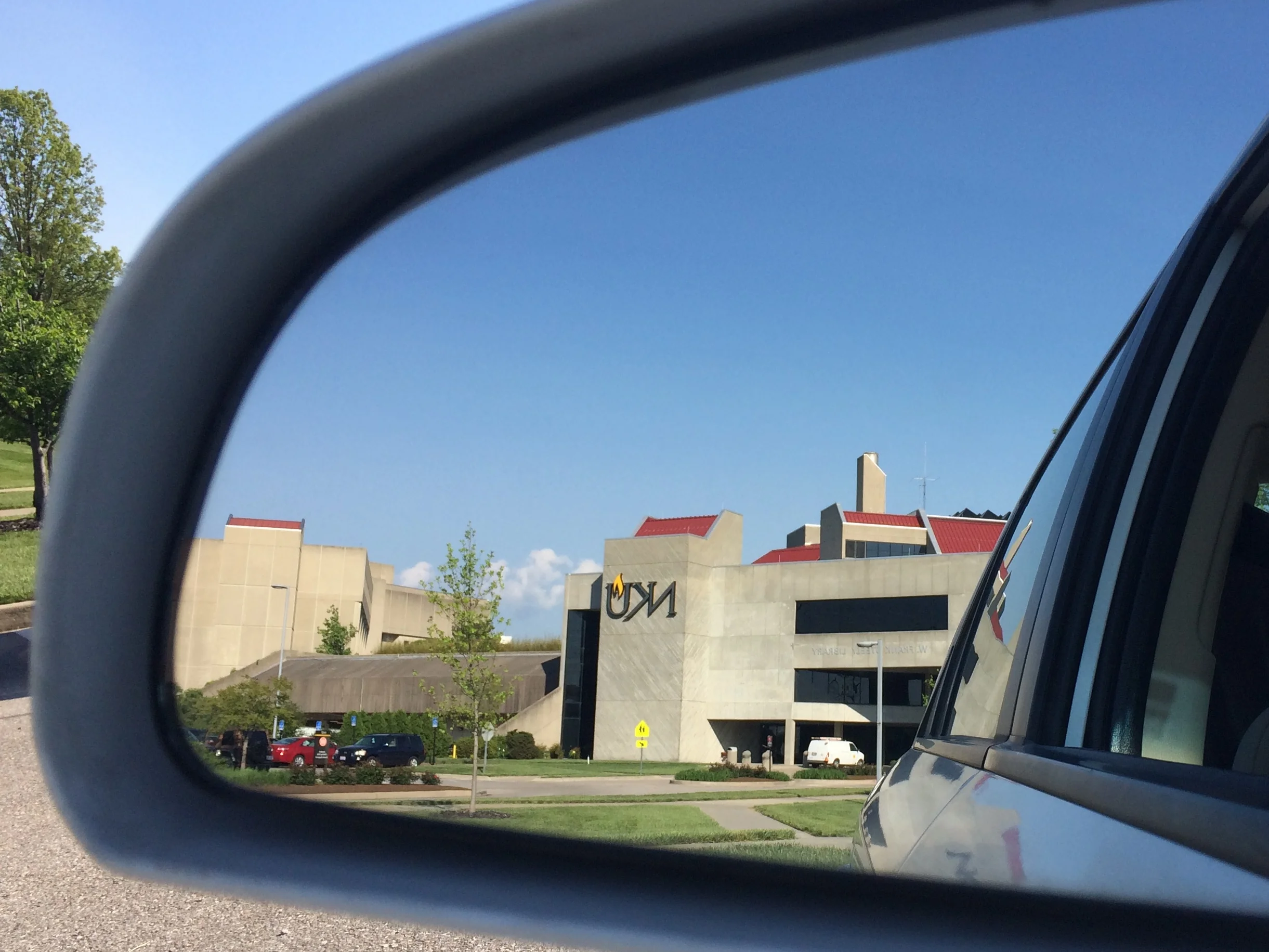
- Served for five years as a member of the faculty of the Haile/US Bank College of Business at Northern Kentucky University (NKU).
And it’s on this last point—my role as an assistant professor in the Department of Management at NKU—that I’d like to focus. Although I haven’t been on campus since the spring semester ended a few months ago, this week is technically my last one at NKU. I’m moving on to a tremendously exciting opportunity as a member of the faculty of the Monte Ahuja College of Business at Cleveland State University.
As I look back at the various roles I’ve held and organizations within which I’ve served, I’m reminded of how each experience taught me something new, making me simultaneously more confident and more humble than before. I’m also reminded of how so much of these experiences is shaped by special people and numerous small interactions that together have made me a better person.
Regarding NKU, then, I’d like to do something I haven’t done before, or at least in this way. I’d like to express my gratitude to those people—fellow professors, staff members, administrators, students, and other members of the campus community—who, more than anything, infused me with additional passion for higher education.
NKU is full of smart, hard-working and caring people. People who:
- Debate at length different ways to improve student learning,
- Teach with passion and celebrate when students succeed,
- Support each other’s efforts to innovate or try new things,
- Get to know each other personally and professionally, and
- Engage the community throughout Northern Kentucky and the greater Cincinnati area through research and learning through service.
I’m particularly grateful for all of the members of the Department of Management, the Executive Leadership and Organizational Change program and the Haile/US Bank College of Business at large for their personal and collective support of me, my development and my work.
Their support to me was unwavering, despite the odd challenges that I posed. For example, during my entire time at NKU, I lived 250 miles away. My department leaders understood this and helped when possible to make my teaching schedule work well given my situation. And when I told them that I’d have to leave for one year to serve in Afghanistan, their response was nothing short of total support and gratitude for my military service.
Thank you, NKU.
As I make this transition, I think an underlying lesson that I’ve learned is that gratitude and agility go hand-in-hand. To be agile as leaders or in our careers, we have to lean on those around us. We have to build and maintain relationships. We must be open and humble to learn from others.
And to keep all of that going for the long term, we must be grateful for the people we have the privilege to work alongside during this journey of life. All of you amazing NKU people will forever be my colleagues and friends.
Now as for my colleagues at Cleveland State University, I can hardly wait to learn from you and figure out ways to contribute positively through what we do together.
In the words of one of my former bosses, John Bland at The University of North Carolina at Charlotte, for whom I’m also grateful: Onward!
Find this thought provoking? Leave a comment, like and share!
About Ben Baran
Ben Baran, Ph.D., is probably one of the few people in the world who is equally comfortable in a university classroom, a corporate boardroom and in full body armor carrying a U.S. government-issued M4 assault rifle. Visit: www.benbaran.com.

The Higher Calling of Managing People
As my students can attest, I have a tendency to get rather enthusiastic in the classroom. The reason for that is twofold: (1) I find the topics I teach rather interesting and important and (2) I think that if I expect anyone else to get excited about the material, then I have to demonstrate that excitement myself.
And there’s one part of one class lecture in particular when I get especially fired up.
It’s in my concluding comments regarding the topic of

As my students can attest, I have a tendency to get rather enthusiastic in the classroom. The reason for that is twofold: (1) I find the topics I teach rather interesting and important and (2) I think that if I expect anyone else to get excited about the material, then I have to demonstrate that excitement myself.
And there’s one part of one class lecture in particular when I get especially fired up.
It’s in my concluding comments regarding the topic of job satisfaction. In the lecture, I’ve already talked about what job satisfaction is—a pleasurable emotional state resulting from the appraisal of one’s job or job experiences—and three “buckets” of factors that influence it. These buckets, as I describe them, are (1) factors that make us each different from each other including personality, (2) factors about the job, the work, and the work environment; and (3) factors about the degree of fit between people and their jobs or between them and their work organizations.
We also talk, of course, about why job satisfaction matters. It goes far beyond “a happy worker is a good worker”—which isn’t particularly true (some people are very happy precisely because they can get away with doing very little and still get paid). A more compelling reason is that job satisfaction is consistently related with people’s commitment, or attachment to their organizations.
But the part of the class in which I start to thunder away with an extra dose of enthusiasm is when I discuss “job satisfaction and the big picture.”
This is when I touch upon what I consider the higher calling of managing people.
When we’re in a supervisory position over other people in an organization, that role comes with specific responsibilities to the organization. We’re expected to plan, organize, direct and control the output of those people and ensure that what they do aligns with organizational objectives.
But we also, as supervisors of others, have a unique opportunity. We have the opportunity to control many factors about how people are appreciated and recognized. We sometimes have the opportunity to influence how the work is structured and assigned, and sometimes we’re able to influence the nature of the work itself and the environment in which it’s completed.
Namely, if you manage people, you can have a tremendous influence upon the job satisfaction of the people who work for you.
And that’s important not just because they might exert some more effort or be more committed to your organization.
It’s important because job satisfaction contributes to two factors in people’s lives that are of the utmost importance. Our level of job satisfaction contributes to our:
- Health (here’s some supporting research), and to our
- Life satisfaction (here’s some supporting research).
As a manager of people, therefore, you have the opportunity to make people’s lives better. By being a high-quality supervisor, you could be helping people have lower blood pressure. You could be helping them be less stressed and, as a by-product, have better relationships with their spouses or children.
That’s huge, folks.
Steve Jobs is often quoted as saying that "We're here to put a dent in the universe." That sounds nice, but most of us aren’t in organizations or positions in which we have a good chance at really doing that.
But we do have the chance to put a dent in the universes of the people who we work with and supervise. We have the chance to make their worlds better and literally improve the quality of their experience on this planet. We can do this every single day in the simple interactions we have with each other.
Therefore, the big point is that being a manager is a privilege and an amazing opportunity to influence peoples’ lives positively.
And I think if all supervisors thought about this for a few seconds at the beginning of every day, we’d have a big influence on the world of work.
And collectively, that would indeed “put a dent in the universe.”
Find this thought provoking? Leave a comment, like and share!
About Ben Baran
Ben Baran, Ph.D., is probably one of the few people in the world who is equally comfortable in a university classroom, a corporate boardroom and in full body armor carrying a U.S. government-issued M4 assault rifle. Visit: www.benbaran.com.

What LeBron James Gets About Leading in Adversity
Both the 2016 Cleveland Cavaliers and their opponents in the 2016 NBA finals, the Golden State Warriors, are extraordinary professional basketball teams.
But on Thursday, June 16, the Cavaliers became only the third team in history to come back from a 3-1 deficit in the NBA finals to force a seventh game in the series. Clearly, Cavaliers star LeBron James is central to their performance. They’re one win away from taking the championship, but even if they don’t win, there are some interesting insights we can take away from how James has led his team in the midst of adversity.
Most of the time, we have little insight into what happens behind the scenes within professional sports teams. Or when we do, it might be well after the fact, from memoirs of players, coaches or confidants.
The case of the 2016 Cavaliers is different.

Both the 2016 Cleveland Cavaliers and their opponents in the 2016 NBA finals, the Golden State Warriors, are extraordinary professional basketball teams.
But on Thursday, June 16, the Cavaliers became only the third team in history to come back from a 3-1 deficit in the NBA finals to force a seventh game in the series. Clearly, Cavaliers star LeBron James is central to their performance. They’re one win away from taking the championship, but even if they don’t win, there are some interesting insights we can take away from how James has led his team in the midst of adversity.
Most of the time, we have little insight into what happens behind the scenes within professional sports teams. Or when we do, it might be well after the fact, from memoirs of players, coaches or confidants.
The case of the 2016 Cavaliers is different.
That’s because we have a compelling data point—an insider’s account—via Richard Jefferson, a 15-year NBA veteran and one of James’s teammates on the Cavaliers. It comes in the form of an essay he released just hours prior to the team defeating the Warriors in Game 6. The essay is titled, “Who We Are,” and you can read it on The Players Tribune.
Jefferson’s essay contains many simple, humanizing elements about the Cavaliers. Simply thinking about a player like Jefferson going through a Starbucks drive-through or learning how to use Snapchat brings him and the team back down to earth.
But what I found particularly compelling is Jefferson’s account of a dinner that James hosted at his home just after the season ended, as the team was getting ready to begin the playoffs. As Jefferson wrote,
“The change really took off at a dinner at LeBron’s house right before the first round.
We were 15 guys sitting around his big dining room table. In the middle of the meal, he stood up and addressed each guy in the room. He pointed out something that each player brought to the team, and explained how it was going to be vital if we wanted to win a championship. And he gave each one of us a memento, a little gift. I won’t share what exactly it was because it was a team thing. But it wasn’t anything big. I think it just struck us all in that moment how special a position we were in. Bron was saying to us, ‘We can only do this if we do it together. That’s all that matters.’ He’s won championships before. We wanted to listen.”
From what Jefferson describes, James clearly is more than a great basketball player in terms of individual ability and skill. He brings an element of confidence and humility to the Cavaliers that has made them come together as a team. Specifically, in this one instance in the middle of one particular dinner, he:
- Clearly identified each person’s unique abilities and talents,
- Made each person feel needed and appreciated, and
- Emphasized the connection between each person and the team’s overarching goal.
Part of leading in adversity is inspiring every member of the team to contribute beyond what he or she thinks is possible. And as James illustrates in this story, one powerful way to do that is to look each person in the eye and authentically tell him or her (a) why he or she matters to the success of the team and (b) how his or her effort fits into the team’s objective.
On top of this, James generates confidence because—as Jefferson noted—regarding championships, he’s been there and done that. And he’s willing to take the risks associated with leading the team, win or lose.
In Jefferson’s words:
“I don’t care if you’re a LeBron ‘fan,’ or not, I have seen it: Bron has something I’ve never seen. The way he says ‘follow me and I’ll take you there’ with actions, more than words, is like no one else I’ve ever played with. He’s the kind of leader who makes you want to carry the weight too. I feel indebted to him. We all do.”
Outside of sports and various times in the military, it’s hard for me to think of more than a handful of instances in which I was fortunate to be on a team with an inspirational leader. But I think there are some simple things that leaders everywhere can do to create this type of inspiring atmosphere. These may sound like “common sense”—whatever that is—but I disagree. If they were common sense, they would be more common.
- First, leaders must know what their people actually do in their work.
- Second, leaders must know what their team members care about—their values, their goals, what inspires them.
- Third, leaders must clearly identify the team’s objective.
- Fourth, leaders must look their people in the eye—frequently—and tell them specifically what they appreciate about their contributions, how they care about their well-being and how what they do fits into the bigger picture.
- Fifth, leaders must be humble enough to listen to their people for feedback and follow any recommendations they have that will contribute to the team’s overall success.
Chances are that none of us will ever be on a world-class level sports team. But we all live in a world filled with adversity. And we all have the chance to exercise leadership, some sort of positive influence, on our coworkers, our friends and even within our families.
So sometime soon—today or tomorrow, perhaps—maybe we could all take a cue from LeBron James and recognize the people around us for their gifts, their talents and their efforts. If we all actually did that, I think we’d all be a little better off in this turbulent, crazy world.
Find this thought provoking? Leave a comment, like and share!
About Ben Baran
Ben Baran, Ph.D., is probably one of the few people in the world who is equally comfortable in a university classroom, a corporate boardroom and in full body armor carrying a U.S. government-issued M4 assault rifle. Visit: www.benbaran.com.

Customer Experience Doesn’t End When the Check Clears
You only wanted my money.
Once you had it, you didn’t make me feel special anymore.
I feel a little bit … used.
Two weeks ago, I praised the customer experience I had with a seasoned contractor named Mike. He managed a wide range of work on my house, which included replacing the siding and the windows. Throughout the process, he was thorough and extraordinarily responsive.
But then, something happened.

You only wanted my money.
Once you had it, you didn’t make me feel special anymore.
I feel a little bit … used.
Two weeks ago, I praised the customer experience I had with a seasoned contractor named Mike. He managed a wide range of work on my house, which included replacing the siding and the windows. Throughout the process, he was thorough and extraordinarily responsive.
But then, something happened.
We paid him.
Ninety-nine percent of the work was done, so we felt comfortable settling the payment terms with him. There was, however, one small item that he still needed to address.
We weren’t worried, given that Mike had been highly responsive in the past.
Unfortunately, his behavior changed. Now that he has our money, he has become much less responsive and attentive to the one last remaining item. It’s a rather minor item, but his lack of attention to our needs has been frustrating.
To be fair, I would still recommend Mike due to his work overall. I wouldn’t let this one negative experience unduly influence my overall evaluation. But it’s tempting.
The big point is that customer experience doesn’t end when the check clears.
In fact, one could argue that it’s how you treat people when you expect nothing in return that matters the most.
So in addition to the points I raised originally, there’s another cautionary tale, an important reminder, within my experience with Mike. These include:
- The customer experience includes the pre-purchase, purchase and post-purchase phases
- Negative touch points with the customer at any one of these phases will influence the customer’s perception of you and your product or service
- The post-purchase phase may have an undue influence on the customer’s overall perception
Because the post-purchase phase happens after the other phases, the customer is susceptible to the recency bias in making an overall judgment. Namely, even though Mike was great during the pre-purchase and purchase phases of the project, having this negative touch point at the end of our relationship may carry relatively more weight in how I think about Mike when one of my neighbors asks about him. It’s my most recent memory, so it’s what’s at the top of my mind.
Instead of being an excited advocate like I was before, I may be a cautious advocate.
It’s wise, therefore, for leaders to remember that consistency in the customer experience matters. And even though we all know that the reason we’re doing business is to trade products and services for money, no one likes to feel used—at any phase of the customer journey.
Find this thought provoking? Leave a comment, like and share!
About Ben Baran
Ben Baran, Ph.D., is probably one of the few people in the world who is equally comfortable in a university classroom, a corporate boardroom and in full body armor carrying a U.S. government-issued M4 assault rifle. Visit: www.benbaran.com.

When Drowning Prevention Meets Business Strategy
My children love the water. They swim, they splash, they laugh.
My children, like most children, are fast. They dart, they scurry, they hide.
Therefore, when my children encounter water, it can be an exhausting experience for my wife and me. We must be vigilant.
The pool we frequent has lifeguards. But their vigilance will never match mine.
Unless, of course, we’re talking about

My children love the water. They swim, they splash, they laugh.
My children, like most children, are fast. They dart, they scurry, they hide.
Therefore, when my children encounter water, it can be an exhausting experience for my wife and me. We must be vigilant.
The pool we frequent has lifeguards. But their vigilance will never match mine.
Unless, of course, we’re talking about lifeguards at Great Wolf Lodge. Their vigilance surpasses mine 99 percent of the time (at least when it comes to paying attention to all of the children in an area, not just my own).
And one reason, I suspect, has to do with business strategy.
For the unfamiliar, Great Wolf Lodge is a large, growing chain of indoor, family-friendly water parks. They’re open year-round, and children of all ages can swim, go down slides and splash around with a host of water-related valves and buckets. My children love it.
But Great Wolf Lodge realizes that regardless of how fun they make the water park or how attentive they are to the overall customer experience, there’s a chink in their armor.
They have an Achilles heel.
There’s a specific type of failure that could severely damage their reputation and their business.
It’s drowning, leading to the death of a child.
The entire business model of Great Wolf Lodge depends on the safety of the children and a fun experience for everyone. If the safety of the experience—either real or perceived—came into question within the minds of potential customers, their business would suffer dramatically. (And the safety of children is intrinsically good, of course.)
And so, back to the lifeguards. During the times I’ve visited Great Wolf Lodge, I couldn’t help but notice that they:
- Avoid eye contact with people outside of the water
- Continually scan their gaze back and forth on their area, focusing on the water itself, not on individual children
- Seem to rotate on shifts more frequently than lifeguards at most pools
- Get tested unexpectedly by training personnel who nonchalantly toss a dummy child into the water and time how fast the lifeguard reacts
In this way, Great Wolf Lodge lifeguards and their managers are preoccupied with failure. They have specifically identified what they must avoid as an organization. And they have constructed hiring, training, cultural norms and incentives to guide behavior accordingly.

Photo from: https://www.greatwolf.com/culture
To be fair, Great Wolf Lodge doesn’t have a zero-incident safety record. I highly doubt any park of its magnitude does. But it’s also fair to say that the probability of any specific child having a serious incident at Great Wolf Lodge is very, very low. That’s the way it should be. Safety is boring. It’s a non-event.
For businesses not in the amusement park industry, however, I think there are some lessons to be learned from Great Wolf Lodge, its lifeguards and its preoccupation with drowning.
These lessons include:
- Focusing on the positive might be warm and fuzzy, but it’s critical to identify what your organization must avoid
- Avoiding failure—and really risk management in general to some degree—involves creatively thinking about what could go wrong
- Once you’ve identified these potential internal weaknesses or external threats, you should consider what you can do about them
- Leaders can use these risky areas of their operations as a focusing mechanism for employee behavior through hiring practices, training and incentives
- Managing for non-events requires ongoing vigilance, which must be shared and replenished
The key is to figure out what “a drowning child” looks like in your organization, and then to identify how it can be detected as quickly as possible. Having a reliable organization doesn’t mean that you’ll never encounter a “drowning child,” but it does mean that your people will recognize what it looks like and take mitigating actions—before it becomes a catastrophe.
Find this thought provoking? Leave a comment, like and share!
About Ben Baran
Ben Baran, Ph.D., is probably one of the few people in the world who is equally comfortable in a university classroom, a corporate boardroom and in full body armor carrying a U.S. government-issued M4 assault rifle. Visit: www.benbaran.com.

Customer Focus: Lessons from a Roofer
Recently, a flurry of skilled laborers worked on my house. Some of them replaced the siding; others replaced the windows. A separate group painted the exterior trim, and still another group handled replacing the rain gutters.
Quarterbacking this major project was a big, friendly guy who has been doing roofing and siding on homes in my area for decades.
We'll call him "Mike." Because that's his name.
A number of aspects of how Mike managed this project impressed me, but most of all,

Recently, a flurry of skilled laborers worked on my house. Some of them replaced the siding; others replaced the windows. A separate group painted the exterior trim, and still another group handled replacing the rain gutters.
Quarterbacking this major project was a big, friendly guy who has been doing roofing and siding on homes in my area for decades.
We'll call him "Mike." Because that's his name.
A number of aspects of how Mike managed this project impressed me, but most of all, it was his focus on me and my wife as the customer. For example:
- Mike remained the single point of contact during the entire project. That made it easy for us to know who to call with questions or concerns. It was Mike, no one else.
- Mike shielded us from the complexities of managing and coordinating the different groups of specialists who actually did the work. These groups were all subcontractors on the project (or at least that's what I'm assuming), but we never dealt with them directly as far as the work itself was concerned.
- Mike communicated frequently and proactively, using multiple methods. We texted, e-mailed and talked on the phone. Additionally, he stopped by the house in person every few days to check on the progress and make sure we were happy.
- Mike quickly dealt with any issues--either real ones that we had or ones that he perceived as potential problems--very quickly.
From a financial incentive point of view, Mike's behavior makes perfect sense. Most of his business comes through customer referrals. If we're not happy, he will quickly lose his reputation and his income.
To some degree, this is true for all businesses. We love personal recommendations and referrals. A product with hundreds of glowing reviews on Amazon.com gets our attention. A friend's horror story about dealing with an airline negatively affects our view of that organization.
When I've worked with organizations on the topic of customer experience, we often go through a process of mapping the customer's journey--all the way from the earliest stages of awareness through the post-purchase stage, at which happy customers become loyalists, or, even better, advocates. Throughout that process are a host of "touch points," or instances in which the customer interacts with the organization.
Through his attention to our concerns and by leaning forward in his communications with us, Mike was managing his customer touch points. These are direct touch points that he could control, and he did.
But the secondary touch points in my home improvement story involves the subcontractors that Mike managed. And Mike managed those touch points to some degree as well.
For example, the first group that Mike assigned to replace our gutters came by our house to complete some initial measurements. The problem is that they came by at 9 p.m. We found this odd, but Mike found it completely unacceptable. He apologized profusely on their behalf.
And then, he fired them.
Mike took swift action to protect the customer experience he is attempting to create. I suspect he did this because he (a) wanted to send a clear signal to us that he cared, (b) he lost some faith in their sense of judgment and (c) he found their actions to be misaligned with his sense of how the customer must be treated. He realized that they reflected poorly on him, and he quickly corrected the situation.
Although the concept of customer experience and the customer's journey along a continuum of interaction applies to virtually all businesses, the details certainly become much more complex in larger enterprises with numerous customer touch points. Customers become aware of the organization through early, often subtle sources of advertising--including word of mouth. Sales people add a critical additional dimension, followed by technical experts, customer support people and so on.
Regardless, a few fundamental principles remain:
- A mindset of customer service must prevail. Top leaders set the tone and all of their managers have a role in expecting, supporting and rewarding behaviors that align with how organizational values pertaining to customer relationships.
- Competing priorities must be uncovered and addressed. For example, if sales people make unrealistic promises that other people then have to try to clean up, customer disappointment is likely (and internal conflict is certain).
- Leaders must quickly deal with behavior that fails to reflect a superior customer experience. As an organization, you become what you tolerate.
Oftentimes, you get what you inspect, not what you expect. This is an old axiom from my earliest days as a U.S. Navy officer, but it applies here particularly well. Mike had a direct feedback loop regarding our customer experience. Namely, he checked in with us frequently. Larger organizations would likely benefit from building such feedback loops and continually measuring customer experience.
Because what every organization wants is an advocate, a person who tells others how great its products or services are and encourages others to buy what they're selling.
On that note, if you live in my area and need some siding or roofing assistance, let me know.
I might know a guy.
Find this thought provoking? Leave a comment, like and share!
About Ben Baran
Ben Baran, Ph.D., is probably one of the few people in the world who is equally comfortable in a university classroom, a corporate boardroom and in full body armor carrying a U.S. government-issued M4 assault rifle. Visit: www.benbaran.com.

On Strength Training and Leadership
Goals are everywhere, but they rarely correspond with behavior. To illustrate, here’s a quick story.
I started taking strength training seriously in January 2013. I was serving in Afghanistan, and neither my military base nor the weather was conducive for my go-to physical exercise, running.
So I dove into educating myself and practicing getting strong by focusing on kettlebell training and the “big lifts” in the world of barbells: squat, bench press, and deadlift.
I made some progress, but I hit a plateau after a few months. This is common, but my plateau seemed unusually stubborn. I found this troubling, particularly given that my goal was to join the “1,000 Pound Club” by the time I was set to leave my base in late November. This means that the clock was ticking, reminding me of the dwindling of time left for me to squat, bench press, and deadlift a combined 1,000 lbs.
Then, I started reading

Goals are everywhere, but they rarely correspond with behavior. To illustrate, here’s a quick story.
I started taking strength training seriously in January 2013. I was serving in Afghanistan, and neither my military base nor the weather was conducive for my go-to physical exercise, running.
So I dove into educating myself and practicing getting strong by focusing on kettlebell training and the “big lifts” in the world of barbells: squat, bench press, and deadlift.
I made some progress, but I hit a plateau after a few months. This is common, but my plateau seemed unusually stubborn. I found this troubling, particularly given that my goal was to join the “1,000 Pound Club” by the time I was set to leave my base in late November. This means that the clock was ticking, reminding me of the dwindling of time left for me to squat, bench press, and deadlift a combined 1,000 lbs.
Then, I started reading more from the renowned strength and conditioning coach and writer Dan John (he’s full of great advice and philosophical musings, as is Pavel Tsatsouline).
At that moment in Afghanistan, one of Dan John’s most deceptively profound statements resonated with me like a quick slap to the face:
“The goal is to keep the goal the goal.”
Up until that point, I had been combining my strength training with some periodic treadmill running and other “cardio” exercise. But Dan John’s statement, “The goal is to keep the goal the goal,” illustrated how I was doing all kinds of things that weren’t conducive to my goal. In addition to my regular treadmill running, I wasn’t consuming enough protein each day, and I wasn’t getting enough sleep.
So I changed. I aligned my schedule, my training program and my diet to that goal. I forged new habits and stuck to them. And on Nov. 8, 2013, I squatted 315, bench pressed 275 and deadlifted 425—for a total of 1,015 lbs.
I’m not sharing any of that to brag. Not at all. Although I’m probably a little stronger than the average person and it was a nice personal milestone, it’s all relative. In the world of serious lifting, I’m really weak.
So what does this have to do with leadership?
I’m sharing that personal experience because I think it has a great deal to do with what I see people struggle with over and over and over again.
Leaders set goals and busy themselves with setting priorities. Organizations have numerous metrics to assess performance. That’s good, in and of itself.
It’s necessary to have goals and ways to measure them, but it’s not sufficient if they don’t influence behavior.
All too often, I encounter executives who are distracted. They have goals—indeed, often brilliant, strategic ones—but they fail to execute. It’s because they aren’t keeping the goal the goal. They fail to separate what they can do or even should do with what they must do. Their “priorities” are more often than not just lists of more stuff to do.
There’s a Russian or Chinese (or West Virginian, for that matter) proverb that states: “He who chases two rabbits, misses both.”
It seems to me that distractions and “being busy” are killing both effectiveness and efficiency for leaders and organizations everywhere. Looking critically at my own life, I can find many examples.
But in an increasingly turbulent world—one in which we have increasingly greater numbers of flashy things vying for our attention—it seems like we could all perform at a higher level if we paused, identified what really matters and held ourselves accountable for behaving in ways that align with our top priority.
Namely, I think that whether you’re trying to pick up something heavy or lead a team or guide an organization in a new strategic direction, it’s helpful to remember that goals are meaningless unless you truly commit to both the goal and what it’s going to take to achieve it—and what you’re going to prune from your list of activities (what’s your “to don’t” list?).
So here’s to picking up something heavy, developing a new product, launching a new business or inspiring a team to go beyond what they thought possible—all while keeping the goal the goal.
Find this thought provoking? Leave a comment, like and share!
About Ben Baran
Ben Baran, Ph.D., is probably one of the few people in the world who is equally comfortable in a university classroom, a corporate boardroom and in full body armor carrying a U.S. government-issued M4 assault rifle. Visit: www.benbaran.com.

Leadership is a Game of Inches
The 1999 movie Any Given Sunday tells the story of a fictional American football team, with much of the focus on the team’s head coach. To be honest, I don’t remember much about the plot aside from one scene.
In that scene, the coach, played by the actor Al Pacino, delivers a speech to his team. He says:
“You know, when you get old in life things get taken from you. I mean that's, that’s—that’s part of life. But you only learn that when you start losing stuff. You find out life’s this game of inches. So is football. Because

The 1999 movie Any Given Sunday tells the story of a fictional American football team, with much of the focus on the team’s head coach. To be honest, I don’t remember much about the plot aside from one scene.
In that scene, the coach, played by the actor Al Pacino, delivers a speech to his team. He says:
“You know, when you get old in life things get taken from you. I mean that's, that’s—that’s part of life. But you only learn that when you start losing stuff. You find out life’s this game of inches. So is football. Because in either game, life or football, the margin for error is so small—I mean, one-half a step too late, or too early, and you don’t quite make it. One-half second too slow, too fast, you don’t quite catch it.
“The inches we need are everywhere around us. They’re in every break of the game, every minute, every second.
“On this team, we fight for that inch. On this team, we tear ourselves and everyone else around us to pieces for that inch. We claw—with our fingernails—for that inch. Because we know when we add up all those inches, that’s gonna make the ____in' difference between winning and losing—between livin' and dyin'.
“I’ll tell you this: In any fight, it’s the guy who’s willing to die who’s gonna win that inch. And I know if I’m gonna have any life anymore, it’s because I’m still willin' to fight and die for that inch.”
In my work as a business professor and management consultant, I’ve come to believe that leadership is also a game of inches.
Everywhere around us in our organizations—and among our friends and family members, for that matter—exist opportunities to make a difference, to introduce new patterns of communication and thinking, to connect and align people with goals and visions for the future.
But we often fail to capitalize on those opportunities.
One reason, I think, is that we place “leadership” on some sort of pedestal, with some sort of romantic notion that “leaders” are “great people” who do “great things.” Sometimes that certainly is the case. But it’s also true that leadership is often in the little moments—fleeting opportunities to influence the people around us in a positive way. In this way, leadership doesn’t have to be grandiose or flashy or even specifically planned. It can include:
- Looking one of your team members, peers or even your supervisor in the eyes and telling him or her that you value his or her contributions;
- Listening to people with the intent to understand them, not simply thinking about what you’re going to say next or how you can fix their problem;
- Taking a moment to encourage someone who is going through a tough time;Sharing a personal story of wins or (even better) losses that taught you a lesson;
- Clarifying expectations about who is responsible for specific outcomes;
- Reducing ambiguity about what success “looks like” and how people fit into team goals;
- Encouraging dissent and courageous, respectful conversations about what’s not working well;
- Explaining the procedures behind your decisions that affect people’s work or rewards;
- Stepping aside and letting someone else lead a project or conversation;
- Following others who are doing something worthwhile;
- Running effective, satisfying meetings;
- And being a role model for the behavior you value in numerous other small moments that happen either in one-on-one situations or with larger groups.
Even though many of these little moments of leadership might be small or mundane, they can be mighty.
Because when we “add up all those inches”—to paraphrase the Any Given Sunday coach—that can make the difference between winning and losing, either as an individual leader or as an organization.
If we wait until the perfect time to “lead,” we can end up missing these small, everyday opportunities.
But if we act instead by being the change we want to see around us, the ripple effects can be far-reaching.
And after all, isn’t that what leadership is all about?
Find this thought provoking? Leave a comment, like and share!
About Ben Baran
Ben Baran, Ph.D., is probably one of the few people in the world who is equally comfortable in a university classroom, a corporate boardroom and in full body armor carrying a U.S. government-issued M4 assault rifle. Visit: www.benbaran.com.

Why Perfection Isn’t Good Enough
“I just want it to go the right way,” he said, with tears starting to form at the corners of his eyes. “I’m trying and trying and trying and it’s not working.”
The tears began to flow, as he rapidly stamped his feet on the green artificial turn covering the mini-golf course. His knuckles turned white as he gripped his club with a surge of frustration, and he swung as hard as he could at the ball.
He missed. It was fortunate that he did, because

“I just want it to go the right way,” he said, with tears starting to form at the corners of his eyes. “I’m trying and trying and trying and it’s not working.”
The tears began to flow, as he rapidly stamped his feet on the green artificial turf covering the mini-golf course. His knuckles turned white as he gripped his club with a surge of frustration, and he swung as hard as he could at the ball.
He missed. It was fortunate that he did, because had his club head connected with the ball, property damage or harm to bystanders would have been probable.
During that moment in 2014 watching my then 3-year-old son, I had a flashback. It was a moment of complete and total empathy.
Years ago, that was me.
When I was a kid, I loved playing board games with my family. But I hated losing. I remember swiping all of the chess pieces off the board mid-game in a fit of anger. For a few years, that was my common reaction to even a hint of things not going my way.
I once ruined a National Geographic trivia game for the entire family by spending a full day or two memorizing the answers to every single question. I quickly became unbeatable—and I became a totally annoying competitor. No one would play with me. Game over.
The strength of one’s quest for perfection is probably a function of both our environment and our genes. Regardless, perfection as a quest or even as a goal needs to be abolished—for children, for adults, for leaders, for teams, for organizations.
In other words, perfection simply isn’t good enough. In fact, it’s entirely counterproductive in today’s fast-paced world. Expecting perfection, either from yourself or from the people around you, is anathema to success, and here are a few reasons why.
- It’s isolating. When people project an image of perfection, those around them might be less likely to suggest different ways to do things. They might think, “She’s perfect and knows everything. She’s never wrong. So why would she need my idea? She has it all figured out.” This saps the creative energy from any team, and it can insulate the “perfect” person from potentially critical information.
- It’s exhausting. We only have so many resources at our disposal, only so many activities to which we can attend. So if you’re attempting to achieve perfection in all of them, you’ll run out of gas very quickly.
- It’s slow. As LinkedIn founder Reid Hoffman is often quoted as saying, “If you are not embarrassed by the first version of your product, you've launched too late.” Achieving anything close to perfection takes a lot of time, and if you’re trying to develop the perfect product or service, it’s going to take so long that you risk (a) creating something that perfectly solves a non-existent problem or (b) creating something that’s already outdated. Focus instead on creating quickly and learning.
- It’s often unnecessary. Many problems in our lives and in our organizations can be addressed adequately with a solution that takes care of 80 percent of the issue. And the effort that it would take to have a 100-percent solution (assuming one actually exists, which is doubtful) often far outweighs the benefits.
- It’s a unicorn. It doesn’t exist. Even the most seemingly error-free organizations and groups (like nuclear power plants, naval aircraft carriers and surgical teams) encounter small failures frequently. The key is that the people in those situations have been trained to recognize weak signals of danger quickly and make rapid course corrections. That’s not perfection; it’s highly reliable iteration.
When I think about my son and that moment of frustration on the mini-golf course in 2014, I feel for him. And it’s not just that I feel his pain in that moment. It’s that I know that setting the bar at the level of perfection is harmful. It limits his willingness to try, to fail. As such, it’s my job to help him learn to experiment, to mess things up and to learn.
Because after all, it’s not perfection that the world needs. It’s grit, leadership and teamwork.
So, perfection? You and I are over. We’re done.
Please excuse me now while I go to the golf course.
And cry on every hole.
Find this thought provoking? Leave a comment, like and share!
About Ben Baran
Ben Baran, Ph.D., is probably one of the few people in the world who is equally comfortable in a university classroom, a corporate boardroom and in full body armor carrying a U.S. government-issued M4 assault rifle. Visit: www.benbaran.com.
The Rise of HR … Agility
It’s easy to fall into patterns and comfortable routines.
Some of those are great. Take, for example, dental hygiene. Or strength training.
But if our routines too often keep us around the same people, we run the risk of stagnating. It’s even worse if we’re isolated—or insulated, depending on how you look at it—from other ideas.
That’s one reason why I enjoy professional conferences. Even if you’re around people in a similar area of expertise or interest, you’ll learn a great deal from their different perspectives and experiences.
Last week, I spent a few days at the annual conference of the Society for Industrial and Organizational Psychology (SIOP) in Anaheim, Calif. And in between all of the
It’s easy to fall into patterns and comfortable routines.
Some of those are great. Take, for example, dental hygiene. Or strength training.
But if our routines too often keep us around the same people, we run the risk of stagnating. It’s even worse if we’re isolated—or insulated, depending on how you look at it—from other ideas.
That’s one reason why I enjoy professional conferences. Even if you’re around people in a similar area of expertise or interest, you’ll learn a great deal from their different perspectives and experiences.
Last week, I spent a few days at the annual conference of the Society for Industrial and Organizational Psychology (SIOP) in Anaheim, Calif. And in between all of the catching up with wonderful friends and making new ones, I managed to gain some new perspectives on what I do professionally.
For context, it’s important to note that SIOP conferences tend to be about half professors and half industry professionals. And although I’m firmly planted in the world of academia in addition to my consulting work, I tend to gravitate toward conference sessions that are geared more toward those in industry than those of us in academia.
Why?
Quite simply, it gives me some insight into what’s on the minds of people on the front lines of leadership development, talent management, human resources (HR) and other related areas.

I attended a number of interesting sessions, but the one that stuck out to me most was a panel discussion that featured Dave Ulrich, William Schiemann and Libby Sartain.
They’re the editors of the recent book The Rise of HR: Wisdom from 73 Thought Leaders.
Given that I teach HR classes and often consult in HR or areas of relevance to HR, I thought I’d benefit from what they had to say. I was right.
Here are some of the highlights from that session, from my perspective:
- The Rise of HR is a book with 73 essays on the future of HR. It’s free. Anyone can download it. Simply visit www.theriseofhr.com. Did I mention that it’s free?
- Much of what I see as the future of HR seems to be validated by others. For example, HR leaders must continually be aware of their strategic context.
- As Ulrich mentioned during the session, doing HR well requires “managing paradoxes” well. Think about the tension between stability and change, or between globalization and localization, for example.
- At the heart of the idea of managing paradoxes is agility. Leaders at all levels need to be able to sense and respond to the forces of change around them, and in HR, leaders have the opportunity to build organizations with agile capabilities too. In Ulrich’s words, “The war for talent is won through the organizations we create.”
Here’s more from Ulrich talking about The Rise of HR.
Given my interest in the intersection of leadership, organizational change and HR, it’s my point of view that HR leaders must (a) demonstrate agility themselves and (b) actively work toward creating agile organizations. Practically speaking, this means that HR professionals need to:
- Stop acting like gate keepers. Be service providers instead. (Read more.)
- Stay in touch with what top leaders see as the most disruptive trends. (Read more.)
- Understand and master organizational change. (Read more here and here.)
- Lead boldly. (Read more.)
And getting back to my original point, HR professionals at all levels need to reach out beyond their current horizons, letting fresh ideas inoculate them from the stagnation of isolation.
With that approach, we’ll all be well equipped to thrive in this increasingly turbulent—and exciting—world of work.
Find this thought provoking? Leave a comment, like and share!
About Ben Baran
Ben Baran, Ph.D., is probably one of the few people in the world who is equally comfortable in a university classroom, a corporate boardroom and in full body armor carrying a U.S. government-issued M4 assault rifle. Visit: www.benbaran.com.

Engaging Employees and Customers
My research, teaching and consulting frequently focuses on employees and the strategic use of human capital, and the topic of employee engagement has been hot for some time now. It’s clearly important—organizations oftentimes thrive most when their employees are fully contributing their efforts and expertise. Related to the topic of employee engagement is the area of customer engagement—another critical topic.
Recently, I had the wonderful opportunity to pick the brain of someone who is on the front lines of engaging both employees and customers at one of the world’s largest companies: Heather Gordon, Ph.D.
Heather is currently the customer strategy manager at Duke Energy Corporation. Here’s my interview with her.

My research, teaching and consulting frequently focuses on employees and the strategic use of human capital, and the topic of employee engagement has been hot for some time now. It’s clearly important—organizations oftentimes thrive most when their employees are fully contributing their efforts and expertise. Related to the topic of employee engagement is the area of customer engagement—another critical topic.
Recently, I had the wonderful opportunity to pick the brain of someone who is on the front lines of engaging both employees and customers at one of the world’s largest companies: Heather Gordon, Ph.D.
Heather is currently the customer strategy manager at Duke Energy Corporation. Here’s my interview with her.

Heather Gordon, Ph.D.
Heather, you have deep expertise in the psychology of human behavior at work at two of the world's largest companies, so I'm curious to know what you think about employee engagement in general. First, what is it and does it matter?
Employee engagement is the extent to which employees are passionate about their jobs, committed to the organization, and their willingness to go above and beyond to help the organization accomplish its goals. Simply put, employee engagement is how engaged an employee is with their job and organization. And it absolutely matters. Think about a time when you felt extremely engaged in your job and with your organization… likely, you contributed more to the organization and you did more than the status quo for success. More importantly, you left work with an enhanced sense of your own well-being and a feeling of being valued.
Likewise, the organization benefits from an engaged workforce in many different ways. First, engaged employees tend to be more loyal to the organization, they feel a sense of commitment and camaraderie with their fellow co-workers, helping to improve employee retention and reducing the expenses associated with recruitment, selection, and training. Second, much research has been dedicated to demonstrating the impact an engaged workforce has on the bottom line. An engaged workforce is more likely to result in higher customer engagement and satisfaction, an effect size as high as r =.43. Contrast that to the correlation of r = .14 with the effect of ibuprofen and pain reduction and you can see the impact of employee engagement and customer satisfaction.
Here’s the citation to that research article:
Winkler, Konig, & Kleinmann (2012). New insights into an old debate: Investigating the temporal sequence of commitment and performance at the business unit level. Journal of Occupational and Organizational Psychology, 85(3), 503-522.
In your experience, what are some things that leaders and human resource functions can do to increase employee engagement?
It’s simple—engage their employees in the process, ask for their feedback, take actions on it, and recognize them for their efforts. For HR, two jobs are critical—aligning the organization and the leaders to listen to the feedback from their employees, and providing the structure, tools, and resources where employees can be developed. For managers and leaders, talking with their employees is the first step. Many large organizations today provide employee engagement surveys, which is a great start to get collective feedback. However, it must not stop there. The most important piece of the puzzle is getting the employees’ thoughts and ideas to address the opportunities the survey demonstrates. When you engage them in the process of creating the solutions, you get their investment in the solutions and share the accountability in making the organization a better place to work.
Also, a simple “thank you” and recognition for hard work can go a long way. Imagine the impact of a senior leader hand-writing a thank you note to an employee, thanking them for going above and beyond. I’ve seen it done before and it has a huge impact on the employee and the overall culture.
Recently, you changed your focus from employee engagement to customer engagement. First, what was that change like for you personally? And second, what are some of the similarities or differences between the two?
I thought it would be a huge shift, and in some ways it was, but in most ways it wasn’t. At its core, engagement is the same for employees and customers. We all want to be heard and want to feel as our needs are met. Once I realized that for customer and employee engagement there is the same process of getting feedback, acting on that feedback and communicating the actions as a result of the feedback, it didn’t seem so different. Likewise, similarly to how HR practitioners have to prioritize which talent and leadership offerings and services are provided and modified, on the customer side we have to decide which products and services will be best received and needed by our customers.
The same article above demonstrated that there is a causal effect of employee engagement on customer satisfaction. The big difference I see between the two is that organizations have more direct control over the employee experience and thus, the engagement levels of those employees. While customers have many more external influences that may impact their judgments and experiences with a company, the experience of the employee can be greater influenced by the practices and culture of the company.
For me, it's especially easy to think about how employees engage the customer in settings such as retail. For example, someone helping me pick out a pair of shoes at Nordstrom directly interacts with me, learns about my preferences and sizes, and brings me pairs of shoes to try on. And my experience with that person shapes my perception of Nordstrom overall. Is it the same with Duke Energy? Why or why not?
Customer engagement is the responsibility of every company and every employee. It is not tied only to those who have direct interaction with the customer. For example, at Duke Energy, we do have those customer service representatives who directly interact with the customer. However, much of the work is being done behind the scenes and at a distance from the customer- for example, making sure the grid is appropriately set up to prevent outages and sources of energy that will meet their needs. Distance from the customer does not mean that the engagement strategy needs to occur at a distance. To be successful, the company’s culture and employees must have the customer at the forefront in all of their decisions, whether or not they are directly interacting with the customer.
What are some practices you've found effective in enhancing customer engagement? Do you have any specific ways in which you measure customer engagement or any ideas about how it could be done?
It’s about providing real-time experiences and service that reach customers when they need it.
Whether that is a service, product, mobile app, or just electricity, it’s getting their need fulfilled. You can do this by applying insights to the data you have on customer behaviors. By collecting and analyzing data on customers’ behavioral consumption patterns, you can begin to predict what customers will need and hopefully get it to them before they are asking for it. It’s also about listening to the customer, and then listening again. You must understand and empathize with the issues the customer is facing and figure out a way to solve that problem. This is only accomplished through leveraging and embracing customer feedback.
Another thing I have seen that’s very effective is having a holistic view of and understanding of what can impact the customer experience. I’ve been witness to some incredible work dissecting the impact of internal and external events on the overall engagement of customers. When we can understand those impacts, we can begin to understand how information should be communicated with customers to make sure they have the knowledge and background that will impact their experience.
How is customer engagement related to agility, or the ability to sense and respond to the forces of change?
With customer engagement, we must have a broader perspective than simply trying to engage and serve our customers in their current environment. We are building the capabilities to meet their future needs. If we don’t do this, someone else will serve their needs as more options for energy sources and services emerge. Therefore, we must remain agile to the needs of customers by remaining attuned to their changing needs and the changes to external trends in the environment. In order to be successful at agility, it goes back to the right workforce and engaged employees—employees who are willing to go above and beyond in understanding their customers and delivering superior service every time.
Thank you very much, Heather, for providing your insights on both employee and customer engagement.
Find this thought provoking? Leave a comment, like and share!
About Ben Baran
Ben Baran, Ph.D., is probably one of the few people in the world who is equally comfortable in a university classroom, a corporate boardroom and in full body armor carrying a U.S. government-issued M4 assault rifle. Visit: www.benbaran.com.
What 280 Executives Said They Face
Turbulence ahead.
That’s one key message I learned while writing the inaugural issue of The VUCA Report™, which outlines findings from an ongoing study I’m spearheading here through The Strategic Agility Institute.
This study essentially focuses on two elements: (a) the forces of change that executives face and (b) what they’re doing about it. We were fortunate to have had 280 responses
Turbulence ahead.
That’s one key message I learned while writing the inaugural issue of The VUCA Report™, which outlines findings from an ongoing study I’m spearheading here through The Strategic Agility Institute.
This study essentially focuses on two elements: (a) the forces of change that executives face and (b) what they’re doing about it. We were fortunate to have had 280 responses (from almost as many different organizations) to analyze for this first issue of The VUCA Report™.
Thank you to everyone who participated in this global, collaborative effort.
Regarding the forces of change, we built upon the “VUCA” framework, which was first coined by social scientists at the U.S. Army War College in the early 1990s. VUCA stands for four aspects of turbulence, so to speak: volatility, uncertainty, complexity and ambiguity.
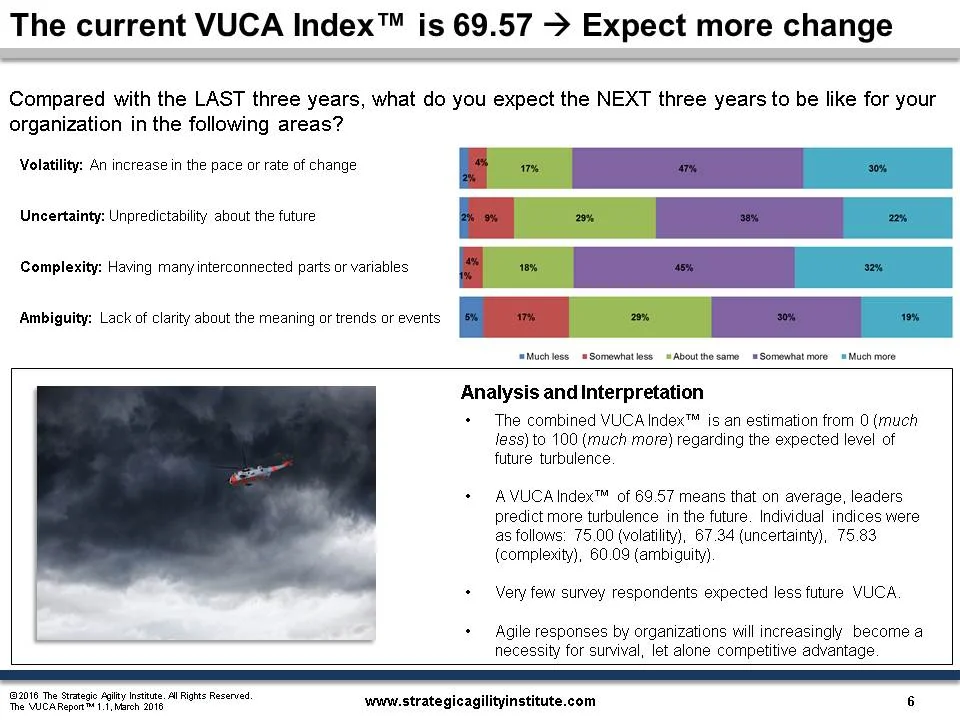
Our analysis of the data suggests that VUCA will continue to increase, with a current VUCA Index™ of 69.57. This is an estimate from 0 (much less) to 100 (much more) regarding the expected level of future turbulence.
Additionally, we asked the 280 executives in our sample about their perceptions of 35 disruptive trends. These 35 trends fell across five categories: (a) technological advances, (b) economic and financial issues, (c) environmental and societal concerns, (d) geopolitics, regulations and security issues and (e) workforce dynamics.
It’s important to note that our data were from executives across all functions and numerous industries, so we’re relatively confident about what these data reveal. Interestingly, of the 10 most highly rated disruptive trends, five of them were in the category of workforce dynamics.
Leaders in the world of human resources, talent management and organizational development: Take heed.
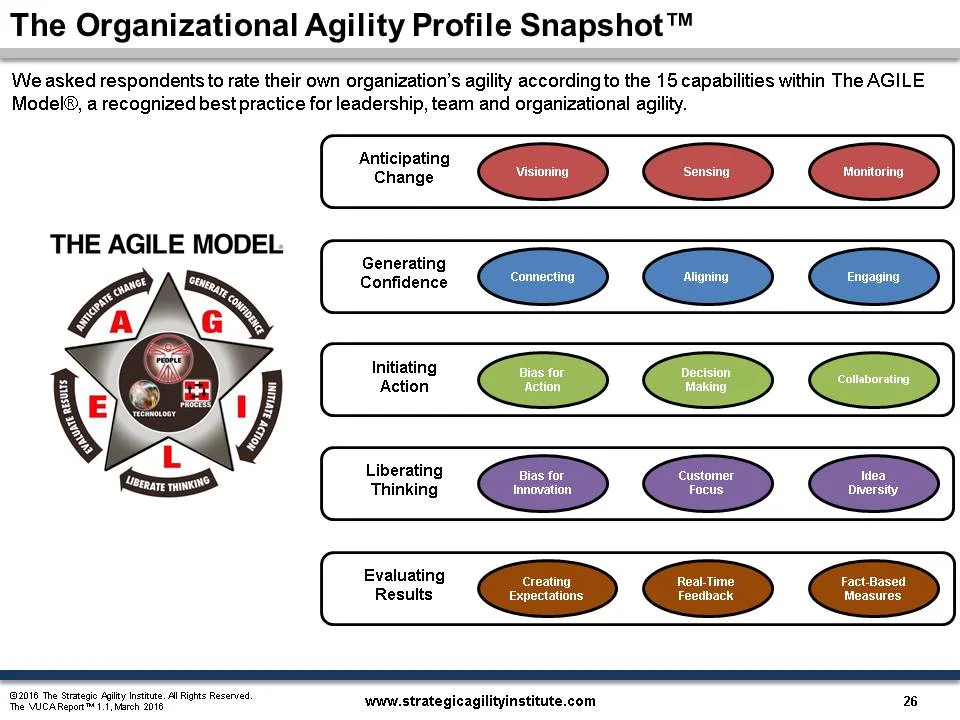
We then turned our focus to agility, which describes the ability to sense and respond to change quickly at the leader, team and organizational levels. Our experience—and that of many others—strongly suggests that agility is the antidote to VUCA. As such we asked our respondents to rate their own organization across the 15 capabilities within The AGILE Model®. On average, our respondents rated their capabilities in the areas of bias for action and customer focus as relatively strong—but they rated their capabilities in decision making and real-time feedback as relatively weak.
Finally, we included three open-ended items in the survey to gather our respondents’ thoughts across three questions related to agile practices. These questions are displayed below along with a word cloud for each that depicts the top keywords from the responses.
What is the most important practice that your organization is CURRENTLY doing that is helping you become more agile?
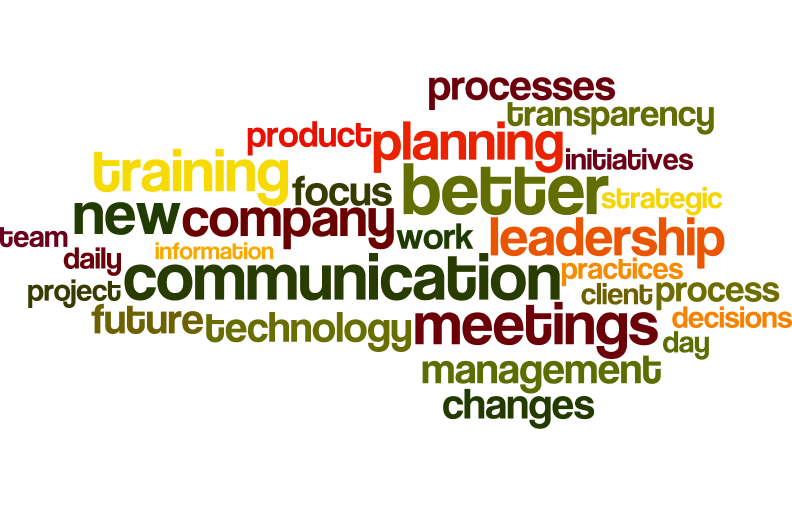
What is the most important practice that your organization SHOULD DO in the future to help you become more agile?

What is the biggest OBSTACLE keeping your organization from becoming more agile?

The full version of The VUCA Report™, of course, contains much more detail and analysis that you may find interesting and useful. We’re providing it to the entire world for the premium price of … nothing.
It’s totally free.
All we ask is that you take the survey that’s collecting data for the next version—Volume 1, Issue 2—of The VUCA Report™. After taking the survey, you’ll be immediately provided with a link that you can use to download this inaugural issue.
Click here to take the survey and download your copy of the inaugural issue of The VUCA Report™.
Together, we hope that The VUCA Report™ and other initiatives that we’re spearheading here at The Strategic Agility Institute will help us all become increasingly focused, fast and flexible in this VUCA world.
Find this thought provoking? Leave a comment, like and share!
About Ben Baran
Ben Baran, Ph.D., is probably one of the few people in the world who is equally comfortable in a university classroom, a corporate boardroom and in full body armor carrying a U.S. government-issued M4 assault rifle. Visit: www.benbaran.com.

Research-Based Implications of The Gig Economy
Chances are that you’ve encountered the “gig economy” in your organization already, even if you haven’t called it that.
Simply speaking, it refers to the increasingly prevalent trend of people and organizations choosing to work in temporary, contingent arrangements. I’ve experienced it across a number of industries and sectors, from working alongside adjunct professors to advising Afghan police officers alongside civilian contractors. I’ve worked with a number of businesses that are increasingly maintaining a contingent workforce that can respond to shifting labor demands.

Chances are that you’ve encountered the “gig economy” in your organization already, even if you haven’t called it that.
Simply speaking, it refers to the increasingly prevalent trend of people and organizations choosing to work in temporary, contingent arrangements. I’ve experienced it across a number of industries and sectors, from working alongside adjunct professors to advising Afghan police officers alongside civilian contractors. I’ve worked with a number of businesses that are increasingly maintaining a contingent workforce that can respond to shifting labor demands.
When thinking about the history of modern organizations—from the industrial revolution to today—this change is dramatic.
For all of us and our careers, the expectation and reality of working for one organization for most of one’s life in a continuous, full-time status is rapidly fading.
For organizations, leaders—particularly those in human resources (HR) and related functions—will need to uncover both the mechanics of efficiently integrating such workers across projects and—potentially even more importantly—find ways to engage such workers and create the conditions under which they can flourish.
A Research Perspective
Rigorous, scholarly research on contingent workers is still in its early stages, at least from the standpoint of uncovering tried-and-true best practices for leaders and managers. There are, however, a few broad areas that we can consider regarding some implications of the gig economy. In particular, let’s take a psychological perspective.
As I’ve written elsewhere, it’s well established that employees have a higher level of well-being and perform better when they sense that their work organization cares about them and values what they do (this is part of a conceptual framework called organizational support theory).
But what about those situations in which a person is essentially a member of multiple organizations?
This is the essence of the gig economy—people doing their actual work performing tasks for one organization but also belonging to another. For example, when I served in Afghanistan in 2013, I worked as part of the police training unit of North Atlantic Treaty Organization Training Mission-Afghanistan (NTM-A). I was there serving in a military uniform, but some of my coworkers were civilian contractors who worked for DynCorp International, a defense-contracting firm. Those contractors served both NTM-A and DynCorp, but from a talent management perspective, such relationships were almost exclusively transactional and administrative.
If we think about some research-based implications of these increasingly common arrangements, a number of possibilities emerge, including:
- What do organizations do to onboard, orient and welcome contingent workers?
- How do organizations make contingent workers feel appreciated?
- What might organizations do to train and equip managers to best engage contingent workers?
Addressing such questions fundamentally requires a shift in thinking within the realm of talent management. It means that employee engagement doesn’t only apply to full-time workers. It implies that the ecosystem of work itself is changing, as John Boudreau has described.
It also implies, as described by my colleague and agility expert Nick Horney, that HR leaders should think about their workforce more broadly, using a “talent portfolio” that includes traditional and non-traditional employees.
Speaking of Nick Horney, I encourage you to join him at the 2016 HR People + Strategy Annual Conference in Scottsdale, Ariz., April 10-13 where he'll take a deep dive into The New Talent Ecosystem (http://www.hrps.org/annual). In particular, I encourage you to participate in a facilitated discussion with Nick on April 12 on The Gig Economy: A Human Resource Agility Fitness Challenge. Finally, click here and take 60 seconds to provide your insights on the gig economy.
Find this thought provoking? Leave a comment, like and share!
About Ben Baran
Ben Baran, Ph.D., is probably one of the few people in the world who is equally comfortable in a university classroom, a corporate boardroom and in full body armor carrying a U.S. government-issued M4 assault rifle. Visit: www.benbaran.com.

For Those About to Lead
For those about to lead, I salute you.
The vast majority of people go with the flow. Many people—even those whom we often dub “leaders”—fulfill their roles by finding out what others expect of them and meeting those expectations. This includes many heads of state—current, former and aspiring—military generals and admirals, university presidents and chief executives.
There’s nothing inherently wrong with going with the flow, depending on

For those about to lead, I salute you.
The vast majority of people go with the flow. Many people—even those whom we often dub “leaders”—fulfill their roles by finding out what others expect of them and meeting those expectations. This includes many heads of state—current, former and aspiring—military generals and admirals, university presidents and chief executives.
There’s nothing inherently wrong with going with the flow, depending on where the flow is headed.
There’s nothing inherently wrong with doing what’s expected, depending on the nature of those expectations.
But leadership is something different.
Leadership is about exploration, adaptation, guiding others through uncharted waters. It’s about sensing and responding quickly to the forces of change; it’s about agility.
Consider an example from May 1804.
As the keelboat turned her bow into the stream, Lewis and his party cut themselves off from civilization. There would be no more incoming letters, no orders, no commissions, no fresh supplies, no reinforcements, nothing reaching them, until they returned.
The captains expected to be gone two years, maybe more. In all that time in whatever lay ahead of them, whatever decisions had to be made, they would receive no guidance from their superiors. This was an independent command, such as the U.S. Army had not previously seen and never would again. Lewis and Clark were as free as Columbus, Magellan, or Cook to make their mark on the sole basis of their judgments and abilities.
Such is the description of the first moments of the famous expedition of Meriwether Lewis and William Clark, who, upon the orders of no one other than the third President of the United States Thomas Jefferson, embarked upon one of history’s greatest expeditions—as documented by Stephen Ambrose in his 1996 bestselling book Undaunted Courage (p. 139).
Lewis and Clark, in their journey across the North American continent in the early 1800s, truly didn’t know what to expect. Consider that President Thomas Jefferson himself, for example, believed that the expedition might encounter mastodons upon the prairie (Ambrose, 1996, p. 91).
These two leaders and their team had only themselves, their supplies and educated guesses about what they might face. The rest they would have to deal with in real time, in an environment of complete self-reliance.
When we truly lead, we are taking risks; we are being vulnerable—to judgment, to criticism, to both passive and active rebellion, and to failure.
It’s simply easier and safer to do nothing. But the solution to most of what ails our organizations and our society often boils to doing things differently. And as such, the answer always requires leaders and leadership.
And so, regardless of whether you’re setting out with an expedition party exploring a new geography or charting a new course for your team, department or organization, I salute you for giving it a shot.
Go boldly—either out in front or by following someone else who’s doing something worthwhile—and chart new waters.
And never forget that going boldly doesn’t have to be big or even public. Small positive disruptions, repeated over time, can indeed yield radical change.
Find this thought provoking? Leave a comment, like and share!
About Ben Baran
Ben Baran, Ph.D., is probably one of the few people in the world who is equally comfortable in a university classroom, a corporate boardroom and in full body armor carrying a U.S. government-issued M4 assault rifle. Visit: www.benbaran.com.

Should We Abolish Performance Reviews?
In four weeks from today, I’ll be enjoying the company of thousands of organizational psychologists at this year’s annual conference of the Society for Industrial and Organizational Psychology (SIOP) in Anaheim, Calif. This is a fun-loving crowd. It’s probably also one of the few crowds in which you’ll find passionate debates about topics such as psychometrics, leadership assessments or classical test theory.
At last year’s conference, in fact, a structured debate took place on the topic of performance appraisals. Yes, you read that correctly.

In four weeks from today, I’ll be enjoying the company of thousands of organizational psychologists at this year’s annual conference of the Society for Industrial and Organizational Psychology (SIOP) in Anaheim, Calif. This is a fun-loving crowd. It’s probably also one of the few crowds in which you’ll find passionate debates about topics such as psychometrics, leadership assessments or classical test theory.
At last year’s conference, in fact, a structured debate took place on the topic of performance appraisals. Yes, you read that correctly.
You might know of performance appraisals as performance reviews. Many managers think of them as administrative burdens accompanied by awkward conversations.
The debate I attended was standing-room only.
Being a little bit taller than average (I’m 6’1”), I stood in the back and watched over the heads of bright-eyed graduate students and opinionated professionals alike as a handful of the field’s most well-respected people argued their sides of the story. I’m over-generalizing, but the extreme sides of the arguments regarding performance reviews were:
- Abolish them! Managers hate them. Employees hate them. They do nothing to promote job performance. And they might even make performance worse. Focus instead on coaching and real-time continual feedback.
- Keep them! When they’re well-designed and executed, performance appraisals help employees know where they stand. And they’re essential for documenting both good and not-so-good performance, which is most-welcomed evidence to have on hand in the human resources department for legal reasons.
Both sides of this argument tended to agree that research suggests that it’s essential to have high-quality, feedback-rich conversations between employees and their supervisors. And maybe it’s a copout, but I tend to think that an organization can have both—a formal appraisal system and a productive coaching environment. That happens to be the position that organizational psychologist Gary Latham takes in his book, Becoming the Evidence-Based Manager (I highly recommend it).
One of the most beneficial outcomes of a productive coaching and developmental relationship between a supervisor and an employee is that it can enhance the employee’s perception that the performance review process is fair. If you’ve ever dealt with people who thought they were performing well until their annual performance review meeting, you know what I mean.

At the same time, I’m left wondering about two distinct situations:
- In some organizations, completing the administrative performance review process has become the end itself—not a means for improving performance. The pieces of paper and process are well-designed, but they rarely coincide with high-quality coaching or development. They also take an inordinate amount of time to complete. I’m thinking of a real organization—the U.S. Navy—and it’s one in which I’ve written, edited or otherwise touched hundreds of such evaluations during the past 14 years. How could this type of organization start to revitalize its approach toward performance appraisal and developmental coaching?
- In other organizations, no formal performance appraisal or feedback system is in place. In such a circumstance, what might be the ideal way to both document performance and help employees truly flourish in their roles? Or should nothing be done?
Regardless of the “right” answer, the area of performance appraisal seems to be a distinct opportunity for leaders in human resources and beyond to make an impact. Because if we’re going to have organizations that meet the challenges of today’s turbulent world, we’re going to need to be creative in how we address the delicate, fascinating topic of human performance—what it looks like and how to support it in the right way.
I’m certainly just one of many who are thinking about this, and opinions abound (see articles in Forbes, The Washington Post and the BBC).
But what do you think?
Find this thought provoking? Leave a comment, like and share!
About Ben Baran
Ben Baran, Ph.D., is probably one of the few people in the world who is equally comfortable in a university classroom, a corporate boardroom and in full body armor carrying a U.S. government-issued M4 assault rifle. Visit: www.benbaran.com.

What HR People Need to Know About Change
In a recent post and in some of my research, I’ve been exploring the role that human resources (HR) plays in organizational change. This includes both HR as a function and HR professionals themselves as they get involved (either proactively or reactively) in change efforts.
And there’s one key aspect of organizational change that I think is helpful for HR people to consider.

In a recent post and in some of my research, I’ve been exploring the role that human resources (HR) plays in organizational change. This includes both HR as a function and HR professionals themselves as they get involved (either proactively or reactively) in change efforts.
And there’s one key aspect of organizational change that I think is helpful for HR people to consider. Namely, not all change is created equal, and the nature of change should likely dictate to some degree how HR should respond.
At a basic level, there are two types of organizational change: episodic and continuous.[i] There are additional ways to categorize change,[ii] but let’s focus on these two types.
Episodic change is intentional, event-driven adaptation. In my experience, this is what most people tend to think about when they think about change. A few examples include managing succession of top leaders, instituting new policies or procedures after a crisis, integrating organizations after a merger or acquisition and other planned changes.
In these types of instances, HR leaders are probably likely to find themselves in the role of a change agent. They’ll be visible drivers and supporters of change processes from announcement of the change through its institutionalization.
Continuous change, however, refers to ongoing adaptations. From the perspective of HR, a few examples include integrating survey feedback into leadership practices, aligning incentive systems with desired cultural changes, developing leadership development systems and other adaptations or improvements that build long-term adaptability. This type of change is much more of a process than an event.
In these types of instances, HR leaders might be more likely to be in the role of an adaptation mechanism than a change agent. That is, they function as facilitators, as educators, as ambassadors of change instead of as the driver or leader of the change. While potentially less visible than the role of change agent, the role of adaptation mechanism is arguably just as important and impactful for the adaptability of the organization.
By recognizing a little bit more about the type of change they’re facing, I think, HR leaders are better equipped with insight about what role they should play. And that match between their role and the situation is at the heart of agility—being able to sense and respond to the forces of change.
Related to this topic, I recently had the pleasure of being interviewed for a podcast on “HR's Role in Fostering Agile Behaviors During Changing Times” with the Human Capital Institute. In that interview, we discussed:
- The problems HR leaders and practitioners face with regard to change management and agility
- The concept of design-thinking and how can it be used in change management
- What can HR practitioners do on a more personal level in dealing with individual’s resistance to change
To check out that podcast (it’s only about seven minutes long), click on the video below or click here.
Furthermore, I’m looking forward to learning more about this topic from HR executives and other smart colleagues at the 2016 Human Capital Summit in New Orleans, March 29-30. The theme of that conference is “Agile Talent Strategies for Managing Change and Shifting Priorities,” and I’d love to see you there. Click here for more about the conference.
What else can HR leaders do to facilitate adaptation within their organizations? Are there different strategies for managing change that work better in some situations than in others? Leave a comment below!
Find this thought provoking? Like and share!
About Ben Baran
Ben Baran, Ph.D., is probably one of the few people in the world who is equally comfortable in a university classroom, a corporate boardroom and in full body armor carrying a U.S. government-issued M4 assault rifle. Visit: www.benbaran.com.
[i] Karl E. Weick and Robert E. Quinn, “Organizational Change and Development,” Annual Review of Psychology 50, no. 1 (1999): 361–86.
[ii] Donde Ashmos Plowman et al., “Radical Change Accidentally: The Emergence and Amplification of Small Change,” Academy of Management Journal 50, no. 3 (2007): 515–43.

Bill Gates Built the Deadliest Weapon in the U.S. Military
Bill Gates, the co-founder of Microsoft, unwittingly created a weapon of mass destruction for the U.S. military when his company created PowerPoint. It can be a useful tool for presentations, but within the U.S. military it has become a ubiquitous technology and communication format that structures much of what gets done, particularly for staff officers.
The proliferation of PowerPoint within the U.S. armed forces is nothing new, and its presence is no surprise to those of us who have served within it. But one could argue that its use is so pervasive that it even structures how people think and how they make decisions.
So in some ways, Microsoft PowerPoint is the deadliest weapon in the U.S. military’s arsenal. The question, though,

Photo By: Staff Sgt. Joseph Digirolamo. The appearance of U.S. Department of Defense (DoD) visual information does not imply or constitute DoD endorsement.
Bill Gates, the co-founder of Microsoft, unwittingly created a weapon of mass destruction for the U.S. military when his company created PowerPoint. It can be a useful tool for presentations, but within the U.S. military it has become a ubiquitous technology and communication format that structures much of what gets done, particularly for staff officers.
The proliferation of PowerPoint within the U.S. armed forces is nothing new, and its presence is no surprise to those of us who have served within it. But one could argue that its use is so pervasive that it even structures how people think and how they make decisions.
So in some ways, Microsoft PowerPoint is the deadliest weapon in the U.S. military’s arsenal. The question, though, is one of targeting: Toward whom is this weapon aimed?
While serving in Afghanistan during 2013, a friend and I pondered this. Fortunately, we were both in roles that somehow avoided being directly responsible for the production of specific PowerPoint slides on a regular basis, although we were frequent contributors to them. This particular friend and I both have young children, and we reflected upon how the use of meetings and PowerPoint often coincided in a cycle of dependency much like what is described in Laura Joffe Numeroff’s popular children’s book, If You Give a Mouse a Cookie.
So, in homage to that wonderful book, we wrote what follows.
# # #
If You Give a General a Staff Meeting
Phenomenological Insights on Counterinsurgency, Afghanistan, Globalization, Technology and the Organizational Science of U.S. Military Operations in the Twenty-First Century
If you give a general a staff meeting, he’s going to ask for a PowerPoint presentation.
When your colonel finds out about the PowerPoint presentation, he’ll probably ask you for a copy to approve beforehand.
When the colonel gets your copy, he’ll ask for about 50 changes. Then he’ll change those changes a few dozen more times.
When the colonel approves the presentation, you might notice that it no longer resembles anything close to what the general supposedly wants. So you’ll prepare some back-up slides.
When you finish making the back-up slides, you’ll need to add pretty pictures and flow charts. You’ll start adding.
You might get carried away and add pretty pictures and flow charts on every single slide. You may even end up with a PowerPoint presentation that belongs in the United States Military Museum of PowerPoint Art!
When you’re done, you’ll probably have to rehearse the presentation with the colonel. You’ll have to fix the flow-chart colors and font on several slides to make him comfortable.
On the day of the presentation, you’ll arrive to the conference room one hour early. Just to be safe, you’ll have three dozen printed color copies for the 10 people planning to attend.
Upon seeing a pretty picture of a warzone project on the first slide, the general will probably ask you to arrange a visit there for him and his entourage. You feel your blood pressure increase by 33 points.
When you begin the presentation, the general will look confused and ask for the “bottom line.” You’ll quickly skip to your back-up slides. He’ll settle back in his chair, looking pleased, while the colonel feigns agreement.
When the meeting ends, the general will ask unrelated questions. Then he’ll pull out his notebook and pause for a moment to look at it.
Looking at his notebook will remind him that he wants an update on an obscure project so he can impress his fellow generals with strategic thoughts and reports of dramatic progress.
So … he’ll ask for a PowerPoint presentation.
And chances are if he asks you for a PowerPoint presentation, he’s going to want a staff meeting to go with it.
# # #
Certainly, PowerPoint is a useful tool. I don’t mean to imply that it’s not. But it’s a tool that needs to be employed judiciously. The same goes for other technologies like e-mail and for the use of meetings themselves.
Does PowerPoint dominate your organization? Have you ever worked in an organization that had clear rules about how to use PowerPoint and how not to use it? What about meetings?
Find this thought provoking? Like and share!
About Ben Baran
Ben Baran, Ph.D., is probably one of the few people in the world who is equally comfortable in a university classroom, a corporate boardroom and in full body armor carrying a U.S. government-issued M4 assault rifle. Visit: www.benbaran.com.

What’s HR’s Role in Change Management?
Is human resources (HR) the organizational function that must lead when dealing with organizational change?
Or is managing change a fundamental leadership competency that a wide array of people from every function should have or develop? If that’s the case, should HR professionals themselves try to be change agents?
What works best in organizations that are dealing with a particularly turbulent business environment?
These are a few of the questions that I had the pleasure of discussing last week in a lively conversation in Cincinnati with

Is human resources (HR) the organizational function that must lead when dealing with organizational change?
Or is managing change a fundamental leadership competency that a wide array of people from every function should have or develop? If that’s the case, should HR professionals themselves try to be change agents?
What works best in organizations that are dealing with a particularly turbulent business environment?
These are a few of the questions that I had the pleasure of discussing last week in a lively conversation in Cincinnati with Jenna Filipkowski, who is the director of research at the Human Capital Institute (HCI). She’s planning some research targeted at these and related questions, so I encourage you to be on the lookout for that given its relevance for today’s HR professional.
But in the meantime, I think that we have some insight that’s useful to consider regarding the role of HR in dealing with organizational change.
Namely, if we look at the Society for Human Resource Management (SHRM) Competency Model (download a full copy if you’re curious), what does it include regarding change and the related concept of agility?
The SHRM Competency Model is a detailed, researched-based description of the nine categories of competencies required of today’s HR professional. It includes sub-competencies, related behaviors and a whole lot more. Below, I summarize what the SHRM Competency Model includes related to (1) change and (2) agility.

Change and the SHRM Competency Model
The word “change” or “changing” appears 19 times in the full SHRM Competency model. Here’s a summary of those mentions.
- Within the competency of “Human Resource Expertise,” one of the sub-competencies is “change management.” In that same competency, one of the proficiency standards for mid-level HR professionals is “Implements change based on proven change-management techniques” as is “Interprets both policies and changes to policy” and “Recommends policy changes to support business needs.” Clearly, change management appears to be part of what HR professionals need to know and practice, at least at the mid-level of one’s HR career.
- Within the competency of “Consultation,” one of the example behaviors of those who exhibit the highest level of proficiency is “Generates specific organizational interventions (e.g., culture change, change management, restructuring, training, etc.) to support organizational objectives.”
- “Change management” also appears as a sub-competency within the “Leadership & Navigation” competency, with an associated behavior of “Serves as a transformational leader for the organization by leading change.” This also appears as a proficiency standard for mid-level HR professionals within this competency, listed as “Supports critical large-scale organizational changes.” At the senior level within this competency, a proficient HR professional according to SHRM “Serves as a change agent for the organization,” and at the executive level, he or she “Identifies the need for and facilitates strategic organizational change,” “Oversees critical large-scale organizational changes with the support of business leaders,” “Ensures appropriate accountability for the implementation of plans and change initiatives,” “Sets tone for maintaining or changing organizational culture” and “Gains buy-in for organizational change across senior leadership with agility.”
- Finally, within the competency of “Critical Evaluation,” an associated behavior is “Assesses the impact of changes to law on organizational human resource management functions,” and a proficiency standard at the senior level is “Creates and/or dissects organizational issues, changes, or opportunities.”
Taken together, it appears that dealing with or managing or leading change is an important part of what HR leaders should be doing, at least according to the SHRM Competency Model. But what about agility?
Agility and the SHRM Competency Model
Agility, which I typically define as the ability to sense and respond quickly to the forces of change, is an increasingly talked-about topic. For example, McKinsey Quarterly recently devoted its cover and three associated articles to agility (click here for more).
In the SHRM Competency Model, “agility” appears three times.
First, within the competency of “Leadership & Navigation,” an associated behavior listed is “Demonstrates agility and expertise when leading organizational initiatives or when supporting the initiatives of others.”
Next, as quoted above, an executive-level proficiency standard within “Leadership & Navigation” is “Gains buy-in for organizational change across senior leadership with agility.”
Finally, “Strategic Agility” is listed as a sub-competency within the overall competency of “Business Acumen.”
Beyond that, agility does not seem to appear within the SHRM Competency Model. But that by no means indicates that the SHRM Competency Model doesn’t value the concept of agility—particularly if you tend to see agility as a fundamental part of being good at all of the other areas related to change more broadly. In fact, it could be argued that “HR agility” is at the root of all of many if not all of the HR competencies related to change and change management.
What we do know for certain is that the ever-evolving world of organizations requires HR to continue to evolve as well.
It’s also clear that professionals in HR and talent management have an increasingly relevant opportunity to be agile leaders, and I’m looking forward to see what that continues to mean and look like for the HR profession. On that note, I’ll be joining other HR professionals at the 2016 Human Capital Summit in New Orleans, March 29-30. The theme of that conference is “Agile Talent Strategies for Managing Change and Shifting Priorities,” and I’d love to see you there. Click here for more about the conference.
Should HR professionals be change agents? Or does that belong elsewhere in the organization? How should HR professionals deal with their profession as it changes? Leave a comment below!
Find this thought provoking? Like and share!
About Ben Baran
Ben Baran, Ph.D., is probably one of the few people in the world who is equally comfortable in a university classroom, a corporate boardroom and in full body armor carrying a U.S. government-issued M4 assault rifle. Visit: www.benbaran.com.

HR in 2016: Top Industry Insights from SHRM, Bersin and SIOP
One increasingly common trend is, well, trend reports. Professional organizations, research firms and consultancies frequently publish what they see as the latest developments or top predictions for the future. Depending on the source, these trend reports can be thought-provoking and insightful.
At the very least, I find it interesting to see what various leaders see on the horizon.
Recently, three

One increasingly common trend is, well, trend reports. Professional organizations, research firms and consultancies frequently publish what they see as the latest developments or top predictions for the future. Depending on the source, these trend reports can be thought-provoking and insightful.
At the very least, I find it interesting to see what various leaders see on the horizon.
Recently, three such organizations published their trend reports for 2016—all focusing on the workplace and human resources (HR) topics. These three organizations are the Society for Human Resource Management (SHRM), Bersin by Deloitte, and the Society for Industrial and Organizational Psychology (SIOP).
Below, I’ve summarized each and provided links for the full reports.
SHRM—What HR Needs to Know in 2016
The approach. SHRM used its competency model to organize its report. As such, the report outlines key areas within each of SHRM’s HR competency areas, with notable writers and researchers providing their thoughts.
- Leadership and Navigation: It’s All About Teams
- Relationship Management: The New Flexibility
- Consultation: Preparing Your Company for the New Overtime Rules
- HR Expertise: Facing the Future of Work
- Critical Evaluation: Put Your Analytics into Action
- Global and Cultural Effectiveness: Recruiting Is Social and Talent Is Local
- Ethical Practice: HR Must Champion a Principled Culture
- Business Acumen: Building a Better HR
I recommend checking out the complete report, as each of these areas has its own article. Click here for more from SHRM.
Bersin by Deloitte—Predictions for 2016: A Bold New World of Talent, Learning, Leadership, and HR Technology Ahead
The approach. It isn’t exactly clear how the author(s) derived the 10 areas highlighted in this report, but I infer from the introduction that the 10 areas came from a qualitative, narrative categorization of what they have seen, researched or experienced during the past year. (If you have insight on the methodology, please feel free to leave a comment.)
- Digital HR Arrives—Changing the Way HR Organizations Design and Deliver Employee Solutions
- The Need to Improve the Employee Experience and Harness People Data Drive the Stampede to Replace Dated HR Systems
- New Models of Talent Management Emerge—Creating a New Generation of Talent Management Platforms
- The Rush to Replace and Reengineer Performance Management Accelerates around the World
- Engagement, Retention, and Culture Persist as Top Priorities—With New Feedback and Analytics Systems Coming to Market
- Global Leadership Development, Coupled with Career and Talent Mobility, Takes on a Fresh New Focus. Mentoring and Coaching Grow Rapidly
- The Revolution in Corporate Learning Continues as a New Model Evolves
- Diversity and Inclusion Merge with Key HR and Business Strategies—To Move Well Beyond Compliance and Become a Strategic Part of Business
- People Analytics Accelerates Its Growth—Evolving to a Mainstream Program in the HR Function
- The HR Profession Leaps Forward as a New Breed of HR Leaders Enter the Stage
Click here for more from the Bersin by Deloitte report (you’ll need to provide some information in order to download a copy of the report).
SIOP—Top 10 Workplace Trends 2016
The approach. SIOP derived its list by asking its members for their predictions. Then, they asked their members to rank-order the items on the list. About 700 of the organization’s members participated (full disclosure, I was one of them).
#10. Using Social Media to Make Employment-Related Decisions
#9. Building Healthy, Diverse Workforces
#8. Work–Life Balance Across Generations
#7. Increased Focus on Business Agility and Flexibility in Work and Business Processes
#6. Increasing Focus on Health and Wellness in the Workplace
#5. Employee Engagement
#4. Changing Nature of Performance Management and Development
#3. Managing Virtual Teams
#2. Trends in Technology Are Changing the Way Work Is Done
#1. Leveraging and Maximizing Big Data and Applying the Correct Analytics to Make Better Business Decisions
Click here to see more details about this list.
So are there any themes that cut across multiple reports? From what I can tell, it seems like there are a few, such as:
- Technology is changing HR and the way people work (Bersin, SIOP)
- Evolving views and practices for performance management (Bersin, SIOP)
- Workforce well-being and diversity (Bersin, SIOP, SHRM)
- Using data and analytics for people-related planning and operations (Bersin, SIOP, SHRM)
- Agility and flexibility for processes, planning and leadership across the organization (Bersin, SIOP, SHRM)
- Engagement and culture (Bersin, SIOP, SHRM)
- New models for leadership and teams (Bersin, SIOP, SHRM)
Which of these HR trends do you see as most prevalent in your industry or organization? Are there any that surprised you or any that you think are missing from these lists? Leave a comment below!
Find this thought provoking? Like and share!
By the way, we’re collecting data for our own unique type of ongoing study: The VUCA Report. I’d love to have your insights.
About Ben Baran
Ben Baran, Ph.D., is probably one of the few people in the world who is equally comfortable in a university classroom, a corporate boardroom and in full body armor carrying a U.S. government-issued M4 assault rifle. Visit: www.benbaran.com.