
I’ve moved my blogging to Substack!
Feel free to check out any of the content I have here, but also be sure to check out my newest content at Reckoning and Elevating What Works.

The Indigo Podcast is Live
These days I’m disseminating my thought leadership largely through a podcast me and my business partner, Chris Everett, launched in early November 2019: The Indigo Podcast.
These days I’m disseminating my thought leadership largely through a podcast me and my business partner, Chris Everett, launched in early November 2019: The Indigo Podcast. I recommend you subscribe via your favorite podcasting platform, email, or RSS. Please visit https://www.indigotogether.com/indigopodcast to learn more.


Announcing The Indigo Podcast: An Exploration of Human Flourishing at Work and Beyond
When Chris Everett and I formed Indigo Anchor in 2018, we knew we would be a different kind of management consulting firm. We would not be interested in fancy suits, not interested in churning out reports that were unhinged from real change. Nor would we be interested in peddling the latest organizational pop psychology.
What we wanted to do was bring evidence-based approaches and strategies from academia, the military, and successful enterprise organizations to clients that were truly ready for the change required for improvement.
Fast forward to 2019, we’ve stayed true to these values and have had tremendous success where our competitors have previously failed. And we’ve received validation that we are indeed “different.” We are “bold” … “challenging” … “funny” … “intense.” We’ve had clients laugh, cry,

When Chris Everett and I formed Indigo Anchor in 2018, we knew we would be a different kind of management consulting firm. We would not be interested in fancy suits, not interested in churning out reports that were unhinged from real change. Nor would we be interested in peddling the latest organizational pop psychology.
What we wanted to do was bring evidence-based approaches and strategies from academia, the military, and successful enterprise organizations to clients that were truly ready for the change required for improvement.
Fast forward to 2019, we’ve stayed true to these values and have had tremendous success where our competitors have previously failed. And we’ve received validation that we are indeed “different.” We are “bold” … “challenging” … “funny” … “intense.” We’ve had clients laugh, cry, cheer, yell, and yet ultimately succeed when they thought success was elusive. We’ve gotten results for every client on every engagement leaving them with increased revenue, increased profits, happier employees, and happier boards of directors. When approached, we only take on the work if we know we can leave the organization better than we found it.
We’ve turned work away when organizations have floundered in describing the results they’re seeking, when they’ve wanted a solution that won’t fix their problem, or when their ask has been unrealistic.
While we’re obsessed with quantifiable results, we also have a soft side that revels in the complexities of humanity with all of its intangibles and idiosyncrasies. We are lovers of people and community. We have a higher purpose beyond the bottom line, and that is to see people flourish at work and beyond.
In many of our engagements, clients have taken us aside to tell us how the communication and leadership skills we’ve taught has helped them in their marriages, with their children, and with their extended families.
So, we started thinking to ourselves that we and our clients should have a place to learn from each other and invite others to do the same. We did not want this to be a sales pitch or marketing ploy for our company; however, we wanted the community to be distinct.
How were we going to do this? Forum-style like Reddit? Conversations or groups on LinkedIn? Start a Facebook page? As we discussed our options, preferences, and talents as well as who our audience would be and their preferences, we landed on the format of a podcast.
Why a podcast?
We liked the idea of podcasting for several reasons: it’s interactive and it’s digestible when you live a busy life on the go. We saw it as a way to extend beyond ourselves and engage in conversations that are essential to building community. We also anticipated that our audience likely includes those who already listen to podcasts and would enjoy that format.
We are proud to announce The Indigo Podcast, which is set to launch Nov. 4, 2019. It’s an informative, real, quirky, and somewhat irreverent resource for executives, managers, leaders, and anyone else interested in flourishing … in the world of work and beyond.
During the last several months, we have been putting our heads together to come up with the best content that would be the most useful to our audience. We’ve recorded several episodes already.
In every episode, we’re seeking to do some combination of the following:
promote the flourishing of people and organizations
bridge the gap between social science and management practice
provide an antidote or counterpoint to the ever-increasing overly simplistic reductionist approaches to work and life
feed the curiosity of people who want to make the world a better place through work
inspire listeners to become lifelong learners and bold difference-makers
Initially, the podcast will feature me along with my fellow co-founder and principal at Indigo Anchor, Chris Everett. We will also feature interviews with respected experts and other people of interest. The first several episodes will be on the subjects of thriving in the face of bad management, flourishing in a turbulent operating environment, agility and why it matters, and exploring why managers derail and how to avoid it.
Our style is rather different from many of the business, management, or leadership podcasts that currently exist. Most notably, we recognize that the world is messy and that solutions often require a nuanced view of reality. Most of life does not lend itself to lists of easy steps to follow or “silver bullets” that fix everything. Our conversations, therefore, are fairly in-depth. And while we often provide perspectives and evidence-based ideas that our listeners will find immediately useful, our overall goal is to help our listeners think, learn, and maybe even laugh a little.
We’re hoping that listeners and subscribers will find our podcast to be a refreshing resource for proven tools in the areas of management, leadership, human resources, organizational behavior, dealing with change, organizational culture, hiring, process improvement, organizational agility, and related topics.
The Indigo Podcast launches Nov. 4, 2019 on iTunes/Apple Podcasts, Spotify, GooglePlay, Stitcher, TuneIn, and Castbox.
To learn more about The Indigo Podcast, visit: https://www.indigotogether.com/indigopodcast
Indigo Anchor is a management consulting firm serving clients across a wide range of industries, sectors, sizes, and locations. Visit: https://www.indigoanchor.com/
Ben Baran, Ph.D., is probably one of the few people in the world who is equally comfortable in a university classroom, a military uniform, or in a corporate boardroom advising top management teams. He is an award-winning assistant professor of management at Cleveland State University, a co-founder and principal of the consulting firm Indigo Anchor LLC, and a commander in the U.S. Navy Reserve. He regularly consults leaders and organizations across a wide range of sectors and industries. He earned his undergraduate degree from Villanova University and his master’s in industrial and organizational psychology and Ph.D. in organizational science from The University of North Carolina at Charlotte. Connect with Ben on LinkedIn. For more, visit: www.benbaran.com
For additional information, contact Ben Baran at ben@indigoanchor.com

What Ohio Manufacturers are Doing to Address Talent Needs
On Nov. 1, 2018, about 450 people from manufacturing, education, the public sector, and other organizations at the intersection of workforce matters and the manufacturing industry met in Columbus, Ohio, at the Ohio Manufacturers’ Workforce Summit 2018.

On Nov. 1, 2018, about 450 people from manufacturing, education, the public sector, and other organizations at the intersection of workforce matters and the manufacturing industry met in Columbus, Ohio, at the Ohio Manufacturers’ Workforce Summit 2018.
The daylong event, organized by The Ohio Manufacturers’ Association (OMA), featured speakers and panelists who discussed best practices, lessons learned, and other tools or initiatives being used by manufacturing companies and their partners to develop and attract the talent they need.

This was my first time at such an event. I chose to attend this year due to my roles as both a business professor at Cleveland State University and as a co-founder and principal of Indigo Anchor, a management consulting firm with a number of manufacturers as clients. Many of my clients have shared with me their struggles with finding the talent they need for their companies. And as a professor in manufacturing-centric Northeast Ohio, I hear similar concerns from both executives and mid-career professionals in my graduate business classes.
Below is a summary of what I heard and learned during the Summit, along with my grateful recognition of those who contributed to the event as speakers or panelists.
Eric Burkland, president of The OMA, began the day with opening remarks focused on the OMA Workforce Roadmap. This framework has four components: (1) sector leadership and leadership capacity building, (2) advocacy at both the state and federal levels with regard to manufacturing issues, (3) marketing with regard to manufacturing as a career, and (4) education innovation to strengthen the manufacturing talent pipeline.
Burkland highlighted MakingOhio.com, an OMA initiative designed to provide information about manufacturing jobs and career pathways. Such efforts, Burkland noted, are central to Ohio’s economic strength overall given that manufacturing is the largest industry sector in the state, employing one in every 10 Ohioans.
Key take-away point 1: Strong manufacturing equals a strong Ohio. Addressing talent needs in manufacturing benefits from a collaborative approach; an example of that is the initiative led by The OMA.
Next, Scot McLemore, manager of talent acquisition and deployment at Honda North America Inc., moderated a session titled, “Industry-Driven Sector Partnerships: A Proven Workforce Model.” The session featured four panelists: Shawn Hendrix, president at Nissen Chemitec America Inc.; Amy Meyer, vice president of corporate development at Rhinestahl AMG; and Kip Winzeler, chief operating officer at Altenloh Brink & Co. US Inc./Trufast.
A key theme that emerged during this session is the need for manufacturers to work together to develop their workforce, particularly with regard to the future talent and the pipeline that supports it.
“We are all struggling with this labor shortage,” said Hendrix. “It’s motivating to meet with educators … we just need to clearly communicate what our needs are.”
“The people are there … the issue is the pipeline,” said Brigham.
Winzeler highlighted how sector partnerships must be both geography and community-driven. Furthermore, such efforts “must be a long-term game.” In terms of timeline, Hendrix suggested that manufacturers and their talent-pipeline partners should realize that they might not reap the full benefits of their efforts until eight to 10 years after beginning any partnerships.
Both Meyer and Brigham discussed how building a talent pipeline in manufacturing must be a holistic effort. For example, noted Meyer, manufacturing jobs are “much more than labor,” and include functions such as accounting, human resources, and more.
“We’ve got to start recruiting to a career opportunity, not just jobs,” said Brigham. He and other panelists noted how recruiting for manufacturing jobs involves educating not only potential job candidates about the manufacturing industry, but also including their parents in the conversation. Such educational efforts can help to correct common misunderstandings about manufacturing. For example, modern manufacturing is often very clean and technical—not dirty and monotonous.
Key take-away point 2: Ensuring sufficient talent for manufacturing requires a long-term focus in partnerships with educators, an educational campaign about modern manufacturing for both job candidates and their families, and a collaborative approach among manufacturers—even if they are otherwise competitors.
The next session, ”Innovative New Tools for Partnerships,” began with a presentation by Lisa Morales Cook, senior vice president for brand planning at Fahlgren Mortine. Her discussion focused upon the results of a study that sought to explore how to build the workforce pipeline for the next generation of manufacturers.
Key findings from the study included:
Perceptions of manufacturing are generally favorable, but they lack clarity. Some people perceive manufacturing as a “dirty, dark, and dangerous place to work,” which presents a barrier to recruiting efforts.
Messages about pay, benefits, and job stability are well-received by potential job applicants. The relatively high pay for manufacturing—which in Ohio in 2015 averaged $81,000 per year compared with $63,000 per year for other jobs—generally surprised study participants.
Job seekers today research opportunities considerably, suggesting that employers need to provide detailed information about jobs and the organization overall. They will want to know about the career paths, job types, time it might take to earn certain salaries, and more.
The manufacturing workplace is somewhat mysterious for today’s job seekers. The modern manufacturing environment is more often one in which 1,000 people are doing 1,000 different jobs—not one in which there are 1,000 people doing the same job. As such, the variety of job types and skills in manufacturing needs more exposure.
Finally, manufacturers would benefit from clarifying leadership and growth opportunities in their organizations.
Many of these findings connect with the notion of an employer brand and the idea that orienting new employees starts in the pre-hire phase.
Key take-away point 3: Manufacturers must actively work to change perceptions about what work “looks like” in their organizations if they are to recruit talent effectively.
Gerry Hanley, assistant vice chancellor for academic technology services at California State University, Office of the Chancellor, then shared how The OMA has partnered with Skills Commons to provide free training resources for their employees and workforce partners.
Such resources include courses on becoming an effective instructor, which can help current experts teach transfer their knowledge and skills to others. Others include training materials for specific occupations, soft-skills training, and recruitment resources.
Key take-away point 4: Before paying for manufacturing-specific training, research and evaluate how free online courses may meet your needs.
Following lunch, JobsOhio team members Cheryl Hay, director of project talent acquisition, and Lenee’ Pezzano manager of strategic talent delivery, presented in a session titled, “Connecting Economic Development Strategies with Industry Sector Partnerships.”
One key for successful development of a talent pipeline in manufacturing, Hay noted, was to find, prescreen, and train talent—and to consider these issues before the need for talent is urgent. Echoing ideas from earlier in the day, she also discussed how marketing is important to help drive excitement about manufacturing as a career.
Pezzano added by outlining several elements that could be considered best practices when approaching sector partnerships. These include using data (such as research available from the Bureau of Labor Statistics and other studies) to inform approaches, having an industry intermediary to help guide the process, developing concepts first before trying to get funding, and ensuring that all program content is industry-informed and experiential.
Key take-away point 5: Manufacturers must think ahead regarding the talent they will need in the future—not just the talent they need right now. For example, many companies would love to have highly experienced computer numeric controlled (CNC) machinists available to hire right now. That’s understandable and important, but manufacturers should also be thinking about how they can support the development of, for example, more CNC machinists in the future—and how they might acquire a wide variety of skilled labor that they might need in a year to several years from now. Such efforts should stem from the organization’s strategy, and developing partnerships is an important component in building such a talent pipeline.
The final session I attended—unfortunately, I had to leave prior to the final segment in order to make it back to Cleveland State University to teach in the evening—was a breakout session on “Manufacturers’ Role in Training Program Improvement.”
This session featured Mara Lynne Banfield, director of curriculum and instruction at Mahoning County Career and Technical Center; Matt Joing, plant manager at Butech Bliss and vice president of Mahoning Valley Manufacturers Coalition; and Rebecca Kusner, founder of R4 Workforce.
In the session, the presenters shared various factors related to how manufacturers can contribute to the quality of training programs in an effort to better equip their current or future talent. Examples of such factors included integrating the skills needed in the professional manufacturing environment into the academic setting, developing a deep understanding of the skills needed for employees to be successful, and combining training efforts with a nuanced understanding of what different businesses need.
Key take-away point 6: Manufacturers should work with any training partners to conduct a careful diagnosis of their needs, which should include an understanding of the knowledge, skills, abilities, and other characteristics needed in the job.
To summarize, The OMA Workforce Summit 2018 provided a wealth of insight regarding many elements of the talent pipeline for manufacturers in Ohio. Many of these would likely apply beyond Ohio, and I hope that some of these ideas may spark additional thought and insight among those in manufacturing who are also looking for ways to deal with their labor shortages. Second, thank you to those who contributed to the event as speakers or panelists.
If you attended this event and would like to add to the conversation—or if you simply have additional insights to share—please leave a comment below.
Join the Movement
Our vision is to create—through The Indigo Anchor Manufacturing Excellence Study™—a comprehensive network of manufacturing business leaders and researchers united by our common interest. By participating, you’ll have access to the latest manufacturing insights, giving you a competitive edge. Less guesswork, more knowledge. And that gives you both speed and confidence. Get involved today by taking a quick (about 15 minutes) online survey. In that survey, we ask about your perspective regarding a variety of market trends and your organization. CLICK HERE to take the survey.
About Indigo Anchor
Indigo Anchor is a management consulting firm that improves engineering teams within manufacturing environments, resulting in faster engineering, an improved company overall, and less frustration. With a focus on people, processes, and tools, Indigo Anchor helps turn engineering teams into a competitive advantage. The firm has more than 40 years of combined business and military leadership experience, which it applies to the top priorities of its clients. For more information, visit: www.indigoanchor.com
About Ben Baran
Ben Baran, Ph.D., is probably one of the few people in the world who is equally comfortable in a university classroom, a military uniform, or in a corporate boardroom advising top management teams. A co-founder and principal at the consulting firm Indigo Anchor, he's also an award-winning business professor and published scholar at Cleveland State University and a commander in the U.S. Navy Reserve. He regularly consults leaders and organizations across a wide range of sectors and industries. Visit: www.indigoanchor.com and www.benbaran.com.

Agile HR: Trends and Opportunities
The future of human resources (HR) lies at the intersection of strategy, data analytics, design thinking, and a new set of practices and mindsets ushered in by the world of agile methods and organizational agility writ large.
And the time is ripe for HR professionals to have the bandwidth necessary to devote themselves to such matters. Numerous HR services—particularly those that are

The future of human resources (HR) lies at the intersection of strategy, data analytics, design thinking, and a new set of practices and mindsets ushered in by the world of agile methods and organizational agility writ large.
And the time is ripe for HR professionals to have the bandwidth necessary to devote themselves to such matters. Numerous HR services—particularly those that are more compliance and administrative in nature—have been prime candidates for outsourcing for years. Automation, furthermore, has the potential to eliminate or reduce further many repetitive HR tasks.
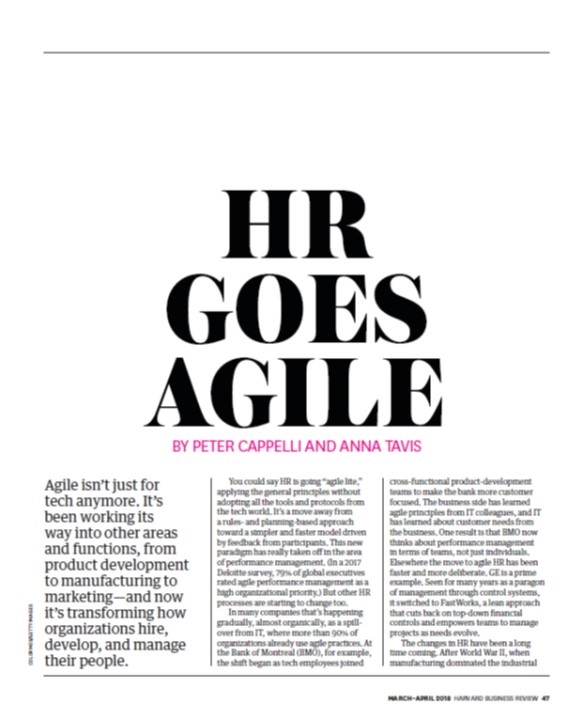
In the March-April 2018 issue of Harvard Business Review, Peter Cappelli and Anna Tavis outline a number of ways in which HR is adopting agile principles. In their article, “HR Goes Agile,” Cappelli and Tavis highlight how HR practices are beginning to trend away from the old approaches governed by rules and plans. Taking cues from agile, they contend, HR is increasingly moving toward a feedback-driven approach characterized by simplicity and speed.
Here are some highlights from their article.
First, a number of big trends are fundamentally influencing HR. These include increasingly rare lifelong employment and an environment marked by rapid change, which drives rapidly changing skill requirements.
Second, the strategic imperative now is rapid innovation, and this applies to HR. In a fast-paced world, top-down planning doesn’t work very well. Instead, nimble, user-driven methods such as rapid prototyping, team-based decisions, and “sprints” centered on specific tasks.
Third, such changes in the larger business environment are driving changes in specific practices, many of which are either HR-driven or used by HR. These include:
Performance appraisals, in which the clear trend is toward having higher-frequency, sometimes project-based feedback versus the typical annual review. The emphasis here is on quick feedback to enable “course corrections.” Elements of agile methods and design thinking can also inform the organization’s approach toward performance appraisal design, with a specific emphasis on involving employees in the prototyping, testing, and iterative improvement process.
Coaching, in which organizations are realizing that they must invest time in developing manager’s skills. In a world driven by high-quality feedback to drive fast improvement, managers need to build a robust set of communication and coaching skills.
Teams, in which work may be best organized by projects instead of by functions or other aspects of formal hierarchy. Here, methodologies such as Scrum are proving useful, as well as norms and rituals that support multi-directional feedback, lower-level decision-making, and supervisors who facilitate healthy teams—not just individual performance.
Compensation, in which incentives may be used to reinforce values such as learning and sharing knowledge. Another potential implication is the use of quick bonuses instead of annual merit-based raises.
Recruiting, in which the use of cross-functional teams with hiring managers who rotate on and off depending on whether they’re hiring can drive the acquisition effort for specific sets of jobs. Prioritization is also key, because not all vacancies are created equal: Some should be filled before others.
Learning and development, in which efforts become tailored to the job and the person in real-time. IBM appears to be at the forefront of these efforts, using “cognitive” (artificial intelligence) approaches to drive training. Additional value may be created by training the organization on specialized topics within the world of agile principles and methods.
My take on this is that these are excellent points—and all in HR should heed them.
But there’s much more, some of which I’ve written about previously. What remains somewhat unexplored is how HR can specifically help the organization overall become more nimble, more agile. Becoming agile itself may be a start, but HR should also continue to work to better define how its practices and strategies can drive innovation and responsiveness to change overall. Related topics and bodies of knowledge including strategy, data analytics, and design thinking play critical roles as well.
What’s clear is that these are exciting times. And perhaps within this context, HR has an opportunity to—in the words of management scholar Gary Hamel— create organizations that are both “fit for the future” and “fit for human beings.”
About Ben Baran
Ben Baran, Ph.D., is probably one of the few people in the world who is equally comfortable in a university classroom, a corporate boardroom and in full body armor carrying a U.S. government-issued M4 assault rifle. He regularly consults leaders and organizations across a wide range of sectors and industries. Visit: www.benbaran.com.

The Big Lie That’s Hindering Your Agility
I’ve seen it in almost every work-related team—both those in which I’ve been a member, and those I’ve coached or led.
It’s a blind spot that we all have. It’s a big lie we all tell ourselves.
It makes us feel good, secure, worthy. It’s psychologically soothing; it’s comfortable.

I’ve seen it in almost every work-related team—both those in which I’ve been a member, and those I’ve coached or led.
It’s a blind spot that we all have. It’s a big lie we all tell ourselves.
It makes us feel good, secure, worthy. It’s psychologically soothing; it’s comfortable.
But it’s blocking our access to the truth. It’s hurting our ability to make optimal decisions. And it’s certainly keeping us from sensing and responding rapidly to change, which is the essence of being an agile leader.
This big lie that we all tell ourselves is as follows:
My team would be extraordinary if only my teammates changed the way they act. It’s not my fault; I’m doing great. It’s about them—they need to communicate better, work harder, hold themselves more accountable.
If that’s the lie, then what’s the truth?
The truth is that being an agile leader demands honesty and humility about ourselves. We must have the strength to reflect on what’s going on—especially in the face of failure or underperformance—and look in the mirror. We must ask ourselves:
What can I do differently to bring out the best in others?
What are those things that I’m just not great at doing, and have I told my team about them?
How must I adapt my communication, my routines, my style to match the situation?
Am I wrong?
Do I really know what I think I know?
Because without such humility, we delude ourselves. We might be able to get away with it for a while when the situation is routine and predictable, when everything is a “known known.” But this arrogance—when deployed in environments characterized by volatility, uncertainty, complexity, and ambiguity (VUCA)—will lead to failure.
In the face of VUCA, humility and transparency must reign supreme. And that starts with each of us being honest about ourselves.
Our tendency to overlook our own faults and to believe that failure originates from anything other than ourselves is natural. It’s also natural for us to attribute success to ourselves—isn’t that convenient? But in addition to becoming a blind spot that can hurt our ability to perform at a high level with others in a VUCA environment, overlooking our own role in underperforming teams or failure hurts our credibility. Namely, by refusing to recognize my own faults, it’s difficult for others to take me seriously when I provide feedback to them.
Such behavior isn’t agile leadership. It’s hypocritical leadership.
To get a better handle on what you’re doing that could be hindering your team’s productivity, I suggest asking for feedback from those around you. Keep in mind, however, that most of us are also predisposed to lie to each other about such matters. Most of us don’t like making other people feel bad, so we tend to gloss over negative feedback. That’s not necessarily a bad thing; it’s complicated. And I’m not advocating recklessly brutal honesty.
But in requesting honest feedback from people about your own behavior, you need to realize that people need to feel safe to do so. One way to do this is through a multirater (commonly known as a “360”) assessment, in which people can provide feedback anonymously (assuming the group is large enough). Such a step can be a good start.
Beyond that, however, it’s about creating a team culture in which everyone knows where the team is heading and in which everyone truly knows in their guts that tough love is sometimes required to get the best out of each other—regardless of titles, age, experience level, and so forth.
How do you create that feeling of safety and freedom to provide honest feedback?
A lot of it has to do with the idea of psychological safety, which Amy Edmonson introduced in her seminal 1999 article in Administrative Science Quarterly. In that research, she found that psychological safety was associated with team learning behavior—characterized by behaviors such as open discussion of different opinions, testing assumptions, and experimentation—which was in turn associated with team performance. To create psychological safety in a team, Edmonson’s data suggested, leaders must:
Provide a compelling team vision and goals
Ensure the team has adequate resources, information, and rewards,
Adopt a supportive, coaching-oriented leadership style, and
Respond to questions and challenges in a non-defensive manner.
Going hand-in-hand with all of these is a posture of humility. No leader knows everything, so when we’re acting as a leader, we should openly acknowledge this reality.
Of course, the most likely case is that in most teams, everyone could be doing something a bit differently to support the team’s objectives. But instead of starting with the issues that we have with each other, it’s better to start with ourselves.
After all, over whom do we really have the most control?
It’s ourselves.
So let’s open ourselves to the possibility that being a humble leader may actually increase our strength, making the teams we lead better able to cope with VUCA and thrive.
About Ben Baran
Ben Baran, Ph.D., is probably one of the few people in the world who is equally comfortable in a university classroom, a corporate boardroom and in full body armor carrying a U.S. government-issued M4 assault rifle. He regularly consults leaders and organizations across a wide range of sectors and industries. Visit: www.benbaran.com.
Reference
Edmonson, A. 1999. Psychological safety and learning behavior in work teams. Administrative Science Quarterly, 44(2), 350-383.

Military Veterans and Employment: Four Hidden Issues and Potential Solutions
Making the leap from active-duty military service to successful civilian employment is hard.
I know. I did it in 2005.
Despite my best efforts, I ended up in a dead-end outside sales job for which I was unprepared and in which my employer left me to sink or swim.
Making the leap from active-duty military service to successful civilian employment is hard.

Photo By: Lance Cpl. Luke Hoogendam. The appearance of U.S. Department of Defense (DoD) visual information does not imply or constitute DoD endorsement.
I know. I did it in 2005.
Despite my best efforts, I ended up in a dead-end outside sales job for which I was unprepared and in which my employer left me to sink or swim.
After about two months, I sank.
I got a better job, one that better fit my skills and abilities. But I was still underemployed. Thus began years of clawing with my fingernails for something better, pushing my way through graduate school and into what has become a fabulous career.
Things worked out. But it was unexpectedly hard—for five reasons. One of those reasons is commonly discussed. Four of those reasons are hidden, or at least in my experience, they’re less frequently discussed.
The one reason that’s common and well-discussed among veteran-assistance organizations is that it’s very difficult to translate what you did in the military into terms and roles that make sense to civilian human resources people and hiring managers. Because this is a very common and well-discussed issue, I won’t delve into it more deeply here. I will say that this is one area that military transition executive recruiters can be very helpful. Although I didn’t end up being placed through one of these service providers (due to me having issue number 2 below), I will put in an unsolicited plug for people like Lee Cohen at Lucas Group. He and others like him open doors to employers for veterans that would be hard for veterans to open without assistance.
Let’s focus, therefore, on what I’m calling four “hidden” issues regarding military veterans and employment, and then I’ll offer a few ideas regarding potential solutions.
Here they are:
Unrealistic transition preview.
Geographic inflexibility.
A sense of entitlement.
A knowledge and skills gap.
Let’s unpack these with a bit more detail.
Unrealistic Transition Preview
The problem: First, like any new experience, you can’t know exactly what it’ll be like until you do it. The same is true for transitioning from active-duty military service to civilian employment. Yet I had—and I sense that others may also have—an unrealistically positive view of what this transition would entail. I distinctly remember people telling me that after a few years as a surface warfare officer in the U.S. Navy, employers would be falling over themselves to hire me. This simply isn’t the case, and it’s what I’m calling an “unrealistic transition preview.” Decades of research has taught us the value of having a realistic job preview, or of knowing what a job will entail prior to employment—warts and all. The same, I think, is true of the military-to-civilian employment leap.
It’s simply better to know in advance—at least a little bit—what you’re getting into.
Potential solutions: To deal with unrealistic transition preview, military personnel should start planning for their post-military careers on day one of their military service. Even if a person stays on active duty for 20 or 30 years, he or she will make the transition to civilian life at some point. More specifically, military personnel on active duty should consider:
Staying connected to civilian life. Military personnel should continue, as much as possible, to nurture interests and networks outside of the military. This must be intentional, because otherwise the military can easily become an all-encompassing lifestyle, and if you’re not careful, all of your friends will be military friends, all of your social relationships will become exclusively military-centric, and you’ll become increasingly isolated from the reality of the modern world of civilian work.
Developing mentoring relationships with civilians. As part of staying connected to civilian life, military personnel should consider building and maintaining relationships with civilians who have successful careers. This will help military personnel stay abreast of what their careers might look like when they decide to leave active military service. Veterati appears to be a potentially helpful vehicle for such relationships.
Managing their own expectations. Simply embracing the notion that transitioning to civilian employment will be hard could be helpful. It’s better to have expectations of difficulty and be pleasantly surprised than the other way around.
Geographic Inflexibility
The problem: When you’re trying to find a job, it’s a basic fact that you’ll have more options if you can go anywhere. Furthermore, the way most executive recruiters or “headhunters” operate is one that’s best suited for people who are willing to go where the job is located, versus having geographic restrictions (e.g., “I will only take a job in Charlotte, N.C.”). I get it—life is complicated. I used Charlotte as an example because that’s where my search focused due to my wife’s employment there.
Potential solutions: I see two possible ways to deal with this issue. Military personnel planning their transition should consider:
Being open to employment anywhere. I know, this is much easier said than done—and it’s an overly simplistic solution to this problem. It will, however, help one’s chances of getting a great job.
Strategically focused networking. If you do have distinct geographic preferences for where you want to work and live after military service, one potentially helpful avenue is to focus your networking efforts on those groups and people located in the area in which you want to locate. Here’s the catch: These efforts often take months or years to yield benefits, so you should start well in advance of your desired transition date.
A Sense of Entitlement
The problem: We’re lucky to live in an era in which American sentiments about the military and military service are overwhelmingly positive. I really, really like that. It has made me feel appreciated for my active-duty service and subsequent reserve service (I’ve been in the U.S. Navy Reserve now for about 12 years, making for about 15.5 years of total service thus far). A complicated side effect, however, is that such consistent admiration combined with occasionally interesting and high-stakes work can result in a sense of entitlement. Namely, I’ve noticed a tendency among veterans (including myself, in 2005) to feel like we deserve civilian employment. But such thinking is not only incorrect—no one owes me a job unless I provide value to them or their organization—but it’s also unattractive. Such an attitude could negatively affect how you act and talk about yourself, leading to a tougher-than-necessary transition to civilian life. Note that I’m not saying that all military personnel or veterans have this sense of entitlement, but it is something I’ve noticed, and it’s a potential barrier to successfully transitioning to civilian employment.
A potential solution: Military personnel transitioning to civilian employment should remember to stay humble and to stay hungry. We have some wonderful, transferrable skills—like leadership, teamwork, problem-solving, and more—but we also have much to learn. Civilian organizations run differently than military organizations, so it’s up to us to crack the code of what they do, how and why they do it, and how we can add value.
A Knowledge and Skills Gap
The problem: As discussed above, part of the problem with military transition is that it’s hard to translate military jobs and skills into language that resonates with civilian hiring managers. That’s true. But it’s also true that businesses need people with knowledge and skills that aren’t taught in the military. Despite our transferrable skills, we veterans aren’t always God’s gift to Corporate America. For example, military service doesn’t teach you fundamentals of accounting, finance, marketing, or entrepreneurship. One could argue that military service does provide some background in management, yet there’s still a great deal to be learned about how civilian organizations run (e.g., civilian human resources law, hiring practices, talent management, and more).
Potential solutions: If one accepts the premise that military personnel might have a knowledge and skills gap regarding what civilian organizations need, potential solutions center upon education and training. A proactive approach toward gaining such knowledge and skills could include the following:
Seeking transformative educational experiences. Boot camp, Officer Candidate School, Reserve Officer Training Corps programs, and the military service academies are effective for training and socializing people for military service because they are intense, transformative experiences. To gain additional skills and knowledge of value in the civilian world, similarly transformative educational experience can help. For example, IESE Business School is actively recruiting military veterans for its Global Executive MBA, a top-ranked global program. My good friend (and fellow Navy officer) Matt Larkin went through this program, and he raves about it. I encourage anyone in the military—active or veteran—who wants a transformative, global experience to check it out. Click here for more information. IESE, by the way, is also the top executive education provider in the world as rated by the Financial Times for the past three years, and they’re actively seeking military veterans for those programs as well. I encourage military folks to learn more about two of their programs—Driving Leadership Potential and the Advanced Management Program and consider attending a preview day on Friday, Jan. 12 in New York City.
Seeking employers that have a history of dealing well with veterans. One could potentially gain the necessary knowledge and skills for successful civilian employment through on-the-job training as well. And such training, or at least an ability to support newly hired veterans, is more likely to exist in organizations that deal well with veterans. One organization that helps to identify such organizations is Victory Media, which happens to have former Master Chief Petty Officer of the Navy Mike Stevens as its chief operating officer.
Gaining professional certifications that civilian organizations value. An additional path toward gaining knowledge and skills that will help with successful transition to civilian employment for veterans is through obtaining professional certifications that employers recognize and value. Some examples come from the areas of project management, human resources (two organizations that offer certifications are SHRM and HRCI), investment management, and supply chain management. Numerous others abound.
Finally, myriad organizations exist to help veterans. Here’s the page where you can download a list of them from the Department of Veterans Affairs. Here’s another list from Military.com. Not too long ago, Facebook launched its own group for veterans, with a focus on the technology industry. And I’m sure many others are out there doing great work (feel free to highlight any in the comments below).
Above all, I think there’s value in broadening the conversation about what it takes to transition successfully from military service to civilian employment. And perhaps thinking about some of these “hidden” issues could be a place to start.
I welcome and look forward to your comments and thoughts.
About Ben Baran
Ben Baran, Ph.D., is probably one of the few people in the world who is equally comfortable in a university classroom, a corporate boardroom and in full body armor carrying a U.S. government-issued M4 assault rifle. He regularly consults leaders and organizations across a wide range of sectors and industries. Visit: www.benbaran.com.

Good Managers Do These 102 Things
I teach a “managerial skills development” course, in which I attempt to share research-based insights on what it takes to be a good manager of people.
I recently changed one aspect of the course by highlighting important concepts—or “keys” to being a good manager. In most class sessions, I introduced anywhere from five to nine such keys. By the end of the semester, I had 102 “Keys to Being a Good Manager.”

I teach a “managerial skills development” course, in which I attempt to share research-based insights on what it takes to be a good manager of people.
I recently changed one aspect of the course by highlighting important concepts—or “keys” to being a good manager. In most class sessions, I introduced anywhere from five to nine such keys. By the end of the semester, I had 102 “Keys to Being a Good Manager.”
It’s important to note that these aren’t meant to be the only actions one must take to manage people in a way that unlocks their potential and inspires them to be their best at work. Furthermore, when I teach these, I include quite a bit of amplifying information and context for each of these points. I also didn’t get too hung up on the distinction between management and leadership, because great organizations have both.
That being said, there’s no harm—at least none that I can imagine right now—from sharing these 102 items as standalone concepts.
So here they are:
102 Keys to Being a Good Manager
Good managers …
Make people feel welcomed.
Encourage idea sharing.
Create and clarify expectations.
Respect people's time.
Show up on time and well-prepared.
Respond quickly to people's concerns.
Set high standards and hold people accountable for them.
Never stop learning.
Write clearly.
Speak confidently.
Anticipate needs and reactions.
Use data to substantiate claims and decisions.
Assume all written communication is public.
Never send messages that were written in anger.
Listen actively and empathize.
Provide continual feedback.
Learn from others.
Communicate with purpose and redundancy.
Check for understanding.
Run great meetings.
Seek and ask for feedback.
Treat people with dignity and respect--at all times.
Welcome new information--especially bad news.
Strive to understand criticism, not reject it.
Appreciate how people are different from each other.
Develop an awareness of how others perceive them.
Control their emotions.
Respond appropriately to the emotions of others.
Empathize when working across cultures.
Adhere to a set of core values and principles.
Sense and respond quickly to change.
Cope effectively with stress.
Take care of their own well-being.
Eliminate unnecessary stressors.
Distinguish between what is urgent and what is important.
Practice gratitude daily.
Systematically realign their activities and goals.
Seek balance in their lives.
Positively influence the lives of others.
Question solutions that seem too easy to be true.
Revisit problems when they're in a different mood.
Trust and question their intuition at the same time.
Discuss and plan for multiple scenarios.
Gather diverse perspectives.
Promote failing fast to encourage creativity and learning.
Ask many questions.
Devote time and effort to thinking.
Approach problem-solving creatively.
Continually foster positive relationships.
Coach people using specific, behavioral guidance.
Notice and discuss positive behaviors—right away.
Notice and discuss negative behaviors—right away.
Communicate with both accuracy and kindness.
Base their feedback on personal observation or verifiable facts.
Regularly make time to meet one-on-one with direct reports.
Make performance feedback an ongoing, positive conversation.
Are firm, fair, courteous, and consistent.
Trust but verify.
Clearly link rewards with behaviors.
Carefully plan and judiciously use discipline.
Develop useful expertise.
Serve others with sincerity.
Positively influence both the attitudes and behaviors of others.
Implement fair policies, procedures, and practices.
Navigate organizational politics and negotiate effectively.
Carefully diagnose performance issues.
Emphasize both performance and satisfaction.
Collaboratively set difficult, specific goals.
Identify and remove obstacles to high performance.
Focus more on learning experiences than on discipline.
Examine and redesign work to make it motivating.
Reward employees who perform at a high level.
Care about both objective and subjective fairness.
Don't tolerate relationship conflict.
Encourage appropriate constructive conflict.
Promote conflict management at the lowest levels.
Allow vigorous debate and respectful candor.
Adapt their conflict management style to the situation.
Keep the team focused on its goals.
Stay calm and collected, especially when others aren't.
Create opportunities for people to master skills or knowledge.
Give people choices about how to contribute to objectives.
Help people see the outcomes of their work.
Continually clarify the vision of what success "looks like."
Are reliable, honest, open, and fair.
Clarify roles and responsibilities in teams.
Focus on both team and individual performance.
Use teams when tasks are highly interdependent.
Balance team size with diversity of competencies and perspectives.
Explicitly discuss desired and undesired norms when forming teams.
Gather input from all team members, not just the most vocal ones.
Promote positive deviance in mature teams.
Promote both team cohesion and individual expression.
Create a context and incentives that reward ethical behavior.
Approach change as a process, not an event.
Involve others in creating the future.
Revise plans when new information changes assumptions.
Proactively plan for what might happen.
Value the contributions and care about the well-being of others.
Encourage collaborative action and empower decision-making.
Support innovation at all levels that solves people’s challenges.
Clarify outcomes and use feedback to improve continually.
I’d like to think that if more people—particularly those who hold positions of authority—did these types of things more often, both their employees and their organizations overall would benefit.
And for those of us who manage others, perhaps these might serve as a few reminders of actions we can take to promote flourishing both for ourselves and for those around us.
About Ben Baran
Ben Baran, Ph.D., is probably one of the few people in the world who is equally comfortable in a university classroom, a corporate boardroom and in full body armor carrying a U.S. government-issued M4 assault rifle. He regularly consults leaders and organizations across a wide range of sectors and industries. Visit: www.benbaran.com.

Harvey Weinstein, King David, You, and Me
People who have power without oversight are likely to abuse it. Such has been the case throughout history. Not all people in power are abusive or unethical, yet power itself increases the probability for wrongdoing.
Recent examples include Harvey Weinstein, whose reportedly habitual repugnant, criminal behavior against women is—appropriately—shocking.

King David Handing the Letter to Uriah, by Pieter Lastman
People who have power without oversight are likely to abuse it. Such has been the case throughout history. Not all people in power are abusive or unethical, yet power itself increases the probability for wrongdoing.
Recent examples include Harvey Weinstein, whose reportedly habitual repugnant, criminal behavior against women is—appropriately—shocking.
And every day, it seems that more reports of similar behavior surface.
One explanation for such behavior is that these people are somehow “bad” themselves. Namely, something is, and was perhaps always, immoral about them. This could be the case, and regardless of how we explain or understand what they did, our criminal justice system and we as a society should absolutely hold all such people who do such things fully accountable for their actions.
At the same time, I suggest that seeing such behavior—be it sexual assault or other forms of criminal or unethical actions by people who hold power—only as the result of being a “bad” person is overly simplistic. It’s also self-serving and convenient, as it suggests that only “bad” people do bad things, therefore “I” as a “good” person can only do good things.
In other words, in addition to considering “bad apples,” we must consider “bad barrels.” We must recognize that situational conditions can bring out the good and bad in all of us. Research by psychologists Stanley Milgram and Philip Zimbardo, among others, provides compelling evidence of the inconvenient reality that we are all capable of good—and, perhaps more importantly—that we are all capable of evil.
And regarding people lead or who aspire to lead organizations, there’s a critical lesson to take away.
It’s one best illustrated by none other than the psalmist, King David, and discussed in a 1993 article in the Journal of Business Ethics titled, “The Bathsheba syndrome: The ethical failure of successful leaders.”
The article draws upon the story of King David and Bathsheba. If you’re not familiar, here’s a summary, according to the Bible (see 2 Samuel, Chapter 11):
It happened, late one afternoon, when David arose from his couch and was walking upon the roof of the king's house, that he saw from the roof a woman bathing; and the woman was very beautiful. And David sent and inquired about the woman. And one said, “Is not this Bathsheba, the daughter of Eliam, the wife of Uriah the Hittite?” So David sent messengers, and took her; and she came to him, and he lay with her … And the woman conceived; and she sent and told David, “I am with child.”
The plain language of these verses can unintentionally gloss over a few facts that are important to highlight:
David is a king, holding vast power and authority
He sees a woman bathing and fetches her to his bed
It’s hard to find evidence of a consensual relationship here
Even if it were consensual, he knows she’s married, so it’s clearly wrong in this context
And then he learns that she’s pregnant, which naturally increases the probability of David’s actions becoming public. So, the king’s response? Let’s murder her husband. As written:
In the letter he wrote [to Joab, one of his military commanders], “Set Uriah in the forefront of the hardest fighting, and then draw back from him, that he may be struck down, and die.” And as Joab was besieging the city, he assigned Uriah to the place where he knew there were valiant men. And the men of the city came out and fought with Joab; and some of the servants of David among the people fell. Uriah the Hittite was slain also.
The “Bathsheba syndrome,” as described by the article’s authors, involves the nature of power and leadership. It’s about how successful leaders, due to the very nature of their success, will almost inevitably find themselves in positions that can, if they’re not careful, lead to unethical behavior.
This is because successful leaders increasingly have:
Privileged access to information, people, and objects
A tendency to lose strategic focus and get complacent
Control over resources with little or no oversight
The ability to manipulate the outcomes of their actions
Such products of success, the authors argue, leads to an increased probability of wrongdoing. It’s not about whether you’re a good or bad person; it’s not about whether or not you know the rules. It’s about the very outcomes of success.
And that should serve as a warning to everyone who aspires to achieve success, at least success when defined as a position of authority within an organization.
It’s a reminder that human nature can lead us to abuse our authority, to abuse our power over others to get what we want.
It’s a reminder that it’s not just about Harvey Weinstein or King David; it’s about you. It’s about me. Because the minute we start thinking, “I’m a good person, so I would never do that” is the minute that we begin to step down the dangerous path of hubris.
It’s an uncomfortable idea, but it’s valuable for us to remember. In particular, the article suggests that’s important for all leaders to keep in mind that, among other points:
It could happen to you—King David had principles; he was smart. And yet we see what he did. When confronted with ethical dilemmas, it’s best to assume that you will always get caught if you choose the wrong path.
Stay humble and grounded by living a balanced life. Find meaning in activities outside of your own organization to help you avoid believing in your own “greatness.”
Understand that your privileged access to information or people isn’t for your own benefit; it’s not something you deserve. Your job is always to help your organization flourish.
Surround yourself with people who will challenge your opinions and decisions, people whose job expressly includes keeping you focused and out of trouble.
Use boards of directors or other oversight mechanisms to keep your power in check; if you’re on a board, you should be particularly vigilant in your monitoring activities.
So in the midst of the many recent high-profile cases of sexual harassment and assault, it is perhaps timely to remind ourselves of the corrupting nature of power without oversight. When people depend upon us for resources, for approval, for jobs, for anything, the temptation to exploit such relationships exists.
Such is the double-edged sword of success. It behooves all of us, therefore, to stay vigilant regarding our own behavior and the behavior of all others in power around us.
About Ben Baran
Ben Baran, Ph.D., is probably one of the few people in the world who is equally comfortable in a university classroom, a corporate boardroom and in full body armor carrying a U.S. government-issued M4 assault rifle. He regularly consults leaders and organizations across a wide range of sectors and industries. Visit: www.benbaran.com.

On the Origins of VUCA and How it Affects Decision Making
It’s not just you; it’s not just me. The acronym VUCA is more popular than ever.
According to Google Trends, interest in the term is at an all-time high, following a distinct trend upward in the past several years.
Like many ideas, however, VUCA as a framework for understanding turbulence in one’s environment wasn’t an overnight sensation. The acronym—which stands for
It’s not just you; it’s not just me. The acronym VUCA is more popular than ever.

According to Google Trends, interest in the term is at an all-time high, following a distinct trend upward in the past several years.
Like many ideas, however, VUCA as a framework for understanding turbulence in one’s environment wasn’t an overnight sensation. The acronym—which stands for volatility, uncertainty, complexity, and ambiguity—began decades ago with attempts to help develop strategic leaders at the U.S. Army War College.
One of the earliest references to VUCA that I’ve found is in a 1992 article in the Journal of Management Development by Herbert Barber titled, “Developing strategic leadership: The US Army War College experience.” In the article, he describes how the U.S. Army War College and The Army Research Institute for the Behavioral and Social Sciences sponsored a conference in February 1991 that brought together both scholars and practitioners to discuss leadership at the top of complex organizations. One of the aspects of strategic leadership upon which participants at the conference focused was the environment, or the context in which strategic leaders must operate. Even in 1991, the environment described by conference participants was one fraught with turbulence, from geopolitical uncertainty to technological advancement.
Crediting even earlier work in 1986 by leadership scholars Warren Bennis and Burton Nanus, Barber describes how the U.S. Army War College decided to use the VUCA acronym as a way to help their students (typically senior military officers) characterize the turbulence they would face as they took on increasingly strategic leadership positions. The recent popularity of the acronym stems in large part from increased application within civilian sectors, as leaders outside the military have found it useful in helping them make sense of their challenges and opportunities.
So what do the four components of VUCA mean? Here’s a brief summary of the explanations that I typically use.
Volatility is about the increasing pace of change. Although we can find examples from throughout history of people being astonished by the pace of change, two relatively recent factors are driving unprecedented change: (1) technological advancement and (2) globalization. Those factors, combined with the speed of innovation and increased competition, make for a world filled with many examples of exponential—not linear—change.
Uncertainty is about the unpredictability of the future. Predicting what the “next big thing” will be has always been difficult, but given the increasingly fast pace of change it’s getting even harder. Furthermore, people use new technologies in novel and interesting ways—ways that could never have been predicted even by their original creators (Twitter is a good example).
Complexity is about the interconnected nature of organizations, industries, markets, and geographies. Readers of the sociologist Charles Perrow may think of the concepts “interactive complexity” and “tight coupling” that he uses to describe how unpredictable and fast chain reactions can occur, particularly when risky technologies are involved.
Ambiguity is about what the famed military theorist Carl von Clausewitz called “the fog of war.” It’s about those confusing situations in which multiple plausible interpretations exist about what’s going on or what it means. It’s about those times when a group of smart people are all looking at the same data yet coming to different conclusions about what it means—and here’s the key—they all sound right.
Aside from overwhelming leaders with what the future holds, though, how is the VUCA construct helpful?
I’ve found it to be helpful in my conversations with executives in a few ways.
First, it provides a language and a framework for having a meaningful conversation about what an organization faces, both internally and externally. What are our knowns? What are our unknowns? And might there be unknown unknowns? Having those conversations is a critical step in the sensemaking process for leadership teams. And as my good friend and consulting partner Mike Richardson says, “conversation flow leads to cash flow!”
Second, it helps leaders understand the mindset and behavioral shift that they need to enact when entering the “land of VUCA.” Namely, VUCA problems are ones in which best practices—and even good practices—likely don’t apply. When encountering VUCA, one cannot reliably depend upon the past as a guide for the future.
As such, an understanding of VUCA can assist with understanding a specific domain of decision-making. And to help make sense of how to make decisions within a VUCA environment, the Cynefin framework is useful.
For those who aren’t familiar, the Cynefin framework originated around the turn of the century at IBM, specifically led by Dave Snowden. Since then, it’s become a useful way for leaders to help make sense of what types of problems they face and how to deal with them.
A complete description of the Cynefin framework is beyond the scope of this article, however, as depicted below, it categorizes four types of problems: simple, complicated, complex, and chaos. These all exist outside of disorder—those instances in which no clarity exists about which domain applies.
A sketch, by Edwin Stoop of Sketching Maniacs, of the Cynefin framework
Simple problems are solved using best practices, and complicated problems are solved using good practices (or a limited range of good options).
Complex problems are those in the land of VUCA. These are problems that aren’t solved by doing what worked well in the past (best practices), and there really don’t seem to be any good answers. Instead, experimentation is critical. This is the domain of probing, trying something, and then sensing and responding accordingly.
Chaos describes true crisis situations. These situations call for direct action in an immediate attempt to stop the bleeding (or the organizational equivalent), figure out some next steps, and move the problem into another domain.
So the next time you’re facing VUCA—in your life or in your organization—resist the temptation to treat it like a best practice. Instead, make friends with experimentation, embrace smart (i.e., small, fast, cheap) failure, and continually learn. Such an orientation toward leadership and decision making also requires a deep commitment to building trust, agility, and resilience within your team, because without those elements, you’ll never be able to create, fail, or learn effectively together.
About Ben Baran
Ben Baran, Ph.D., is probably one of the few people in the world who is equally comfortable in a university classroom, a military uniform, or in a corporate boardroom advising top management teams. A co-founder and principal at the consulting firm Indigo Anchor, he's also an award-winning business professor and published scholar at Cleveland State University and a commander in the U.S. Navy Reserve. He regularly consults leaders and organizations across a wide range of sectors and industries. Visit: www.indigoanchor.com and www.benbaran.com.
References:
Barber, H. F. (1992). Developing strategic leadership: The US Army War College experience. Journal of Management Development, 11(6), 4–12. https://doi.org/10.1108/02621719210018208
Bennis, W. G., & Nanus, B. (1986). Leaders: The Strategies for Taking Charge. New York: Harper & Row.

Leading Collaboration and Disaster Response
Rescue and recovery efforts related to Hurricane Harvey, which struck the Texas coast on Aug. 26, are likely testing the ability of numerous organizations to coordinate or collaborate effectively.
People within all of these organizations—including the U.S. Coast Guard, the Federal Emergency Management Agency, Department of Homeland Security, the National Guard, state and local law enforcement, the fire service, and many others—have undoubtedly been working around the clock to help those in need. Like those professionals whom I’ve had the pleasure to know in these and similar areas of public service, these people are selfless, hardworking, and well-intentioned.
With any massive event like this, however, there are

Photo by Army National Guard Sgt. 1st Class Malcolm McClendon. The appearance of U.S. Department of Defense (DoD) visual information does not imply or constitute DoD endorsement.
Rescue and recovery efforts related to Hurricane Harvey, which struck the Texas coast on Aug. 26, are likely testing the ability of numerous organizations to coordinate or collaborate effectively.
People within all of these organizations—including the U.S. Coast Guard, the Federal Emergency Management Agency, Department of Homeland Security, the National Guard, state and local law enforcement, the fire service, and many others—have undoubtedly been working around the clock to help those in need. Like those professionals whom I’ve had the pleasure to know in these and similar areas of public service, these people are selfless, hardworking, and well-intentioned.

Photo by Coast Guard Petty Officer 3rd Class Brandon Giles. The appearance of U.S. Department of Defense (DoD) visual information does not imply or constitute DoD endorsement.
With any massive event like this, however, there are likely to be some frustrating issues related to how the various organizations interact. Who does what? Who is responsible for whom? How are resources shared—or not? Friction is almost certainly guaranteed due to the turbulent nature of the situation.
Although such friction may not be totally avoidable, we do seem to know a few things about organizations that helps us understand some of the factors that promote coordination and collaboration in these types of situations. Here are two of those factors:
- Deference to expertise. In addition to applying at the individual level—for example, giving authority to people in teams based upon their level of expertise on a given topic—we can think about this idea with regard to organizations overall. Some organizations are better equipped and trained to do certain tasks than others. Instead of fighting over decision-making authority, leaders within various organizations that are attempting to collaborate should defer such authority to organizations that have such expertise. For example, I could be wrong, but for matters related to water-borne rescue, the U.S. Coast Guard probably should be driving the show.
- Organizational identity. In order for deference to expertise to work, an organization must have a clear idea about what it does well and what it does not do well. This requires a high level of intellectual honesty and humility among those who run such organizations. In planning and coordination meetings, for example, representatives from various organizations must be knowledgeable about not only what their organization can provide better than others—but also be willing to concede that other organizations have their own specific areas of expertise.

Photo by Air National Guard Master Sgt. Matt Hecht. The appearance of U.S. Department of Defense (DoD) visual information does not imply or constitute DoD endorsement.
Leaders at all levels within responding organizations would be well served to keep these ideas in mind and act accordingly. I’m sure many of them already are doing so.
But as the work in Houston and surrounding areas goes on—not for weeks and months, but likely years—these are principles that will continue to apply.
These are tough times for those affected by Harvey. And Hurricane Irma is currently building strength in the Atlantic. If you’re fortunate like me to not be directly affected by these events, consider donating to a charity that is helping. Here’s a list of such groups from the New York Times.
About Ben Baran
Ben Baran, Ph.D., is probably one of the few people in the world who is equally comfortable in a university classroom, a corporate boardroom and in full body armor carrying a U.S. government-issued M4 assault rifle. Visit: www.benbaran.com.
Ben is also the author of the e-book, The Navy’s 11: Reflections and tips for leaders everywhere based upon the U.S. Navy’s Leadership Principles. It’s full of ...

- Leadership guidance, based upon the U.S. Navy's Leadership Principles, which have been used to create and sustain the greatest navy known to humankind;
- Real-world examples, based upon my nearly 20 years of experience with the U.S. Navy and a decade of academic research combined with business consulting;
- Actionable tips, meant to help you implement the leadership principles in your daily life and work; and
- Much more!
Click here to get your FREE copy today.

Accidents at Sea and Human Behavior
When I heard about the collision involving USS Fitzgerald (DDG 62) on June 17, 2017, my heart sank. For me and other Navy veterans who have served aboard ships like Fitzgerald, the feeling is rather personal—we’ve driven ships, we’ve been in situations that are tough to navigate, and we can imagine fairly closely the moments before and after a collision.
Then, only about two months after Fitzgerald, came the news that USS John S. McCain (DDG 56) collided with a vessel on Aug. 21 near the Strait of Malacca. Because it connects the Pacific and Indian Oceans, it’s a high-traffic area, one that puts many large ships within relatively close proximity of each other. Of the many tough waters in the world to traverse, this one is somewhere near the top of the list.
My heart—and, I’m sure, the hearts of many others—sank again.
First, of course, I think of those killed and injured. My thoughts and prayers are with them and their families.
Second, I wonder:
Why?
What happened?
Myriad explanations abound, and

Aug. 21, 2017--Damage to the port side of the guided-missile destroyer USS John S. McCain (DDG 56) as it steers towards Changi Naval Base, Republic of Singapore, following a collision with the merchant vessel Alnic MC. Photo by Mass Communication Specialist 2nd Class Joshua Fulton. The appearance of U.S. Department of Defense (DoD) visual information does not imply or constitute DoD endorsement.
When I heard about the collision involving USS Fitzgerald (DDG 62) on June 17, 2017, my heart sank. For me and other Navy veterans who have served aboard ships like Fitzgerald, the feeling is rather personal—we’ve driven ships, we’ve been in situations that are tough to navigate, and we can imagine fairly closely the moments before and after a collision.
Then, only about two months after Fitzgerald, came the news that USS John S. McCain (DDG 56) collided with a vessel on Aug. 21 near the Strait of Malacca. Because it connects the Pacific and Indian Oceans, it’s a high-traffic area, one that puts many large ships within relatively close proximity of each other. Of the many tough waters in the world to traverse, this one is somewhere near the top of the list.
My heart—and, I’m sure, the hearts of many others—sank again.
First, of course, I think of those killed and injured. My thoughts and prayers are with them and their families.
Second, I wonder:
Why?
What happened?
Myriad explanations abound, and the investigations for both the Fitzgerald and McCain collisions are ongoing. One report, which outlines actions that occurred after the Fitzgerald collision (but doesn’t investigate the events leading up to the collision) has been released (read it here). It’s well worth reading, as it discusses the specifics of what occurred and the damage-control efforts that followed.
The investigations regarding the causes will thoroughly explore the incidents. I won’t speculate regarding what happened specifically in these situations.
I do, however, think it’s reasonable to expect—given the research on safety and accidents plus my firsthand knowledge of being a surface warfare officer in the U.S. Navy—that the investigations will find a number of related factors, including:
A chain of events. It’s difficult to imagine such an event being caused by a single poor decision, a single mechanical problem, or any other “one” cause. Given the complexity of operating a large ship safely at sea, a number of redundant systems are in place to help reduce risk. For example, on a U.S. Navy ship, more than one group of people are looking at charts and monitoring other ships nearby. Mechanical features have backups and the backups have backups. Therefore, a collision would involve a number of events in which things went wrong. The scholar James Reason’s “Swiss Cheese Model” comes to mind. This model suggests that errors occur when various failures of human behavior and aspects of the environment align such that vulnerabilities or the “holes” (hence the Swiss cheese) line up to cause an error or accident.
A human component to the situation. In any such disaster, people are making decisions. These are real people—complex humans who differ in how they think, communicate, and make judgments. The human component also involves the reality that ships are organizations. They are complex amalgamations of unique people attempting—and nearly all the time succeeding, it should be noted—at interacting in mindful, productive way. As such, issues of leadership and culture are critical. Everyone, regardless of rank or status, must know in the depths of their very being that their coworkers and leaders want them to bring confusing or even vaguely problematic situations to their attention.
When interacting in a high-risk environment, furthermore, the best organizations are ones that anticipate and contain errors quickly. Research on such “high-reliability organizations” suggests this capability allows the organization to catch small problems before they escalate into bigger ones, potentially leading to disaster. (The scholars Karl Weick, Kathleen Sutcliffe, Todd La Porte, and Karlene Roberts are some of foremost researchers in this area—for interested readers, I suggest starting here.)
I’m confident that the U.S. Navy will investigate these incidents quickly enough to promote understanding and learning, but not too quickly, as a too rapid investigation could overlook potential aspects of the problem.
I’m hopeful that the lessons learned from these incidents will be (a) the right lessons that can lead to improved performance and (b) implemented in a thoughtful-yet-rapid manner.
Until then, be safe shipmates.
About Ben Baran
Ben Baran, Ph.D., is probably one of the few people in the world who is equally comfortable in a university classroom, a corporate boardroom and in full body armor carrying a U.S. government-issued M4 assault rifle. Visit: www.benbaran.com.
Ben is also the author of the e-book, The Navy’s 11: Reflections and tips for leaders everywhere based upon the U.S. Navy’s Leadership Principles. It’s full of ...

- Leadership guidance, based upon the U.S. Navy's Leadership Principles, which have been used to create and sustain the greatest navy known to humankind;
- Real-world examples, based upon my nearly 20 years of experience with the U.S. Navy and a decade of academic research combined with business consulting;
- Actionable tips, meant to help you implement the leadership principles in your daily life and work; and
- Much more!
Click here to get your FREE copy today.

Human Resource Management and The Great Unlearning
Exciting changes in the world of human resources (HR) abound. As noted by Stephen Barley (University of California Santa Barbara), Beth Bechky, and Frances Milliken (both of New York University) in their recent article in Academy of Management Discoveries,
“Few people would deny that the nature of work and employment has changed over the last four decades, not only in the United States but in many countries worldwide. Moreover, the nature of work is likely to continue to change as we move further into the 21st century.”
Such changes make HR work continually dynamic, with evolving practices with regard to new technologies, the increasing prevalence of contingent workers, and more. Barley and his coauthors also mention the rise of artificial intelligence and the rise of project-based work as fundamental shifts that will influence careers and even how people think about themselves in relation to their organizations and society.
These changes alone are enough to keep HR leaders and other executives up at night.
Yet I wonder

Exciting changes in the world of human resources (HR) abound. As noted by Stephen Barley (University of California Santa Barbara), Beth Bechky, and Frances Milliken (both of New York University) in their recent article in Academy of Management Discoveries,
“Few people would deny that the nature of work and employment has changed over the last four decades, not only in the United States but in many countries worldwide. Moreover, the nature of work is likely to continue to change as we move further into the 21st century.”
Such changes make HR work continually dynamic, with evolving practices with regard to new technologies, the increasing prevalence of contingent workers, and more. Barley and his coauthors also mention the rise of artificial intelligence and the rise of project-based work as fundamental shifts that will influence careers and even how people think about themselves in relation to their organizations and society.
These changes alone are enough to keep HR leaders and other executives up at night.
Yet I wonder if there are additional, perhaps even more fundamental shifts underway that will forever alter how people behave and interact at work.
Those changes have to do with a recognition of the ingenious beauty of human organizing, the remarkable capacity that we all have to iterate toward something better, and the foolishness—and downright arrogance—that can accompany our best managerial attempts to control.
Teams and organizations are increasingly finding benefits in valuing:
- Individuals and interactions over processes and tools
- Working [solutions] over comprehensive documentation
- Customer collaboration over contract negotiation
- Responding to change over following a plan
If those values look familiar, you’ve likely seen them in the Agile Manifesto, which includes these values and a set of principles for software development.
But here’s the thing—these values and principles have been around for decades prior to their articulation in the Agile Manifesto. That’s because they’re based in how people actually work, not in how various management systems of the 20th Century forced them to obey.
As noted in The Wharton School’s Aug. 1 article, Has Agile Management’s Moment Arrived?,
“The agile approach is one that uses teams to work through a process designed to respond to unpredictability; that allows for and encourages changes in direction; that gives teams great authority and transparency; and that builds in customer or user response to the end product or service while it is still being developed.”
Because agile management thrives in a state of uncertainty, it is highly likely to continue to spread into other sectors and functions, far beyond that of software development.
Case in point: General Electric, which has been implementing similar principles for the past few years with regard to its manufacturing—within a program called “FastWorks.”
And given that agile methods, including those advocated by Scrum, are continuing to increase in popularity, I see a tremendous opportunity—and threat—ahead for the world of HR.
Namely, in successful organizations, HR will be a central component of what I’m starting to think of as “The Great Unlearning.”
The Great Unlearning is what’s required of organizations that are fundamentally committed to a different way of working, a way that’s characterized by how humans actually interact best.
Going back to Barley and his coauthors’ recent work, in addition to discussing fundamental shifts in the world of work, they also astutely highlight how most of management knowledge and practice comes from research and assumptions developed decades ago. They write:
“… it is surprising how little organization and management studies have had to say about the phenomenon. Our field’s lack of attention to the ways in which work is changing is problematic because organization studies and organizational behavior grew out of industrial sociology and industrial and organizational psychology in the 1960s and 1970s.”
For HR leaders, The Great Unlearning means that they will have to undo much of what we have taken for granted as management dogma. For example, if an organization does much of its work based upon project-based teamwork, what might that mean in terms of:
- The employer relationship—will there be much of a need for permanent employees in the future?
- Compensation—what is the value of hourly wages if results are truly project-based?
- Recruiting and selection—how do you find people who can perform in an interdependent, team-based environment?
- Development—how do you help the millions of workers who are deeply accustomed to traditional ways of working adapt to new structures and ways of working? How do you help an organization nurture a culture in which new values matter more than those of the past?
- And much more.
The Great Unlearning for HR also includes HR as a profession taking a hard look at itself in the mirror. Although people have been preaching—rightly, in my opinion—about how HR needs to transform for the past two decades (Dave Ulrich’s 1998 Harvard Business Review article comes to mind), has it really happened?
In most organizations that I know, HR is still the compliance department, the place where you go to find out about your benefits, the people who give you stuff to sign. In today's business environment, HR must unlearn its own ways of working. HR must also help organizations unlearn the behaviors that have been taken-for-granted by employees since the Industrial Revolution.
In short, it seems that The Great Unlearning for HR includes both a threat and an opportunity for HR leaders.
It’s threatening for HR leaders who prefer to maintain the status quo.
It’s an opportunity for HR leaders who are willing to take the risks necessary to make their organizations primed for the future.
About Ben Baran
Ben Baran, Ph.D., is probably one of the few people in the world who is equally comfortable in a university classroom, a corporate boardroom and in full body armor carrying a U.S. government-issued M4 assault rifle. Visit: www.benbaran.com.
Ben is also the author of the e-book, The Navy’s 11: Reflections and tips for leaders everywhere based upon the U.S. Navy’s Leadership Principles. It’s full of ...
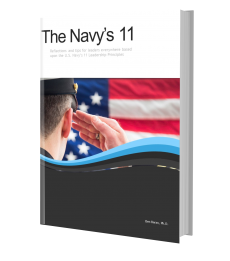
- Leadership guidance, based upon the U.S. Navy's Leadership Principles, which have been used to create and sustain the greatest navy known to humankind;
- Real-world examples, based upon my nearly 20 years of experience with the U.S. Navy and a decade of academic research combined with business consulting;
- Actionable tips, meant to help you implement the leadership principles in your daily life and work; and
- Much more!
Click here to get your FREE copy today.

Wellness? How About Comprehensive Employee Fitness
Within the military, attention in recent years has been shifting among senior military leaders toward a model of health for service members that included the idea of resilience. Notably, in 2011, a whole special issue of the high-visibility journal American Psychologist focused on the U.S. Army’s idea of “Comprehensive Soldier Fitness,” or CSF. In the opening article, then U.S. Army Chief of Staff General George Casey Jr. described it this way:
“… the Army is leveraging the science of psychology in order to improve our force’s resilience. More specifically, we are moving beyond a “treatment-centric” approach to one that focuses on prevention and on the enhancement of the psychological strengths already present in our soldiers. Rooted in recent work in positive psychology, CSF is a “strengths-based” resiliency program that shows promise for our workforce and its support network so our soldiers can “be” better before deploying to combat so they will not have to “get” better after they return.”[i]
Although I’m a Sailor (i.e., in the Navy; more specifically, the Navy Reserve) and not a Soldier, the notion of resilience has seeped across the branches of service. And while most of the personnel burden for the wars in both Iraq and Afghanistan has fallen upon the Army, the Navy has also begun to appreciate the notion of resilience. That’s good, because resilient service members will be better equipped to handle the increasingly dynamic nature of their work, and, when they eventually leave military service, they’ll have yet another skill that transfers to the civilian workplace.
It’s also a concept that’s critical for leaders working in any industry that’s either beginning to experience—or is in the throes of—what’s becoming the turbulent, modern business environment. Work organizations that embraced a concept of “comprehensive employee fitness” would surely benefit through the more engaged, more motivated workforce that would result.

Within the military, attention in recent years has been shifting among senior military leaders toward a model of health for service members that included the idea of resilience. Notably, in 2011, a whole special issue of the high-visibility journal American Psychologist focused on the U.S. Army’s idea of “Comprehensive Soldier Fitness,” or CSF. In the opening article, then U.S. Army Chief of Staff General George Casey Jr. described it this way:
“… the Army is leveraging the science of psychology in order to improve our force’s resilience. More specifically, we are moving beyond a “treatment-centric” approach to one that focuses on prevention and on the enhancement of the psychological strengths already present in our soldiers. Rooted in recent work in positive psychology, CSF is a “strengths-based” resiliency program that shows promise for our workforce and its support network so our soldiers can “be” better before deploying to combat so they will not have to “get” better after they return.”[i]
Although I’m a Sailor (i.e., in the Navy; more specifically, the Navy Reserve) and not a Soldier, the notion of resilience has seeped across the branches of service. And while most of the personnel burden for the wars in both Iraq and Afghanistan has fallen upon the Army, the Navy has also begun to appreciate the notion of resilience. That’s good, because resilient service members will be better equipped to handle the increasingly dynamic nature of their work, and, when they eventually leave military service, they’ll have yet another skill that transfers to the civilian workplace.
It’s also a concept that’s critical for leaders working in any industry that’s either beginning to experience—or is in the throes of—what’s becoming the turbulent, modern business environment. Work organizations that embraced a concept of “comprehensive employee fitness” would surely benefit through the more engaged, more motivated workforce that would result.
Potential Aspects of Comprehensive Employee Fitness
If we look at the psychological research behind the idea of Comprehensive Soldier Fitness, we can get an idea of what it might mean across other contexts—including in civilian organizations.
The fundamental concepts are: grit, hardiness, adaptability, agility, and resilience. To be clear, researchers haven’t reached a total consensus on how all of these ideas are different or similar. But there’s consensus that all of them have positive outcomes. And for the sake of becoming a resilient person and developing into a person who thrives in the face of what’s becoming a world characterized by continual, rapid change, it’s important to become familiar with these ideas. So let’s take a quick look under the hood of each one.
Grit: Just Keep Swimming
Grit is about picking long-term goals and going after them with gusto, regardless of the obstacles. When I think of “grit,” I think of John Wayne. (Thanks, Hollywood.) Grit isn’t about one’s mental ability. It’s not about one’s intelligence quotient, or IQ. But what’s great about grit is that it captures that ever-important quality of stick-to-itiveness, something that I think we can all relate with as a key to success from our childhood, from school, from our careers.
That’s why, in part, that grit is starting to get more serious attention from researchers. For example, Angela Duckworth, a psychologist at the University of Pennsylvania, has been studying grit for a number of years. Her research confirms the value of grit as a predictor of success above and beyond that of IQ and one’s personality.[ii]
That’s not to say that talent is irrelevant. What it means is that if you’re going to be a high achiever, you’ve got to have not only some level of talent, but you’ve also got to have the perseverance and long-term orientation to set big goals and keep chasing them—doggedly, day after day after day.
It’s a lot like the fish Dory, the lovably absent-minded character from Disney’s Finding Nemo, who said, “When life gets you down, do you wanna know what you’ve gotta do? Just keep swimming. Just keep swimming. Just keep swimming.”[iii]
Hardiness: Always Find Meaning
Hardiness is a personal quality or characteristic that develops early in our lives, but likely becomes shaped or even strengthened by life events. Whereas grit has to do with tenaciously pursuing future goals, hardiness is about having purpose and meaning in life. Paul Bartone, a senior research fellow at National Defense University who has studied hardiness extensively, puts it this way, saying that hardiness “involves the creation of meaning in life, even life that is sometimes painful or absurd, and having the courage to live life fully despite its inherent pain and futility. It is a global perspective that affects how one views the self, others, work, and even the physical world.”[iv]
Any adult who has tried to do anything remotely difficult experiences failure at some point or another. Many of us fail over and over again. If we have grit, we keep going. If we are hardy, we find meaning in the journey.
Not surprisingly, hardiness is another characteristic that tends to predict high performance, specifically leader performance, above and beyond IQ.[v]
Adaptability: Accept External Changes
Adaptability describes the ability to change in order to fit with external demands. Elaine Pulakos, president of Personnel Decisions Research Institutes and a well-known researcher within the field of industrial/organizational psychology, has studied adaptability as it relates to job performance along with other researchers. Their findings include uncovering eight different dimensions of adaptability as it pertains to peoples’ behavior at work.
Namely, adaptability tends to involve one or more of the following dimensions: handling emergencies, handling work stress, solving problems creatively, dealing with uncertain situations, learning, interpersonal adaptability, cultural adaptability, and physically oriented adaptability.[vi]
As such, being adaptable involves being able to “fit” within numerous types of different circumstances. And with an ever-changing organizational landscape, having employees with these types of abilities will surely set organizations apart from those that do not.
Agility: Become Proactively Nimble
Agility allows people (and, and many argue, whole organizations) to create and implement strategies that allow one to deal with continuous change.[vii] It’s about having nimbleness and a proactive posture about oneself that supports continual effectiveness. Clearly, agility is a characteristic that’s important for all employees, leaders, teams, and organizations in a rapidly changing world.
My colleague Nick Horney, who co-founded the consulting firm Agility Consulting and Training in 2001, puts it this way with regard to leaders:
“Leadership agility is the capability of a leader to dynamically sense and respond to changes in the business environment with actions that are focused, fast and flexible. It is about a leader’s ability to prepare all employees … to shift their mindsets and supporting skills from ‘I know change is coming, but I can’t really see the potential changes that might impact our organization’ to ‘I see change coming and am prepared and already doing something about it.’[viii]
Resilience: Thrive Amidst Adversity
Finally, there’s resilience. Whereas agility reflects a certain perspective toward change and volatility, resilience is more about how we deal with and react to adversity.[ix] Given this difference, it’s no wonder that the U.S. Army is partnering with researchers to uncover how to build resilience among its people. And while preparing for and enduring the year-long deployment I spent in Afghanistan, it became clear to me that resilience is a fundamental concept and aspect of personal, inner strength that’s necessary for thriving in adverse circumstances.
One part of resilience is about your attitude. That is, we always have the ability to choose how we react to a situation. That’s true, and it’s important to remember because that concept will get you through many a tough circumstance.
But it’s also important to remember that adversity also really can affect us—deeply, personally, suddenly, unexpectedly. We don’t simply experience stressful circumstances, make a choice to not let it bother us, and move on. We can own our attitude, but we need resilience to make it for the long haul.
A fascinating, related concept regarding how people react to adversity is that of “posttraumatic growth.”[x] Such an approach is rather different from the notion of posttraumatic stress, which is most commonly referred to in the context of posttraumatic stress disorder, or PTSD. Stories of PTSD among returning veterans continue to surface, and it’s certainly an issue with which the military and its supporting organizations (e.g., the U.S. Department of Veterans Affairs) need to deal. But it’s not the whole story.
Posttraumatic growth has to do with the fact that people who encounter highly stressful situations are by no means guaranteed to develop PTSD; rather, some people can grow as a result of their trauma and become more resilient over time. As such, experiencing adversity may boost resilience among some people, and those changes may be more dramatic among those who were less resilient beforehand.[xi] This idea is one that I think has great merit and should receive continued attention by both researchers and those on the frontlines of dealing with adversity or helping those who do.
The takeaway for the rest of us?
Adversity can make us stronger.
Below, I outline more key details that highlight the similarities and differences among grit, hardiness, adaptability, agility, and resilience. As you already likely understand, the concepts are certainly related. One way I like to think about is as follows: Having grit, hardiness, and adaptability will make you more agile and resilient. And being agile and resilient will allow you to succeed in times of turbulence and adversity, respectively.
- Grit helps you set long-term goals and drive persistently toward them when you encounter obstacles and want to quit.
- Hardiness helps you find meaning and live with a purpose when the world around you seems cruel, unfair, or meaningless.
- Adaptability helps you bend, change, or otherwise adjust when external demands change or require different behavior.
- Agility helps you proactively create novel pathways toward effectiveness when change becomes increasingly rapid and unpredictable.
- Resilience helps you cope, press through, recover, and become stronger when adversity strikes through truly disruptive change, tragedy, or unexpected turmoil.
So how might an organization go about increasing its comprehensive employee fitness?
Is it about selecting the right people? Developing and training the people you currently have?
Yes and yes.
A full roadmap for such a program is beyond the scope of this post, as my hope is simply to introduce the idea and concepts.
Yet a central take-away point is that it’s not about avoiding hardship or adversity. It’s about coping with them proactively—and even more, it’s about using those experiences as a source for lessons about what works, what doesn’t, and about how we are often much stronger than we ever imagine.
About Ben Baran
Ben Baran, Ph.D., is probably one of the few people in the world who is equally comfortable in a university classroom, a corporate boardroom and in full body armor carrying a U.S. government-issued M4 assault rifle. Visit: www.benbaran.com.
Ben is also the author of the e-book, The Navy’s 11: Reflections and tips for leaders everywhere based upon the U.S. Navy’s Leadership Principles. It’s full of ...

- Leadership guidance, based upon the U.S. Navy's Leadership Principles, which have been used to create and sustain the greatest navy known to humankind;
- Real-world examples, based upon my nearly 20 years of experience with the U.S. Navy and a decade of academic research combined with business consulting;
- Actionable tips, meant to help you implement the leadership principles in your daily life and work; and
- Much more!
Click here to get your FREE copy today.
References and Further Reading
[i] George W. Casey, “Comprehensive Soldier Fitness: A Vision for Psychological Resilience in the U.S. Army.,” American Psychologist 66, no. 1 (2011): 1–3, doi:10.1037/a0021930.
[ii] Angela L. Duckworth et al., “Grit: Perseverance and Passion for Long-Term Goals.,” Journal of Personality and Social Psychology 92, no. 6 (2007): 1087–1101, doi:10.1037/0022-3514.92.6.1087.
[iii] “The Best Dory Quotes,” Disney Blogs, accessed June 3, 2014, http://blogs.disney.com/oh-my-disney/2013/06/26/the-best-dory-quotes/.
[iv] Paul T. Bartone, “Resilience under Military Operational Stress: Can Leaders Influence Hardiness?,” Military Psychology 18, no. S (2006): S131.
[v] Paul T. Bartone et al., “Big Five Personality Factors, Hardiness, and Social Judgment as Predictors of Leader Performance,” Leadership & Organization Development Journal 30, no. 6 (2009): 498–521.
[vi] Elaine D. Pulakos et al., “Adaptability in the Workplace: Development of a Taxonomy of Adaptive Performance.,” Journal of Applied Psychology 85, no. 4 (2000): 612–24, doi:10.1037//0021-9010.85.4.612.
[vii] Cynthia A. Lengnick-Hall, Tammy E. Beck, and Mark L. Lengnick-Hall, “Developing a Capacity for Organizational Resilience through Strategic Human Resource Management,” Human Resource Management Review 21, no. 3 (September 2011): 243–55, doi:10.1016/j.hrmr.2010.07.001; Joseph McCann, “Organizational Effectiveness: Changing Concepts for Changing Environments.,” Human Resource Planning 27, no. 1 (January 2004): 42–50.
[viii] Nick Horney, Bill Pasmore, and Tom O’Shea, “Leadership Agility: A Business Imperative for a VUCA World,” Human Resource Planning 33, no. 4 (2010): 34.
[ix] Anthony D. Ong et al., “Psychological Resilience, Positive Emotions, and Successful Adaptation to Stress in Later Life.,” Journal of Personality and Social Psychology 91, no. 4 (2006): 730–49, doi:10.1037/0022-3514.91.4.730.
[x] Richard G. Tedeschi and Lawrence G. Calhoun, Trauma & Transformation: Growing in the Aftermath of Suffering (Thousand Oaks, Calif.: Sage Publications, 1995).
[xi] Richard G. Tedeschi and Richard J. McNally, “Can We Facilitate Posttraumatic Growth in Combat Veterans?,” American Psychologist 66, no. 1 (2011): 19–24, doi:10.1037/a0021896.

Take the High Road in Office Politics
If you haven’t worked in the military or alongside the military as part of a larger operation, you may think that the danger of being in a warzone or the importance of the overall mission may supersede the political games people often play in organizations.
I wish that were true.
I was part of NATO Training Mission-Afghanistan (NTM-A) from December 2012 to December 2013. I quickly learned upon my arrival was that NTM-A comprised myriad types of people
If you haven’t worked in the military or alongside the military as part of a larger operation, you may think that the danger of being in a warzone or the importance of the overall mission may supersede the political games people often play in organizations.

I wish that were true.
I was part of NATO Training Mission-Afghanistan (NTM-A) from December 2012 to December 2013. I quickly learned upon my arrival was that NTM-A comprised myriad types of people from myriad groups around the world. In general, however, there were three groups: the military and members of national police forces (from many countries), U.S. Department of Defense (DoD) civilians, and civilian contractors. Many of the DoD civilians were part of a group known as Ministry of Defense Advisors, or MoDAs.
The MoDAs were participants in a special program that trained experienced government civil servants and retired military personnel to be advisors to the governments of Iraq and Afghanistan.
Doug (not his real name) was a MoDA. He was a GS-15, which refers to the U.S. government pay grades for civilians. It also means that he was roughly the civilian equivalent of a U.S. Army colonel or U.S. Navy captain. That’s important because it means he outranked me at the time by two levels. Doug was also former military, so he knew about rank structure, and he frequently used it to his advantage.
Being a relatively friendly (I think) person who advised Afghans in similar areas as Doug, I would sometimes discuss matters with Doug and work with him on various issues. One of my main areas that I was working upon was literacy, because about 70 percent of the Afghan National Police either couldn’t read at all or couldn’t read at a level high enough for them to do their job. That makes it kind of hard to enforce laws and be a good police officer.
The Afghan police colonel whom I advised—a friendly, animated, jet-black-bearded man in his 40s or early 50s of Pashtun ethnicity—needed his boss at the Afghan Ministry of Interior to authorize him to do anything related to literacy training for the police. This highlights one of the many frustrating aspects about working within the Afghan governmental structures: Everything was highly centralized. That means that decision-making happened at a much higher level than is typical in most U.S. organizations.
Instead of a colonel just “getting things done,” he’d need to get his boss to approve, and often he’d need his boss’ boss to approve. One wrong misstep would cost the colonel his job, and maybe more. This fact made progress slow and significantly concentrated power at higher levels within the Afghan bureaucracy.
Doug’s job was to mentor my Afghan colonel’s boss, who was an overweight, clean-shaven lieutenant general of Hazara background who had a habit of avoiding direct eye contact and often looked rather sleepy. Because Doug mentored him, I could sometimes get my Afghan colonel to do things by asking Doug to tell his Afghan lieutenant general to tell my guy to take action. So Doug and I had a limited-yet-amicable history of working together.
The problem was that Doug had the habit of often trying to get people who didn’t directly work for him (like me) to do work that he should be doing himself. One week in late July 2013, Doug mentioned to me that his Afghan lieutenant general would be convening a “literacy working group” on the following Saturday to address literacy training issues within the police. I replied that it sounded like a good idea, and that he should tell his lieutenant general to be sure to invite my Afghan colonel. Although he didn’t directly say it, Doug implied that I should be at the meeting as well.
The problem with me attending that meeting, however, was three-fold. First, the meeting was at the Ministry of Interior, a location to which my unit didn’t typically travel. So going there would present a logistical issue in terms of transportation. Second, if I attended the meeting, I would be implicitly reinforcing the notion that NTM-A would do most of the work—work that needed to transition to the Afghans. Third, and most importantly, being present at the meeting would perpetuate the notion—both on the Afghan and NTM-A sides—that literacy training for the police was an issue to be relegated to one single, relatively powerless Afghan colonel. Instead, the lieutenant general at the Ministry of Interior, Doug’s guy, needed to own the program for it to be successful.
As such, Saturday came and went. I didn’t attend the meeting. I fully expected that Doug would be annoyed that I didn’t do what he wanted, but for the good of the program overall, I was fine with that. I also fully expected Doug to confront me on my lack of attendance the following day. I discussed this on Sunday morning with my Dutch officemate, a friendly major with an equal appreciation for cigarettes and coffee. Sure enough, within the next 30 minutes, my phone rang. I could tell by the phone number that appeared on my phone that it was Doug.
I looked over at my Dutch colleague and said, “Watch this.”
“Good morning, Doug! How are you doing, my friend?” I said with over-caffeinated exuberance.
Silence.
An awkward pause.
“Lieutenant Commander Baran, we missed you at the meeting yesterday.” I could tell that my friendliness had taken him off guard. “Oh, wow, Doug, I didn’t know I was invited.”
Another awkward pause. “Well, your guy was there, and it was all about literacy, which is your thing.”
“So, Doug, is this literacy working group going to meet again?,” I said. “Because if so, it really needs to be driven by your guy’s office.”
“Yeah, I’ll let you know. I think they have another meeting planned soon.”
“Sounds great, Doug. Keep me in the loop for sure. Have a great day.”
“You too, commander.”
Click.
The conversation took less than 45 seconds. If I had gone with my default attitude—my initial evaluation of the situation—I would have most likely been annoyed and somewhat confrontational. That would have come through in both what I said and how I said it. The conversation would have likely turned out poorly, and my working relationship with Doug would have suffered.
More importantly, our mission with the Afghans would have suffered as a result.
But because I deliberately chose to shift my attitude toward something positive, it caught Doug off guard. Much like a jiu jitsu fighter uses his opponent’s momentum to win the match, taking the high road with a positive attitude can quickly shift how people react to us.
Doug and I continued to have a productive working relationship after this small incident. I’m confident that it had much to do with the attitude that I chose to own as it pertained to him and our work together.
Don’t get me wrong—it’s hard to choose your attitude in situations like this. I’ve failed in this exercise far more times than I’ve succeeded.
But being the “bigger person” frequently involves swallowing your pride and truly considering the long-term implications of how you interact with and treat those around you.
About Ben Baran
Ben Baran, Ph.D., is probably one of the few people in the world who is equally comfortable in a university classroom, a corporate boardroom and in full body armor carrying a U.S. government-issued M4 assault rifle. Visit: www.benbaran.com.
Ben is also the author of the e-book, The Navy’s 11: Reflections and tips for leaders everywhere based upon the U.S. Navy’s Leadership Principles. It’s full of ...

- Leadership guidance, based upon the U.S. Navy's Leadership Principles, which have been used to create and sustain the greatest navy known to humankind;
- Real-world examples, based upon my nearly 20 years of experience with the U.S. Navy and a decade of academic research combined with business consulting;
- Actionable tips, meant to help you implement the leadership principles in your daily life and work; and
- Much more!
Click here to get your FREE copy today.

The Death Star Aimed at Your Scrum Team
I worry about many companies that are starting to use scrum for project management or product development.
I worry not because scrum doesn’t work. It surely can, and when done right, it can be a highly invigorating and effective process for all involved.
I worry about companies that are starting to use scrum for two reasons:

I worry about many companies that are starting to use scrum for project management or product development.
Note: You may already know this, but scrum is a team-based methodology for solving complex problems. It’s based upon a highly transparent and visible workflow, and it relies heavily upon the candid use of evidence to experiment and iterate. A full discussion of scrum is beyond the scope of this post; click here for an overview.
I worry not because scrum doesn’t work. It surely can, and when done right, it can be a highly invigorating and effective process for all involved.
I worry about companies that are starting to use scrum for two reasons:
First, some companies try to introduce scrum without guidance from someone who has been there and done that. Regardless of the intelligence of the team members, it’s exceedingly difficult to “do scrum” void of firsthand experience. It’s simply too different from the status quo for the vast majority of people to really “get” from only reading about it. Great companies with great leaders—like a current manufacturing client working with me and my world-class partners Mike Richardson and Chris Everett—understand this and get the coaching and support necessary to make the transition to scrum. Everett puts it this way, “You can read a ton about boxing, but that’s not going to help you a whole lot in the ring.”
Second, and perhaps even more commonly, many companies introduce scrum without sufficient understanding among top management about how their own behavior must change to support scrum and overall organizational agility. This is the top of what Richardson calls the “T-shaped” approach to agility. The horizontal part of the “T” is all about executive processes and behaviors, with the verticals (there can and should be more than one) being core business processes. Those executive processes and behaviors at the top of the “T”—either intentional or unintentional—can become a “Death Star” aimed at the verdant, energized world created by the new scrum team.
One example of this is “dark work.” Dark work comprises all of those tasks or projects that are unplanned and simply added on top of all the other tasks or projects that the team and others have already vetted for strategic importance and workload feasibility. It’s the unplanned “Hey, could you take a look at this?” or “Excuse me, would you help with this project?” If a team is using scrum correctly, its members are carefully and continually reviewing and prioritizing their task list. They’re making estimates based upon workload capacity—which itself is an estimate based upon their conversations. But if dark work creeps in, it can cause a team member to falter in delivering to other team members, eventually leading to a breakdown in the overall process.
The key to success is two-fold:
Scrum requires agile behaviors across the top of the organizational chart, starting with a hard look at strategy and strategic initiatives. Prioritization here is critical, too. If everything is a priority, nothing is a priority. Top management needs to understand not only how their scrum teams are operating, but they also need to become more nimble themselves. This requires an honest appraisal of their current state along with an unvarnished, no-kidding set of agile operating principles to which they hold themselves and each other accountable.
With regard to the “Death Star” of dark work specifically, executives need to realize that interrupting the scrum process has consequences. If the dark work really is a necessity—it can certainly happen—executives shouldn’t be surprised if the scrum team then reprioritizes its work due to the workload change.
One of the most rewarding aspects of scrum, from my experience, is seeing the creative energy that it can bring to those involved. It’s a method of doing work, I think, that’s much closer to how humans work best than what happens in most organizations.
At the same time, top leaders must be mindful that allowing a scrum team to flourish requires much more than simply giving a team the permission to work in a different way.
It also requires agility within the top management team.
And that often starts with every executive realizing that change always starts with one person in particular—the man or woman in the mirror.
Find this thought provoking? Leave a comment, like and share!
About Ben Baran
Ben Baran, Ph.D., is probably one of the few people in the world who is equally comfortable in a university classroom, a corporate boardroom and in full body armor carrying a U.S. government-issued M4 assault rifle. Visit: www.benbaran.com.

Death, Taxes, and Fancy Mustard
A healthy awareness of death is good. The back of my house overlooks a cemetery, and I’m grateful for this continual reminder of my eventual resting place.
Death is, of course, inevitable. So too, apparently, are taxes. A handful of men—including Benjamin Franklin and Daniel Defoe—wrote about the permanence and certainty of these two largely unpleasant parts of life a few hundred years ago.
And while reminding myself that I’ll die someday helps me prioritize my remaining life, and while reminding myself that taxes must be paid helps me stay on the right side of the law, there’s another saying that I find even more useful as I grow older.

A healthy awareness of death is good. The back of my house overlooks a cemetery, and I’m grateful for this continual reminder of my eventual resting place.
Death is, of course, inevitable. So too, apparently, are taxes. A handful of men—including Benjamin Franklin and Daniel Defoe—wrote about the permanence and certainty of these two largely unpleasant parts of life a few hundred years ago.
And while reminding myself that I’ll die someday helps me prioritize my remaining life, and while reminding myself that taxes must be paid helps me stay on the right side of the law, there’s another saying that I find even more useful as I grow older.
It’s a phrase that I first heard from Russ Roberts, host of the fascinating podcast EconTalk.
It’s one that should be emblazoned upon MBA diplomas and BMW titles.
Here it is: There’s always fancier mustard.
Another variant is “there’s always a bigger boat.”
The idea is that no matter how successful you become, no matter what you do, there will always be some material possession that exceeds what you have.
Got a house? Well, there’s a bigger one.
Got a new car? Your friend just bought the nicer model.
And so on and so on, for everything from lawnmowers to bespoke suits, ad infinitum.
Now, material possessions can be fun. I once heard Daniel Tosh (yes, the comedian) point out, “Have you ever seen a sad person on a WaveRunner?”
Well, no.
But when we allow material possessions to become an end, when acquisition and ownership become the goals themselves, all of that stuff ceases to become stuff that we own.
Instead, it all starts to own us. It starts slowly, with thoughts about what you want, then decisions, actions, and then ways of living.
Yet for me, simply remembering “there’s always fancier mustard” is a way to take it all less seriously. It’s a way to remember that the race for more or the race “to the top” is a fool’s errand. You’ll never get there, because “there” doesn’t exist.
By all means, work hard, strive for greatness, get an MBA and a BMW, make a ton of money if that’s what you want to do. There’s nothing intrinsically harmful in that. But along the way, remember that it’s all fleeting. What really matters is living a life full of meaning and purpose, one that enriches others through generosity, gratitude, and selfless interaction.
It’s no mistake that I’m thinking about this after having recently moved into my current house—the one with a fabulous view of a cemetery. The house is a little bigger than my prior one, and it has some neat features that the other one didn’t have.
Yet in this life of houses, cars, and careers, I'm finding that it’s increasingly important to remember that there’s always fancier mustard.
At the same time, there’s also very good mustard.
And you know what? Very good mustard is still very good.
Find this thought provoking? Leave a comment, like and share!
About Ben Baran
Ben Baran, Ph.D., is probably one of the few people in the world who is equally comfortable in a university classroom, a corporate boardroom and in full body armor carrying a U.S. government-issued M4 assault rifle. Visit: www.benbaran.com.

Four Reasons Why Leaders Should Write More
As I write this, I have the urge to check Facebook and LinkedIn. I feel the need to see if there’s anything new in the news. I want to minimize the page upon which I’m typing and look for new e-mail.
I also know that such satisfying those desires, in a way, is a drug that’s killing purposeful thinking and thoughtful action for millions of leaders around the world.
And it’s only getting worse, with intentional efforts to make these distractions ever more addictive increasing daily. Web sites need faithful eyeballs to boost their revenue.
Yet I argue that leaders must practice distraction-free existence, even if just for a short time every day. One way to do this is

As I write this, I have the urge to check Facebook and LinkedIn. I feel the need to see if there’s anything new in the news. I want to minimize the page upon which I’m typing and look for new e-mail.
I also know that such satisfying those desires, in a way, is a drug that’s killing purposeful thinking and thoughtful action for millions of leaders around the world.
And it’s only getting worse, with intentional efforts to make these distractions ever more addictive increasing daily. Web sites need faithful eyeballs to boost their revenue.
Yet I argue that leaders must practice distraction-free existence, even if just for a short time every day. One way to do this is through reading—deep reading, the kind in which you lose track of time—not skimming the way we often do the newspaper or online content.
Another practical way to do this is through writing. Below are four reasons I think leaders should write more.
- Writing focuses thinking. If you’re anything like me, forcing yourself to write about a topic requires you to transform general thoughts or opinions into identifiable ideas. Additionally, the process of writing for me goes hand-in-hand with figuring out what I actually think about a topic. The very process of articulating thoughts through language is thought-provoking. And having clarity about a topic streamlines decision-making and creates a solid foundation for your point of view.
- Writing promotes reflection. Experience is a wonderful teacher, but only if we take the time to understand what we’ve learned. Otherwise, we can have the same experience over and over again and learn nothing. Imagine if we all took a few minutes to document what we learned after our failures and successes. Such reflection, through focused writing, would become a font of knowledge to guide us.
- Writing enhances mood. When you write about intensely positive experiences, you begin to relive the experience in your mind. It boosts your mood and potentially even your health. Try a gratitude journal—simply write about the various things for which you’re grateful today. If Viktor Frankl could find meaning and even joy while under the horror of Nazi imprisonment, I think we all can.
- Writing enhances stories. One powerful way in which humans have built shared meaning and understanding for thousands and thousands of years is through storytelling. We use stories to communicate various truths of life to our children; we use stories about heroes and villains in our organizations to show what “good” and “bad” behavior looks like. Leaders can use writing as a way to better articulate stories about what’s going on, where the group is headed, what needs to be done. Those stories, in writing, can endure and be shared.
So if you’re feeling like you need to reset and gain some clarity, try writing. In fact, why don’t you quit reading this and do it right now.
Find this thought provoking? Leave a comment, like and share!
About Ben Baran
Ben Baran, Ph.D., is probably one of the few people in the world who is equally comfortable in a university classroom, a corporate boardroom and in full body armor carrying a U.S. government-issued M4 assault rifle. Visit: www.benbaran.com.

What Everyone in HR Needs to Know About Change: Part 2
Recently, I had the wonderful opportunity to engage with hundreds of people from around the world as part of a webcast titled, "What Everyone in HR Needs to Know About Change." The Human Capital Institute (HCI) hosted the webcast, and afterward, HCI gave me the recorded version so that I could share it with people who weren't able to join the live presentation.
Here it is--enjoy.

Recently, I had the wonderful opportunity to engage with hundreds of people from around the world as part of a webcast titled, "What Everyone in HR Needs to Know About Change." The Human Capital Institute (HCI) hosted the webcast, and afterward, HCI gave me the recorded version so that I could share it with people who weren't able to join the live presentation.
Here it is--enjoy.
Also, here is a PDF of the slides from the same presentation.
Find this thought provoking? Leave a comment, like and share!
About Ben Baran
Ben Baran, Ph.D., is probably one of the few people in the world who is equally comfortable in a university classroom, a corporate boardroom and in full body armor carrying a U.S. government-issued M4 assault rifle. Visit: www.benbaran.com.

What Everyone in HR Needs to Know About Change
Models for planning and executing organizational change abound—for example, Kotter’s eight steps, among many others. These models are helpful in highlighting many of the critical aspects of organizational change, and I highly recommend immersing yourself in them.
That being said, I find that such models often deal more with planned organizational change than with unplanned or continuous organizational change.
And in an increasingly turbulent world, it’s important for human resources (HR) professionals and the HR function overall to

Models for planning and executing organizational change abound—for example, Kotter’s eight steps, among many others. These models are helpful in highlighting many of the critical aspects of organizational change, and I highly recommend immersing yourself in them.
That being said, I find that such models often deal more with planned organizational change than with unplanned or continuous organizational change.
And in an increasingly turbulent world, it’s important for human resources (HR) professionals and the HR function overall to take a more fluid, proactive and strategic approach toward change. The realities of the business environment continue to drive changes within organizations, and it’s time for HR to get up to speed.
From what I’ve observed and experienced in HR during the past decade, the HR profession has an opportunity to contribute meaningfully to how organizations adapt. But we in HR may need to consider organizational change from a slightly different angle. We must start with connecting with the organization’s strategy, and we can then use that direction to guide what we do. Furthermore, we’d be well served to think about what we do a little bit differently, adopting some of what’s working well elsewhere, to get things done quickly.
Specifically, those of us in HR would benefit from the following regarding our approach to organizational change:
1. Know your terrain.
It’s critical for HR professionals to understand their environment, or their terrain, both within and outside of their organization. While it’s important to know what people in HR care about, it’s even more important for HR people to know what their top leaders outside of HR care about—what are the main concerns of the c-suite? We in HR also must start thinking much more than we do currently about the environment outside of the organization—where does your organization compete? How does it win? What are the big trends in your industry, and how can HR address them? These questions and others like them allow HR professionals to better understand what’s ahead and anticipate change.
2. Think like a startup.
The ambiguity of working in a startup is extreme. Everyone has advice; most of it seems plausible, yet some of it is contradictory. Yet you must forge ahead and create that which has never existed. Given the nature of startups, it’s worth thinking about how they deal with ambiguity and change to see what lessons we may glean for HR. I advocate for a more strategic, proactive, entrepreneurial and agile HR function that will quickly add value to the business. In addition, startups can deal with change in a more iterative fashion, taking some of the lessons we know from design thinking to develop fast prototypes, test them and continually improve—instead of letting the perfect become the enemy of the good.
3. Embrace agility.
As organizations attempt to cope with a turbulent business environment, they may need to move from continually seeking equilibrium to being nimble. Agility, generally speaking, is the capability to sense and respond quickly to the forces of change at all levels within the organization. HR would be well served to assess its own agility, along with the agile capabilities of the organization overall. But agility isn’t about reckless flexibility. Rather, we all need some “North Star” to cling onto as our organizations adapt and evolve. As such, HR can help provide stability through working with top management to clarify and communicate continually its core values. Additionally, “agile HR” involves moving from some of our tried and true dogma (e.g., job descriptions) to practices that reflect how people actually work (e.g., project and team charters).
I see the next 10 years as ones in which HR will likely go through a number of dramatic shifts—because if it doesn’t, it may become a victim of accelerated obsolescence. And when it comes to remaining relevant through a different understanding of change, having an increased focus on (a) knowing the terrain, (b) thinking like a startup and (c) embracing agility will serve the HR function and those who work within it well.

I’ll be discussing these topics in much more detail next Tuesday, April 18, from 3 to 4 p.m. EDT in a webcast with the Human Capital Institute. Click here for more details.
I’d love to have you join the conversation.
UPDATE: The webcast was great--hundreds of people joined me for a wonderful conversation. Click here to access the full recording and the slides I used.
Find this thought provoking? Leave a comment, like and share!
About Ben Baran
Ben Baran, Ph.D., is probably one of the few people in the world who is equally comfortable in a university classroom, a corporate boardroom and in full body armor carrying a U.S. government-issued M4 assault rifle. Visit: www.benbaran.com.

Long Live the Organizational Heretic!
The pressure to conform is tremendous. It starts before we can walk.
Be nice.
Share.
See what your brother is doing? He’s doing a good job. Be like him.
As Yusuf Islam, better known by his former stage name of Cat Stevens, once sang, “From the moment I could talk, I was ordered to listen.”
And that’s just at home. We then, very quickly,

The pressure to conform is tremendous. It starts before we can walk.
Be nice.
Share.
See what your brother is doing? He’s doing a good job. Be like him.
As Yusuf Islam, better known by his former stage name of Cat Stevens, once sang, “From the moment I could talk, I was ordered to listen.”
And that’s just at home. We then, very quickly, enter the world of organizations, in which the mantra of conformity resounds even louder. As early as preschool, the powers that be tell us:
Stand in line.
Don’t poke your friends.
Wait your turn.
This is how we sit, stand, eat, play, learn.
This is how we get along. This is what’s acceptable; this is what’s not.
The message is so pervasive that it’s subtle. It’s blindly accepted. We’re taught how to conform, and we’re rewarded for doing so. Deviate from the rules at your own risk.
Without such conformity and social pressure, to be sure, life would be chaos. I have four young children, and you can bet I want them to listen and not throw golf balls at each other’s heads.
Yet we shouldn’t be surprised at all when such a bias for conformity infuses our organizations through the mindsets of our employees.
It’s not surprising at all that most of us, most of the time, do what we can to fit in and get along.
Therefore, it shouldn’t surprise us at all that people seldom lead—because leadership itself is about being a positive social deviant.
When the crowd plods ahead in mediocrity, leaders set high standards, create new visions of the future, and inspire new directions.
When the group convinces itself about the certainty of a particular course of action, leaders stand alone and reveal potential pitfalls. They point out the absurdity of taken-for-granted assumptions about the way things have been done in the past, about the way we sometimes think the world works.
And so, I say, long live the organizational heretic!
Here’s to those who make us uncomfortable, just when we think we have it figured out.
Here’s to those who question the value in pursuing failing objectives, especially in the face of significant sunk costs.
Here’s to those who, in the words of Gary Hamel, “challenge management dogma.”
All of us, particularly if we hold a position of authority, would be well served by considering how we treat the organizational heretics—those people who challenge the status quo—when they speak or act as positive social deviants.
And we would be well served by having the courage to sometimes being organizational heretics ourselves--as would those whom we lead in the process.
Find this thought provoking? Leave a comment, like and share!
About Ben Baran
Ben Baran, Ph.D., is probably one of the few people in the world who is equally comfortable in a university classroom, a corporate boardroom and in full body armor carrying a U.S. government-issued M4 assault rifle. Visit: www.benbaran.com.