
I’ve moved my blogging to Substack!
Feel free to check out any of the content I have here, but also be sure to check out my newest content at Reckoning and Elevating What Works.

Forget Goals. What’s Your Moonshot?
In early 1997, I started the process of applying to the U.S. Naval Academy. I was a junior in high school, yet I was somehow undaunted by the steps involved in this application—one of which is obtaining an official nomination, which typically comes from your U.S. Representative or either of your state’s two U.S. Senators. I applied to all three of these elected officials for my nomination.
That was the first time I paid serious attention to the name “John Glenn.”
He was U.S. Senator John Glenn at the time, but he was also, of course, the first American to orbit the Earth, a feat which he accomplished in 1962. He did it again in 1998, at the age of 77. He was also a U.S. Marine Corps combat pilot and
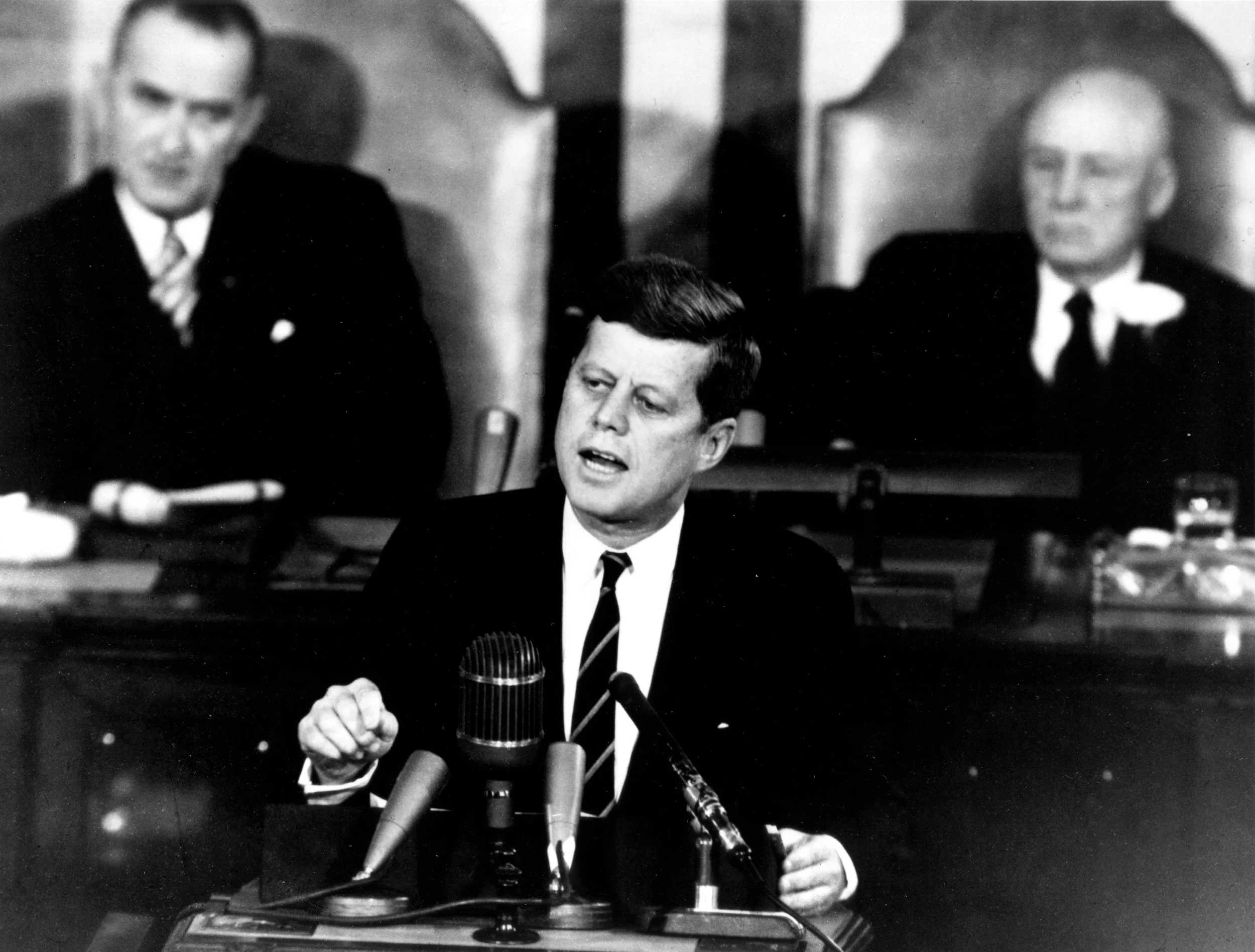
President Kennedy Addresses Congress May 25, 1961. Shown in the background are, (left) Vice President Lyndon Johnson, and (right) Speaker of the House Sam T. Rayburn. Image #: 70-H-1075.
In early 1997, I started the process of applying to the U.S. Naval Academy. I was a junior in high school, yet I was somehow undaunted by the steps involved in this application—one of which is obtaining an official nomination, which typically comes from your U.S. Representative or either of your state’s two U.S. Senators. I applied to all three of these elected officials for my nomination.
That was the first time I paid serious attention to the name “John Glenn.”
He was U.S. Senator John Glenn at the time, but he was also, of course, the first American to orbit the Earth, a feat which he accomplished in 1962. He did it again in 1998, at the age of 77. He was also a U.S. Marine Corps combat pilot and a whole lot more.
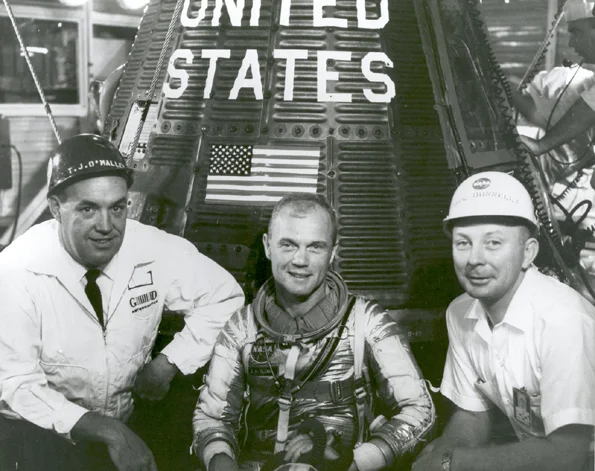
January 24, 1962: John Glenn With T.J. O'Malley and Paul Donnelly in Front of Friendship 7. Grouped together with astronaut John H. Glenn, Jr., beside "Friendship 7" spacecraft are left to right: T.J. O'Malley, chief test conductor for General Dynamics; Glenn; and Paul Donnelly.
Image # : 62-MA6-58.
Glenn died on Dec. 8, 2016, at the Ohio State University Wexner Medical Center in Columbus, less than 100 miles from the small town of Cambridge, Ohio, where he was born in 1921.
He was 95 years old.
I received both a nomination from Glenn and an appointment to the U.S. Naval Academy. I ended up choosing a different path, but I’m glad I had a reason back then to learn a little bit about him.
His life was, certainly, remarkable. It’s inspiring. And I think the Cleveland Plain Dealer’s editorial board said it well: “The most fitting tribute Americans can pay to this American hero … is to live up to the optimism of Glenn's vision.”
But I think there’s another aspect of Glenn’s optimism and the U.S. space program in general that holds a bigger lesson for all of us.
Let’s go back to May 25, 1961—about nine months before Glenn orbited the Earth for the first time. President John F. Kennedy, in a speech before a joint session of the U.S. Congress, said, “… I believe this nation should commit itself to achieving the goal, before this decade is out, of landing a man on the Moon and returning him safely to the Earth.”
That’s not just a big goal. That’s what we now call a “moonshot.”
It was a compelling vision that, with the appropriate resources dedicated to it, harnessed the ingenuity of thousands and the curiosity of millions.
And it’s that type of purpose that can galvanize people into an organization that’s fighting for something big. Something meaningful.
When I work with executives, we often talk about goals and objectives. That’s great; these are important. Keep setting goals.
But I’m afraid that there’s not much about quarterly reports or even big financial targets that really motivate the average employee.
For that, you need a moonshot. You need a vision that helps people see the connection between their everyday activities and something bigger than themselves.
If you ask people in your organization about their job, they’ll probably tell you what they actually do, something technical or something about their functional role.
That’s good, but it’s not great.
If you truly have an organizational moonshot, an audacious vision that you’re committed to achieve, you should be able to go around and ask your people what they do and have them respond with your equivalent of “I’m helping to put a man on the moon.”
So as we remember the legacy of John Glenn, let’s also remember the power of the moonshot—in our lives and in the lives of the people in our organizations.
Find this thought provoking? Leave a comment, like and share!
About Ben Baran
Ben Baran, Ph.D., is probably one of the few people in the world who is equally comfortable in a university classroom, a corporate boardroom and in full body armor carrying a U.S. government-issued M4 assault rifle. Visit: www.benbaran.com.

Siri, Drive the Kids to Soccer Practice
Touchscreen ordering at McDonald’s. Self-checkout at the grocery store.
Programmable logic controllers that guide manufacturing processes. Industrial robots that weld, assemble and, even, inspect.
And perhaps one that really sparks widespread imagination: driverless vehicles. We probably have some time before we can get a positive result from telling our iPhones, “Siri, drive the kids to soccer practice,” but

Touchscreen ordering at McDonald’s. Self-checkout at the grocery store.
Programmable logic controllers that guide manufacturing processes. Industrial robots that weld, assemble and, even, inspect.
And perhaps one that really sparks widespread imagination: driverless vehicles. We probably have some time before we can get a positive result from telling our iPhones, “Siri, drive the kids to soccer practice,” but numerous advancements are already underway. Take, for instance, the Google Self-Driving Car Project.
These are only a few of the ways in which automation, or the use of control systems that reduce human involvement in a process, is taking shape at the moment.
Automation, it seems, is one critical aspect of turbulence and change that’s affecting businesses and everyday life. It’s a trend that’s not going away—it’s not actually new, either, for that matter—and it’s one that business leaders need to continue watching.
The topic of automation writ large is far too broad to capture here, but here are a few considerations for business leaders on the topic:
- We are indeed in interesting times, as computing power continues to accelerate our ability to complete tasks with increasingly less direct human involvement.
- The tasks or processes that are the best candidates for automation are those that are relatively routine and repetitive.
- Some of the advantages of automation include the ability to use machines to complete dangerous or boring, repetitive tasks; potential labor cost savings and the ability to complete work beyond the realm of human abilities.
- Some of the disadvantages of automation include high initial costs and the need for continual maintenance of the system, which may involve highly technical monitoring.
- Not all tasks or processes can be automated, particularly those that involve non-routine types of work.
- Automation isn’t an all-or-nothing proposition. For example, consider the many aspects of driving your car that are already automated (depending on the age and model your vehicle, of course): cruise control, warning systems, climate control, and so on. Sometimes, the best returns in automation may come from automating parts of a system, not the entire system.
- Monitor your environment. Advances in automation may lead to increased capabilities or productivity of your competitors, so it’s critical to stay abreast of what’s going on in your industry. Read trade publications, attend conferences, and systematically evaluate potential automation candidates in your organization.
Additionally, keep in mind that advances in automation that affect your industry may not originate in your industry. As such, you’ll want to not only monitor your industry but also automation and its influence upon business more broadly.
The implications of automation certainly can capture the imagination. For example, many are concerned about the influence of automation on jobs and opportunities available to people for participation in the labor force.
Here are a few resources for further reading:
- How to Save Time and Money Through Automation (Forbes, Nov. 17, 2016)
- Robots and Automation May Not Take Your Desk Job After All (Harvard Business Review, Nov. 22, 2016)
- Preparing Your Workforce for the Automation Age (Harvard Business Review, Nov. 23, 2016)
- David Autor of the Massachusetts Institute of Technology wrote an excellent paper on automation and how it intersects with human capabilities and behavior
- Numerous podcasts and other resources from The Library of Economics and Liberty
Regardless of whether you’re excited, terrified or somewhere in between regarding the future of automation, business and work, it’s a reality that we all must face. It’s a trend that I intend to continue monitoring as we head into 2017—because it’s a big one.
As it is with all disruptive trends, although we cannot control everything about the future, we can anticipate, we can see the small signs and weak signals. The sooner we sense those forces of change, the sooner we can respond.
And sometimes, that’s what makes the difference between change being a disaster or an opportunity.
What are some of the most compelling examples of automation trends you're noticing? I'd love to hear about them.
Find this thought provoking? Leave a comment, like and share!
About Ben Baran
Ben Baran, Ph.D., is probably one of the few people in the world who is equally comfortable in a university classroom, a corporate boardroom and in full body armor carrying a U.S. government-issued M4 assault rifle. Visit: www.benbaran.com.

Why Gratitude is Smart Business for Leaders
One of the most prominent experiences I’ve had as an adult was the year I spent in Afghanistan, where I advised the Afghan National Police in 2013.
And one of the biggest reasons why it was a prominent experience is that it gave me a fresh perspective and sense of how good my life was in America. Being around poverty and people who had live through various levels of armed conflict for the past three decades has a way of making your “problems” seem a little less consequential. It makes you grateful for what you have.
But it doesn’t take a trip to Afghanistan to develop a sense of gratitude. In fact, I’ve come to realize how gratitude is a daily choice: You must
One of the most prominent experiences I’ve had as an adult was the year I spent in Afghanistan, where I advised the Afghan National Police in 2013.
And one of the biggest reasons why it was a prominent experience is that it gave me a fresh perspective and sense of how good my life was in America. Being around poverty and people who had lived through various levels of armed conflict for the past three decades has a way of making your “problems” seem a little less consequential. It makes you grateful for what you have.
But it doesn’t take a trip to Afghanistan to develop a sense of gratitude. In fact, I’ve come to realize how gratitude is a daily choice: You must consciously decide to be thankful, or you’ll quickly become complacent and focus only on what’s not going well in your life. Furthermore, there’s a difference between (a) feeling grateful for what you have in life overall and (b) expressing gratitude to others for something they’ve done.
While feeling grateful is intrinsically beneficial in boosting our positive outlook on life, the latter—expressing thanks to other people—is a small-yet-powerful way in which we can influence the people we lead or the people with whom we work.
And what’s more, thanking people who work for us or work with us is smart business.
Why?

Because when we thank other people for what they do, they’re more likely to feel socially valued. They’re also more likely to help us again and perform other, valuable social behaviors such as helping each other, talking positively about the organization, being polite and other critical tendencies that make teams and organizations run well.
So this holiday season, instead of or in addition to—hey, I’m not judging—overeating and braving the throngs of retail deal-seekers, set a goal of thanking the people around you at work. And when you do, consider a few of the following:
- Be sincere. This isn’t about manipulating people, and empty praise won’t work well very long anyway. People can often tell if you’re not genuine.
- Be specific. When thanking someone, describe to them the situation, what he or she actually did and the impact it had on you or the team. That way, the person can know exactly what behavior you noticed and appreciated. This will also help ensure that you’re thanking people for actions that truly deserve thanks.
- Be timely. If someone does something praiseworthy, tell him or her about it right away. It’ll mean more then than it will if you wait six months to mention it in a performance review or awards ceremony.
One of the best parts of expressing thanks to those around us is that it’s free. All it takes is some intentional effort and a sense of sincere appreciation.
Find this thought provoking? Leave a comment, like and share!
About Ben Baran
Ben Baran, Ph.D., is probably one of the few people in the world who is equally comfortable in a university classroom, a corporate boardroom and in full body armor carrying a U.S. government-issued M4 assault rifle. Visit: www.benbaran.com.

Advanced Manufacturing and Two Ways to Reward Agility
Modern factory floors fascinate me. There’s something about the clang and whoosh of the myriad machines, the hum of an overhead crane gliding along its tracks, the intricate yellow lines demarcating where it’s safe to walk and the ambiguous chemical aroma punctuating the air with hints of solvents or grease or paint or maybe all of them mixed together.
There’s something about the delicate dance of interdependent and interconnected parts and processes that somehow—amazingly—produce that which we and the entire world outside the factory walls often takes for granted.
When I’m in a factory, I still get the same sense of wonder and curiosity that I had when I was 8 or 9 years old, touring the Rohm and Haas plant in Louisville, Ky. And this week, I had the opportunity to visit one of Cleveland’s (and Ohio’s, for that matter) oldest and largest manufacturing firms: Lincoln Electric.

Modern factory floors fascinate me. There’s something about the clang and whoosh of the myriad machines, the hum of an overhead crane gliding along its tracks, the intricate yellow lines demarcating where it’s safe to walk and the ambiguous chemical aroma punctuating the air with hints of solvents or grease or paint or maybe all of them mixed together.
There’s something about the delicate dance of interdependent and interconnected parts and processes that somehow—amazingly—produce that which we and the entire world outside the factory walls often takes for granted.
When I’m in a factory, I still get the same sense of wonder and curiosity that I had when I was 8 or 9 years old, touring the Rohm and Haas plant in Louisville, Ky. And this week, I had the opportunity to visit one of Cleveland’s (and Ohio’s, for that matter) oldest and largest manufacturing firms: Lincoln Electric.

Although it’s old (founded in 1895) and large (about 10,000 total employees, $2.5 billion in revenue), Lincoln Electric has a distinct track record of innovative practices within the realms of strategy execution and incentive systems designed to channel its employees' motivation and effort.
It’s not surprising that it has long served as a case study for Harvard Business School.
But what I found most intriguing was how Lincoln Electric has structured agility—the capability to sense and respond to change—into two distinct parts of its measurement and evaluation systems.
First, Lincoln Electric’s managers systematically assess and rate their employees’ flexibility. These ratings—along with ratings on dimensions of teamwork and dependability, safety, quality and contributing to improvement efforts by providing recommendations—form what’s known as the employee’s “report card.” And this report card plays an important role in determining the employees’ bonuses, so it’s meaningful.
The feature of Lincoln Electric’s incentive system that’s probably most well-known is its piecework pay structure. For many workers, that means they get paid based upon how many items they actually produce—no hourly wage, no salary. This creates a powerful motive for workers to work quickly and efficiently. To ensure quality, mistakes matter. If an item fails any aspect of a quality check, the same employee (or group of employees) who put it together must fix the problem.
Many aspects of this system are intriguing, but what I like about the flexibility component of the report card at Lincoln Electric is that it’s strategic in nature. That’s because Lincoln Electric is a low-volume, high-mix manufacturer. Simply put, they make many different types of products in quantities that often vary. This has allowed them to meet their customers’ often-diverse needs, but it also means that they need their employees to become proficient in more than one area of expertise. They need their employees to be willing and able to jump in and help in other areas if needed. This is critical to maintaining their business model, and it’s critical for employee behavior. As such, including this type of flexibility (which I’d argue is closer to agility) is part of the evaluation and incentive structure sends a clear signal to their employees in terms of what’s expected and rewarded.
Second, Lincoln Electric’s commitment to agility extends to its supply chain. Not surprisingly, to support its diverse array of products, Lincoln Electric depends heavily on high-quality materials. And because their production volume is often variable, they depend not only on having high-quality materials, but also upon having those materials available in variable quantities. As such, Lincoln Electric requires flexibility from its suppliers.
And just like it does with its employees, Lincoln Electric systematically assesses the flexibility of its suppliers. This occurs as part of periodic evaluations in which its supply-chain leaders rate each supplier on a number of dimensions as part of an overall scorecard. Furthermore, Lincoln Electric works with its suppliers to ensure they have contingency plans in place to help them manage the unexpected—because that which affects the suppliers will certainly affect Lincoln Electric.
There’s surely much more detail and nuance involved in both Lincon Electric’s commitment to employee and supply-chain agility, but I think one big lesson that applies to organizations everywhere is this:
If you truly value an aspect of behavior, it’s not enough to talk about it. You must take the next step and measure it—and reward it.
This sounds simple enough, but I’m continually surprised by firms that hope for certain outcomes or changes in behavior yet are unwilling to systematically measure and incentivize those very same outcomes or behaviors.
Many companies claim to value agility, flexibility, responsiveness or nimbleness. But never forget—hope and expectations and slogans and posters and speeches won’t necessarily influence what people actually do. To create alignment between behaviors and strategy, the right incentives must exist.
Find this thought provoking? Leave a comment, like and share!
About Ben Baran
Ben Baran, Ph.D., is probably one of the few people in the world who is equally comfortable in a university classroom, a corporate boardroom and in full body armor carrying a U.S. government-issued M4 assault rifle. Visit: www.benbaran.com.

Leadership Advice for the New Administration
On the evening of Wednesday, Nov. 9, one day after the general election here in the United States, I met with my graduate students who are in my course on leadership and interpersonal effectiveness.
Up until this point, we hadn’t talked much about the U.S. presidential race in class. But I felt that on that one class the day after the election, it might make sense to do so. It just felt weird to not talk about it. Our course is about leadership, after all.
In particular, we’ve talked at length in the course about the agility required for leaders to pivot into new roles. This is particularly true for people who have never managed or led people before—that first-time manager job can be tough.
And although both Secretary Clinton and now President-Elect Trump have extensive experience leading people and projects, transitioning from presidential hopeful to President of the United States must surely be a dramatic shift personally and professionally.
For anyone.
And so, on Nov. 9, with my class, we

On the evening of Wednesday, Nov. 9, one day after the general election here in the United States, I met with my graduate students who are in my course on leadership and interpersonal effectiveness.
Up until this point, we hadn’t talked much about the U.S. presidential race in class. But I felt that on that one class the day after the election, it might make sense to do so. It just felt weird to not talk about it. Our course is about leadership, after all.
In particular, we’ve talked at length in the course about the agility required for leaders to pivot into new roles. This is particularly true for people who have never managed or led people before—that first-time manager job can be tough.
And although both Secretary Clinton and now President-Elect Trump have extensive experience leading people and projects, transitioning from presidential hopeful to President of the United States must surely be a dramatic shift personally and professionally.
For anyone.
And so, on Nov. 9, with my class, we discussed. We talked about, based upon what we’ve covered in the course so far, what advice we would give to the new administration, including the newly elected President, in making this transition from campaigning to governing.
We didn’t get into the politics of the matter.
We didn’t get into who’s right and who’s wrong.
Instead, I prefaced the conversation with a few observations:
- If you’re sad today, about 59 million other people aren’t
- If you’re happy today, about 59 million other people aren’t
- Things are usually neither as good nor as bad as they may seem at first
- The country isn’t even close to being at its peak of divisiveness, if you consider our entire history
- We always have myriad reasons for which to be grateful about living in the United States
We then focused the conversation on leadership. Namely, we zeroed in on a few key concepts that could assist the new administration as it transitions into power during the next few months.
Here are some of the excellent observations that emerged from our discussion. The new administration could benefit from, among other things, doing the following:
- Communicate differently. Remember that one’s words have consequences, and those consequences are often magnified when spoken from positions of authority. Also, move from generalities and begin speaking more precisely about goals and policies.
- Empathize. Although the nation isn’t as divided as it was in 1862, that’s not exactly a high bar for cohesion. People get inspired when they feel as though their leaders are listening to them and attempting to understand their situations. This, for the new administration, includes people of all backgrounds, status levels and ideologies. Trust must be earned, and it must begin with demonstrating respect.
- Share leadership and delegate. Remember that it’s OK to not know everything. Seek and rely upon experts for complicated decisions. Include people who think differently from you—maybe even very differently—in the conversation. Think carefully about whom you appoint to key positions, and demonstrate an openness to ideas and people who aren’t necessarily familiar at the moment.
- Flip your mindset from “me” to “we.” This bit of advice comes directly from the great book we’re reading in the course—Be the Boss Everyone Wants to Work For—by my good friend Bill Gentry. The new administration must broaden its message, recognizing that being a great leader requires an emphasis on the people you’re trying to lead—not on your own greatness.
Another bit of advice from my class? Maybe the newly elected President shouldn’t take a salary, or maybe he should donate all of it to a reputable charity.
I was particularly impressed with my class and their ideas on this tough, emotionally freighted topic. I have no idea if the new administration will do anything that resembles the ideas my class discussed or not. But the new regime would, I think, be wise to consider them.
Because regardless of your preferences, we’re all on the same ship. And although we Americans can fight and bicker and sling mud at each other with the best of them, we also have a proud tradition of peaceful transitions of power and of resilience.
So, let’s get to work.
Find this thought provoking? Leave a comment, like and share!
About Ben Baran
Ben Baran, Ph.D., is probably one of the few people in the world who is equally comfortable in a university classroom, a corporate boardroom and in full body armor carrying a U.S. government-issued M4 assault rifle. Visit: www.benbaran.com.

You Already Won the Lottery
A few weeks ago, I was discussing the topic of stress and well-being with my students in class. Our focus was on the importance of monitoring your well-being and managing your stress when you’re in a leadership position. Being a manager and having to get work done through a team is tough work, and it’s often full of stressors which, left unchecked, can take a toll on the manager.
That toll can include negative outcomes such as:
- Irritability,
- Reduced productivity,
- Burnout
- And a host of physical symptoms, from higher blood pressure to weight gain.
So it’s critical for managers of all levels to take care of themselves, both mentally and physically.
As the class went on, I discussed the importance of self-care for managers and how it can include many techniques, but one that I find particularly interesting is something that’s free and relatively easy. That technique?
It’s

A few weeks ago, I was discussing the topic of stress and well-being with my students in class. Our focus was on the importance of monitoring your well-being and managing your stress when you’re in a leadership position. Being a manager and having to get work done through a team is tough work, and it’s often full of stressors which, left unchecked, can take a toll on the manager.
That toll can include negative outcomes such as:
- Irritability,
- Reduced productivity,
- Burnout
- And a host of physical symptoms, from higher blood pressure to weight gain.
So it’s critical for managers of all levels to take care of themselves, both mentally and physically.
As the class went on, I discussed the importance of self-care for managers and how it can include many techniques, but one that I find particularly interesting is something that’s free and relatively easy. That technique?
It’s gratitude.
It turns out that gratitude has a number of beneficial outcomes. It helps us build productive social relationships, and it seems to protect us from stress and depression. (See this report of two longitudinal studies on the topic.)
And overall, being grateful for the positive things we have in life is strongly linked to well-being.
Given this evidence regarding the role of gratitude, I took a moment in class to encourage gratitude.
“Take out a piece of paper,” I said, “and write down as many things as you can think of for which you are grateful in your life.”
Some people started writing right away; others froze motionless. A few others looked at me quizzically, as if to suggest, “I haven’t really done anything in my life yet, so what’s there to be so happy about?”
As they started this exercise, I looked at them all and thought about their situations and how it compares with millions of other people’s situations, either in the United States or around the world, particularly in war-torn or developing countries I’ve visited.
And then I said, “You are sitting in a college classroom in the United States of America. You have already won the lottery.”
Those who weren’t already busy creating their gratitude list now at least had a place to start.
And so, for the rest of us, what’s the implication? Well, you, too, have already won the lottery. You’re literate (almost 16 percent of adults in the world aren’t) and you’re part of the 40 percent of the world that currently has an internet connection. That’s pretty good, just to start. And beyond that, count yourself among a much smaller, even more fortunate group if you (1) live in relative safety, (2) have access to clean drinking water and (3) have reasonable access to health and dental care. That’s not even considering your education, your job-related skills, your valued relationships and numerous other aspects of your life that truly set you apart from many in the world.
For whatever reason, it’s easy to think about what we don’t have. But that’s unproductive. It’s only going to make you feel more stressed and lower your well-being.
Instead, take a few minutes every day and think about your gratitude list. Even better, write them down in a gratitude journal.
Because if you do, I’m fairly certain you’ll be happier and less stressed. And that’s yet another thing for which—you guessed it—you can be grateful.
Find this thought provoking? Leave a comment, like and share!
About Ben Baran
Ben Baran, Ph.D., is probably one of the few people in the world who is equally comfortable in a university classroom, a corporate boardroom and in full body armor carrying a U.S. government-issued M4 assault rifle. Visit: www.benbaran.com.

Never Give Up, Never Stop Learning
Although I teach courses on various topics related to leadership, I’m quick to admit it: Learning a lot about leadership won’t necessarily make you a great leader.
Similarly, just because someone has 20 years of experience doing something doesn’t necessarily make him or her an expert. It’s quite possible—and common—for people to have the same experience, 20 years in a row.
What oftentimes elevates truly great leaders above the rest is their tenacity, their commitment to never give up—and to never stop learning. It’s their ability to persevere through adversity with an open mind, applying the lessons they acquire along the way.
One such leader whom I’ve always enjoyed listening to and reading about is United States Marine Corps General James Mattis (ret.). Among recent military leaders, Mattis is a legend, particularly if you talk with other U.S. Marines.
Stories about his selfless, direct style of leadership abound.
Additionally,

Photo By: Lance Cpl. Jesus Sepulveda Torre. The appearance of U.S. Department of Defense (DoD) visual information does not imply or constitute DoD endorsement.
Although I teach courses on various topics related to leadership, I’m quick to admit it: Learning a lot about leadership won’t necessarily make you a great leader.
Similarly, just because someone has 20 years of experience doing something doesn’t necessarily make him or her an expert. It’s quite possible—and common—for people to have the same experience, 20 years in a row.
What oftentimes elevates truly great leaders above the rest is their tenacity, their commitment to never give up—and to never stop learning. It’s their ability to persevere through adversity with an open mind, applying the lessons they acquire along the way.
One such leader whom I’ve always enjoyed listening to and reading about is United States Marine Corps General James Mattis (ret.). Among recent military leaders, Mattis is a legend, particularly if you talk with other U.S. Marines.
Stories about his selfless, direct style of leadership abound.
Additionally, his use of the “knife hand”—basically pointing for emphasis with all of one’s fingers outstretched and the hand oriented such that the little finger is closest to the ground, like the sharp edge of a knife—is equally legendary.
So I couldn’t help but pause for a moment recently when the Marines released a video of Mattis talking about leadership. In the video, he answers a number of questions related to leadership. At the end, he even addresses the lethality of his knife hand.
He’s quick to point out that it was the spirit of the people he led, his Marines, that kept him motivated throughout his career.
And in no uncertain terms, he says that the key to improving continually as a leader is that “You have to assume that you must keep improving.” For Mattis, this is simply a given. Leaders must “maintain this body, mind and spirit improvement at all times.”
But above all, I’m impressed with his humble-yet-confident demeanor. People tend to follow those who know where they’re headed, but at the same time they’re inspired by those who are humble enough to share recognition with the team for getting stuff done.
Or, as Mattis says, “You’re not going to win any fights as a leader. Your troops are going to win those fights.”
Take a few minutes to listen to these and other bits of timeless leadership wisdom in the video below.
Although none of us will go through the same situations as Mattis and it’s unlikely that any of us will achieve his level of regard among any group of leaders, not to mention leaders in the U.S. Marine Corps, there’s plenty that we can learn from his style.
And if we do, I think we’ll be just a little better equipped than we were before to adapt to change and to perform well in adversity.
That’s not to say that it’s easy. Quite to the contrary, leadership is hard. It’s often vastly different from the somewhat romantic vision that we sometimes have of it. But just because it’s difficult doesn’t mean that leadership can’t be effective.
Because, as Mattis says, “Difficulty is an excuse that the Marine Corps will never accept.”
What excuses do you accept? What do you tolerate, in yourself, in those around you, in your organization?
And what, during the next week or so, can we all do to re-identify what’s important, to re-commit to never giving up and never stopping our process of learning?
Find this thought provoking? Leave a comment, like and share!
About Ben Baran
Ben Baran, Ph.D., is probably one of the few people in the world who is equally comfortable in a university classroom, a corporate boardroom and in full body armor carrying a U.S. government-issued M4 assault rifle. Visit: www.benbaran.com.

Are You “Rewarding A While Hoping For B?”
Incentives matter. Rewards motivate people to behave in certain ways. Using incentives, therefore, is one great way to influence the form, direction and intensity of how people act.
Goals also matter. They help us clarify where we’re headed and how to focus our efforts. Setting difficult, specific goals, therefore, is one of the best ways to motivate yourself and others (see the numerous studies on the topic, particularly those by Gary Latham and Edwin Locke).
But goals and incentives can—and sometimes do—run amuck.
And when that happens, it’s often in the form of

Incentives matter. Rewards motivate people to behave in certain ways. Using incentives, therefore, is one great way to influence the form, direction and intensity of how people act.
Goals also matter. They help us clarify where we’re headed and how to focus our efforts. Setting difficult, specific goals, therefore, is one of the best ways to motivate yourself and others (see the numerous studies on the topic, particularly those by Gary Latham and Edwin Locke).
But goals and incentives can—and sometimes do—run amuck.
And when that happens, it’s often in the form of “rewarding A while hoping for B,” a topic described thoroughly in the classic management article by Steven Kerr.
That is, we often forget that it’s not just about what you’re rewarding formally; it’s also about what you’re rewarding informally. And it’s in the unintended informal rewards that we can run into trouble.
Here’s a simple example: You assign a task to one of your direct reports. He quickly responds with a sub-par product with multiple errors. You’re frustrated, but you know that you can fix the errors about 10 times more quickly than he can. So you tell him that it’s not sufficient, but then you go ahead and fix the product yourself—leaving him with no more tasks to complete that day.
What have you done?
In addition to missing a training opportunity, you’ve informally rewarded your direct report for sub-par effort. By not having him go through the pain of fixing the problem, he now knows that he can get by with little effort. That leaves you at the office at 7 p.m., while he’s already home or at happy hour.
Did you mean to reward poor performance? Of course not. But in a way, you did.
Here’s another simple example: You set a team goal of 1,000 error-free shipments of one of your new products. If that occurs, everyone on the team will receive a $3,000 bonus. One of your people finds an error after one of the products ships, but it’s an error that the customer might not notice for quite a while. Have you rewarded that employee to speak up and report the problem, or have you rewarded silence?
Here’s a bigger example: Wells Fargo. As you likely know, between about 2011 and 2016, the company set goals for its lower-level bank employees to sell additional products to its customers—a practice known as cross-selling. There’s nothing inherently wrong with that. What company doesn’t want its customers to purchase and use more than one or two or three or more of its products or services?
But what happened at Wells Fargo is that the incentives and goals were such that people—more than 5,000—found numerous “creative” ways to cross-sell. These methods included widespread opening of accounts for customers who didn’t request them and even using fake customers to pad one’s sales numbers.
Here’s a Wall Street Journal recap of some of the highlights.
Clearly, this was an error of management and leadership at a grand scale. It’s hard to claim that such a problem might be due to a few “bad apple” employees given that at least 5,000 were involved.
Instead, it’s the barrel—the system. And in particular, it’s the incentive and goal-setting systems set in place by senior leaders—the “barrel makers.” They, along with the direct violators, are culpable.
Incentives and goals are important aspects to guiding people’s effort at work. When properly aligned with organizational objectives, they can powerfully harness people’s ingenuity for the good of the team.
But it’s equally important to remember that incentives and goals may have unintended consequences. So let’s be on guard for those ways—both big and small—in which we might be “rewarding A while hoping for B.”
Find this thought provoking? Leave a comment, like and share!
About Ben Baran
Ben Baran, Ph.D., is probably one of the few people in the world who is equally comfortable in a university classroom, a corporate boardroom and in full body armor carrying a U.S. government-issued M4 assault rifle. More at www.benbaran.com and www.agilityconsulting.com.

On Human Connection, Vulnerability and Leadership
Years ago, as a young junior officer in the U.S. Navy, a few hundred of my peers and I shuffled into a large auditorium to hear an admiral speak. I don’t remember his name or his title. But I remember one phrase, one nugget of “wisdom” that he provided.
He said, “Leaders are people who know stuff.”
At the time this seemed like a simple, yet compelling insight. And it’s certainly the case that one source of people’s power and influence over others can be their expertise. In many situations, we follow those people who know the most (or at least seem to know the most) about how to solve problems.
We also tend to follow people who have definitive answers. People who are decisive, outspoken, direct.
But such tendencies grossly oversimplify

Years ago, as a young junior officer in the U.S. Navy, a few hundred of my peers and I shuffled into a large auditorium to hear an admiral speak. I don’t remember his name or his title. But I remember one phrase, one nugget of “wisdom” that he provided.
He said, “Leaders are people who know stuff.”
At the time this seemed like a simple, yet compelling insight. And it’s certainly the case that one source of people’s power and influence over others can be their expertise. In many situations, we follow those people who know the most (or at least seem to know the most) about how to solve problems.
We also tend to follow people who have definitive answers. People who are decisive, outspoken, direct.
But such tendencies grossly oversimplify the heart of leadership and what it means to connect with our fellow humans.
The implication of treating leaders and leadership as being about “knowing stuff” is that to be a leader, you need to have all of the answers. You need to know more than the people you’re trying to lead. And your knowledge, therefore, gives you the right to tell those people what to do.
Sorry, admiral, but this conceptualization of leadership is as sophisticated as my 3.5 year-old son—whom I caught wiping his nose on the couch cushion yesterday.
Clearly, it’s important to have professional expertise and competence if you want other people to follow you. There’s a great benefit to knowing “stuff,” to building specific sets of knowledge and skill. By all means, do this.
But leadership at a higher level is all about human connection. And that’s where another set of ideas kick in and truly start to matter. These are topics that often receive less attention than expertise or decisiveness. These include concepts such as
- Empathy.
- Compassion.
- Forgiveness.
- Vulnerability, and, dare I say …
- Love.
Vulnerability is particularly interesting. Being vulnerable is fundamentally about being open about who you are, your strengths and your weakness. And embracing who you are—not who you think you should be, not who other people want you to be—can be a tremendous source of confidence. It allows people to walk into the unknown, facing the ambiguity that characterizes so many of the problems in this world that require leadership.
Brené Brown, a research professor at the University of Houston Graduate College of Social Work, has studied this and related topics extensively. And, as she discusses in her popular TEDx talk below, vulnerability is about not only being courageous enough to see ourselves as we truly are, but it’s also about feeling worthy.
If you’re not one of the more than 26 million people who have already done so, take a few minutes to hear her talk. You won’t regret it.
Being vulnerable and willing to admit that you’re not perfect opens the door to new possibilities; it opens the door to creating new opportunities in the face of uncertainty. It’s a quality that specifically requires you to admit that sometimes you don’t “know stuff,” that other people might have better ideas than you do.
And leaders who do that, I think, are uniquely suited to lead others, particularly in times of change or adversity. They still must, of course, be willing to make tough decisions when necessary. They still must, of course, be competent and knowledgeable.
But thinking that leadership is only about being the smartest person in the room is short-sighted. And it’s fragile. It breaks down quickly when things change. Instead, what’s becoming increasingly clear is that being an agile, adaptive leader in times of turbulence demands courage, authenticity and the confident grace that comes with embracing the unknown.
Find this thought provoking? Leave a comment, like and share!
About Ben Baran
Ben Baran, Ph.D., is probably one of the few people in the world who is equally comfortable in a university classroom, a corporate boardroom and in full body armor carrying a U.S. government-issued M4 assault rifle. More at www.benbaran.com and www.agilityconsulting.com

The Courage to be Agile and Pivot
My morning routine gives me comfort. I get up at the exact same time almost every day. My coffee maker is set to turn on 15 minutes earlier, so I go downstairs, pour my coffee and fill my 1-liter water bottle. I then head to my home office and get oriented for the day’s activities.
After about 40 minutes, my coffee cup and water bottle are empty. Then, it’s time to get ready for some exercise. That lasts for about an hour, after which comes the remainder of my tasks to prepare for the day prior to the stampede of our four soon-to-awaken children.
And so on.
These are comfortable routines; they are generally productive habits.
But sometimes habits can become too comfortable. We can stick to routines for the sake of sticking to the routine—when in fact, change is necessary.
For example,

My morning routine gives me comfort. I get up at the exact same time almost every day. My coffee maker is set to turn on 15 minutes earlier, so I go downstairs, pour my coffee and fill my 1-liter water bottle. I then head to my home office and get oriented for the day’s activities.
After about 40 minutes, my coffee cup and water bottle are empty. Then, it’s time to get ready for some exercise. That lasts for about an hour, after which comes the remainder of my tasks to prepare for the day prior to the stampede of our four soon-to-awaken children.
And so on.
These are comfortable routines; they are generally productive habits.
But sometimes habits can become too comfortable. We can stick to routines for the sake of sticking to the routine—when in fact, change is necessary.
For example, I recently had a fairly ambitious exercise regimen outlined for the week ahead. I noticed some pain after a few days, but I ignored it. I wanted to stick to the plan.
Sticking to the plan, though, resulted in a level of pain that I couldn’t ignore, and I ended up having to take the whole next week off from exercise.
This was all because I was stubborn and refused to recognize that the game had changed. My original assumptions were invalid, but I pressed on anyway.
That’s why it takes courage to change, courage to pivot toward a new set of routines. It involves recognizing that some condition or something in the world around you has shifted. It then involve realizing that you must give up something comfortable and sail into uncharted waters. Goodbye, familiar routines.
The same process happens over and over again in teams and organizations. For example, consider the startup Gild Collective.
During the past 15 months, I’ve had the privilege of watching and documenting Gild Collective grow and evolve. This has involved much more than casual observation. In fact, I’ve surveyed the team of co-founders 45—yes, 45—times during these 15 months.
Like most startups, they’ve evolved quickly. And for a number of months, they settled into what seemed like a good set of routines. Their business focuses on making it easy for women to get together and create something beautiful—think art, accessories, and more—all while the group has great time and learns something about themselves and each other.
This was going well, but along the way, they discovered a potentially bigger opportunity—transforming their “get togethers” into professional workshops for the purpose of women’s leadership development.
They realized the game had changed; an opportunity presented itself. But it would require the courage to venture into the unknown, leaving behind their comfortable routines. It would require them, in startup parlance, to “pivot.”
They’ve had to forge new networks, and, above all, adapt to a new sense of who they were as leaders and who they were as a company.
That level of agility—sensing and responding to the forces of change—is hard. It takes courage. But it’s what it takes to succeed in a changing world. And in the case of Gild Collective, I’m happy to say, it’s working. Their new approach is resonating with recent clients (like Procter & Gamble), and many others are starting to notice what they’re doing. (Because their new focus aligns with my expertise, I’ve joined Gild Collective’s advisory board—I’m thrilled to have a role in helping them.)
So regardless of whether it’s with a startup, an established organization, or within your own daily life, I think it’s valuable to remember that quitting the old to take on the new—in other words, being agile—is courageous. We must be open to the possibility that the assumptions under which we made our original plans may have changed. Just because you planned a certain exercise regimen for the week doesn’t mean you should stick to it in the face of injury; just because your original business strategy demanded a certain focus and set of actions doesn’t mean you should stick to it if new information or opportunities emerge.
And by having the courage to pivot, we open ourselves to opportunities; we create the freedom within which we can innovate and evolve into the next chapter of our lives.
Find this thought provoking? Leave a comment, like and share!
About Ben Baran
Ben Baran, Ph.D., is probably one of the few people in the world who is equally comfortable in a university classroom, a corporate boardroom and in full body armor carrying a U.S. government-issued M4 assault rifle. Visit www.benbaran.com.

Orienting New Employees Starts Well Before You Meet Them
My fascination with the military—and the U.S. Navy, in particular—started before I was 10 years old. And during the decade between then and when I was commissioned as an officer in 2002, I acquired a whole set of ideas about what actually being in the Navy would be like.
These ideas came from books, movies, stories from veterans and myriad other information sources around me.
Some of those ideas turned out to be accurate; others weren’t. For example, most of what you experience on a day-to-day basis in the U.S. Navy—especially if you’re a ship driver like I was—bears little to no resemblance to Maverick’s job as a fighter pilot in the 1986 movie Top Gun.
But other patterns of behavior such as respect for rank structure, commitment to teammates, and aspects of selfless leadership that I’d learned about turned out to be

My fascination with the military—and the U.S. Navy, in particular—started before I was 10 years old. And during the decade between then and when I was commissioned as an officer in 2002, I acquired a whole set of ideas about what actually being in the Navy would be like.
These ideas came from books, movies, stories from veterans and myriad other information sources around me.
Some of those ideas turned out to be accurate; others weren’t. For example, most of what you experience on a day-to-day basis in the U.S. Navy—especially if you’re a ship driver like I was—bears little to no resemblance to Maverick’s job as a fighter pilot in the 1986 movie Top Gun.
But other patterns of behavior such as respect for rank structure, commitment to teammates, and aspects of selfless leadership that I’d learned about turned out to be fairly true. And certainly the overarching ideas of duty to one’s country and mission accomplishment, which attracted me in the first place to military service, are indeed a large part of military culture.
The same process occurs with other organizations, even if they are not as large or embedded in broader society as the U.S. military. Organizations project messages through their current and former employees, their formal recruiting communications and various other formal or informal, intentional and unintentional ways. People then interpret and assign meaning to those messages, and, here’s the key—they may begin at that moment to form ideas about what it would be like to be a member of the organization.
They also begin forming ideas about what types of behavior might be acceptable or unacceptable and about what norms or routines they might expect.
Orienting new employees, therefore, starts well before you meet them.
What’s more, this process also influences who even is more or less likely to express interest in joining your organization, focusing your pool of applicants. It’s the first part of the “attraction-selection-attrition” framework first discussed in 1987 by Ben Schneider (in this article).
All of this points to the importance of an organization’s brand—not in terms of its products or services, although that’s very important for different reasons—but its brand as an employer.
When people think about your organization, do they think about it as a potentially ideal place to work?
If not, who are you attracting in your recruitment efforts?
And from what sources are people learning about the internal culture of your organization? Friends? Family members? Glassdoor? LinkedIn?
And, perhaps even more importantly, who is controlling that message?
These questions are important to consider, because without a strong employer brand that’s linked to your organization’s strategy, your recruiting efforts run the risk of being suboptimal.
Furthermore, creating a strong employer brand can complement the orientation or socialization process for new employees. This happens when an organization consistently projects an employer brand that attracts people with specific values or preferences that are congruent with what the organization needs.
Many organizations, in my experience, fail to capitalize on the opportunity for setting expectations and socializing employees during their first few days or weeks. Still fewer have a deep, strategic view of this process that includes the employer brand and what types of people it hopes to attract into its workforce.
Therefore, most organizations and human resources (HR) functions have the opportunity to strengthen this critical initial part of the talent-management pipeline.
Perhaps, the opportunity also exists for HR as a function to learn even more from its partners in marketing—because HR should not just be concerned with internal, administrative matters.
Instead, HR must also look outward, with a strategic focus on acquiring the talent needed both today and tomorrow. And clarifying a strong employer brand that helps to orient future employees might be a place to start.
Find this thought provoking? Leave a comment, like and share!
About Ben Baran
Ben Baran, Ph.D., is probably one of the few people in the world who is equally comfortable in a university classroom, a corporate boardroom and in full body armor carrying a U.S. government-issued M4 assault rifle. Visit: www.benbaran.com.

Can Leadership Prevent Mistakes?
"While I was in the middle of the room, the attic floor and beams collapsed onto the second floor crashing down to the first floor where I was standing. The time between us entering the building and the time of the collapse was no longer than 90 seconds. I was knocked to the floor and was trapped under the debris. I suffered a head injury and a torn patellar tendon. The contents of the upstairs ended up in the first floor room and I could have been killed. By my judgment, approximately 80,000 gallons of water was pumped into that structure and we were ordered in anyway. This was after a previous call to evacuate 45 minutes earlier. This should not have happened!"
Mistakes happen. Sometimes, those mistakes hurt or kill people. I’ve studied them among fire fighters, who sometimes experience events like the one described above (which comes from Report 07-0001036, U.S. Department of Homeland Security, 2014). The mistakes that people in the fire service and other high-risk occupations make often have important safety implications. In other industries and occupations, mistakes may not hurt or kill people, but mistakes often derail projects or anger customers. They create conflict and they degrade the quality of what we make or do.
Mistakes aren’t exclusive to any industry or sector.
Mistakes also almost happen. These close calls or near misses—when discussed well and integrated into a learning program—can serve as powerful wakeup calls for people and teams.
Regardless of whether we’re talking about mistakes or near misses, learning from the past to improve future performance is

“While I was in the middle of the room, the attic floor and beams collapsed onto the second floor crashing down to the first floor where I was standing. The time between us entering the building and the time of the collapse was no longer than 90 seconds. I was knocked to the floor and was trapped under the debris. I suffered a head injury and a torn patellar tendon. The contents of the upstairs ended up in the first floor room and I could have been killed. By my judgment, approximately 80,000 gallons of water was pumped into that structure and we were ordered in anyway. This was after a previous call to evacuate 45 minutes earlier. This should not have happened! ”
Mistakes happen. Sometimes, those mistakes hurt or kill people. I’ve studied them among fire fighters, who sometimes experience events like the one described above (which comes from Report 07-0001036, U.S. Department of Homeland Security, 2014). The mistakes that people in the fire service and other high-risk occupations make often have important safety implications. In other industries and occupations, mistakes may not hurt or kill people, but mistakes often derail projects or anger customers. They create conflict and they degrade the quality of what we make or do.
Mistakes aren’t exclusive to any industry or sector.
Mistakes also almost happen. These close calls or near misses—when discussed well and integrated into a learning program—can serve as powerful wakeup calls for people and teams.
Regardless of whether we’re talking about mistakes or near misses, learning from the past to improve future performance is a fundamental management and leadership objective (Catino & Patriotta, 2013; Morris & Moore, 2000). But a common problem that I’ve seen in organizations is that we’re often apt to treat mistakes as problems with individual people. Sometimes an individual person is part of the problem, but pinning a mistake on a single person doesn’t necessarily help a team or organization learn. Instead, what’s required is a culture that embraces learning from mistakes in non-judgmental, non-punitive way.
One example of such an approach is in health care. Modern hospitals are systems in which extraordinary good and life-saving care happens daily. But they’re also places where mistakes hurt and even kill people.
Frequently.
And one person within the healthcare industry whose insights I’ve always enjoyed is Paul F. Levy, the former president and CEO of Beth Israel Deaconess Medical Center in Boston.
In the clip below, he discusses some of the nuances of teamwork and leadership as they pertain to mistakes in health care. Paraphrasing one of his senior leaders commenting on what to do about a doctor who made a serious mistake (starting at 7:00 in the video), he says,
“If we want to establish a culture in our organization that encourages and permits people to admit their mistakes and their near misses, we are more likely to establish that culture if we do not punish doctors who, with best of intentions, make a mistake. They’ve already suffered enough. ”
So, is there a way to make organizations error free? In this continually changing world, probably not. The key, instead, is to promote continual learning through what we do and what we say, catching small errors before they become big ones and taking the necessary steps to improve. That’s at the heart of building a team and organization that encourages open discussion of hazards and errors, of what almost went wrong and what could have happened.
Years ago, I had a much more punitive approach to dealing with mistakes than I do now. That’s because I’ve realized that leadership isn’t about being perfect or having a perfect team. It’s about unlocking people’s own ability to learn, to imagine, and to become something greater than they realized was possible.
Leadership, therefore, can’t prevent mistakes. But with an approach of humility, continuous improvement and open communication, it can help to build routines and patterns of learning that make mistakes less likely and less frequent.
Find this thought provoking? Leave a comment, like and share!
About Ben Baran
Ben Baran, Ph.D., is probably one of the few people in the world who is equally comfortable in a university classroom, a corporate boardroom and in full body armor carrying a U.S. government-issued M4 assault rifle. Visit: www.benbaran.com.
References
Catino, M., G. Patriotta. 2013. Learning from errors: Cognition, emotions and safety culture in the Italian air force. Organizational Studies, 34: 437-467.
Morris, M. W., P. C. Moore. 2000. The lessons we (don’t) learn: Counterfactual thinking and organizational accountability after a close call. Administrative Science Quarterly, 45: 737-765.
U.S. Department of Homeland Security. 2014. National Fire Fighter Near-Miss Reporting System. Retrieved from http://www.firefighternearmiss.com

The Higher Calling of Managing People
As my students can attest, I have a tendency to get rather enthusiastic in the classroom. The reason for that is twofold: (1) I find the topics I teach rather interesting and important and (2) I think that if I expect anyone else to get excited about the material, then I have to demonstrate that excitement myself.
And there’s one part of one class lecture in particular when I get especially fired up.
It’s in my concluding comments regarding the topic of

As my students can attest, I have a tendency to get rather enthusiastic in the classroom. The reason for that is twofold: (1) I find the topics I teach rather interesting and important and (2) I think that if I expect anyone else to get excited about the material, then I have to demonstrate that excitement myself.
And there’s one part of one class lecture in particular when I get especially fired up.
It’s in my concluding comments regarding the topic of job satisfaction. In the lecture, I’ve already talked about what job satisfaction is—a pleasurable emotional state resulting from the appraisal of one’s job or job experiences—and three “buckets” of factors that influence it. These buckets, as I describe them, are (1) factors that make us each different from each other including personality, (2) factors about the job, the work, and the work environment; and (3) factors about the degree of fit between people and their jobs or between them and their work organizations.
We also talk, of course, about why job satisfaction matters. It goes far beyond “a happy worker is a good worker”—which isn’t particularly true (some people are very happy precisely because they can get away with doing very little and still get paid). A more compelling reason is that job satisfaction is consistently related with people’s commitment, or attachment to their organizations.
But the part of the class in which I start to thunder away with an extra dose of enthusiasm is when I discuss “job satisfaction and the big picture.”
This is when I touch upon what I consider the higher calling of managing people.
When we’re in a supervisory position over other people in an organization, that role comes with specific responsibilities to the organization. We’re expected to plan, organize, direct and control the output of those people and ensure that what they do aligns with organizational objectives.
But we also, as supervisors of others, have a unique opportunity. We have the opportunity to control many factors about how people are appreciated and recognized. We sometimes have the opportunity to influence how the work is structured and assigned, and sometimes we’re able to influence the nature of the work itself and the environment in which it’s completed.
Namely, if you manage people, you can have a tremendous influence upon the job satisfaction of the people who work for you.
And that’s important not just because they might exert some more effort or be more committed to your organization.
It’s important because job satisfaction contributes to two factors in people’s lives that are of the utmost importance. Our level of job satisfaction contributes to our:
- Health (here’s some supporting research), and to our
- Life satisfaction (here’s some supporting research).
As a manager of people, therefore, you have the opportunity to make people’s lives better. By being a high-quality supervisor, you could be helping people have lower blood pressure. You could be helping them be less stressed and, as a by-product, have better relationships with their spouses or children.
That’s huge, folks.
Steve Jobs is often quoted as saying that "We're here to put a dent in the universe." That sounds nice, but most of us aren’t in organizations or positions in which we have a good chance at really doing that.
But we do have the chance to put a dent in the universes of the people who we work with and supervise. We have the chance to make their worlds better and literally improve the quality of their experience on this planet. We can do this every single day in the simple interactions we have with each other.
Therefore, the big point is that being a manager is a privilege and an amazing opportunity to influence peoples’ lives positively.
And I think if all supervisors thought about this for a few seconds at the beginning of every day, we’d have a big influence on the world of work.
And collectively, that would indeed “put a dent in the universe.”
Find this thought provoking? Leave a comment, like and share!
About Ben Baran
Ben Baran, Ph.D., is probably one of the few people in the world who is equally comfortable in a university classroom, a corporate boardroom and in full body armor carrying a U.S. government-issued M4 assault rifle. Visit: www.benbaran.com.

What LeBron James Gets About Leading in Adversity
Both the 2016 Cleveland Cavaliers and their opponents in the 2016 NBA finals, the Golden State Warriors, are extraordinary professional basketball teams.
But on Thursday, June 16, the Cavaliers became only the third team in history to come back from a 3-1 deficit in the NBA finals to force a seventh game in the series. Clearly, Cavaliers star LeBron James is central to their performance. They’re one win away from taking the championship, but even if they don’t win, there are some interesting insights we can take away from how James has led his team in the midst of adversity.
Most of the time, we have little insight into what happens behind the scenes within professional sports teams. Or when we do, it might be well after the fact, from memoirs of players, coaches or confidants.
The case of the 2016 Cavaliers is different.

Both the 2016 Cleveland Cavaliers and their opponents in the 2016 NBA finals, the Golden State Warriors, are extraordinary professional basketball teams.
But on Thursday, June 16, the Cavaliers became only the third team in history to come back from a 3-1 deficit in the NBA finals to force a seventh game in the series. Clearly, Cavaliers star LeBron James is central to their performance. They’re one win away from taking the championship, but even if they don’t win, there are some interesting insights we can take away from how James has led his team in the midst of adversity.
Most of the time, we have little insight into what happens behind the scenes within professional sports teams. Or when we do, it might be well after the fact, from memoirs of players, coaches or confidants.
The case of the 2016 Cavaliers is different.
That’s because we have a compelling data point—an insider’s account—via Richard Jefferson, a 15-year NBA veteran and one of James’s teammates on the Cavaliers. It comes in the form of an essay he released just hours prior to the team defeating the Warriors in Game 6. The essay is titled, “Who We Are,” and you can read it on The Players Tribune.
Jefferson’s essay contains many simple, humanizing elements about the Cavaliers. Simply thinking about a player like Jefferson going through a Starbucks drive-through or learning how to use Snapchat brings him and the team back down to earth.
But what I found particularly compelling is Jefferson’s account of a dinner that James hosted at his home just after the season ended, as the team was getting ready to begin the playoffs. As Jefferson wrote,
“The change really took off at a dinner at LeBron’s house right before the first round.
We were 15 guys sitting around his big dining room table. In the middle of the meal, he stood up and addressed each guy in the room. He pointed out something that each player brought to the team, and explained how it was going to be vital if we wanted to win a championship. And he gave each one of us a memento, a little gift. I won’t share what exactly it was because it was a team thing. But it wasn’t anything big. I think it just struck us all in that moment how special a position we were in. Bron was saying to us, ‘We can only do this if we do it together. That’s all that matters.’ He’s won championships before. We wanted to listen.”
From what Jefferson describes, James clearly is more than a great basketball player in terms of individual ability and skill. He brings an element of confidence and humility to the Cavaliers that has made them come together as a team. Specifically, in this one instance in the middle of one particular dinner, he:
- Clearly identified each person’s unique abilities and talents,
- Made each person feel needed and appreciated, and
- Emphasized the connection between each person and the team’s overarching goal.
Part of leading in adversity is inspiring every member of the team to contribute beyond what he or she thinks is possible. And as James illustrates in this story, one powerful way to do that is to look each person in the eye and authentically tell him or her (a) why he or she matters to the success of the team and (b) how his or her effort fits into the team’s objective.
On top of this, James generates confidence because—as Jefferson noted—regarding championships, he’s been there and done that. And he’s willing to take the risks associated with leading the team, win or lose.
In Jefferson’s words:
“I don’t care if you’re a LeBron ‘fan,’ or not, I have seen it: Bron has something I’ve never seen. The way he says ‘follow me and I’ll take you there’ with actions, more than words, is like no one else I’ve ever played with. He’s the kind of leader who makes you want to carry the weight too. I feel indebted to him. We all do.”
Outside of sports and various times in the military, it’s hard for me to think of more than a handful of instances in which I was fortunate to be on a team with an inspirational leader. But I think there are some simple things that leaders everywhere can do to create this type of inspiring atmosphere. These may sound like “common sense”—whatever that is—but I disagree. If they were common sense, they would be more common.
- First, leaders must know what their people actually do in their work.
- Second, leaders must know what their team members care about—their values, their goals, what inspires them.
- Third, leaders must clearly identify the team’s objective.
- Fourth, leaders must look their people in the eye—frequently—and tell them specifically what they appreciate about their contributions, how they care about their well-being and how what they do fits into the bigger picture.
- Fifth, leaders must be humble enough to listen to their people for feedback and follow any recommendations they have that will contribute to the team’s overall success.
Chances are that none of us will ever be on a world-class level sports team. But we all live in a world filled with adversity. And we all have the chance to exercise leadership, some sort of positive influence, on our coworkers, our friends and even within our families.
So sometime soon—today or tomorrow, perhaps—maybe we could all take a cue from LeBron James and recognize the people around us for their gifts, their talents and their efforts. If we all actually did that, I think we’d all be a little better off in this turbulent, crazy world.
Find this thought provoking? Leave a comment, like and share!
About Ben Baran
Ben Baran, Ph.D., is probably one of the few people in the world who is equally comfortable in a university classroom, a corporate boardroom and in full body armor carrying a U.S. government-issued M4 assault rifle. Visit: www.benbaran.com.

Customer Experience Doesn’t End When the Check Clears
You only wanted my money.
Once you had it, you didn’t make me feel special anymore.
I feel a little bit … used.
Two weeks ago, I praised the customer experience I had with a seasoned contractor named Mike. He managed a wide range of work on my house, which included replacing the siding and the windows. Throughout the process, he was thorough and extraordinarily responsive.
But then, something happened.

You only wanted my money.
Once you had it, you didn’t make me feel special anymore.
I feel a little bit … used.
Two weeks ago, I praised the customer experience I had with a seasoned contractor named Mike. He managed a wide range of work on my house, which included replacing the siding and the windows. Throughout the process, he was thorough and extraordinarily responsive.
But then, something happened.
We paid him.
Ninety-nine percent of the work was done, so we felt comfortable settling the payment terms with him. There was, however, one small item that he still needed to address.
We weren’t worried, given that Mike had been highly responsive in the past.
Unfortunately, his behavior changed. Now that he has our money, he has become much less responsive and attentive to the one last remaining item. It’s a rather minor item, but his lack of attention to our needs has been frustrating.
To be fair, I would still recommend Mike due to his work overall. I wouldn’t let this one negative experience unduly influence my overall evaluation. But it’s tempting.
The big point is that customer experience doesn’t end when the check clears.
In fact, one could argue that it’s how you treat people when you expect nothing in return that matters the most.
So in addition to the points I raised originally, there’s another cautionary tale, an important reminder, within my experience with Mike. These include:
- The customer experience includes the pre-purchase, purchase and post-purchase phases
- Negative touch points with the customer at any one of these phases will influence the customer’s perception of you and your product or service
- The post-purchase phase may have an undue influence on the customer’s overall perception
Because the post-purchase phase happens after the other phases, the customer is susceptible to the recency bias in making an overall judgment. Namely, even though Mike was great during the pre-purchase and purchase phases of the project, having this negative touch point at the end of our relationship may carry relatively more weight in how I think about Mike when one of my neighbors asks about him. It’s my most recent memory, so it’s what’s at the top of my mind.
Instead of being an excited advocate like I was before, I may be a cautious advocate.
It’s wise, therefore, for leaders to remember that consistency in the customer experience matters. And even though we all know that the reason we’re doing business is to trade products and services for money, no one likes to feel used—at any phase of the customer journey.
Find this thought provoking? Leave a comment, like and share!
About Ben Baran
Ben Baran, Ph.D., is probably one of the few people in the world who is equally comfortable in a university classroom, a corporate boardroom and in full body armor carrying a U.S. government-issued M4 assault rifle. Visit: www.benbaran.com.

When Drowning Prevention Meets Business Strategy
My children love the water. They swim, they splash, they laugh.
My children, like most children, are fast. They dart, they scurry, they hide.
Therefore, when my children encounter water, it can be an exhausting experience for my wife and me. We must be vigilant.
The pool we frequent has lifeguards. But their vigilance will never match mine.
Unless, of course, we’re talking about

My children love the water. They swim, they splash, they laugh.
My children, like most children, are fast. They dart, they scurry, they hide.
Therefore, when my children encounter water, it can be an exhausting experience for my wife and me. We must be vigilant.
The pool we frequent has lifeguards. But their vigilance will never match mine.
Unless, of course, we’re talking about lifeguards at Great Wolf Lodge. Their vigilance surpasses mine 99 percent of the time (at least when it comes to paying attention to all of the children in an area, not just my own).
And one reason, I suspect, has to do with business strategy.
For the unfamiliar, Great Wolf Lodge is a large, growing chain of indoor, family-friendly water parks. They’re open year-round, and children of all ages can swim, go down slides and splash around with a host of water-related valves and buckets. My children love it.
But Great Wolf Lodge realizes that regardless of how fun they make the water park or how attentive they are to the overall customer experience, there’s a chink in their armor.
They have an Achilles heel.
There’s a specific type of failure that could severely damage their reputation and their business.
It’s drowning, leading to the death of a child.
The entire business model of Great Wolf Lodge depends on the safety of the children and a fun experience for everyone. If the safety of the experience—either real or perceived—came into question within the minds of potential customers, their business would suffer dramatically. (And the safety of children is intrinsically good, of course.)
And so, back to the lifeguards. During the times I’ve visited Great Wolf Lodge, I couldn’t help but notice that they:
- Avoid eye contact with people outside of the water
- Continually scan their gaze back and forth on their area, focusing on the water itself, not on individual children
- Seem to rotate on shifts more frequently than lifeguards at most pools
- Get tested unexpectedly by training personnel who nonchalantly toss a dummy child into the water and time how fast the lifeguard reacts
In this way, Great Wolf Lodge lifeguards and their managers are preoccupied with failure. They have specifically identified what they must avoid as an organization. And they have constructed hiring, training, cultural norms and incentives to guide behavior accordingly.

Photo from: https://www.greatwolf.com/culture
To be fair, Great Wolf Lodge doesn’t have a zero-incident safety record. I highly doubt any park of its magnitude does. But it’s also fair to say that the probability of any specific child having a serious incident at Great Wolf Lodge is very, very low. That’s the way it should be. Safety is boring. It’s a non-event.
For businesses not in the amusement park industry, however, I think there are some lessons to be learned from Great Wolf Lodge, its lifeguards and its preoccupation with drowning.
These lessons include:
- Focusing on the positive might be warm and fuzzy, but it’s critical to identify what your organization must avoid
- Avoiding failure—and really risk management in general to some degree—involves creatively thinking about what could go wrong
- Once you’ve identified these potential internal weaknesses or external threats, you should consider what you can do about them
- Leaders can use these risky areas of their operations as a focusing mechanism for employee behavior through hiring practices, training and incentives
- Managing for non-events requires ongoing vigilance, which must be shared and replenished
The key is to figure out what “a drowning child” looks like in your organization, and then to identify how it can be detected as quickly as possible. Having a reliable organization doesn’t mean that you’ll never encounter a “drowning child,” but it does mean that your people will recognize what it looks like and take mitigating actions—before it becomes a catastrophe.
Find this thought provoking? Leave a comment, like and share!
About Ben Baran
Ben Baran, Ph.D., is probably one of the few people in the world who is equally comfortable in a university classroom, a corporate boardroom and in full body armor carrying a U.S. government-issued M4 assault rifle. Visit: www.benbaran.com.

Customer Focus: Lessons from a Roofer
Recently, a flurry of skilled laborers worked on my house. Some of them replaced the siding; others replaced the windows. A separate group painted the exterior trim, and still another group handled replacing the rain gutters.
Quarterbacking this major project was a big, friendly guy who has been doing roofing and siding on homes in my area for decades.
We'll call him "Mike." Because that's his name.
A number of aspects of how Mike managed this project impressed me, but most of all,

Recently, a flurry of skilled laborers worked on my house. Some of them replaced the siding; others replaced the windows. A separate group painted the exterior trim, and still another group handled replacing the rain gutters.
Quarterbacking this major project was a big, friendly guy who has been doing roofing and siding on homes in my area for decades.
We'll call him "Mike." Because that's his name.
A number of aspects of how Mike managed this project impressed me, but most of all, it was his focus on me and my wife as the customer. For example:
- Mike remained the single point of contact during the entire project. That made it easy for us to know who to call with questions or concerns. It was Mike, no one else.
- Mike shielded us from the complexities of managing and coordinating the different groups of specialists who actually did the work. These groups were all subcontractors on the project (or at least that's what I'm assuming), but we never dealt with them directly as far as the work itself was concerned.
- Mike communicated frequently and proactively, using multiple methods. We texted, e-mailed and talked on the phone. Additionally, he stopped by the house in person every few days to check on the progress and make sure we were happy.
- Mike quickly dealt with any issues--either real ones that we had or ones that he perceived as potential problems--very quickly.
From a financial incentive point of view, Mike's behavior makes perfect sense. Most of his business comes through customer referrals. If we're not happy, he will quickly lose his reputation and his income.
To some degree, this is true for all businesses. We love personal recommendations and referrals. A product with hundreds of glowing reviews on Amazon.com gets our attention. A friend's horror story about dealing with an airline negatively affects our view of that organization.
When I've worked with organizations on the topic of customer experience, we often go through a process of mapping the customer's journey--all the way from the earliest stages of awareness through the post-purchase stage, at which happy customers become loyalists, or, even better, advocates. Throughout that process are a host of "touch points," or instances in which the customer interacts with the organization.
Through his attention to our concerns and by leaning forward in his communications with us, Mike was managing his customer touch points. These are direct touch points that he could control, and he did.
But the secondary touch points in my home improvement story involves the subcontractors that Mike managed. And Mike managed those touch points to some degree as well.
For example, the first group that Mike assigned to replace our gutters came by our house to complete some initial measurements. The problem is that they came by at 9 p.m. We found this odd, but Mike found it completely unacceptable. He apologized profusely on their behalf.
And then, he fired them.
Mike took swift action to protect the customer experience he is attempting to create. I suspect he did this because he (a) wanted to send a clear signal to us that he cared, (b) he lost some faith in their sense of judgment and (c) he found their actions to be misaligned with his sense of how the customer must be treated. He realized that they reflected poorly on him, and he quickly corrected the situation.
Although the concept of customer experience and the customer's journey along a continuum of interaction applies to virtually all businesses, the details certainly become much more complex in larger enterprises with numerous customer touch points. Customers become aware of the organization through early, often subtle sources of advertising--including word of mouth. Sales people add a critical additional dimension, followed by technical experts, customer support people and so on.
Regardless, a few fundamental principles remain:
- A mindset of customer service must prevail. Top leaders set the tone and all of their managers have a role in expecting, supporting and rewarding behaviors that align with how organizational values pertaining to customer relationships.
- Competing priorities must be uncovered and addressed. For example, if sales people make unrealistic promises that other people then have to try to clean up, customer disappointment is likely (and internal conflict is certain).
- Leaders must quickly deal with behavior that fails to reflect a superior customer experience. As an organization, you become what you tolerate.
Oftentimes, you get what you inspect, not what you expect. This is an old axiom from my earliest days as a U.S. Navy officer, but it applies here particularly well. Mike had a direct feedback loop regarding our customer experience. Namely, he checked in with us frequently. Larger organizations would likely benefit from building such feedback loops and continually measuring customer experience.
Because what every organization wants is an advocate, a person who tells others how great its products or services are and encourages others to buy what they're selling.
On that note, if you live in my area and need some siding or roofing assistance, let me know.
I might know a guy.
Find this thought provoking? Leave a comment, like and share!
About Ben Baran
Ben Baran, Ph.D., is probably one of the few people in the world who is equally comfortable in a university classroom, a corporate boardroom and in full body armor carrying a U.S. government-issued M4 assault rifle. Visit: www.benbaran.com.

Leadership is a Game of Inches
The 1999 movie Any Given Sunday tells the story of a fictional American football team, with much of the focus on the team’s head coach. To be honest, I don’t remember much about the plot aside from one scene.
In that scene, the coach, played by the actor Al Pacino, delivers a speech to his team. He says:
“You know, when you get old in life things get taken from you. I mean that's, that’s—that’s part of life. But you only learn that when you start losing stuff. You find out life’s this game of inches. So is football. Because

The 1999 movie Any Given Sunday tells the story of a fictional American football team, with much of the focus on the team’s head coach. To be honest, I don’t remember much about the plot aside from one scene.
In that scene, the coach, played by the actor Al Pacino, delivers a speech to his team. He says:
“You know, when you get old in life things get taken from you. I mean that's, that’s—that’s part of life. But you only learn that when you start losing stuff. You find out life’s this game of inches. So is football. Because in either game, life or football, the margin for error is so small—I mean, one-half a step too late, or too early, and you don’t quite make it. One-half second too slow, too fast, you don’t quite catch it.
“The inches we need are everywhere around us. They’re in every break of the game, every minute, every second.
“On this team, we fight for that inch. On this team, we tear ourselves and everyone else around us to pieces for that inch. We claw—with our fingernails—for that inch. Because we know when we add up all those inches, that’s gonna make the ____in' difference between winning and losing—between livin' and dyin'.
“I’ll tell you this: In any fight, it’s the guy who’s willing to die who’s gonna win that inch. And I know if I’m gonna have any life anymore, it’s because I’m still willin' to fight and die for that inch.”
In my work as a business professor and management consultant, I’ve come to believe that leadership is also a game of inches.
Everywhere around us in our organizations—and among our friends and family members, for that matter—exist opportunities to make a difference, to introduce new patterns of communication and thinking, to connect and align people with goals and visions for the future.
But we often fail to capitalize on those opportunities.
One reason, I think, is that we place “leadership” on some sort of pedestal, with some sort of romantic notion that “leaders” are “great people” who do “great things.” Sometimes that certainly is the case. But it’s also true that leadership is often in the little moments—fleeting opportunities to influence the people around us in a positive way. In this way, leadership doesn’t have to be grandiose or flashy or even specifically planned. It can include:
- Looking one of your team members, peers or even your supervisor in the eyes and telling him or her that you value his or her contributions;
- Listening to people with the intent to understand them, not simply thinking about what you’re going to say next or how you can fix their problem;
- Taking a moment to encourage someone who is going through a tough time;Sharing a personal story of wins or (even better) losses that taught you a lesson;
- Clarifying expectations about who is responsible for specific outcomes;
- Reducing ambiguity about what success “looks like” and how people fit into team goals;
- Encouraging dissent and courageous, respectful conversations about what’s not working well;
- Explaining the procedures behind your decisions that affect people’s work or rewards;
- Stepping aside and letting someone else lead a project or conversation;
- Following others who are doing something worthwhile;
- Running effective, satisfying meetings;
- And being a role model for the behavior you value in numerous other small moments that happen either in one-on-one situations or with larger groups.
Even though many of these little moments of leadership might be small or mundane, they can be mighty.
Because when we “add up all those inches”—to paraphrase the Any Given Sunday coach—that can make the difference between winning and losing, either as an individual leader or as an organization.
If we wait until the perfect time to “lead,” we can end up missing these small, everyday opportunities.
But if we act instead by being the change we want to see around us, the ripple effects can be far-reaching.
And after all, isn’t that what leadership is all about?
Find this thought provoking? Leave a comment, like and share!
About Ben Baran
Ben Baran, Ph.D., is probably one of the few people in the world who is equally comfortable in a university classroom, a corporate boardroom and in full body armor carrying a U.S. government-issued M4 assault rifle. Visit: www.benbaran.com.
The Rise of HR … Agility
It’s easy to fall into patterns and comfortable routines.
Some of those are great. Take, for example, dental hygiene. Or strength training.
But if our routines too often keep us around the same people, we run the risk of stagnating. It’s even worse if we’re isolated—or insulated, depending on how you look at it—from other ideas.
That’s one reason why I enjoy professional conferences. Even if you’re around people in a similar area of expertise or interest, you’ll learn a great deal from their different perspectives and experiences.
Last week, I spent a few days at the annual conference of the Society for Industrial and Organizational Psychology (SIOP) in Anaheim, Calif. And in between all of the
It’s easy to fall into patterns and comfortable routines.
Some of those are great. Take, for example, dental hygiene. Or strength training.
But if our routines too often keep us around the same people, we run the risk of stagnating. It’s even worse if we’re isolated—or insulated, depending on how you look at it—from other ideas.
That’s one reason why I enjoy professional conferences. Even if you’re around people in a similar area of expertise or interest, you’ll learn a great deal from their different perspectives and experiences.
Last week, I spent a few days at the annual conference of the Society for Industrial and Organizational Psychology (SIOP) in Anaheim, Calif. And in between all of the catching up with wonderful friends and making new ones, I managed to gain some new perspectives on what I do professionally.
For context, it’s important to note that SIOP conferences tend to be about half professors and half industry professionals. And although I’m firmly planted in the world of academia in addition to my consulting work, I tend to gravitate toward conference sessions that are geared more toward those in industry than those of us in academia.
Why?
Quite simply, it gives me some insight into what’s on the minds of people on the front lines of leadership development, talent management, human resources (HR) and other related areas.

I attended a number of interesting sessions, but the one that stuck out to me most was a panel discussion that featured Dave Ulrich, William Schiemann and Libby Sartain.
They’re the editors of the recent book The Rise of HR: Wisdom from 73 Thought Leaders.
Given that I teach HR classes and often consult in HR or areas of relevance to HR, I thought I’d benefit from what they had to say. I was right.
Here are some of the highlights from that session, from my perspective:
- The Rise of HR is a book with 73 essays on the future of HR. It’s free. Anyone can download it. Simply visit www.theriseofhr.com. Did I mention that it’s free?
- Much of what I see as the future of HR seems to be validated by others. For example, HR leaders must continually be aware of their strategic context.
- As Ulrich mentioned during the session, doing HR well requires “managing paradoxes” well. Think about the tension between stability and change, or between globalization and localization, for example.
- At the heart of the idea of managing paradoxes is agility. Leaders at all levels need to be able to sense and respond to the forces of change around them, and in HR, leaders have the opportunity to build organizations with agile capabilities too. In Ulrich’s words, “The war for talent is won through the organizations we create.”
Here’s more from Ulrich talking about The Rise of HR.
Given my interest in the intersection of leadership, organizational change and HR, it’s my point of view that HR leaders must (a) demonstrate agility themselves and (b) actively work toward creating agile organizations. Practically speaking, this means that HR professionals need to:
- Stop acting like gate keepers. Be service providers instead. (Read more.)
- Stay in touch with what top leaders see as the most disruptive trends. (Read more.)
- Understand and master organizational change. (Read more here and here.)
- Lead boldly. (Read more.)
And getting back to my original point, HR professionals at all levels need to reach out beyond their current horizons, letting fresh ideas inoculate them from the stagnation of isolation.
With that approach, we’ll all be well equipped to thrive in this increasingly turbulent—and exciting—world of work.
Find this thought provoking? Leave a comment, like and share!
About Ben Baran
Ben Baran, Ph.D., is probably one of the few people in the world who is equally comfortable in a university classroom, a corporate boardroom and in full body armor carrying a U.S. government-issued M4 assault rifle. Visit: www.benbaran.com.

Engaging Employees and Customers
My research, teaching and consulting frequently focuses on employees and the strategic use of human capital, and the topic of employee engagement has been hot for some time now. It’s clearly important—organizations oftentimes thrive most when their employees are fully contributing their efforts and expertise. Related to the topic of employee engagement is the area of customer engagement—another critical topic.
Recently, I had the wonderful opportunity to pick the brain of someone who is on the front lines of engaging both employees and customers at one of the world’s largest companies: Heather Gordon, Ph.D.
Heather is currently the customer strategy manager at Duke Energy Corporation. Here’s my interview with her.

My research, teaching and consulting frequently focuses on employees and the strategic use of human capital, and the topic of employee engagement has been hot for some time now. It’s clearly important—organizations oftentimes thrive most when their employees are fully contributing their efforts and expertise. Related to the topic of employee engagement is the area of customer engagement—another critical topic.
Recently, I had the wonderful opportunity to pick the brain of someone who is on the front lines of engaging both employees and customers at one of the world’s largest companies: Heather Gordon, Ph.D.
Heather is currently the customer strategy manager at Duke Energy Corporation. Here’s my interview with her.

Heather Gordon, Ph.D.
Heather, you have deep expertise in the psychology of human behavior at work at two of the world's largest companies, so I'm curious to know what you think about employee engagement in general. First, what is it and does it matter?
Employee engagement is the extent to which employees are passionate about their jobs, committed to the organization, and their willingness to go above and beyond to help the organization accomplish its goals. Simply put, employee engagement is how engaged an employee is with their job and organization. And it absolutely matters. Think about a time when you felt extremely engaged in your job and with your organization… likely, you contributed more to the organization and you did more than the status quo for success. More importantly, you left work with an enhanced sense of your own well-being and a feeling of being valued.
Likewise, the organization benefits from an engaged workforce in many different ways. First, engaged employees tend to be more loyal to the organization, they feel a sense of commitment and camaraderie with their fellow co-workers, helping to improve employee retention and reducing the expenses associated with recruitment, selection, and training. Second, much research has been dedicated to demonstrating the impact an engaged workforce has on the bottom line. An engaged workforce is more likely to result in higher customer engagement and satisfaction, an effect size as high as r =.43. Contrast that to the correlation of r = .14 with the effect of ibuprofen and pain reduction and you can see the impact of employee engagement and customer satisfaction.
Here’s the citation to that research article:
Winkler, Konig, & Kleinmann (2012). New insights into an old debate: Investigating the temporal sequence of commitment and performance at the business unit level. Journal of Occupational and Organizational Psychology, 85(3), 503-522.
In your experience, what are some things that leaders and human resource functions can do to increase employee engagement?
It’s simple—engage their employees in the process, ask for their feedback, take actions on it, and recognize them for their efforts. For HR, two jobs are critical—aligning the organization and the leaders to listen to the feedback from their employees, and providing the structure, tools, and resources where employees can be developed. For managers and leaders, talking with their employees is the first step. Many large organizations today provide employee engagement surveys, which is a great start to get collective feedback. However, it must not stop there. The most important piece of the puzzle is getting the employees’ thoughts and ideas to address the opportunities the survey demonstrates. When you engage them in the process of creating the solutions, you get their investment in the solutions and share the accountability in making the organization a better place to work.
Also, a simple “thank you” and recognition for hard work can go a long way. Imagine the impact of a senior leader hand-writing a thank you note to an employee, thanking them for going above and beyond. I’ve seen it done before and it has a huge impact on the employee and the overall culture.
Recently, you changed your focus from employee engagement to customer engagement. First, what was that change like for you personally? And second, what are some of the similarities or differences between the two?
I thought it would be a huge shift, and in some ways it was, but in most ways it wasn’t. At its core, engagement is the same for employees and customers. We all want to be heard and want to feel as our needs are met. Once I realized that for customer and employee engagement there is the same process of getting feedback, acting on that feedback and communicating the actions as a result of the feedback, it didn’t seem so different. Likewise, similarly to how HR practitioners have to prioritize which talent and leadership offerings and services are provided and modified, on the customer side we have to decide which products and services will be best received and needed by our customers.
The same article above demonstrated that there is a causal effect of employee engagement on customer satisfaction. The big difference I see between the two is that organizations have more direct control over the employee experience and thus, the engagement levels of those employees. While customers have many more external influences that may impact their judgments and experiences with a company, the experience of the employee can be greater influenced by the practices and culture of the company.
For me, it's especially easy to think about how employees engage the customer in settings such as retail. For example, someone helping me pick out a pair of shoes at Nordstrom directly interacts with me, learns about my preferences and sizes, and brings me pairs of shoes to try on. And my experience with that person shapes my perception of Nordstrom overall. Is it the same with Duke Energy? Why or why not?
Customer engagement is the responsibility of every company and every employee. It is not tied only to those who have direct interaction with the customer. For example, at Duke Energy, we do have those customer service representatives who directly interact with the customer. However, much of the work is being done behind the scenes and at a distance from the customer- for example, making sure the grid is appropriately set up to prevent outages and sources of energy that will meet their needs. Distance from the customer does not mean that the engagement strategy needs to occur at a distance. To be successful, the company’s culture and employees must have the customer at the forefront in all of their decisions, whether or not they are directly interacting with the customer.
What are some practices you've found effective in enhancing customer engagement? Do you have any specific ways in which you measure customer engagement or any ideas about how it could be done?
It’s about providing real-time experiences and service that reach customers when they need it.
Whether that is a service, product, mobile app, or just electricity, it’s getting their need fulfilled. You can do this by applying insights to the data you have on customer behaviors. By collecting and analyzing data on customers’ behavioral consumption patterns, you can begin to predict what customers will need and hopefully get it to them before they are asking for it. It’s also about listening to the customer, and then listening again. You must understand and empathize with the issues the customer is facing and figure out a way to solve that problem. This is only accomplished through leveraging and embracing customer feedback.
Another thing I have seen that’s very effective is having a holistic view of and understanding of what can impact the customer experience. I’ve been witness to some incredible work dissecting the impact of internal and external events on the overall engagement of customers. When we can understand those impacts, we can begin to understand how information should be communicated with customers to make sure they have the knowledge and background that will impact their experience.
How is customer engagement related to agility, or the ability to sense and respond to the forces of change?
With customer engagement, we must have a broader perspective than simply trying to engage and serve our customers in their current environment. We are building the capabilities to meet their future needs. If we don’t do this, someone else will serve their needs as more options for energy sources and services emerge. Therefore, we must remain agile to the needs of customers by remaining attuned to their changing needs and the changes to external trends in the environment. In order to be successful at agility, it goes back to the right workforce and engaged employees—employees who are willing to go above and beyond in understanding their customers and delivering superior service every time.
Thank you very much, Heather, for providing your insights on both employee and customer engagement.
Find this thought provoking? Leave a comment, like and share!
About Ben Baran
Ben Baran, Ph.D., is probably one of the few people in the world who is equally comfortable in a university classroom, a corporate boardroom and in full body armor carrying a U.S. government-issued M4 assault rifle. Visit: www.benbaran.com.