
I’ve moved my blogging to Substack!
Feel free to check out any of the content I have here, but also be sure to check out my newest content at Reckoning and Elevating What Works.

Research-Based Implications of The Gig Economy
Chances are that you’ve encountered the “gig economy” in your organization already, even if you haven’t called it that.
Simply speaking, it refers to the increasingly prevalent trend of people and organizations choosing to work in temporary, contingent arrangements. I’ve experienced it across a number of industries and sectors, from working alongside adjunct professors to advising Afghan police officers alongside civilian contractors. I’ve worked with a number of businesses that are increasingly maintaining a contingent workforce that can respond to shifting labor demands.

Chances are that you’ve encountered the “gig economy” in your organization already, even if you haven’t called it that.
Simply speaking, it refers to the increasingly prevalent trend of people and organizations choosing to work in temporary, contingent arrangements. I’ve experienced it across a number of industries and sectors, from working alongside adjunct professors to advising Afghan police officers alongside civilian contractors. I’ve worked with a number of businesses that are increasingly maintaining a contingent workforce that can respond to shifting labor demands.
When thinking about the history of modern organizations—from the industrial revolution to today—this change is dramatic.
For all of us and our careers, the expectation and reality of working for one organization for most of one’s life in a continuous, full-time status is rapidly fading.
For organizations, leaders—particularly those in human resources (HR) and related functions—will need to uncover both the mechanics of efficiently integrating such workers across projects and—potentially even more importantly—find ways to engage such workers and create the conditions under which they can flourish.
A Research Perspective
Rigorous, scholarly research on contingent workers is still in its early stages, at least from the standpoint of uncovering tried-and-true best practices for leaders and managers. There are, however, a few broad areas that we can consider regarding some implications of the gig economy. In particular, let’s take a psychological perspective.
As I’ve written elsewhere, it’s well established that employees have a higher level of well-being and perform better when they sense that their work organization cares about them and values what they do (this is part of a conceptual framework called organizational support theory).
But what about those situations in which a person is essentially a member of multiple organizations?
This is the essence of the gig economy—people doing their actual work performing tasks for one organization but also belonging to another. For example, when I served in Afghanistan in 2013, I worked as part of the police training unit of North Atlantic Treaty Organization Training Mission-Afghanistan (NTM-A). I was there serving in a military uniform, but some of my coworkers were civilian contractors who worked for DynCorp International, a defense-contracting firm. Those contractors served both NTM-A and DynCorp, but from a talent management perspective, such relationships were almost exclusively transactional and administrative.
If we think about some research-based implications of these increasingly common arrangements, a number of possibilities emerge, including:
- What do organizations do to onboard, orient and welcome contingent workers?
- How do organizations make contingent workers feel appreciated?
- What might organizations do to train and equip managers to best engage contingent workers?
Addressing such questions fundamentally requires a shift in thinking within the realm of talent management. It means that employee engagement doesn’t only apply to full-time workers. It implies that the ecosystem of work itself is changing, as John Boudreau has described.
It also implies, as described by my colleague and agility expert Nick Horney, that HR leaders should think about their workforce more broadly, using a “talent portfolio” that includes traditional and non-traditional employees.
Speaking of Nick Horney, I encourage you to join him at the 2016 HR People + Strategy Annual Conference in Scottsdale, Ariz., April 10-13 where he'll take a deep dive into The New Talent Ecosystem (http://www.hrps.org/annual). In particular, I encourage you to participate in a facilitated discussion with Nick on April 12 on The Gig Economy: A Human Resource Agility Fitness Challenge. Finally, click here and take 60 seconds to provide your insights on the gig economy.
Find this thought provoking? Leave a comment, like and share!
About Ben Baran
Ben Baran, Ph.D., is probably one of the few people in the world who is equally comfortable in a university classroom, a corporate boardroom and in full body armor carrying a U.S. government-issued M4 assault rifle. Visit: www.benbaran.com.

For Those About to Lead
For those about to lead, I salute you.
The vast majority of people go with the flow. Many people—even those whom we often dub “leaders”—fulfill their roles by finding out what others expect of them and meeting those expectations. This includes many heads of state—current, former and aspiring—military generals and admirals, university presidents and chief executives.
There’s nothing inherently wrong with going with the flow, depending on

For those about to lead, I salute you.
The vast majority of people go with the flow. Many people—even those whom we often dub “leaders”—fulfill their roles by finding out what others expect of them and meeting those expectations. This includes many heads of state—current, former and aspiring—military generals and admirals, university presidents and chief executives.
There’s nothing inherently wrong with going with the flow, depending on where the flow is headed.
There’s nothing inherently wrong with doing what’s expected, depending on the nature of those expectations.
But leadership is something different.
Leadership is about exploration, adaptation, guiding others through uncharted waters. It’s about sensing and responding quickly to the forces of change; it’s about agility.
Consider an example from May 1804.
As the keelboat turned her bow into the stream, Lewis and his party cut themselves off from civilization. There would be no more incoming letters, no orders, no commissions, no fresh supplies, no reinforcements, nothing reaching them, until they returned.
The captains expected to be gone two years, maybe more. In all that time in whatever lay ahead of them, whatever decisions had to be made, they would receive no guidance from their superiors. This was an independent command, such as the U.S. Army had not previously seen and never would again. Lewis and Clark were as free as Columbus, Magellan, or Cook to make their mark on the sole basis of their judgments and abilities.
Such is the description of the first moments of the famous expedition of Meriwether Lewis and William Clark, who, upon the orders of no one other than the third President of the United States Thomas Jefferson, embarked upon one of history’s greatest expeditions—as documented by Stephen Ambrose in his 1996 bestselling book Undaunted Courage (p. 139).
Lewis and Clark, in their journey across the North American continent in the early 1800s, truly didn’t know what to expect. Consider that President Thomas Jefferson himself, for example, believed that the expedition might encounter mastodons upon the prairie (Ambrose, 1996, p. 91).
These two leaders and their team had only themselves, their supplies and educated guesses about what they might face. The rest they would have to deal with in real time, in an environment of complete self-reliance.
When we truly lead, we are taking risks; we are being vulnerable—to judgment, to criticism, to both passive and active rebellion, and to failure.
It’s simply easier and safer to do nothing. But the solution to most of what ails our organizations and our society often boils to doing things differently. And as such, the answer always requires leaders and leadership.
And so, regardless of whether you’re setting out with an expedition party exploring a new geography or charting a new course for your team, department or organization, I salute you for giving it a shot.
Go boldly—either out in front or by following someone else who’s doing something worthwhile—and chart new waters.
And never forget that going boldly doesn’t have to be big or even public. Small positive disruptions, repeated over time, can indeed yield radical change.
Find this thought provoking? Leave a comment, like and share!
About Ben Baran
Ben Baran, Ph.D., is probably one of the few people in the world who is equally comfortable in a university classroom, a corporate boardroom and in full body armor carrying a U.S. government-issued M4 assault rifle. Visit: www.benbaran.com.

Should We Abolish Performance Reviews?
In four weeks from today, I’ll be enjoying the company of thousands of organizational psychologists at this year’s annual conference of the Society for Industrial and Organizational Psychology (SIOP) in Anaheim, Calif. This is a fun-loving crowd. It’s probably also one of the few crowds in which you’ll find passionate debates about topics such as psychometrics, leadership assessments or classical test theory.
At last year’s conference, in fact, a structured debate took place on the topic of performance appraisals. Yes, you read that correctly.

In four weeks from today, I’ll be enjoying the company of thousands of organizational psychologists at this year’s annual conference of the Society for Industrial and Organizational Psychology (SIOP) in Anaheim, Calif. This is a fun-loving crowd. It’s probably also one of the few crowds in which you’ll find passionate debates about topics such as psychometrics, leadership assessments or classical test theory.
At last year’s conference, in fact, a structured debate took place on the topic of performance appraisals. Yes, you read that correctly.
You might know of performance appraisals as performance reviews. Many managers think of them as administrative burdens accompanied by awkward conversations.
The debate I attended was standing-room only.
Being a little bit taller than average (I’m 6’1”), I stood in the back and watched over the heads of bright-eyed graduate students and opinionated professionals alike as a handful of the field’s most well-respected people argued their sides of the story. I’m over-generalizing, but the extreme sides of the arguments regarding performance reviews were:
- Abolish them! Managers hate them. Employees hate them. They do nothing to promote job performance. And they might even make performance worse. Focus instead on coaching and real-time continual feedback.
- Keep them! When they’re well-designed and executed, performance appraisals help employees know where they stand. And they’re essential for documenting both good and not-so-good performance, which is most-welcomed evidence to have on hand in the human resources department for legal reasons.
Both sides of this argument tended to agree that research suggests that it’s essential to have high-quality, feedback-rich conversations between employees and their supervisors. And maybe it’s a copout, but I tend to think that an organization can have both—a formal appraisal system and a productive coaching environment. That happens to be the position that organizational psychologist Gary Latham takes in his book, Becoming the Evidence-Based Manager (I highly recommend it).
One of the most beneficial outcomes of a productive coaching and developmental relationship between a supervisor and an employee is that it can enhance the employee’s perception that the performance review process is fair. If you’ve ever dealt with people who thought they were performing well until their annual performance review meeting, you know what I mean.

At the same time, I’m left wondering about two distinct situations:
- In some organizations, completing the administrative performance review process has become the end itself—not a means for improving performance. The pieces of paper and process are well-designed, but they rarely coincide with high-quality coaching or development. They also take an inordinate amount of time to complete. I’m thinking of a real organization—the U.S. Navy—and it’s one in which I’ve written, edited or otherwise touched hundreds of such evaluations during the past 14 years. How could this type of organization start to revitalize its approach toward performance appraisal and developmental coaching?
- In other organizations, no formal performance appraisal or feedback system is in place. In such a circumstance, what might be the ideal way to both document performance and help employees truly flourish in their roles? Or should nothing be done?
Regardless of the “right” answer, the area of performance appraisal seems to be a distinct opportunity for leaders in human resources and beyond to make an impact. Because if we’re going to have organizations that meet the challenges of today’s turbulent world, we’re going to need to be creative in how we address the delicate, fascinating topic of human performance—what it looks like and how to support it in the right way.
I’m certainly just one of many who are thinking about this, and opinions abound (see articles in Forbes, The Washington Post and the BBC).
But what do you think?
Find this thought provoking? Leave a comment, like and share!
About Ben Baran
Ben Baran, Ph.D., is probably one of the few people in the world who is equally comfortable in a university classroom, a corporate boardroom and in full body armor carrying a U.S. government-issued M4 assault rifle. Visit: www.benbaran.com.

What HR People Need to Know About Change
In a recent post and in some of my research, I’ve been exploring the role that human resources (HR) plays in organizational change. This includes both HR as a function and HR professionals themselves as they get involved (either proactively or reactively) in change efforts.
And there’s one key aspect of organizational change that I think is helpful for HR people to consider.

In a recent post and in some of my research, I’ve been exploring the role that human resources (HR) plays in organizational change. This includes both HR as a function and HR professionals themselves as they get involved (either proactively or reactively) in change efforts.
And there’s one key aspect of organizational change that I think is helpful for HR people to consider. Namely, not all change is created equal, and the nature of change should likely dictate to some degree how HR should respond.
At a basic level, there are two types of organizational change: episodic and continuous.[i] There are additional ways to categorize change,[ii] but let’s focus on these two types.
Episodic change is intentional, event-driven adaptation. In my experience, this is what most people tend to think about when they think about change. A few examples include managing succession of top leaders, instituting new policies or procedures after a crisis, integrating organizations after a merger or acquisition and other planned changes.
In these types of instances, HR leaders are probably likely to find themselves in the role of a change agent. They’ll be visible drivers and supporters of change processes from announcement of the change through its institutionalization.
Continuous change, however, refers to ongoing adaptations. From the perspective of HR, a few examples include integrating survey feedback into leadership practices, aligning incentive systems with desired cultural changes, developing leadership development systems and other adaptations or improvements that build long-term adaptability. This type of change is much more of a process than an event.
In these types of instances, HR leaders might be more likely to be in the role of an adaptation mechanism than a change agent. That is, they function as facilitators, as educators, as ambassadors of change instead of as the driver or leader of the change. While potentially less visible than the role of change agent, the role of adaptation mechanism is arguably just as important and impactful for the adaptability of the organization.
By recognizing a little bit more about the type of change they’re facing, I think, HR leaders are better equipped with insight about what role they should play. And that match between their role and the situation is at the heart of agility—being able to sense and respond to the forces of change.
Related to this topic, I recently had the pleasure of being interviewed for a podcast on “HR's Role in Fostering Agile Behaviors During Changing Times” with the Human Capital Institute. In that interview, we discussed:
- The problems HR leaders and practitioners face with regard to change management and agility
- The concept of design-thinking and how can it be used in change management
- What can HR practitioners do on a more personal level in dealing with individual’s resistance to change
To check out that podcast (it’s only about seven minutes long), click on the video below or click here.
Furthermore, I’m looking forward to learning more about this topic from HR executives and other smart colleagues at the 2016 Human Capital Summit in New Orleans, March 29-30. The theme of that conference is “Agile Talent Strategies for Managing Change and Shifting Priorities,” and I’d love to see you there. Click here for more about the conference.
What else can HR leaders do to facilitate adaptation within their organizations? Are there different strategies for managing change that work better in some situations than in others? Leave a comment below!
Find this thought provoking? Like and share!
About Ben Baran
Ben Baran, Ph.D., is probably one of the few people in the world who is equally comfortable in a university classroom, a corporate boardroom and in full body armor carrying a U.S. government-issued M4 assault rifle. Visit: www.benbaran.com.
[i] Karl E. Weick and Robert E. Quinn, “Organizational Change and Development,” Annual Review of Psychology 50, no. 1 (1999): 361–86.
[ii] Donde Ashmos Plowman et al., “Radical Change Accidentally: The Emergence and Amplification of Small Change,” Academy of Management Journal 50, no. 3 (2007): 515–43.

Bill Gates Built the Deadliest Weapon in the U.S. Military
Bill Gates, the co-founder of Microsoft, unwittingly created a weapon of mass destruction for the U.S. military when his company created PowerPoint. It can be a useful tool for presentations, but within the U.S. military it has become a ubiquitous technology and communication format that structures much of what gets done, particularly for staff officers.
The proliferation of PowerPoint within the U.S. armed forces is nothing new, and its presence is no surprise to those of us who have served within it. But one could argue that its use is so pervasive that it even structures how people think and how they make decisions.
So in some ways, Microsoft PowerPoint is the deadliest weapon in the U.S. military’s arsenal. The question, though,

Photo By: Staff Sgt. Joseph Digirolamo. The appearance of U.S. Department of Defense (DoD) visual information does not imply or constitute DoD endorsement.
Bill Gates, the co-founder of Microsoft, unwittingly created a weapon of mass destruction for the U.S. military when his company created PowerPoint. It can be a useful tool for presentations, but within the U.S. military it has become a ubiquitous technology and communication format that structures much of what gets done, particularly for staff officers.
The proliferation of PowerPoint within the U.S. armed forces is nothing new, and its presence is no surprise to those of us who have served within it. But one could argue that its use is so pervasive that it even structures how people think and how they make decisions.
So in some ways, Microsoft PowerPoint is the deadliest weapon in the U.S. military’s arsenal. The question, though, is one of targeting: Toward whom is this weapon aimed?
While serving in Afghanistan during 2013, a friend and I pondered this. Fortunately, we were both in roles that somehow avoided being directly responsible for the production of specific PowerPoint slides on a regular basis, although we were frequent contributors to them. This particular friend and I both have young children, and we reflected upon how the use of meetings and PowerPoint often coincided in a cycle of dependency much like what is described in Laura Joffe Numeroff’s popular children’s book, If You Give a Mouse a Cookie.
So, in homage to that wonderful book, we wrote what follows.
# # #
If You Give a General a Staff Meeting
Phenomenological Insights on Counterinsurgency, Afghanistan, Globalization, Technology and the Organizational Science of U.S. Military Operations in the Twenty-First Century
If you give a general a staff meeting, he’s going to ask for a PowerPoint presentation.
When your colonel finds out about the PowerPoint presentation, he’ll probably ask you for a copy to approve beforehand.
When the colonel gets your copy, he’ll ask for about 50 changes. Then he’ll change those changes a few dozen more times.
When the colonel approves the presentation, you might notice that it no longer resembles anything close to what the general supposedly wants. So you’ll prepare some back-up slides.
When you finish making the back-up slides, you’ll need to add pretty pictures and flow charts. You’ll start adding.
You might get carried away and add pretty pictures and flow charts on every single slide. You may even end up with a PowerPoint presentation that belongs in the United States Military Museum of PowerPoint Art!
When you’re done, you’ll probably have to rehearse the presentation with the colonel. You’ll have to fix the flow-chart colors and font on several slides to make him comfortable.
On the day of the presentation, you’ll arrive to the conference room one hour early. Just to be safe, you’ll have three dozen printed color copies for the 10 people planning to attend.
Upon seeing a pretty picture of a warzone project on the first slide, the general will probably ask you to arrange a visit there for him and his entourage. You feel your blood pressure increase by 33 points.
When you begin the presentation, the general will look confused and ask for the “bottom line.” You’ll quickly skip to your back-up slides. He’ll settle back in his chair, looking pleased, while the colonel feigns agreement.
When the meeting ends, the general will ask unrelated questions. Then he’ll pull out his notebook and pause for a moment to look at it.
Looking at his notebook will remind him that he wants an update on an obscure project so he can impress his fellow generals with strategic thoughts and reports of dramatic progress.
So … he’ll ask for a PowerPoint presentation.
And chances are if he asks you for a PowerPoint presentation, he’s going to want a staff meeting to go with it.
# # #
Certainly, PowerPoint is a useful tool. I don’t mean to imply that it’s not. But it’s a tool that needs to be employed judiciously. The same goes for other technologies like e-mail and for the use of meetings themselves.
Does PowerPoint dominate your organization? Have you ever worked in an organization that had clear rules about how to use PowerPoint and how not to use it? What about meetings?
Find this thought provoking? Like and share!
About Ben Baran
Ben Baran, Ph.D., is probably one of the few people in the world who is equally comfortable in a university classroom, a corporate boardroom and in full body armor carrying a U.S. government-issued M4 assault rifle. Visit: www.benbaran.com.

What’s HR’s Role in Change Management?
Is human resources (HR) the organizational function that must lead when dealing with organizational change?
Or is managing change a fundamental leadership competency that a wide array of people from every function should have or develop? If that’s the case, should HR professionals themselves try to be change agents?
What works best in organizations that are dealing with a particularly turbulent business environment?
These are a few of the questions that I had the pleasure of discussing last week in a lively conversation in Cincinnati with

Is human resources (HR) the organizational function that must lead when dealing with organizational change?
Or is managing change a fundamental leadership competency that a wide array of people from every function should have or develop? If that’s the case, should HR professionals themselves try to be change agents?
What works best in organizations that are dealing with a particularly turbulent business environment?
These are a few of the questions that I had the pleasure of discussing last week in a lively conversation in Cincinnati with Jenna Filipkowski, who is the director of research at the Human Capital Institute (HCI). She’s planning some research targeted at these and related questions, so I encourage you to be on the lookout for that given its relevance for today’s HR professional.
But in the meantime, I think that we have some insight that’s useful to consider regarding the role of HR in dealing with organizational change.
Namely, if we look at the Society for Human Resource Management (SHRM) Competency Model (download a full copy if you’re curious), what does it include regarding change and the related concept of agility?
The SHRM Competency Model is a detailed, researched-based description of the nine categories of competencies required of today’s HR professional. It includes sub-competencies, related behaviors and a whole lot more. Below, I summarize what the SHRM Competency Model includes related to (1) change and (2) agility.

Change and the SHRM Competency Model
The word “change” or “changing” appears 19 times in the full SHRM Competency model. Here’s a summary of those mentions.
- Within the competency of “Human Resource Expertise,” one of the sub-competencies is “change management.” In that same competency, one of the proficiency standards for mid-level HR professionals is “Implements change based on proven change-management techniques” as is “Interprets both policies and changes to policy” and “Recommends policy changes to support business needs.” Clearly, change management appears to be part of what HR professionals need to know and practice, at least at the mid-level of one’s HR career.
- Within the competency of “Consultation,” one of the example behaviors of those who exhibit the highest level of proficiency is “Generates specific organizational interventions (e.g., culture change, change management, restructuring, training, etc.) to support organizational objectives.”
- “Change management” also appears as a sub-competency within the “Leadership & Navigation” competency, with an associated behavior of “Serves as a transformational leader for the organization by leading change.” This also appears as a proficiency standard for mid-level HR professionals within this competency, listed as “Supports critical large-scale organizational changes.” At the senior level within this competency, a proficient HR professional according to SHRM “Serves as a change agent for the organization,” and at the executive level, he or she “Identifies the need for and facilitates strategic organizational change,” “Oversees critical large-scale organizational changes with the support of business leaders,” “Ensures appropriate accountability for the implementation of plans and change initiatives,” “Sets tone for maintaining or changing organizational culture” and “Gains buy-in for organizational change across senior leadership with agility.”
- Finally, within the competency of “Critical Evaluation,” an associated behavior is “Assesses the impact of changes to law on organizational human resource management functions,” and a proficiency standard at the senior level is “Creates and/or dissects organizational issues, changes, or opportunities.”
Taken together, it appears that dealing with or managing or leading change is an important part of what HR leaders should be doing, at least according to the SHRM Competency Model. But what about agility?
Agility and the SHRM Competency Model
Agility, which I typically define as the ability to sense and respond quickly to the forces of change, is an increasingly talked-about topic. For example, McKinsey Quarterly recently devoted its cover and three associated articles to agility (click here for more).
In the SHRM Competency Model, “agility” appears three times.
First, within the competency of “Leadership & Navigation,” an associated behavior listed is “Demonstrates agility and expertise when leading organizational initiatives or when supporting the initiatives of others.”
Next, as quoted above, an executive-level proficiency standard within “Leadership & Navigation” is “Gains buy-in for organizational change across senior leadership with agility.”
Finally, “Strategic Agility” is listed as a sub-competency within the overall competency of “Business Acumen.”
Beyond that, agility does not seem to appear within the SHRM Competency Model. But that by no means indicates that the SHRM Competency Model doesn’t value the concept of agility—particularly if you tend to see agility as a fundamental part of being good at all of the other areas related to change more broadly. In fact, it could be argued that “HR agility” is at the root of all of many if not all of the HR competencies related to change and change management.
What we do know for certain is that the ever-evolving world of organizations requires HR to continue to evolve as well.
It’s also clear that professionals in HR and talent management have an increasingly relevant opportunity to be agile leaders, and I’m looking forward to see what that continues to mean and look like for the HR profession. On that note, I’ll be joining other HR professionals at the 2016 Human Capital Summit in New Orleans, March 29-30. The theme of that conference is “Agile Talent Strategies for Managing Change and Shifting Priorities,” and I’d love to see you there. Click here for more about the conference.
Should HR professionals be change agents? Or does that belong elsewhere in the organization? How should HR professionals deal with their profession as it changes? Leave a comment below!
Find this thought provoking? Like and share!
About Ben Baran
Ben Baran, Ph.D., is probably one of the few people in the world who is equally comfortable in a university classroom, a corporate boardroom and in full body armor carrying a U.S. government-issued M4 assault rifle. Visit: www.benbaran.com.

The HR Mindset That Wins Friends and Influences CEOs
During a recent conversation I had with a senior executive, I brought up some of my efforts to promote strategic thinking and using data to guide decision-making among human resources (HR) professionals. She nodded in agreement, but then she interrupted.
“You know, there’s one thing I hate about our HR department,” she said. “They think like gate keepers, when they should be thinking like service providers.”
She went on to describe how

During a recent conversation I had with a senior executive, I brought up some of my efforts to promote strategic thinking and using data to guide decision-making among human resources (HR) professionals. She nodded in agreement, but then she interrupted.
“You know, there’s one thing I hate about our HR department,” she said. “They think like gate keepers, when they should be thinking like service providers.”
She went on to describe how the HR department in her organization tends to always be about forcing compliance, hindering processes and creating administrative obstacles. It was almost, from her perspective, that the HR department was so focused on justifying its own existence that it had institutionalized a “gate-keeper” mindset. HR at this organization seems to be operating on assumptions that communicated to others outside of HR that:
- You don’t know what we know.
- You need us to get what you want.
- You must follow our process.
This mindset is anathema to agility, which is the ability to sense and respond quickly to the needs around us.
Like my executive friend said, we need HR professionals to adopt the mindset of a service provider. (Of course, many do already, but clearly there’s room for improvement.)
A true “service-provider” mindset is one that prizes a focus on customers, both external and internal to the organization. For HR professionals, the customer is often internal: senior executives, hiring managers and, indeed, every current employee. External customers that interact with HR directly or indirectly include job candidates and any potential future employee.
So how might an organization’s HR function adopt—or further enhance—a service mindset?
One area of research that applies here is the literature on “service climate,” which essentially refers to the degree to which employees think their managers and leaders expect, support and reward excellent customer service.
Frankly, top leaders must make service a priority. This means that top HR leaders, should, among other steps:
- Talk about being servants to the rest of the organization
- Publicize good examples of people demonstrating outstanding service to internal and external customers
- Consider building customer service into performance feedback and review processes
- Systematically assess the perceptions that other functions in the organization have of HR
- Promote HR professionals who demonstrate outstanding customer service
Interestingly, research also suggests that HR functions that adopt this mindset may also drive better customer experiences for the organization’s external customers—particularly in service-related businesses. This can happen if HR, for example, helps set high standards for customer service, ensures adequate staffing, reinforces the message that customers are important and helps to ensure that tools and technology for customer service are in place for employees to use. (A quick Google Scholar search of Ben Schneider’s work on service climate will reveal a wealth of related research.)
The HR function does have compliance responsibilities, but enforcing standards does not have to be mutually exclusive with a service mindset. A service mindset is about both the “what” and the “how” of what people see as important. And regarding compliance, HR professionals who see themselves as educators and build healthy, service-oriented relationships with line managers will likely make much more progress than the “gate keepers.”
Leaders in HR and talent management have an increasingly relevant opportunity to be agile leaders, and developing a service mindset is one place to start. I’ll be joining other HR professionals at the 2016 Human Capital Summit in New Orleans, March 29-30. The theme of that conference is “Agile Talent Strategies for Managing Change and Shifting Priorities,” and I’d love to see you there. Click here for more about the conference.
In the meantime, do you see HR as a “gate keeper” or “service provider?” How else can HR adopt a service mindset and be more agile in helping the organization overall? Leave a comment below!
Find this thought provoking? Like and share!
About Ben Baran
Ben Baran, Ph.D., is probably one of the few people in the world who is equally comfortable in a university classroom, a corporate boardroom and in full body armor carrying a U.S. government-issued M4 assault rifle. Visit: www.benbaran.com.

Leadership to Change the World
Recently, I did something that changed the world. It might have been an encouraging word, a provocative question, a smile.
But honestly, I have no idea what it was.
Recently, you did something that changed the world. It might have been an offer to help, an attentive ear, a cup of coffee.
But you, like me, probably don’t know exactly what you did either.
You see, everything we do can either

Recently, I did something that changed the world. It might have been an encouraging word, a provocative question, a smile.
But honestly, I have no idea what it was.
Recently, you did something that changed the world. It might have been an offer to help, an attentive ear, a cup of coffee.
But you, like me, probably don’t know exactly what you did either.
You see, everything we do can either breathe life or death, hope or despair into the people around us. And when we change the people around us by acting differently, we indeed change the world.
Across my spectrum of professional roles, I work with myriad college students, business executives and military personnel. Most of that deals with the function of human resources or the academic field of organizational behavior.
Regardless, the common element across it all is leadership.
Unfortunately, though, leadership has been over-glorified as something momentous. It’s not. It’s often more about perspiration—empathy-driven hard work—than inspiration. Most of the time, it has to do with “lollipop moments.”
Take a moment to learn about that from Drew Dudley in the video below.
If we’re to change the world—or put a “dent in the universe” as Steve Jobs once said—we must start by examining our interactions with those around us.
Are we using those opportunities to life each other up, to make each other’s universe a little more hospitable?
We spend most of our waking hours at work. So if we really want to make a difference in the world, we should start by focusing on how we ourselves can be positive forces of disruption in our organizations.
And if enough people started thinking that way in an organization—about each other, about their customers, about the work itself—they’d be unstoppable. They’d be able to sense and respond quickly to change, displaying a level of agility that most organizations would find impossible. They'd be engaged, driven by purpose.
Your leadership doesn’t have to be big. It could start with something small—like a lollipop.
What are some little ways in which we can change our world at work? Leave a comment below!
Find this thought provoking? Like and share!
About Ben Baran
Ben Baran, Ph.D., is probably one of the few people in the world who is equally comfortable in a university classroom, a corporate boardroom and in full body armor carrying a U.S. government-issued M4 assault rifle. Visit: www.benbaran.com.

How a Startup Revolutionized its Meetings
Some parts of life are easy to dislike. World hunger and terrorism come to mind.
For many people, so do workplace meetings.
But the startup Gild Collective—comprised of three cofounders, Jessie Deye, Kelsey Pytlik, and Rachel Bauer McCreary—has realized that meetings can not only be helpful, but they can be essential for driving alignment and productivity.
Some parts of life are easy to dislike. World hunger and terrorism come to mind.
For many people, so do workplace meetings.
But the startup Gild Collective—comprised of three cofounders, Jessie Deye, Kelsey Pytlik, and Rachel Bauer McCreary—has realized that meetings can not only be helpful, but they can be essential for driving alignment and productivity.

Gild Collective cofounders (from left): Rachel Bauer McCreary, Jessie Deye and Kelsey Pytlik
For the past five months, I’ve been following the Gild Collective team by asking them to complete a survey every single week. That survey has included ratings by the team across the 15 capabilities within The AGILE Model®, a recognized best-practice framework for nimble leaders, teams and organizations. It has also included a series of open-ended questions designed to help the three cofounders align their goals and activities, as well as ratings of their perceived levels of volatility, uncertainty, complexity and ambiguity (VUCA).
My thought upon starting these surveys was to provide the team with a weekly snapshot that they could use to guide their discussions and help them get on the proverbial same page.
Sometimes they did that, sometimes they didn’t.
But a few weeks ago, the team asked me to meet with them in person to discuss how they could better use their weekly snapshot to revolutionize their weekly meetings. I gladly obliged.
Our conversation seemed to me to last about 15 minutes, but when I looked at my watch, I noticed we’d been talking for almost two hours. During that time, we discussed:
- Why even have meetings, what problem should they solve?
- Prior experiences and lessons learned from attempting to have meetings
- How to use weekly survey feedback to improve as a team
- A template for their weekly meetings that would keep them on track and allow them to discuss items efficiently and effectively
The team has now had the chance to use this new approach a few times, and the results are highly positive. Their meetings have energy and purpose, creating alignment of priorities and goals along with necessary collaboration. I’m looking forward to continuing to work with the Gild Collective team as they hone their teamwork and communication through these meetings.
What might this mean for the rest of us? How can you revolutionize your weekly meetings? A few tips come to mind based upon my work with Gild Collective:
- Obtain a shared understanding of WHY you are meeting. What problem are you trying to solve and what do people need to get out of the meeting?
- Have a mechanism in place for making sure everyone prepares. This could be some sort of shared agenda creation, but with the Gild Collective team, this is the weekly survey I have them complete. I send it to them on Friday mornings, they complete it on Friday or Saturday and I send them their team report on Sunday or Monday. Then, they have time to read through it prior to meeting on Tuesday afternoons.
- Create a template for your meeting structure. This will help you avoid getting in conversations that go nowhere—like going down a cul-de-sac.
- Agree to hold each other accountable and keep a regular schedule. It’s important to note that I’m NOT advocating meeting just for meeting's sake. But when you have a senior-level team in a high-VUCA environment, weekly meetings are probably the bare minimum.
- Periodically check in with each other about your meeting structure and process. Ensure that the meeting is still working well and solicit improvement suggestions.
For startups, this kind of meeting is particularly important for a few reasons.
First, the team is moving at high speed. Startup time is not the same as big-corporation time. What Gild Collective has done in five months is probably equivalent to about five years in many companies.
Second, teams of cofounders—whether they know it or not—are setting in place norms and routines that will ripple throughout their organizations when growth occurs. It’s best to be intentional about those norms and routines so that the culture you get is the one you want.
For any team wanting to get things done, having effective meetings is critical.
I don’t think it’s that everyone actually hates meetings. I think it’s that we hate bad meetings—those ones that waste time and generate more confusion than alignment.
What do you love or hate about meetings? Leave a comment below!
Find this thought provoking? Like and share!
Also: The Gild Collective team is really excited about its special holiday promotions. For those of you who are crafty or know someone crafty, check out www.gildcollective.com. They’re running a Black Friday through Cyber Monday promotion, so don’t delay!
About Ben Baran
Ben Baran, Ph.D., is probably one of the few people in the world who is equally comfortable in a university classroom, a corporate boardroom and in full body armor carrying a U.S. government-issued M4 assault rifle. Visit: www.benbaran.com.

Why CEOs (Might) Hate HR
In the American television comedy series "The Office," the hostility between Michael Scott, regional manager of the mythical paper company Dunder Mifflin’s branch in Scranton, Pa., and Toby Flenderson, the branch’s human resources director, is a recurring theme.
During one particularly humorous scene, Michael learns suddenly that Toby—who had left the office previously—has returned.
Michael’s reaction?
In the American television comedy series "The Office," the hostility between Michael Scott, regional manager of the mythical paper company Dunder Mifflin’s branch in Scranton, Pa., and Toby Flenderson, the branch’s human resources director, is a recurring theme.
During one particularly humorous scene, Michael learns suddenly that Toby—who had left the office previously—has returned.
Michael’s reaction?

“No! God! No. God, please, no. No. No. No!”
Is that how your CEO reacts to HR?
One reason the conflict between Michael and Toby is funny to most of us is that it plays on a stereotype of HR as a rule-bound, stultifying function that usually only makes life more difficult for the rest of the organization.
I’m pleased that this stereotype is becoming less accurate, as many HR leaders are becoming more aware of how they must continually add value to the overall organization.
But many executives still don’t see that value, hence the continual discussion of how HR can “get a seat at the table.”
From my observations and conversations, one of the biggest reasons CEOs might not recognize the value of HR is straight-forward, yet simultaneously difficult to overcome: CEOs need HR leaders who think strategically.
This is straight-forward because it appears to have a clear solution. Namely, HR leaders need to start thinking about their functions and their organizations from a strategic perspective. This involves understanding how the organization competes and creates value. But this is a difficult issue to overcome because it involves a different way of thinking—and that’s tough to develop.
Regardless, I’ve been on a bit of a mission during the past few months.

That mission is to promote more strategic thinking among professionals in the world of HR and related functions such as training and talent development. I’ve done so through giving a handful of talks outside of the realm of academia, and that’s given me the opportunity not only meet some wonderful people, but also to share an approach toward strategic thinking.
These have included the 2015 HR Indiana Annual Conference and the 2015 Central Indiana Chapter of the Association for Talent Development Learning Summit.
Specifically, my message is about HR and related functions becoming more agile.
From the feedback I’ve received, HR leaders have found this approach thought-provoking and useful. So, what’s my approach? It has five main parts.
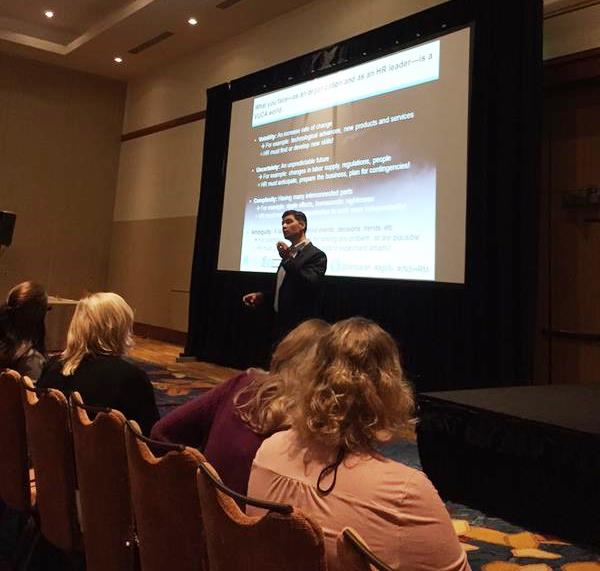
- Our world—and our organizations—operate in an environment of volatility, uncertainty, complexity and ambiguity (VUCA).
- HR professionals must continually study their environments, both internal and external to their organizations, so that they can anticipate and act quickly. Vigilance trumps complacency.
- In short, HR needs to become more agile—having the capability to sense and respond to the VUCA forces that they and their organizations face.
- Being agile means that HR leaders should proactively anticipate how they can help their organization's people perform optimally given what they face today and what they will face tomorrow.
- When HR leaders can connect their practices to the strategic needs of their organizations, top executives will sit up and take notice. Proactively doing this on a continual basis will move HR leaders into the sphere of being strategic business partners for the organization.
Certainly a great deal can go into making these approaches a reality. But here are a few questions HR professionals can ask about their own work and their functions as a whole:
- Are your workforce planning and talent development plans developed with multiple contingencies and scenario planning in mind?
- In what way and how often are you communicating with your key internal and external stakeholders?
- Are the criteria for identifying and selecting talent aligned with what the organization will need in the future, in addition to what’s needed today?
- How do you or your function stay aware of emerging trends in your organization’s industry as well as your profession (i.e., HR, talent development, etc.)?
- In what way does your work reflect a focus on your customers, both internally and externally
- How can you better align what you provide as HR leaders with your customers’ needs?
- To what degree are your practices and decisions based upon valid data and analysis?
This is clearly a complex topic, but it’s one that HR needs to continue tackling in order to help organizations thrive in the modern world of work. And if it does, HR will in many ways lead the organizations of the future.
But if it does not, everyone in HR risks becoming Toby Flenderson.
Do CEOs hate or love HR? Why or why not?
How can HR become even more agile and drive strategic-level results? Leave a comment below!
Find this thought provoking? Like and share!
About Ben Baran
Ben Baran, Ph.D., is probably one of the few people in the world who is equally comfortable in a university classroom, a corporate boardroom and in full body armor carrying a U.S. government-issued M4 assault rifle. Visit: www.benbaran.com.

Feed Them Radishes! And 3 More Ways to Stifle Change
We are creatures of habit. We continually seek—or create—routines. The structures of our days and our weeks give us predictability, and that makes us comfortable.
None of this is inherently bad. In fact, routines and habits let us free our minds to work on other, more complex problems. If we had to think actively about everything in our day, deliberately evaluating every decision from the time we roll out of bed until we return to the pillow, we’d be overwhelmed.
What does this have to do with agility, human resources, leadership and change?
Everything.
We are creatures of habit. We continually seek—or create—routines. The structures of our days and our weeks give us predictability, and that makes us comfortable.
None of this is inherently bad. In fact, routines and habits let us free our minds to work on other, more complex problems. If we had to think actively about everything in our day, deliberately evaluating every decision from the time we roll out of bed until we return to the pillow, we’d be overwhelmed.

What does this have to do with agility, human resources, leadership and change?
Everything.
When we ask people to change, we’re asking them to focus their energy and make different choices.
We’re asking them to be deliberate about specific aspects of their day—features that used to be routine—and do them differently.
And when we do that too often or throw too many changes at people at one time, it’s exhausting and overwhelming for them. That’s one big reason why change is hard.
And what does that have to do with radishes?
Dan Heath, coauthor of Switch, discusses that below.
To summarize, Heath discusses in that clip an experiment in which one group is allowed to eat radishes while being tempted by cookies. The other group just gets cookies and is allowed to eat them. People from both groups are then asked to complete a puzzle of sorts—but there is no solution to the puzzle.
The main finding is that the radish eaters were much more likely to quit working on the puzzle faster than the cookie eaters, with a possible conclusion being that the self-control they had to exert depleted their ability to keep persisting at the impossible task.
The study is titled, “Ego depletion: Is the active self a limited resource?” Four researchers at Case Western Reserve University published it in the Journal of Personality and Social Psychology in 1998, and more than 2,800 other studies have cited it since then.
Reading this study more closely provides some insight regarding at least four ways to stifle change.
If you really want to stifle change, then:
- Feed people radishes. No one likes radishes. (OK, maybe, if they’re cut in very thin slices.)
- Ensure the old way of doing things is easier than the new way. This will tempt people with the status quo, making change seem overly difficult.
- Change too many things at once. This will also make people tired of exerting effort in new directions, making them less likely to persist in creating new habits.
- Make the change ambiguous and full of choices. This will also deplete people’s resources by forcing them to exert brain power and make decisions.
Regarding agility, it’s important to remember that being agile is about sensing and responding quickly to one’s environment. It’s not about changing for change’s sake; it’s not about bending in every direction whenever the wind blows.
That’d be exhausting, pointless and reckless.
Leaders in human resources often find themselves assisting with change management across the organization. In addition to keeping “radishes” in mind, they should be proactive in educating senior leaders about agility before change becomes necessary. That way, they can help the organization change in systematic ways—not exhausting people with excessive ambiguity and numerous new routines being thrown at employees at once.
In addition to radishes, what else stifles change in your organization? Leave a comment below!
About Ben Baran
Ben Baran, Ph.D., is probably one of the few people in the world who is equally comfortable in a university classroom, a corporate boardroom and in full body armor carrying a U.S. government-issued M4 assault rifle. Visit: www.benbaran.com.

Using the Premortem to Drive HR Agility
When the unexpected strikes, our brains often start working like we’re being chased by a wild animal. Levels of hormones—specifically, adrenaline, norepinephrine and cortisol—increase, resulting in a range of reactions including increased heartrate, elevated blood pressure and tunnel-vision like focus on the threat.
This is great if you actually are being chased by a lion. The threat is singular, and your immediate actions are likely singular as well (for example, run fast to shelter).
But it’s not so great if you’re facing a complex problem in your organization.
When the unexpected strikes, our brains often start working like we’re being chased by a wild animal. Levels of hormones—specifically, adrenaline, norepinephrine and cortisol—increase, resulting in a range of reactions including increased heartrate, elevated blood pressure and tunnel-vision like focus on the threat.
This is great if you actually are being chased by a lion. The threat is singular, and your immediate actions are likely singular as well (for example, run fast to shelter).
But it’s not so great if you’re facing a complex problem in your organization.
That’s because solving complex problems often requires the ability to consider many sources of information and to sort through the ambiguity of the situation with other people. It requires a calm mindset and critical thinking to deliver the best solution, not just the first one that comes to mind.
HR leaders can often find themselves in tough, stressful circumstances. These situations demand agility, the ability to sense and respond quickly.
Consider, for example:
- A key executive suddenly announces she is quitting.
- A recently sacked employee files a lawsuit for wrongful termination.
- The CEO decides to begin massive layoffs.
- A sudden surge in demand requires increases in labor.
- A system breach compromises sensitive employee data.
These aren’t unlikely scenarios, and many HR leaders deal with them frequently. But are these situations—and other unexpected events—always handled with the utmost agility? Certainly, there’s room for improvement.
One way in which HR leaders can become more agile is by taking deliberate steps to anticipate change, taking the time to focus on what could go wrong and how prepared they are to deal with those specific issues.
The premortem is a specific tool that can help.
Most of us are familiar with the postmortem, in which a group discusses what went well and what didn’t go well after an event. The premortem, though, takes the idea of thinking about what could have gone wrong—in advance.
The psychologist Gary Klein has written about the premortem within the context of projects, highlighting how premortems can help leaders improve project planning. (I also highly recommend his book Sources of Power.)
Within the HR world, a premortem might look something like this:
- An HR director gathers his team and discusses the plan to address a potential issue, such as the departure of a key executive. He then asks them to imagine that it’s six months (or some other relevant time reference) in the future and the plan has been implemented.
- The HR director then asks everyone to imagine that the plan didn’t work well at all. Each person then takes a few minutes to write down the reasons they think the plan failed.
- Each person shares his or her reasons until all of them are documented.
- Then, the HR director uses that information to strengthen the plan.
This is just one simple example. But the reason a premortem can help drive HR agility is that it can allow the team to think about problems and solutions before the unexpected strikes, before their nervous systems become awash in potentially judgment-clouding stress hormones. It can allow the team to set in place a variety of systems that can help them perform well in a specific situation they may face.
Daniel Levitin, a neuroscientist at McGill University, discussed this concept more broadly, suggesting that pre-planned responses can help you stay calm in stressful circumstances.
His TED talk on the topic is below.
HR agility can come in many shapes and sizes, but the premortem is one tool that HR leaders could begin using to create different patterns of thinking for themselves and their teams. It can be a helpful part of anticipating change, allowing them to be more responsive to disruption when it occurs.
Because for so many of the unexpected situations that can unfold, it’s not a matter of if they will occur.
It’s a matter of when.
About Ben Baran
Ben Baran, Ph.D., is probably one of the few people in the world who is equally comfortable in a university classroom, a corporate boardroom and in full body armor carrying a U.S. government-issued M4 assault rifle. Visit: www.benbaran.com.

Strike a match: Agile improvisation in the face of disaster
On August 5, 1949, a team of 15 smokejumpers parachuted into the Mann Gulch near the Missouri River in Montana to fight a fire that had started the previous day. At first appraisal, fighting the fire seemed a simple task. But thus began one of the worst disasters in the modern history of wildfire suppression in which all but two of the team members lost their lives.
Immortalized in Norman Maclean’s book Young Men and Fire[i], in the folk song Cold Missouri Waters by James Keelaghan and in famed organizational scholar Karl Weick’s scholarly analysis[ii], the incident is a tragic-yet-fascinating account of a team attempting to sense and respond to a rapidly evolving environment. It’s a story of improvisation, counter-intuitive action and collapsed team structures.
According to Maclean’s account, the team

"Playing with Matches" by Dennis Wilkinson is licensed under CC BY 2.0
On August 5, 1949, a team of 15 smokejumpers parachuted into the Mann Gulch near the Missouri River in Montana to fight a fire that had started the previous day. At first appraisal, fighting the fire seemed a simple task. But thus began one of the worst disasters in the modern history of wildfire suppression in which all but two of the team members lost their lives.
Immortalized in Norman Maclean’s book Young Men and Fire[i], in the folk song Cold Missouri Waters by James Keelaghan and in famed organizational scholar Karl Weick’s scholarly analysis[ii], the incident is a tragic-yet-fascinating account of a team attempting to sense and respond to a rapidly evolving environment. It’s a story of improvisation, counter-intuitive action and collapsed team structures.
According to Maclean’s account, the team was beginning to evaluate the fire and plan an attack when the team leader, Wagner Dodge, saw that the wildfire had breached the valley and was approaching their direction rapidly. Quickly, the situation devolved into an all-out race to a rocky area at the top of the ridge, with flames chasing them at a rate of approximately 610 feet per minute.
That’s when Dodge took two actions that both highlight extreme moments of agility.
- He ordered his men to drop their tools. Dodge realized that they needed to run faster if they were to have any chance of reaching the top, and that their heavy tools were slowing them down. But this is a strange order to give a group of experienced firefighters—it’s like telling a group of Marines to throw down their rifles.
- Moments later, he took out a match, struck it and threw it into the waist-high dry grass around him. As his own personal fire grew around him, he ordered his men to lie down with him in the area he scorched. None of them did.
Consider the magnitude of creativity Dodge displayed in these moments: (1) casting away his tools, the very physical representations of being a firefighter and (2) starting a fire and climbing into it, when the entire purpose of firefighting is to extinguish flames while avoiding direct contact if possible.
Dodge arose later from the ashes that had provided a barrier between him and the wall of flame that swept the hillside. He soon learned that only he and one other team member survived. All 13 others died.
This story has numerous lessons, one of which is the value of agile improvisation.
Dodge quickly realized that the environment had changed and took novel, dramatic steps to survive.
The story also highlights the value in continually sensing and monitoring one’s environment for subtle signs of danger. Such processes that support anticipating change involve the use of analytics, which is all about making sense of what’s going on, organizing that information and using it to respond appropriately.
How does an organization systematically sense and monitor its environment? We’ve found that it’s through consistently measuring what’s important from every corner of the system, gathering insights from employees across levels, functions and geographies. It’s about establishing an attitude of questioning assumptions and the status quo, making it OK for people to voice ideas and even dissent.
Agile organizations aren’t error-free.
They’re organizations that have embedded the ability to notice small deviations and deal with them quickly. And formal systems for sensing and monitoring set the foundation for such noticing to occur. Coupled with agile responses—like Dodge’s burning match—organizations can begin to thrive in spite of the turbulence around them.
References
[i] Norman Maclean, Young Men and Fire (Chicago: University of Chicago Press, 1993).
[ii] Karl E. Weick, “The Collapse of Sensemaking in Organizations: The Mann Gulch Disaster,” Administrative Science Quarterly 38, no. 4 (December 1993): 628, doi:10.2307/2393339.
About Ben Baran
Ben Baran, Ph.D., is probably one of the few people in the world who is equally comfortable in a university classroom, a corporate boardroom and in full body armor carrying a U.S. government-issued M4 assault rifle. Visit: www.benbaran.com.

The Power We All Have But Rarely Use
“Hey, you did a really great job in a tough situation. They’re lucky to have you.” I heard the gentleman in front of me say these two simple sentences to the United Airlines flight attendant as we exited the plane. It was a flight that normally takes about one hour, but it turned into more than three hours for all of us aboard the aircraft due to weather considerations. The flight attendant’s reaction to this unsolicited positive feedback, as you can imagine, was one of delight and appreciation.

“Hey, you did a really great job in a tough situation. They’re lucky to have you.” I heard the gentleman in front of me say these two simple sentences to the United Airlines flight attendant as we exited the plane. It was a flight that normally takes about one hour, but it turned into more than three hours for all of us aboard the aircraft due to weather considerations. The flight attendant’s reaction to this unsolicited positive feedback, as you can imagine, was one of delight and appreciation.
“I want you each to say something that you appreciate about everyone else on the team. Say it to them directly, not to me.” After a long day of working through a tough problem-solving session, my colleague Mike Richardson (who is also simply a brilliant, wonderful human being) pushed us all into a simple exercise that illuminated our individual strengths and collective appreciation.
“Let’s share our ‘flowers’ and ‘weeds’ for the past year. Let’s be grateful.” A few years ago, my father-in-law, Bill Hawke, started the tradition of sharing our annual highs and lows within the family during New Year’s Eve celebrations. We’ve all found this ritual to be one of our favorites, as it breathes new life into our plans for the future by situating those dreams within the context of where we’ve been.
Regardless of what happens to us—be it a rotten plane ride, a frustrating team session, personal health issues, or anything else—we always have the power to choose how we react. We always have power over our attitudes. And if we react by finding something positive and then sharing that positivity with others, we can exercise a powerful force not only in how we see the world but in how the people around us view themselves, us, and their circumstances.
Try using the power of gratitude and positivity intentionally this week. Find one thing that someone does that helps you, others, or your organization. Then, make a point to tell them that you noticed and that you’re grateful.
I can guarantee that their reaction—you guessed it—will also be one of gratitude.
Leadership Lessons from Dancing Guy
Derek Sivers is an interesting guy--entrepreneur, speaker, musician, performer, writer, programmer, and more. I first heard him speak at a music business conference in 2004, when he was running CDBaby, the wildly successful online music store that catered to independent musicians. Sivers made a video a few years ago called "Leadership Lessons from Dancing Guy." I think it's great. As a management professor, I've used it in class numerous times as a great way to spark discussion about leadership, followership, risk taking, creativity, and other related topics.
Check it out below and see what you think.

Surviving The Next Catastrophe by Reducing Vulnerabilities
If the renowned organizational sociologist Charles Perrow had a classic-rock theme song, it just might be “You Ain’t Seen Nothin’ Yet,” the 1974 hit song by Bachman Turner Overdrive. Let me explain. In his classic book, Normal Accidents: Living with High-Risk Technologies, Perrow discussed the numerous high-risk technologies that pervade modern life and the dangers they pose for society.
First published in 1984 with an updated version released in 1999, Normal Accidents presents an argument for the inevitability of large-scale disasters such as nuclear meltdowns, petrochemical-plant explosions, maritime accidents, and so forth.
If the renowned organizational sociologist Charles Perrow had a classic-rock theme song, it just might be “You Ain’t Seen Nothin’ Yet,” the 1974 hit song by Bachman Turner Overdrive. Let me explain. In his classic book, Normal Accidents: Living with High-Risk Technologies, Perrow discussed the numerous high-risk technologies that pervade modern life and the dangers they pose for society.
First published in 1984 with an updated version released in 1999, Normal Accidents presents an argument for the inevitability of large-scale disasters such as nuclear meltdowns, petrochemical-plant explosions, maritime accidents, and so forth. These accidents are inevitable, or “normal,” because they stem from systems that have specific structural characteristics. Namely, these systems are interactively complex, meaning that different parts of the system are likely to work together in ways that produce unanticipated consequences. Secondly, these systems exhibit tight coupling, meaning that a single change in one part of the system will directly lead to changes in other parts of the system.
This means that over time disasters will become increasingly likely. In other words, you ain’t seen nothin’ yet.
In his 2007 bookThe Next Catastrophe: Reducing our Vulnerabilities to Natural, Industrial, and Terrorist Disasters, Perrow builds upon the themes presented in Normal Accidents while suggesting a few approaches toward limiting the havoc that such normal accidents will inevitably wreak upon society. In so doing, he also points out three more sources of vulnerability beyond interactive complexity and tight coupling. These three sources are all in the form of high concentrations of the following:
- Energy. In numerous locations around the United States, industrial storage facilities house vast quantities of explosive, toxic, and flammable substances. Because these storage facilities are concentrated in specific locations, an accident in any one of them would be much more disastrous than if storage occurred in smaller quantities at a greater number of separate sites.
- People. High population densities in risky areas make disasters in those locales catastrophic. For example, New Orleans is a vulnerable city—due to its geography and its proximity to high-risk industry. The fact that it is also high in population density makes it particularly vulnerable.
- Economic and political power. Perrow has a knack for drawing our attention to the role of power in organizations, and he argues here that mega-corporations and the political entities with which they interact wield so much power over very real aspects of our daily lives that any failure within them could pose serious risk. One example he cites is the pervasive nature of the Microsoft Windows operating system. If Windows failed—due to a massive computer virus, for example—catastrophic damage to business, government, and personal livelihood would likely result. Another example, although not addressed directly in the book, is the danger posed by financial institutions deemed “too big to fail” that we have witnessed in recent years.

To address these issues, Perrow argues that (a) government should implement wise regulations that limit these concentrations and (b) that leaders should focus on these concentrations as real threats instead of being distracted by other less-likely sources of disaster. In essence, he suggests that the focus should be on “shrinking the targets.” For example, Perrow argues that political interests have overestimated the terrorism threat in the United States while underestimating the threats posed by industrial forces, such as the nuclear power industry.
Overall, Perrow presents a number of examples that suggest the three areas of concentration listed above are indeed sources of vulnerability. His approach toward shrinking those targets, however, appears to focus mostly on policy decisions rather than aspects of human behavior within organizations.
As such, The Next Catastrophe provides an interesting view of disaster and vulnerability at a macro level. Much like “watchdog” groups that illuminate concerns within government agencies and programs, Perrow has been shining a light on the dark side of organizations, business, and government for decades. And his suggestions, when coupled with other viewpoints at the micro level, may provide a way for us to avoid the ominous theme of “you ain’t seen nothin’ yet” that underscores his theories.

Hiring the Right People in a Labor Market Flush with Talent: The Importance of Valid Selection Practices
It’s about supply and demand, human-resource style. Remember when the unemployment rate in the United States was less than 5%? According to the U.S. Department of Labor’s Bureau of Labor Statistics, that describes about five of the past 10 years. That also describes times when employers spent much of their energy on recruiting talent, or wooing top performers to apply for jobs.But times have changed. The unemployment rate now sits at 8.9%, which means employers everywhere are coping with huge numbers of job applicants for a small number of job openings. Recruiting is still important, and valid selection is always important. In a labor market flush with talent, however, figuring out whom to hire from the crowd is all the more crucial—and tricky.
So what really has changed?

It’s about supply and demand, human-resource style. Remember when the unemployment rate in the United States was less than 5%? According to the U.S. Department of Labor’s Bureau of Labor Statistics, that describes about five of the past 10 years. That also describes times when employers spent much of their energy on recruiting talent, or wooing top performers to apply for jobs.But times have changed. The unemployment rate now sits at 8.9%, which means employers everywhere are coping with huge numbers of job applicants for a small number of job openings. Recruiting is still important, and valid selection is always important. In a labor market flush with talent, however, figuring out whom to hire from the crowd is all the more crucial—and tricky.
So what really has changed? It’s something called the “selection ratio.” Simply put, the selection ratio is the number of people you can hire divided by the number of job applicants (read more). In a tough economy, lots of people are vying for a small number of jobs. Companies that used to have 40 applicants for 20 jobs (a selection ratio of 0.5) now may have 400 applicants for 10 jobs (a selection ratio of 0.025).
In other words, the labor supply is increasing, but the labor demand is shrinking. Therefore, many employers have the opportunity, theoretically, to make huge gains in terms of human capital. This assumption depends upon a crucial, often-overlooked and taken-for-granted part of the hiring process: that the procedures organizations are using to make hiring decisions must actually work. Namely, the methods used to choose new employees must adequately distinguish people who have what it takes to succeed from those who don’t.
Industrial psychologists have investigated personnel selection for decades. Although describing the nuances of designing a valid selection system is beyond the scope of this article, a number of general guidelines hold true across most industries and job types.
- Conduct a proper job analysis. This involves figuring out what exactly constitutes performance regarding the job position in question, helping the hiring manager to know what types of knowledge, skills, abilities, and other characteristics (KSAOs) a successful job applicant should embody.
- Understand the legal aspects of hiring. For example, employers should pay attention only to those aspects of applicants that are relevant to the job, or “bona fide occupational qualifications.” Consult an attorney well-versed in employment law to clarify any other concerns, including compliance with the Uniform Guidelines on Employee Selection Procedures (read more).
- Conduct structured interviews. Many hiring managers assume that they can gauge the quality of job applicants through an informal conversation and a handshake. Quite simply, this is a big myth. And thousands of pages of rigorous research provide evidence to this effect. Structured interviews should function like any test: They should have specific questions designed to assess specific KSAOs, and hiring managers should conduct them in the same way for all job applicants who pass initial résumé screening. Here’s a decent guide for conducting structured interviews from the U.S. Office of Personnel Management.
- Consider the use of psychological tests and other selection hurdles. The decision to use these types of selection procedures depend on a variety of factors, and most organizations should consult an expert for further guidance.
Overall, a labor market with large numbers of qualified job seekers can be a very good situation for employers. It gives organizations the opportunity to build their human capital with less of a need for recruiting. But to truly capitalize on the current nature of human-resource supply and demand, employers must understand and implement valid selection procedures. Otherwise, it’s just a shot in the dark—resulting in random selection that is unfair, potentially illegal, and bad for both organizations and employees.