
I’ve moved my blogging to Substack!
Feel free to check out any of the content I have here, but also be sure to check out my newest content at Reckoning and Elevating What Works.
Accidents at Sea and Human Behavior
When I heard about the collision involving USS Fitzgerald (DDG 62) on June 17, 2017, my heart sank. For me and other Navy veterans who have served aboard ships like Fitzgerald, the feeling is rather personal—we’ve driven ships, we’ve been in situations that are tough to navigate, and we can imagine fairly closely the moments before and after a collision.
Then, only about two months after Fitzgerald, came the news that USS John S. McCain (DDG 56) collided with a vessel on Aug. 21 near the Strait of Malacca. Because it connects the Pacific and Indian Oceans, it’s a high-traffic area, one that puts many large ships within relatively close proximity of each other. Of the many tough waters in the world to traverse, this one is somewhere near the top of the list.
My heart—and, I’m sure, the hearts of many others—sank again.
First, of course, I think of those killed and injured. My thoughts and prayers are with them and their families.
Second, I wonder:
Why?
What happened?
Myriad explanations abound, and
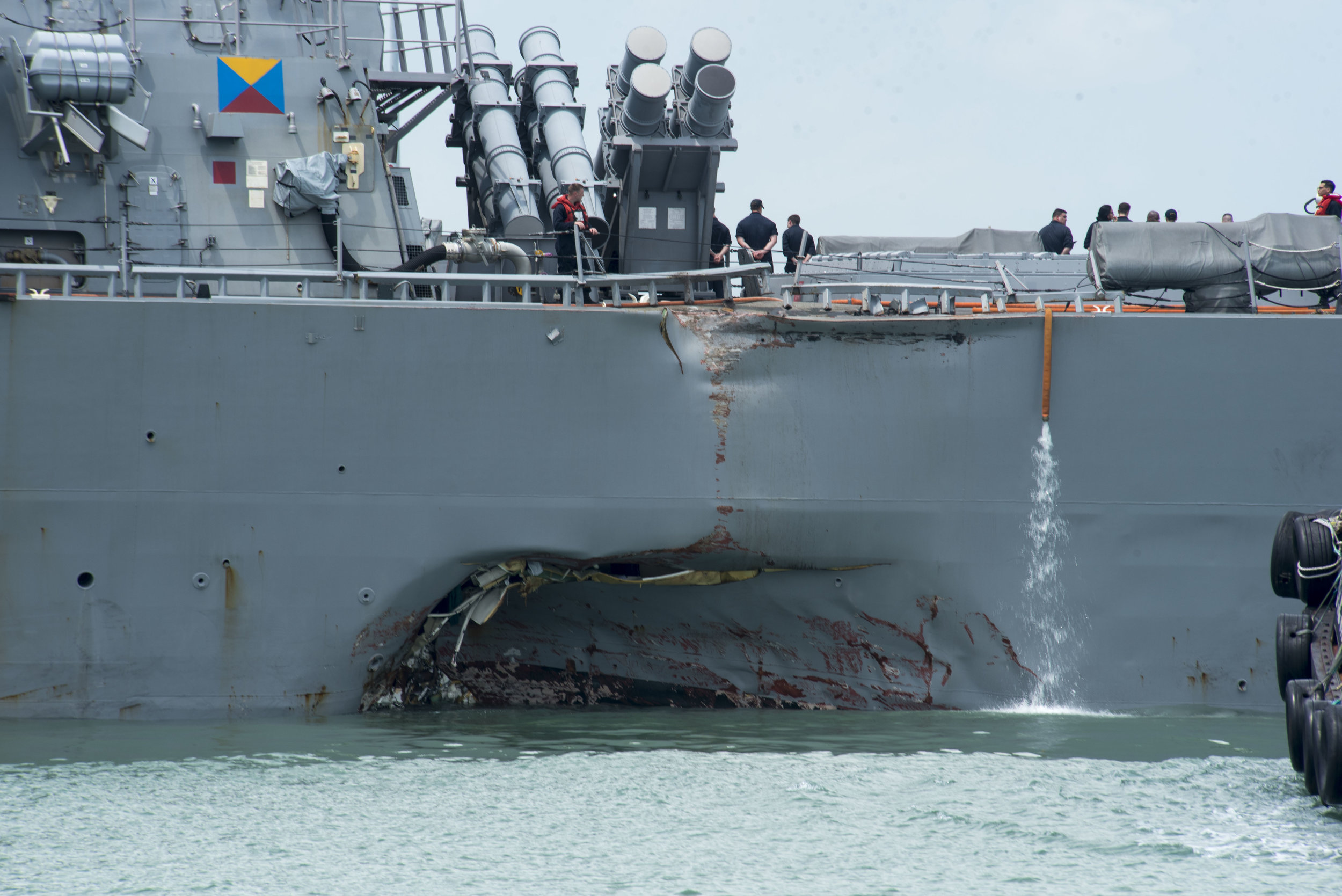
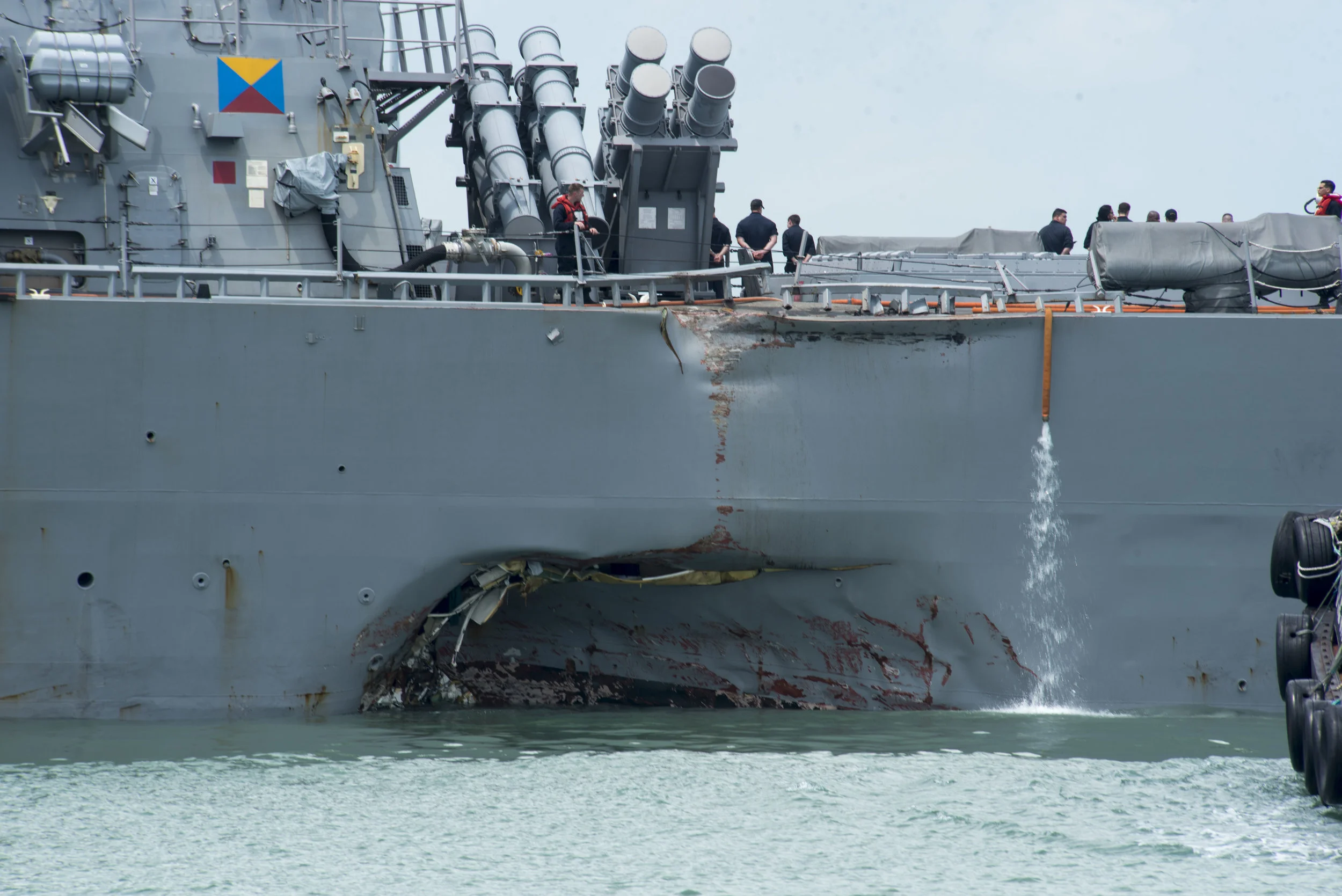
Aug. 21, 2017--Damage to the port side of the guided-missile destroyer USS John S. McCain (DDG 56) as it steers towards Changi Naval Base, Republic of Singapore, following a collision with the merchant vessel Alnic MC. Photo by Mass Communication Specialist 2nd Class Joshua Fulton. The appearance of U.S. Department of Defense (DoD) visual information does not imply or constitute DoD endorsement.
When I heard about the collision involving USS Fitzgerald (DDG 62) on June 17, 2017, my heart sank. For me and other Navy veterans who have served aboard ships like Fitzgerald, the feeling is rather personal—we’ve driven ships, we’ve been in situations that are tough to navigate, and we can imagine fairly closely the moments before and after a collision.
Then, only about two months after Fitzgerald, came the news that USS John S. McCain (DDG 56) collided with a vessel on Aug. 21 near the Strait of Malacca. Because it connects the Pacific and Indian Oceans, it’s a high-traffic area, one that puts many large ships within relatively close proximity of each other. Of the many tough waters in the world to traverse, this one is somewhere near the top of the list.
My heart—and, I’m sure, the hearts of many others—sank again.
First, of course, I think of those killed and injured. My thoughts and prayers are with them and their families.
Second, I wonder:
Why?
What happened?
Myriad explanations abound, and the investigations for both the Fitzgerald and McCain collisions are ongoing. One report, which outlines actions that occurred after the Fitzgerald collision (but doesn’t investigate the events leading up to the collision) has been released (read it here). It’s well worth reading, as it discusses the specifics of what occurred and the damage-control efforts that followed.
The investigations regarding the causes will thoroughly explore the incidents. I won’t speculate regarding what happened specifically in these situations.
I do, however, think it’s reasonable to expect—given the research on safety and accidents plus my firsthand knowledge of being a surface warfare officer in the U.S. Navy—that the investigations will find a number of related factors, including:
A chain of events. It’s difficult to imagine such an event being caused by a single poor decision, a single mechanical problem, or any other “one” cause. Given the complexity of operating a large ship safely at sea, a number of redundant systems are in place to help reduce risk. For example, on a U.S. Navy ship, more than one group of people are looking at charts and monitoring other ships nearby. Mechanical features have backups and the backups have backups. Therefore, a collision would involve a number of events in which things went wrong. The scholar James Reason’s “Swiss Cheese Model” comes to mind. This model suggests that errors occur when various failures of human behavior and aspects of the environment align such that vulnerabilities or the “holes” (hence the Swiss cheese) line up to cause an error or accident.
A human component to the situation. In any such disaster, people are making decisions. These are real people—complex humans who differ in how they think, communicate, and make judgments. The human component also involves the reality that ships are organizations. They are complex amalgamations of unique people attempting—and nearly all the time succeeding, it should be noted—at interacting in mindful, productive way. As such, issues of leadership and culture are critical. Everyone, regardless of rank or status, must know in the depths of their very being that their coworkers and leaders want them to bring confusing or even vaguely problematic situations to their attention.
When interacting in a high-risk environment, furthermore, the best organizations are ones that anticipate and contain errors quickly. Research on such “high-reliability organizations” suggests this capability allows the organization to catch small problems before they escalate into bigger ones, potentially leading to disaster. (The scholars Karl Weick, Kathleen Sutcliffe, Todd La Porte, and Karlene Roberts are some of foremost researchers in this area—for interested readers, I suggest starting here.)
I’m confident that the U.S. Navy will investigate these incidents quickly enough to promote understanding and learning, but not too quickly, as a too rapid investigation could overlook potential aspects of the problem.
I’m hopeful that the lessons learned from these incidents will be (a) the right lessons that can lead to improved performance and (b) implemented in a thoughtful-yet-rapid manner.
Until then, be safe shipmates.
About Ben Baran
Ben Baran, Ph.D., is probably one of the few people in the world who is equally comfortable in a university classroom, a corporate boardroom and in full body armor carrying a U.S. government-issued M4 assault rifle. Visit: www.benbaran.com.
Ben is also the author of the e-book, The Navy’s 11: Reflections and tips for leaders everywhere based upon the U.S. Navy’s Leadership Principles. It’s full of ...

- Leadership guidance, based upon the U.S. Navy's Leadership Principles, which have been used to create and sustain the greatest navy known to humankind;
- Real-world examples, based upon my nearly 20 years of experience with the U.S. Navy and a decade of academic research combined with business consulting;
- Actionable tips, meant to help you implement the leadership principles in your daily life and work; and
- Much more!
Click here to get your FREE copy today.

Surviving The Next Catastrophe by Reducing Vulnerabilities
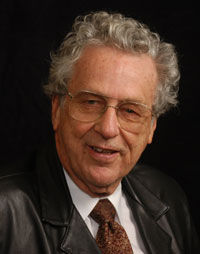
If the renowned organizational sociologist Charles Perrow had a classic-rock theme song, it just might be “You Ain’t Seen Nothin’ Yet,” the 1974 hit song by Bachman Turner Overdrive. Let me explain. In his classic book, Normal Accidents: Living with High-Risk Technologies, Perrow discussed the numerous high-risk technologies that pervade modern life and the dangers they pose for society.
First published in 1984 with an updated version released in 1999, Normal Accidents presents an argument for the inevitability of large-scale disasters such as nuclear meltdowns, petrochemical-plant explosions, maritime accidents, and so forth.
If the renowned organizational sociologist Charles Perrow had a classic-rock theme song, it just might be “You Ain’t Seen Nothin’ Yet,” the 1974 hit song by Bachman Turner Overdrive. Let me explain. In his classic book, Normal Accidents: Living with High-Risk Technologies, Perrow discussed the numerous high-risk technologies that pervade modern life and the dangers they pose for society.
First published in 1984 with an updated version released in 1999, Normal Accidents presents an argument for the inevitability of large-scale disasters such as nuclear meltdowns, petrochemical-plant explosions, maritime accidents, and so forth. These accidents are inevitable, or “normal,” because they stem from systems that have specific structural characteristics. Namely, these systems are interactively complex, meaning that different parts of the system are likely to work together in ways that produce unanticipated consequences. Secondly, these systems exhibit tight coupling, meaning that a single change in one part of the system will directly lead to changes in other parts of the system.
This means that over time disasters will become increasingly likely. In other words, you ain’t seen nothin’ yet.
In his 2007 bookThe Next Catastrophe: Reducing our Vulnerabilities to Natural, Industrial, and Terrorist Disasters, Perrow builds upon the themes presented in Normal Accidents while suggesting a few approaches toward limiting the havoc that such normal accidents will inevitably wreak upon society. In so doing, he also points out three more sources of vulnerability beyond interactive complexity and tight coupling. These three sources are all in the form of high concentrations of the following:
- Energy. In numerous locations around the United States, industrial storage facilities house vast quantities of explosive, toxic, and flammable substances. Because these storage facilities are concentrated in specific locations, an accident in any one of them would be much more disastrous than if storage occurred in smaller quantities at a greater number of separate sites.
- People. High population densities in risky areas make disasters in those locales catastrophic. For example, New Orleans is a vulnerable city—due to its geography and its proximity to high-risk industry. The fact that it is also high in population density makes it particularly vulnerable.
- Economic and political power. Perrow has a knack for drawing our attention to the role of power in organizations, and he argues here that mega-corporations and the political entities with which they interact wield so much power over very real aspects of our daily lives that any failure within them could pose serious risk. One example he cites is the pervasive nature of the Microsoft Windows operating system. If Windows failed—due to a massive computer virus, for example—catastrophic damage to business, government, and personal livelihood would likely result. Another example, although not addressed directly in the book, is the danger posed by financial institutions deemed “too big to fail” that we have witnessed in recent years.

To address these issues, Perrow argues that (a) government should implement wise regulations that limit these concentrations and (b) that leaders should focus on these concentrations as real threats instead of being distracted by other less-likely sources of disaster. In essence, he suggests that the focus should be on “shrinking the targets.” For example, Perrow argues that political interests have overestimated the terrorism threat in the United States while underestimating the threats posed by industrial forces, such as the nuclear power industry.
Overall, Perrow presents a number of examples that suggest the three areas of concentration listed above are indeed sources of vulnerability. His approach toward shrinking those targets, however, appears to focus mostly on policy decisions rather than aspects of human behavior within organizations.
As such, The Next Catastrophe provides an interesting view of disaster and vulnerability at a macro level. Much like “watchdog” groups that illuminate concerns within government agencies and programs, Perrow has been shining a light on the dark side of organizations, business, and government for decades. And his suggestions, when coupled with other viewpoints at the micro level, may provide a way for us to avoid the ominous theme of “you ain’t seen nothin’ yet” that underscores his theories.