
I’ve moved my blogging to Substack!
Feel free to check out any of the content I have here, but also be sure to check out my newest content at Reckoning and Elevating What Works.
Advanced Manufacturing and Two Ways to Reward Agility
Modern factory floors fascinate me. There’s something about the clang and whoosh of the myriad machines, the hum of an overhead crane gliding along its tracks, the intricate yellow lines demarcating where it’s safe to walk and the ambiguous chemical aroma punctuating the air with hints of solvents or grease or paint or maybe all of them mixed together.
There’s something about the delicate dance of interdependent and interconnected parts and processes that somehow—amazingly—produce that which we and the entire world outside the factory walls often takes for granted.
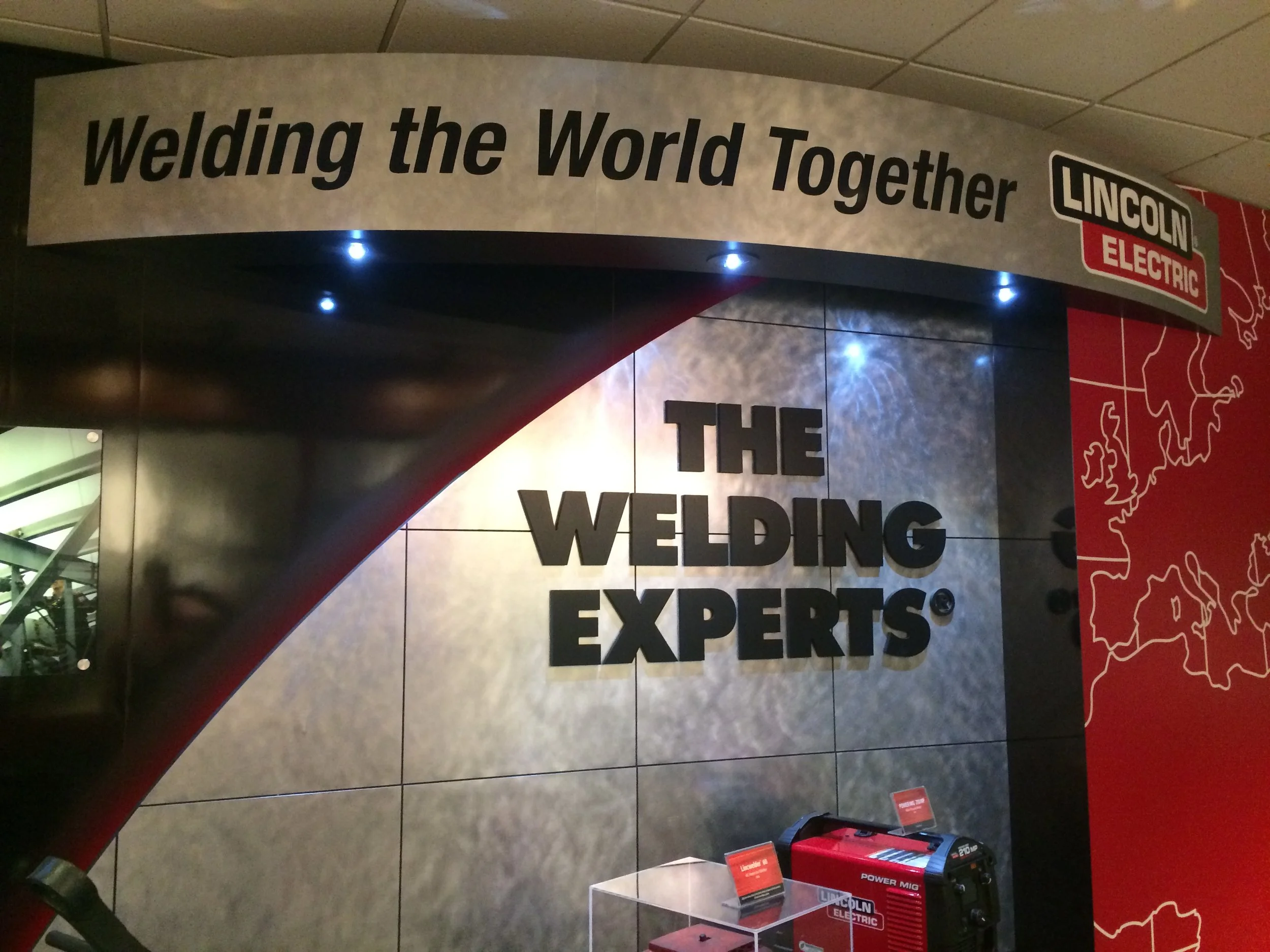
When I’m in a factory, I still get the same sense of wonder and curiosity that I had when I was 8 or 9 years old, touring the Rohm and Haas plant in Louisville, Ky. And this week, I had the opportunity to visit one of Cleveland’s (and Ohio’s, for that matter) oldest and largest manufacturing firms: Lincoln Electric.

Modern factory floors fascinate me. There’s something about the clang and whoosh of the myriad machines, the hum of an overhead crane gliding along its tracks, the intricate yellow lines demarcating where it’s safe to walk and the ambiguous chemical aroma punctuating the air with hints of solvents or grease or paint or maybe all of them mixed together.
There’s something about the delicate dance of interdependent and interconnected parts and processes that somehow—amazingly—produce that which we and the entire world outside the factory walls often takes for granted.
When I’m in a factory, I still get the same sense of wonder and curiosity that I had when I was 8 or 9 years old, touring the Rohm and Haas plant in Louisville, Ky. And this week, I had the opportunity to visit one of Cleveland’s (and Ohio’s, for that matter) oldest and largest manufacturing firms: Lincoln Electric.

Although it’s old (founded in 1895) and large (about 10,000 total employees, $2.5 billion in revenue), Lincoln Electric has a distinct track record of innovative practices within the realms of strategy execution and incentive systems designed to channel its employees' motivation and effort.
It’s not surprising that it has long served as a case study for Harvard Business School.
But what I found most intriguing was how Lincoln Electric has structured agility—the capability to sense and respond to change—into two distinct parts of its measurement and evaluation systems.
First, Lincoln Electric’s managers systematically assess and rate their employees’ flexibility. These ratings—along with ratings on dimensions of teamwork and dependability, safety, quality and contributing to improvement efforts by providing recommendations—form what’s known as the employee’s “report card.” And this report card plays an important role in determining the employees’ bonuses, so it’s meaningful.
The feature of Lincoln Electric’s incentive system that’s probably most well-known is its piecework pay structure. For many workers, that means they get paid based upon how many items they actually produce—no hourly wage, no salary. This creates a powerful motive for workers to work quickly and efficiently. To ensure quality, mistakes matter. If an item fails any aspect of a quality check, the same employee (or group of employees) who put it together must fix the problem.
Many aspects of this system are intriguing, but what I like about the flexibility component of the report card at Lincoln Electric is that it’s strategic in nature. That’s because Lincoln Electric is a low-volume, high-mix manufacturer. Simply put, they make many different types of products in quantities that often vary. This has allowed them to meet their customers’ often-diverse needs, but it also means that they need their employees to become proficient in more than one area of expertise. They need their employees to be willing and able to jump in and help in other areas if needed. This is critical to maintaining their business model, and it’s critical for employee behavior. As such, including this type of flexibility (which I’d argue is closer to agility) is part of the evaluation and incentive structure sends a clear signal to their employees in terms of what’s expected and rewarded.
Second, Lincoln Electric’s commitment to agility extends to its supply chain. Not surprisingly, to support its diverse array of products, Lincoln Electric depends heavily on high-quality materials. And because their production volume is often variable, they depend not only on having high-quality materials, but also upon having those materials available in variable quantities. As such, Lincoln Electric requires flexibility from its suppliers.
And just like it does with its employees, Lincoln Electric systematically assesses the flexibility of its suppliers. This occurs as part of periodic evaluations in which its supply-chain leaders rate each supplier on a number of dimensions as part of an overall scorecard. Furthermore, Lincoln Electric works with its suppliers to ensure they have contingency plans in place to help them manage the unexpected—because that which affects the suppliers will certainly affect Lincoln Electric.
There’s surely much more detail and nuance involved in both Lincon Electric’s commitment to employee and supply-chain agility, but I think one big lesson that applies to organizations everywhere is this:
If you truly value an aspect of behavior, it’s not enough to talk about it. You must take the next step and measure it—and reward it.
This sounds simple enough, but I’m continually surprised by firms that hope for certain outcomes or changes in behavior yet are unwilling to systematically measure and incentivize those very same outcomes or behaviors.
Many companies claim to value agility, flexibility, responsiveness or nimbleness. But never forget—hope and expectations and slogans and posters and speeches won’t necessarily influence what people actually do. To create alignment between behaviors and strategy, the right incentives must exist.
Find this thought provoking? Leave a comment, like and share!
About Ben Baran
Ben Baran, Ph.D., is probably one of the few people in the world who is equally comfortable in a university classroom, a corporate boardroom and in full body armor carrying a U.S. government-issued M4 assault rifle. Visit: www.benbaran.com.

Are You “Rewarding A While Hoping For B?”
Incentives matter. Rewards motivate people to behave in certain ways. Using incentives, therefore, is one great way to influence the form, direction and intensity of how people act.
Goals also matter. They help us clarify where we’re headed and how to focus our efforts. Setting difficult, specific goals, therefore, is one of the best ways to motivate yourself and others (see the numerous studies on the topic, particularly those by Gary Latham and Edwin Locke).
But goals and incentives can—and sometimes do—run amuck.
And when that happens, it’s often in the form of

Incentives matter. Rewards motivate people to behave in certain ways. Using incentives, therefore, is one great way to influence the form, direction and intensity of how people act.
Goals also matter. They help us clarify where we’re headed and how to focus our efforts. Setting difficult, specific goals, therefore, is one of the best ways to motivate yourself and others (see the numerous studies on the topic, particularly those by Gary Latham and Edwin Locke).
But goals and incentives can—and sometimes do—run amuck.
And when that happens, it’s often in the form of “rewarding A while hoping for B,” a topic described thoroughly in the classic management article by Steven Kerr.
That is, we often forget that it’s not just about what you’re rewarding formally; it’s also about what you’re rewarding informally. And it’s in the unintended informal rewards that we can run into trouble.
Here’s a simple example: You assign a task to one of your direct reports. He quickly responds with a sub-par product with multiple errors. You’re frustrated, but you know that you can fix the errors about 10 times more quickly than he can. So you tell him that it’s not sufficient, but then you go ahead and fix the product yourself—leaving him with no more tasks to complete that day.
What have you done?
In addition to missing a training opportunity, you’ve informally rewarded your direct report for sub-par effort. By not having him go through the pain of fixing the problem, he now knows that he can get by with little effort. That leaves you at the office at 7 p.m., while he’s already home or at happy hour.
Did you mean to reward poor performance? Of course not. But in a way, you did.
Here’s another simple example: You set a team goal of 1,000 error-free shipments of one of your new products. If that occurs, everyone on the team will receive a $3,000 bonus. One of your people finds an error after one of the products ships, but it’s an error that the customer might not notice for quite a while. Have you rewarded that employee to speak up and report the problem, or have you rewarded silence?
Here’s a bigger example: Wells Fargo. As you likely know, between about 2011 and 2016, the company set goals for its lower-level bank employees to sell additional products to its customers—a practice known as cross-selling. There’s nothing inherently wrong with that. What company doesn’t want its customers to purchase and use more than one or two or three or more of its products or services?
But what happened at Wells Fargo is that the incentives and goals were such that people—more than 5,000—found numerous “creative” ways to cross-sell. These methods included widespread opening of accounts for customers who didn’t request them and even using fake customers to pad one’s sales numbers.
Here’s a Wall Street Journal recap of some of the highlights.
Clearly, this was an error of management and leadership at a grand scale. It’s hard to claim that such a problem might be due to a few “bad apple” employees given that at least 5,000 were involved.
Instead, it’s the barrel—the system. And in particular, it’s the incentive and goal-setting systems set in place by senior leaders—the “barrel makers.” They, along with the direct violators, are culpable.
Incentives and goals are important aspects to guiding people’s effort at work. When properly aligned with organizational objectives, they can powerfully harness people’s ingenuity for the good of the team.
But it’s equally important to remember that incentives and goals may have unintended consequences. So let’s be on guard for those ways—both big and small—in which we might be “rewarding A while hoping for B.”
Find this thought provoking? Leave a comment, like and share!
About Ben Baran
Ben Baran, Ph.D., is probably one of the few people in the world who is equally comfortable in a university classroom, a corporate boardroom and in full body armor carrying a U.S. government-issued M4 assault rifle. More at www.benbaran.com and www.agilityconsulting.com.